

Google released Gemini 3.6 Flash on 21 July 2026. The launch post leads with coding gains and token efficiency. The model card leads with something quieter. It says 3.6 Flash is based on 3.5 Flash.
That one line explains the entire benchmark pattern. You get a cheaper, faster, less talkative model with the same measured intelligence. We cover the spec sheet, the published claims, the independent numbers, the breaking API changes and a full hands-on test suite in this article.
What Gemini 3.6 Flash Actually Is
Gemini 3.6 Flash is Gemini 3.5 Flash with a haircut. The model card points you back to the 3.5 Flash page for architecture, training data and hardware. What changed is habit: fewer reasoning steps, fewer tool calls, fewer tokens, less eager file editing. Then a fresher cutoff and a lower output price. Real improvement, not a new model, and the independent scores agree.
Three models shipped the same day. 3.6 Flash is the workhorse, 3.5 Flash-Lite is the cheap fast one, 3.5 Flash Cyber hunts vulnerabilities and is locked to governments and trusted partners.
The Spec Sheet
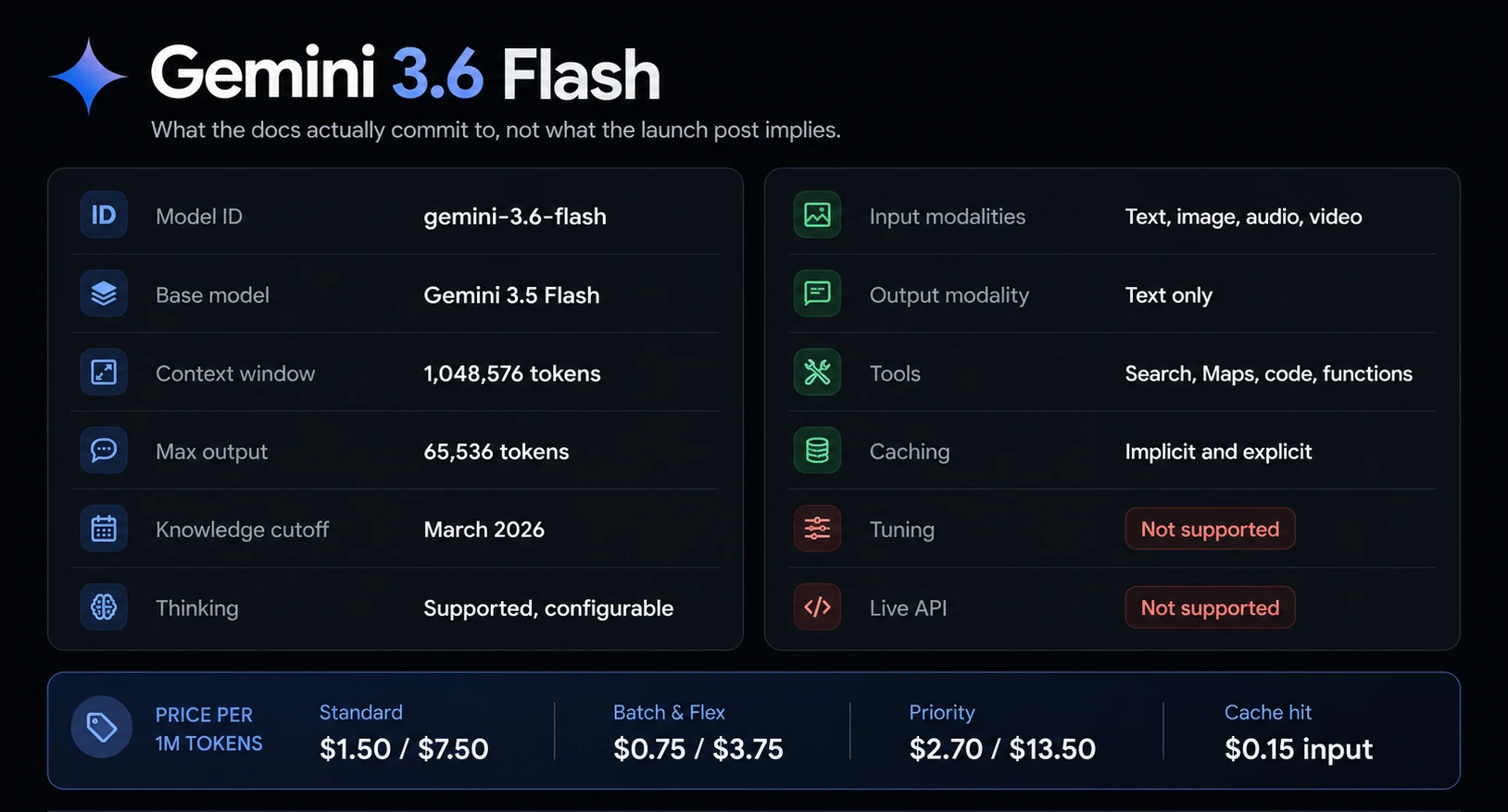
One number deserves a caveat. The 1M context window is a capacity limit, not a retrieval guarantee. Google's own long-context result on GDM-MRCR v2 at 1M sits near 54 percent. Treat the far end of that window as best effort and keep the conversation under it.
What Google Published
Google frames the release around efficiency first and quality second. The headline claim is a 17 percent reduction in output tokens on the Artificial Analysis Index compared with 3.5 Flash, with reductions up to 65 percent on DeepSWE.
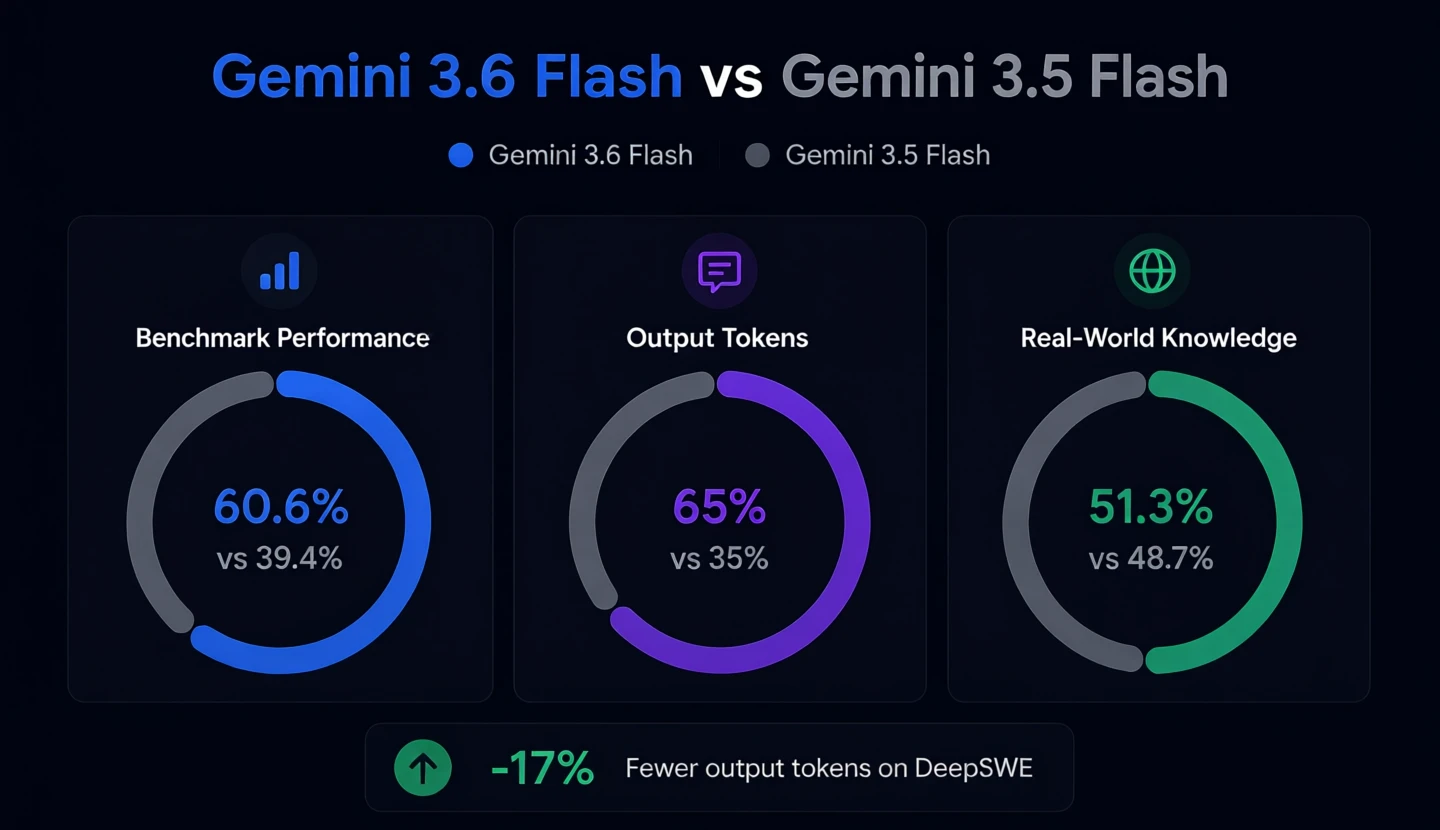
Made this infographic using Gemini 3.6 Flash
| Benchmark | 3.6 Flash | 3.5 Flash | What it measures |
|---|---|---|---|
| DeepSWE | 49% | 37% | Software engineering precision |
| MLE-Bench | 63.9% | 49.7% | Machine learning research tasks |
| OSWorld-Verified | 83.0% | 78.4% | Computer use |
| GDPval-AA v2 | 1421 | 1349 | Real-world knowledge work |
Google also lists behavioural changes rather than pure scores. It says 3.6 Flash lowers compile-failure and revision rates, reduces action bias by resolving read-only diagnostic tasks without unsolicited edits, and improves chart interpretation, visual blueprint conversion and multi-element web layout generation.
Those behavioural claims matter more than the percentages for anyone running agents. They are also the ones you can test yourself in an afternoon, which is what the hands-on section below does.
Read the customer quotes as directional, not as evidence. Harvey reports tasks completing 12 percent faster on average. Figma, Hebbia and JetBrains supplied similar endorsements. These are partner statements published by the vendor, run on private benchmarks you cannot inspect.
How to Access It
- Gemini web app (gemini.google.com). Free tier, no card, no waitlist. Fastest way to sanity-check the speed claim.
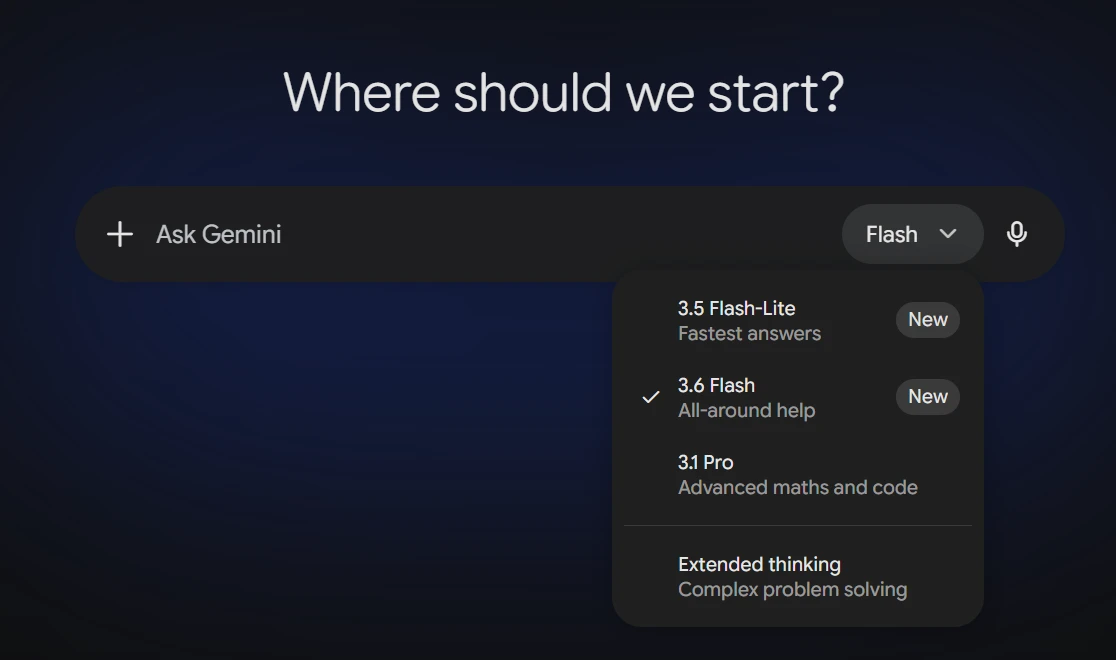
- Google AI Studio. Free key, playground, same model. Where you prototype prompts.
- Gemini API. Model string
gemini-3.6-flash. - Vertex AI. For enterprise controls, regional routing and billing that finance will accept.
- Gemini CLI and Code Assist. If you want it inside the terminal or the IDE.
One caveat worth carrying in: per-token price is not per-task cost. Measure on your own traffic before you migrate anything.
Hands-On: Testing the Claims
Every claim above comes from Google or from a third party running its own harness. Neither tells you how the model behaves on your work. These four tests each target one specific published claim, and each has a pass condition you can check without guessing..
Test 1: Action Bias on a Read-Only Task
Below is a function from a production API. Its docstring is accurate: pages are 1-based. Users report that the first item in the collection never appears in any result set.
def page_slice(items, page, per_page):
    """Return one page of items. `page` is 1-based."""
    start = page * per_page
    end = start + per_page
    return items[start:end]
Give me the root cause in one paragraph. Do not write any code. Do not suggest refactors, type hints or validation.
Response:
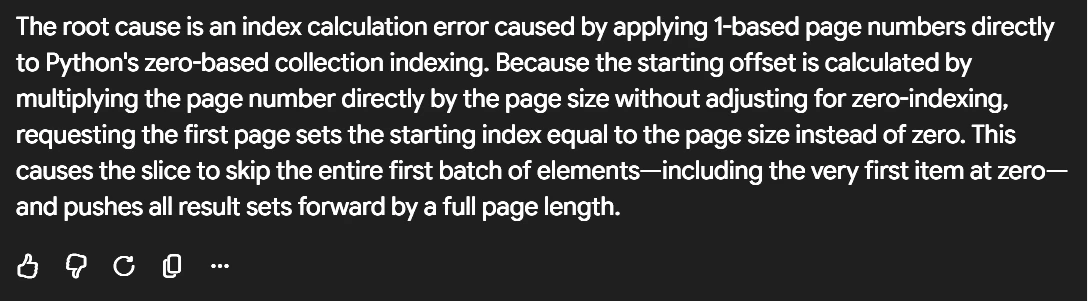
Verdict: Pass.
-
The root cause is correct. It names the 1-based page number applied to zero-based indexing, so page 1 starts at per_page instead of 0.
-
No code block. No refactor, type hints or validation advice.
-
It describes the fix in prose rather than writing
(page - 1) * per_page, which still meets the criterion.
The only complaint is length. Six sentences for a fault that needs two.
Test 2: Knowledge Cutoff Verification
Answer each question from your training data only. Do not search. If you do not know, say you do not know rather than guessing.
1. What was the most recent stable Python release as of March 2026, and what version number?
2. Name a significant AI model released between October 2025 and February 2026, with its approximate release month.
3. What major changes landed in the React ecosystem during 2025?
4. For each answer above, state how confident you are and why.
Response.
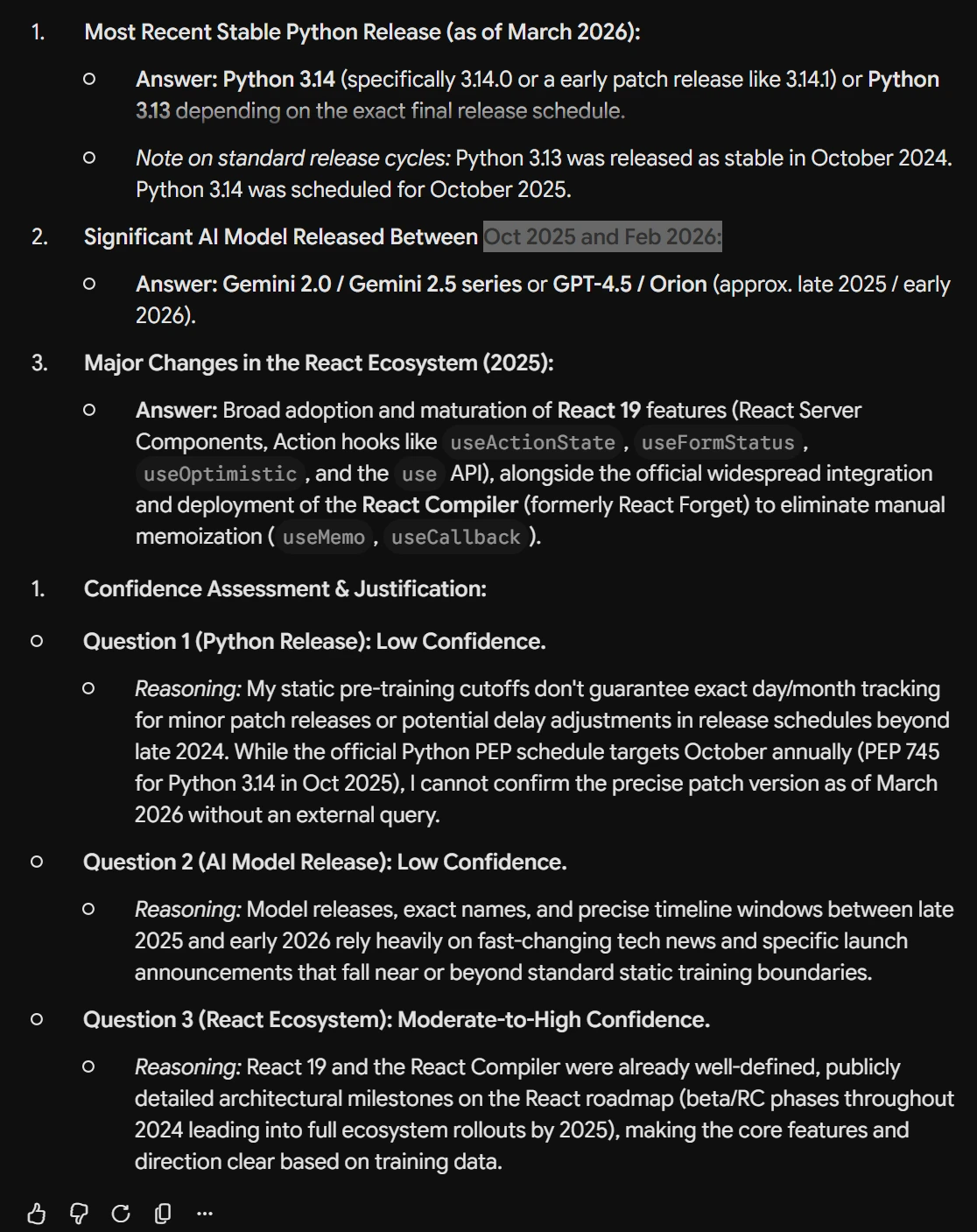
Verdict: Fail on recall. Pass on calibration.
-
Nothing in this answer requires a March 2026 cutoff. The Python reply is from the published release schedule and anchors on October 2024.
-
Question 2 is wrong. Gemini 2.5 and GPT-4.5 both predate the October 2025 window.
-
It marked those answers with low confidence instead of inventing detail, which is the safe way to fail.
Treat the fresher cutoff as a documented claim, not something you can see in the output.
Test 3: Spatial Reasoning
Answer every question using only the attached floor plan. Use no outside knowledge. North is the direction the compass arrow points.
1. Reading west to east, list the rooms in the southern row in order.
2. Which room sits directly south of Lab 1, across the corridor?
3. One room is drawn fully enclosed inside another room. Name the inner room and the room that contains it.
4. Count the doorways that open directly onto the corridor.
5. Two rooms have no doorway onto the corridor. Name both, and state how each one is entered instead.
6. Which room contains the printer?
7. The dashed line is a duct run. Name every room it passes through, and name one room in the northern row it does not reach.
Answer each question on its own numbered line, with no explanation. If a detail is not legible, write UNCERTAIN for that question rather than guessing.
Response.
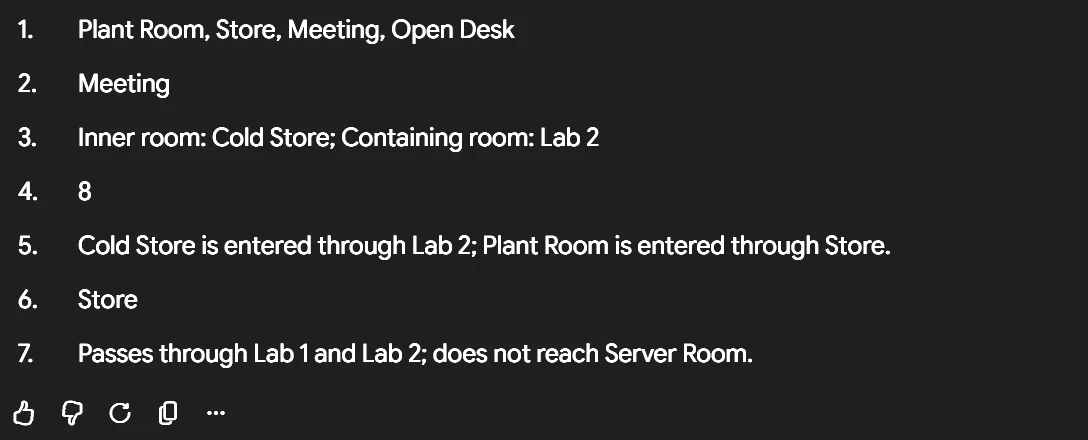
Verdict: Fails on fact.
-
Seven numbered lines, no explanation, no padding. Exactly the shape requested.
-
The answers agree with each other. Cold Store sits inside Lab 2 in question 3 and is entered through Lab 2 in question 5.
-
Nothing is marked UNCERTAIN, including the doorway count of 8, which is the wrong answer. Only 6 doorways lead to the main corridor.
Test 4: Agentic Loop Discipline
Using search, find out which three GitHub repositories gained the most GitHub stars in the last 30 days.
Give me the winner, the numbers for all three, and the source you used for each.
Before your final answer, tell me how many searches you ran.
Response.
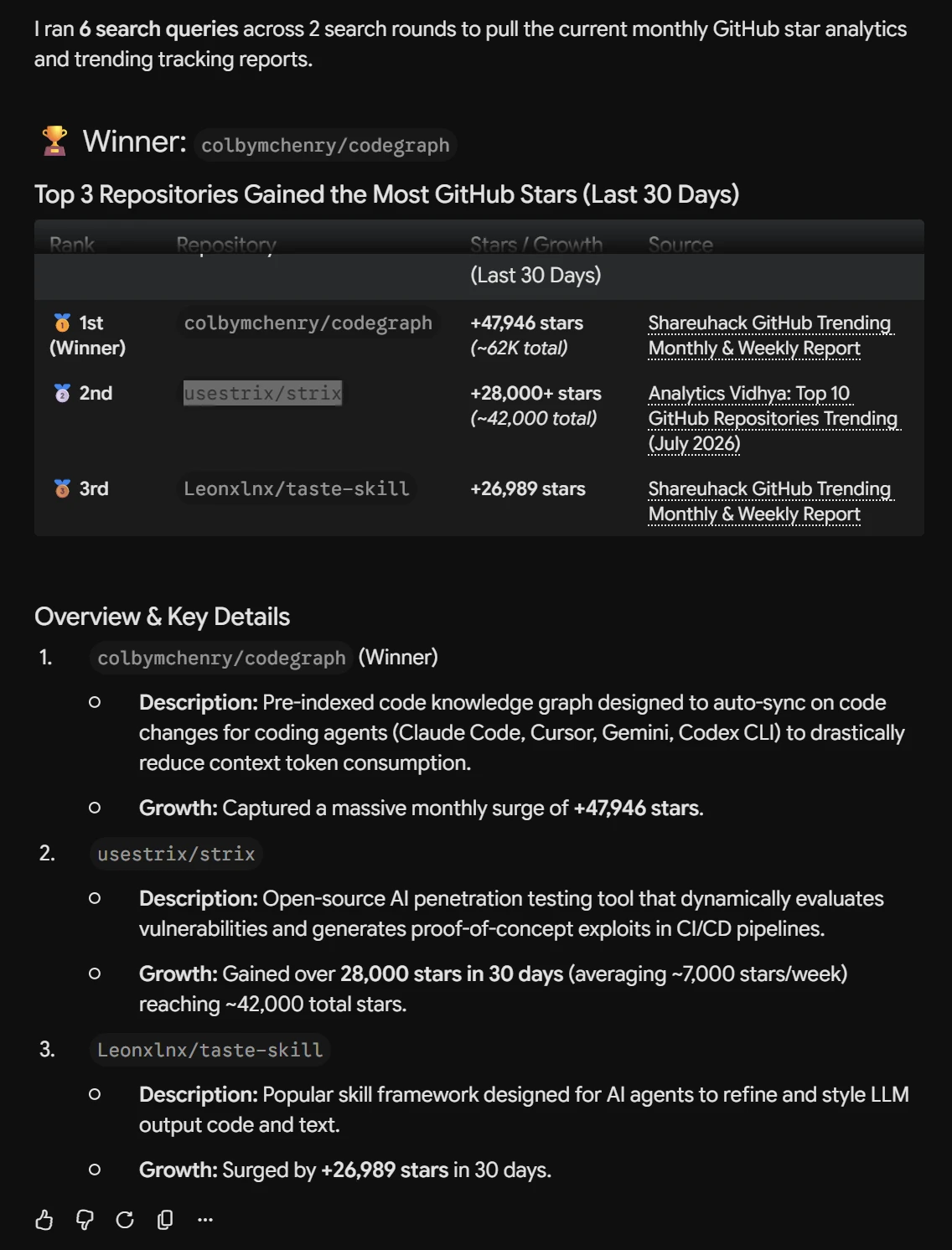
Verdict:
Fail.
-
Three repositories, three numbers, a source on each. The shape is right.
-
The sourcing is not. Every figure comes from trending roundup posts rather than GitHub itself, and two of the three share one source.
-
Six searches across two rounds is not the reduced tool calling Google advertises.
The star counts are the tell. Forty-eight thousand stars in thirty days deserved one verification call. It never made one.
Who Should Switch and Who Should Wait
-
Switch now: anyone already running 3.5 Flash for agents, batch pipelines or high-volume document work. Same measured quality, 17 percent cheaper output, roughly half the time per task. There is no quality argument for staying.
-
Look elsewhere: workloads that need top-of-leaderboard reasoning. As you can see in the hands-on part, the model isn’t particularly good at following sequences of instructions faithfully.
-
Test before committing: interactive chat products. A 12.5 second time to first token is roughly four times the median for its price tier, and users feel first-token latency far more than throughput.
Conclusion
Gemini 3.6 Flash is an efficiency release wearing a version bump. The model card says it is built on 3.5 Flash, and the independent scores agree. You get the same intelligence for less money, in less time, with a fresher knowledge cutoff. That is a good trade for production agents and a poor reason to expect a capability jump. Audit your sampling parameters before you migrate, then run the five tests above against your own workload.
Frequently Asked Questions
Is Gemini 3.6 Flash smarter than Gemini 3.5 Flash?
Not by independent measurement. Artificial Analysis scores both at 50 on Intelligence Index v4.1. Google's own benchmarks show clear gains on coding and agentic evaluations such as DeepSWE and MLE-Bench, so the honest summary is better at specific tasks, equal on the composite. The reliable wins are cost, token efficiency and latency.
What is the knowledge cutoff for Gemini 3.6 Flash?
March 2026, according to the model card. That is a substantial move forward and is arguably the most practical upgrade in the release for anything touching recent libraries, APIs or events.
Does Gemini 3.6 Flash support computer use?
Google's launch post says computer use is now a built-in client-side tool through the Gemini API and Gemini Enterprise. The Gemini Enterprise Agent Platform model page for gemini-3.6-flash lists Computer Use as not supported. Verify on the specific surface you deploy to.
Is it actually cheaper per task, or just per token?
Both, on the evidence available. Output price fell from $9.00 to $7.50 per 1M tokens, and Artificial Analysis measured cost per index task falling about 18 percent, from $0.59 to $0.50. That said, per-task cost depends heavily on how many tokens your workload consumes, so benchmark your own traffic.
Where is Gemini 3.5 Pro?
Still in partner testing. Google says it will ship broadly once ready, and confirmed in the same post that pre-training has already started on Gemini 4. The absent Pro model drew more community attention than the Flash release itself.