

GPT-6.1 Sol offers near-Astra performance for complex reasoning, coding, and business tasks at one-fifth of the API cost. Featuring the same 1.05-million-token context window and rich tool integration, it presents a compelling alternative for high-volume workflows.
To determine where Astra's price premium remains justified, I analyzed OpenAI benchmarks and executed four hands-on evaluation tests across business analysis, Python coding, video generation, and schedule optimization. In this blog, we compare their performance, pricing, and practical value to help you choose the right model.
What are GPT-6.1 Sol and GPT-6 Astra
Sol 6.1 is the newer Sol model. I tested gpt-6.1-sol against gpt-6-astra (API model names).
Astra remains OpenAI's most capable general model for demanding reasoning, coding, research, computer use and document creation. Sol 6.1 brings much of that scope to a lower price point.
| Specification | GPT-6.1 Sol | GPT-6 Astra |
|---|---|---|
| API model ID | gpt-6.1-sol | gpt-6-astra |
| Context window | 1,050,000 tokens | 1,050,000 tokens |
| Maximum output | 128,000 tokens | 128,000 tokens |
| Native input | Text and images | Text and images |
| Native output | Text | Text |
| API reasoning effort | Low through Max | Low through Max |
| Structured outputs | Supported | Supported |
The specifications and supported tools are listed on the official Sol and Astra pages. Both support web search, file search, computer use and code interpreter through the Responses API. The application around the model determines which tools you can actually use.
The shared context window matters if you're working with a large brief or repository. It doesn't establish equal judgment, or guarantee that either model will catch every contradiction in those materials.
Pricing and access
These are standard API prices in US dollars per million tokens for requests with up to 272,000 input tokens.
| Token type | GPT-6.1 Sol | GPT-6 Astra |
|---|---|---|
| Uncached input | $2.00 | $10.00 |
| Cached input | $0.10 | $1.00 |
| Cache writes | $2.50 | $12.50 |
| Output | $10.00 | $50.00 |
Sol's uncached-input and output rates are 80% lower, and its cached-input rate is 90% lower.
Testing GPT-6.1 Sol vs Astra
We gave both models the same four prompts in separate ChatGPT Work conversations at High reasoning effort and kept each first completed response. The screenshots come directly from the ChatGPT web app; the video screenshots show the finished clips. The prompts prohibited browsing and tools.
We checked the arithmetic independently, executed the generated code against independent cases, rendered both video scripts unchanged and enumerated every job order. These tests compare output quality on four prompts. We didn't measure comparative model speed or billing, or reproduce OpenAI's benchmark harnesses.
| Test | What it probes |
|---|---|
| Changing customer mix | Arithmetic and unsupported business conclusions |
| Free-time intervals | Working code, edge cases and input preservation |
| Animated video generation | A finished artifact, readable design and timing |
| Complete scheduling | Optimality and exhaustive constraint reasoning |
Test 1: Can they challenge a misleading business claim
Every channel can hold steady or improve while the overall rate falls. We wanted the models to explain that without inventing a business cause.
Prompt
This is an editorial test using fictional figures. Do not browse, use tools or read files. Answer in under 220 words.

A company says: 'Both channels converted better or equally well, so our overall acquisition performance improved.'

Channel | August signups | August activated | August paid customers | August revenue | September signups | September activated | September paid customers | September revenue

Desktop | 800 | 320 | 80 | $16000 | 300 | 150 | 45 | $9000

Mobile | 200 | 40 | 10 | $2000 | 900 | 225 | 45 | $9000

Calculate signup-to-paid conversion for each channel and overall in both months; overall activation rates; and total revenue growth. Explain how the overall rate can fall without a worse channel-level paid conversion rate. Then give a two-sentence recommendation, separating observed composition effects from causes that these figures cannot establish. Do not invent acquisition spend, profitability or retention.
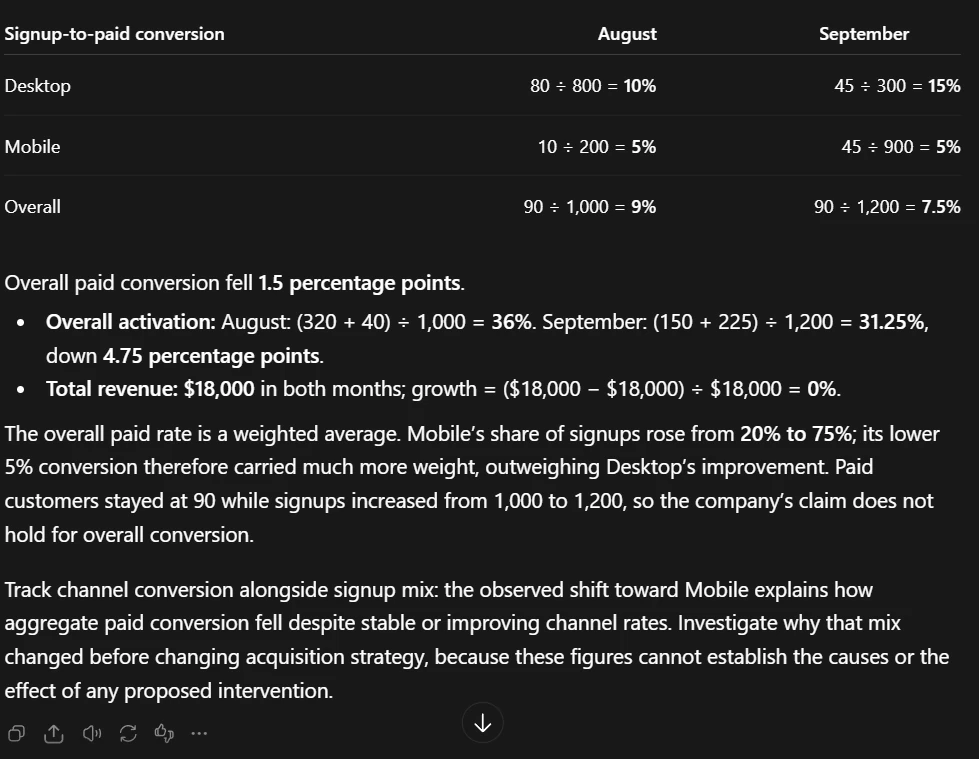
GPT-6.1 Sol output
GPT-6 Astra output
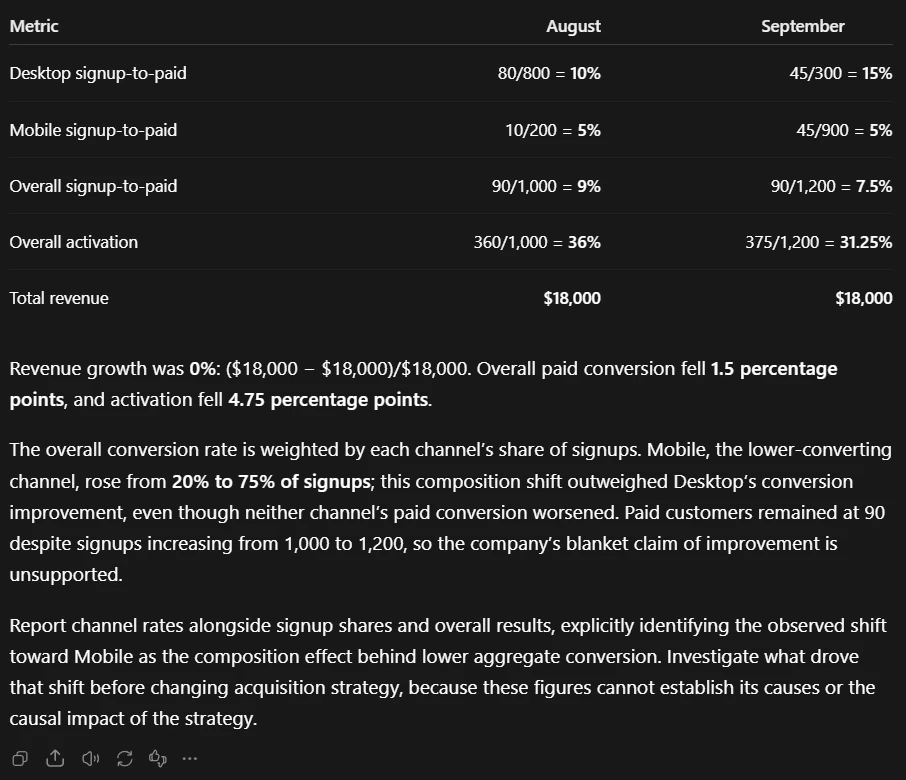
Observation: Both calculated desktop paid conversion at 10% then 15%, mobile at 5% in both months, and overall conversion at 9% then 7.5%. Overall activation fell from 36% to 31.25%, and revenue stayed at $18,000. Both identified the shift toward mobile as a composition effect and avoided inventing acquisition economics.
Both showed that mobile's share of signups rose from 20% to 75%, shifting weight toward its lower conversion rate. Astra put activation and revenue inside the comparison table; Sol used bullets for those figures. Their recommendations made the same useful distinction: the composition effect is observed, while its underlying causes need investigation.
Verdict: Tie. Both challenged the claim correctly and gave a useful recommendation without inventing causes.
Test 2: Can they write code that survives awkward inputs
Subtracting busy periods from an available window tests more than a happy-path loop. Overlaps, touching intervals, empty intervals and clipping all have to work together.
Prompt
Do not browse, use tools or read files. Return one Python 3 code block and an explanation under 70 words.

Write free_windows(start, end, busy). All numbers are integers. The available interval is [start, end), and every busy interval is also half-open. busy is an unsorted list of (left, right) pairs with left <= right. Return the sorted maximal nonempty free intervals inside [start, end) as a list of tuples. Merge overlapping or touching busy intervals, clip them to the available interval, ignore empty intervals, and do not mutate busy. If start >= end, return []. No external packages.

Include four assert statements covering an empty busy list, unsorted overlapping intervals, clipping outside the available interval, and touching intervals. The function must also handle busy intervals that cover the entire available interval.
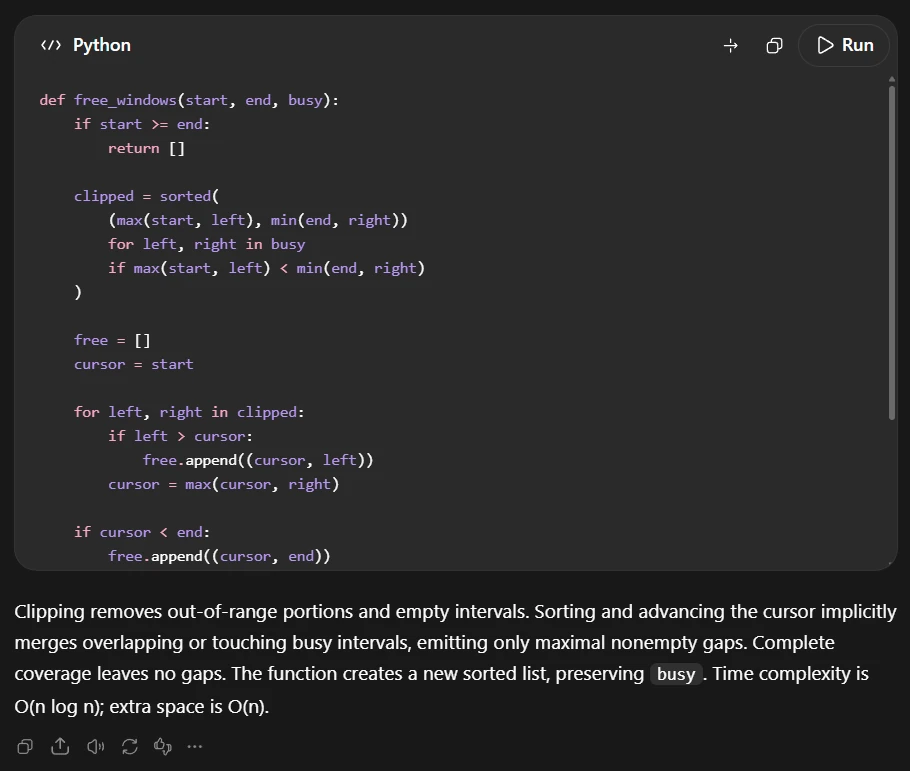
GPT-6.1 Sol output
GPT-6 Astra output
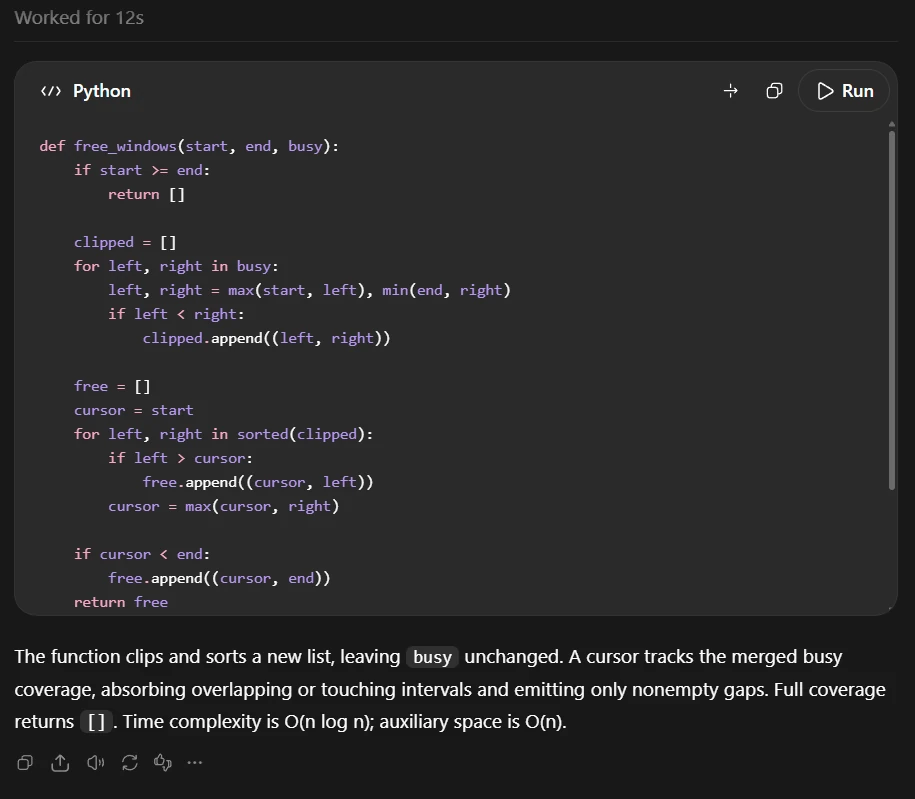
Observation: Sol passed a generator of clipped intervals to sorted; Astra built the clipped list in an explicit loop and then sorted it. Both advanced a cursor across occupied time and returned maximal free gaps, with O(n log n) time and O(n) space.
Both code blocks passed their assertions and 1,007 independent cases each against an integer-grid reference. We checked invalid availability, full coverage, empty intervals, unsorted inputs, overlap, touching boundaries and clipping. Neither mutated the input list.
Verdict: Tie. Our checks found no functional advantage for Astra on this task. They establish correctness on the tested inputs, not every possible input.
Test 3: Can they generate a finished animated video
A script that looks plausible isn't a finished video. We wanted an eight-second explainer with readable cards, eased motion and a clear completion phase.
Both models produce text rather than native video output. Here, each generated the code for a video, which we ran unchanged to produce the actual MP4. This tests video creation through code.
Prompt
Return one complete, self-contained Python 3 script that creates output.mp4: exactly 8 seconds, 1280 by 720 pixels, 24 fps, silent H.264 with yuv420p pixels. Use only the standard library, Pillow and NumPy; FFmpeg is installed on PATH. Arial and Arial Bold are available at C:/Windows/Fonts/arial.ttf and C:/Windows/Fonts/arialbd.ttf. No downloads, package installs or external assets.

Make a polished animated explainer titled "From brief to finished work". Show three readable cards labelled "Brief", "Build" and "Review": introduce them during 0 to 2 seconds, animate a work token travelling through them during 2 to 6 seconds, then show all three completed and "Ready to deliver" during 6 to 8 seconds. Use continuous, eased motion, consistent typography and no clipped text. Render every frame yourself.

Return only the script in a Python code block. Do not browse, use tools or execute it.
GPT-6.1 Sol output
GPT-6 Astra output
Observation: Both the scripts produced by either models ran successfully on the first attempt. Each produced a silent H.264 MP4 with exactly 192 frames: eight seconds at 24 fps and 1280 by 720 pixels. We verified the files independently and checked the introduction, travelling token and final state. Neither needed a repair or downloaded asset.
Verdict: Astra for the clearer completion state and closer timing. Both created working videos; the difference was in following the creative brief, rather than whether the scripts could render.
Test 4: Can they find every optimal schedule
Finding one valid schedule is easier than proving that you've found every best schedule. We added a release time, a deadline and precedence rules to test both optimality and completeness.
Prompt
Solve this fictional scheduling problem without browsing, tools or files. Answer in under 220 words.

One technician handles four nonpreemptive jobs, one at a time, starting no earlier than 09:00. Exactly 10 minutes of buffer are required between consecutive jobs.

A takes 40 minutes; B takes 30; C takes 50; D takes 20\.

A must finish before B starts. C must finish before B starts. C must finish by 10:30. D cannot start before 10:00. Every job must finish by 12:00.

Find the earliest possible finishing time and list EVERY distinct job order that achieves it, with each job's start and end time. Prove that your list is complete. You may add idle time if needed, but may not shorten jobs or buffers. Use a compact table. All times are local.
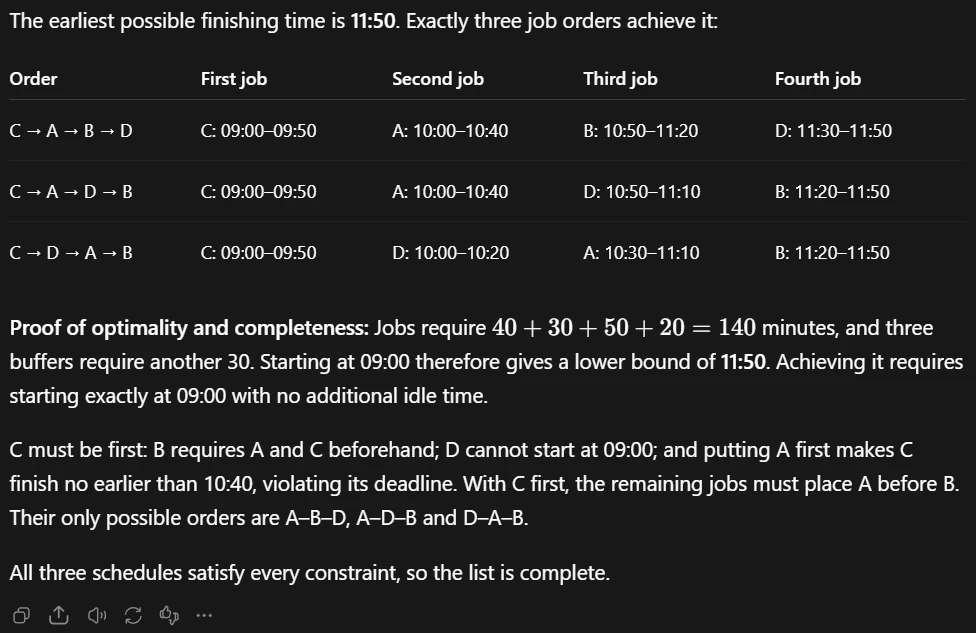
GPT-6.1 Sol output
GPT-6 Astra output
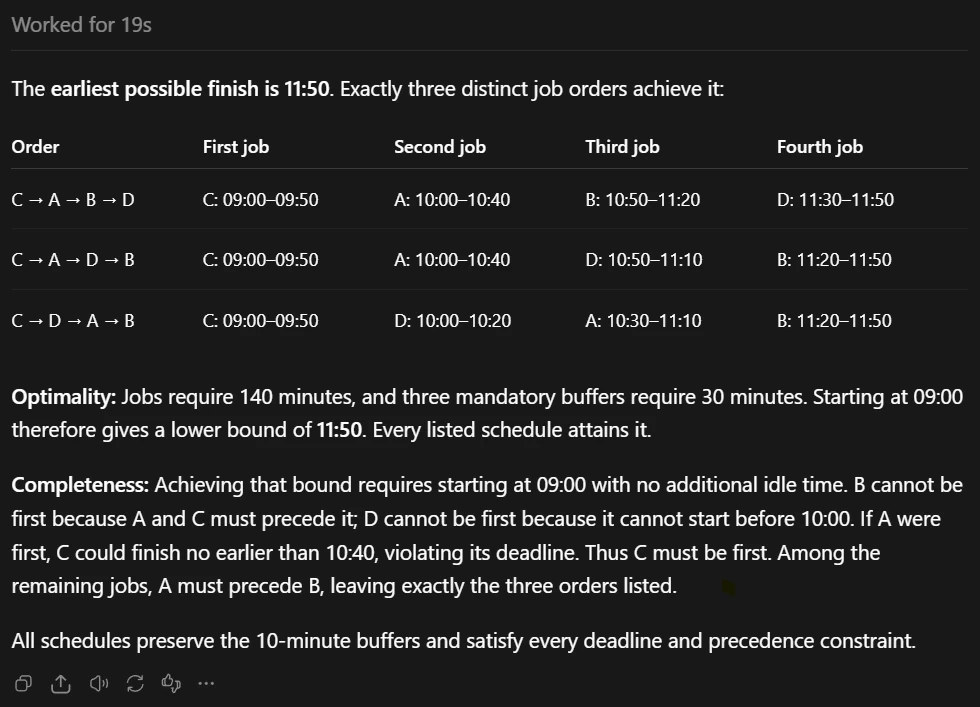
Observation: Both found the earliest finish, 11:50, and exactly the same three optimal orders: C-A-B-D, C-A-D-B and C-D-A-B. Every listed time respected the job durations, ten-minute buffers, C's deadline, D's release time and A/C-before-B rules.
We independently enumerated all 24 job orders. The optimum and complete set matched both answers. The 140 minutes of work and 30 minutes of buffers establish the lower bound; achieving it leaves no room for additional idle time. Both models explained why C must come first.
Verdict: Tie. Both supplied a correct result and a complete argument under the word limit.
What OpenAI's benchmarks show
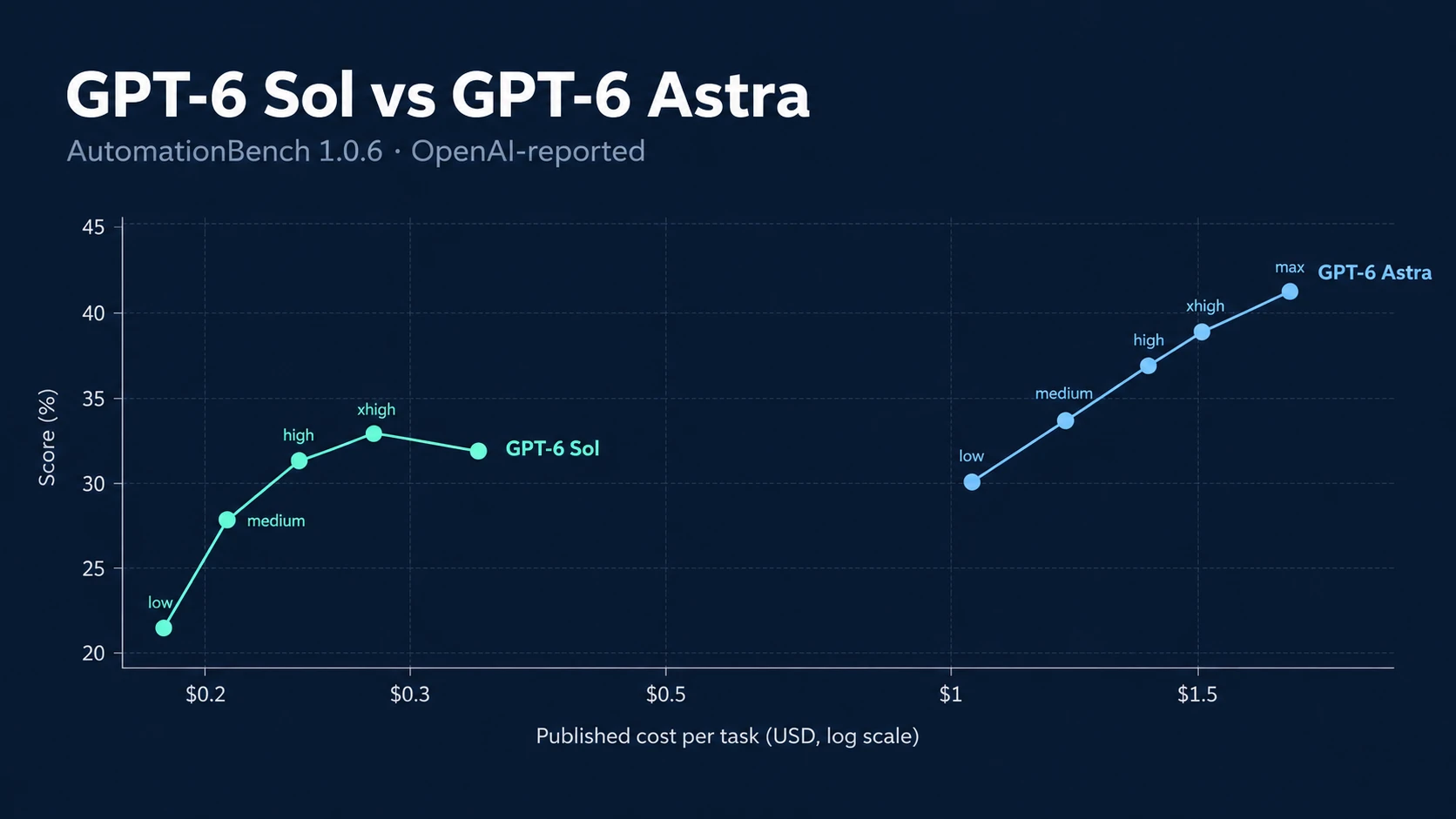
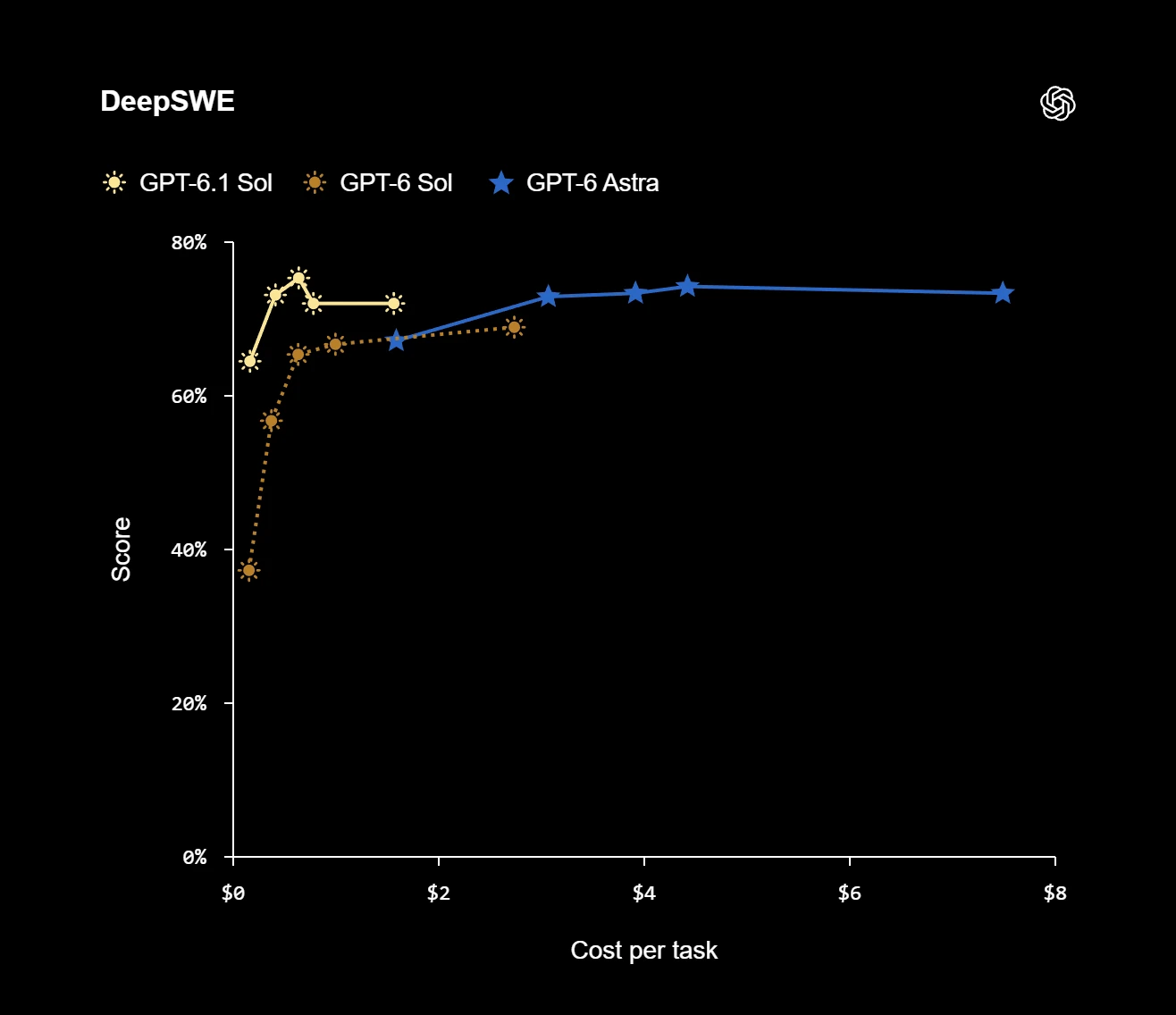
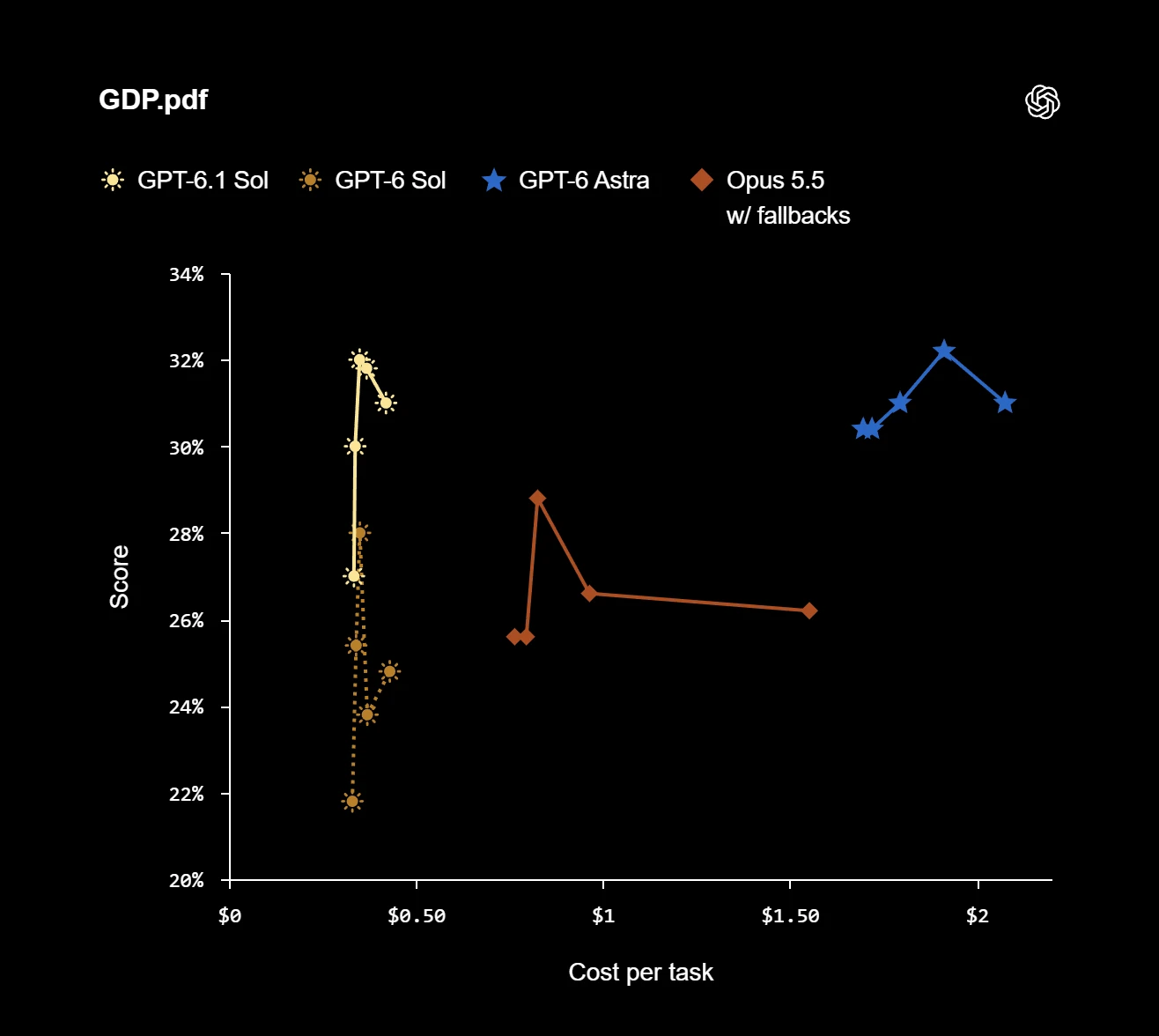
High-effort results and estimated task costs come from OpenAI's Sol release. Charts show multiple efforts.
| Evaluation at High effort | Sol score | Astra score | Sol cost per task | Astra cost per task |
|---|---|---|---|---|
| DeepSWE v1.1 | 75.2% | 73.2% | $0.65 | $3.92 |
| GDP.pdf | 32.0% | 31.0% | $0.35 | $1.79 |
| AutomationBench 1.0.6 | 33.2% | 37.1% | $0.23 | $1.44 |
| OSWorld 2.0 offline partial reward | 69.6% | 70.0% | $0.96 | $6.91 |
| Terminal-Bench Science 0.1 | 51.1% | 62.0% | $2.76 | $14.95 |
| Difficult-prompt factual error rate | 4.5% | 3.9% | $0.08 | $0.48 |
Lower factual error rates are better; these deliberately difficult prompts don't represent everyday usage. OSWorld uses partial reward. Benchmark harnesses differ from our tests.
Coding and PDF work are close in these evaluations
Which model should you choose
The business analysis, executed code and exhaustive scheduling produced ties. Both video scripts worked. Astra followed the creative brief more closely.
| Your workload | Our starting choice | What would justify Astra |
|---|---|---|
| Clearly specified code changes | Sol 6.1 | Better fixes on your own failing cases |
| Recurring reports and routine calculations | Sol 6.1 | Insights that materially improve the decision |
| Animated explainers and creative artifacts | Compare both | Clearer design and closer adherence to the brief |
| Difficult scientific or research workflows | Compare Astra first | Stronger verified results on representative work |
| Ambiguous briefs and demanding deliverables | Compare both | Fewer missed requirements and less cleanup |
Validate these starting choices on your own workload, as OpenAI's model-selection guidance recommends. Compare correctness, completion, review time and total usage across repeated jobs.
The benchmark illustrations have been sourced from OpenAI's GPT-6.1 release blog.
Final verdict
Sol 6.1 is the better starting value for the routine tasks we tested. It matched Astra on the analysis, code and complete scheduling solution at lower API rates.
Keep Astra where execution details improve the deliverable. Its animation followed the timing more closely and made completion clearer. OpenAI's broader comparisons also support testing it on demanding research. Pay the premium where repeated comparisons justify it.
Frequently Asked Questions
Is Sol 6.1 as good as Astra?
They tied on our analysis, coding and scheduling tests. Both rendered the video, with Astra following its timing more closely. Four prompts don't establish equal performance on every task.
Does Astra have a larger context window?
No. Both list a 1,050,000-token context window and a 128,000-token maximum output.
Will switching to Sol save 80 percent on every task?
Standard uncached-input and output rates are 80% lower. Savings per completed task depend on token use, reasoning, tools, tier and retries. We tested quality, not billing.