

Claude Fable 5.2 or Gemini 4 Argon: which turns the same prompt into the better result? An attractive illustration is one test. An interactive web page, a faithful photo reconstruction, and a clear explanation demand different strengths.
In this article, we compare Fable’s published outputs with fresh Argon runs across four practical tasks. We look beyond first impressions to examine the details, the mistakes, and how much work separates each response from something you’d actually use.
1. Drawing a pelican riding a bicycle
This tiny brief tests whether the model can assemble a recognizable subject and a coherent object from drawing instructions. The wheels, frame, feet, and handlebars all need to belong to the same scene.
Prompt
Generate an SVG of a pelican riding a bicycle
Response
| Claude Fable 5.2 at Xhigh | Gemini 4 Argon at High |
|---|---|
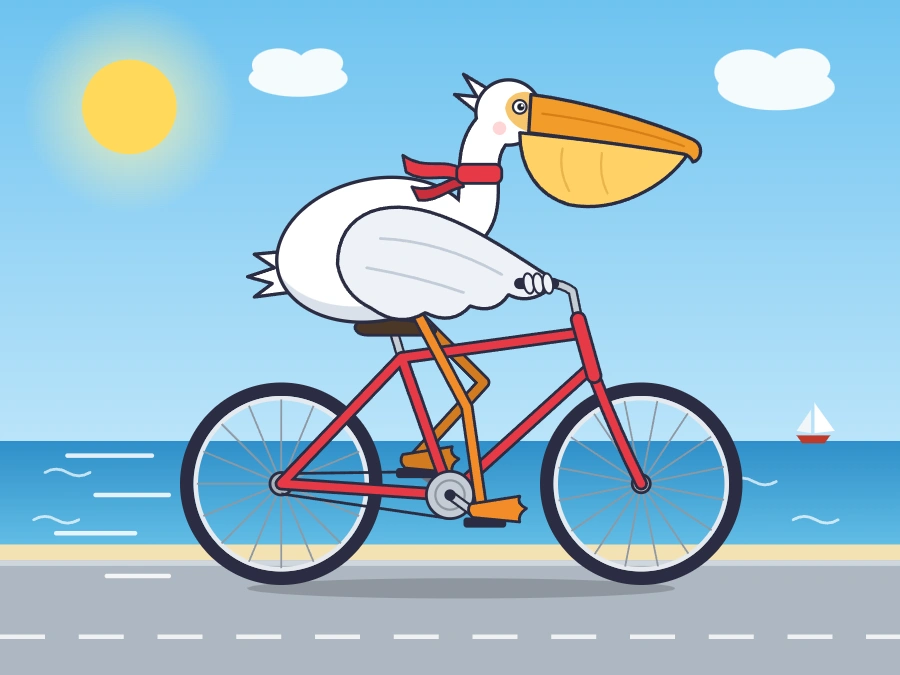 | 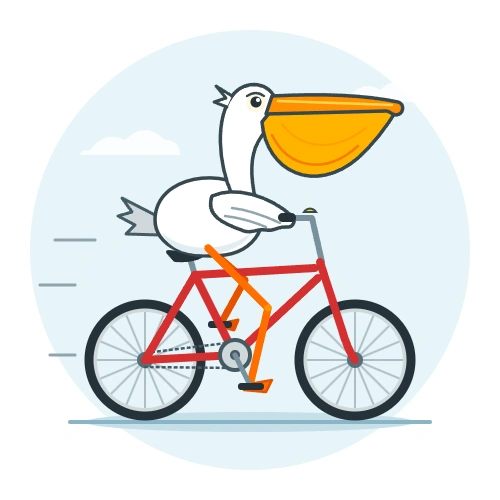 |
The complete SVG outputs rendered without changes to their drawing code.
Observation
Fable builds a whole seaside scene around the bird: a road, water, a small boat, clouds, and a scarf. The bicycle has a conventional frame, and the feet visibly meet the pedals. Its wing ends in a finger-like grip, which is a little odd for a bird, but the overall drawing reads immediately.
Argon frames its pelican inside a pale blue circle. The oversized orange pouch, red bicycle, spoked wheels, and angular legs make the subject easy to read. Its feet meet the two pedals and the wing reaches the handlebar. The drawing is compact, with much less background detail than Fable’s scene.
I prefer Fable’s result as a finished scene. Argon’s circular composition would work well as a small badge or illustration. Both answer the request; the difference is how much of a world they build around it.
2. Creating a beautiful single HTML page
Here the prompt leaves the subject open. The models have to choose a concept, compose the page, and make their own design decisions. Matching the prompt does not mean they will create the same kind of scene.
Prompt
Create the most beautiful and stunning single HTML file you can possibly imagine
Fable 5.2 Response
Argon 4 Response
.
Observation
Fable gives you a calm natural scene; Argon gives you more controls and a busier visual field. Both loaded without JavaScript errors in the browser checks. For an immersive view, I would choose Fable’s aurora. For a page to keep adjusting and exploring, Argon offers more to do.
Argon describes the file as dependency-free, but its HTML requests Google Fonts. The offline check still rendered with fallback fonts and working controls. The supplied HTML was kept unchanged, so that distinction remains part of the result.
3. Recreating a photo as an SVG
This time, the model receives a photograph rather than a description. The job is to preserve the subject, pose, markings, background, and composition while turning the scene into vector shapes.
Prompt
Recreate this photo as an SVG, as close to the original as you can. System instruction: Return a complete, self-contained SVG document.
Response
| Input photo | Fable 5.2 at High | Gemini 4 Argon at High |
|---|---|---|
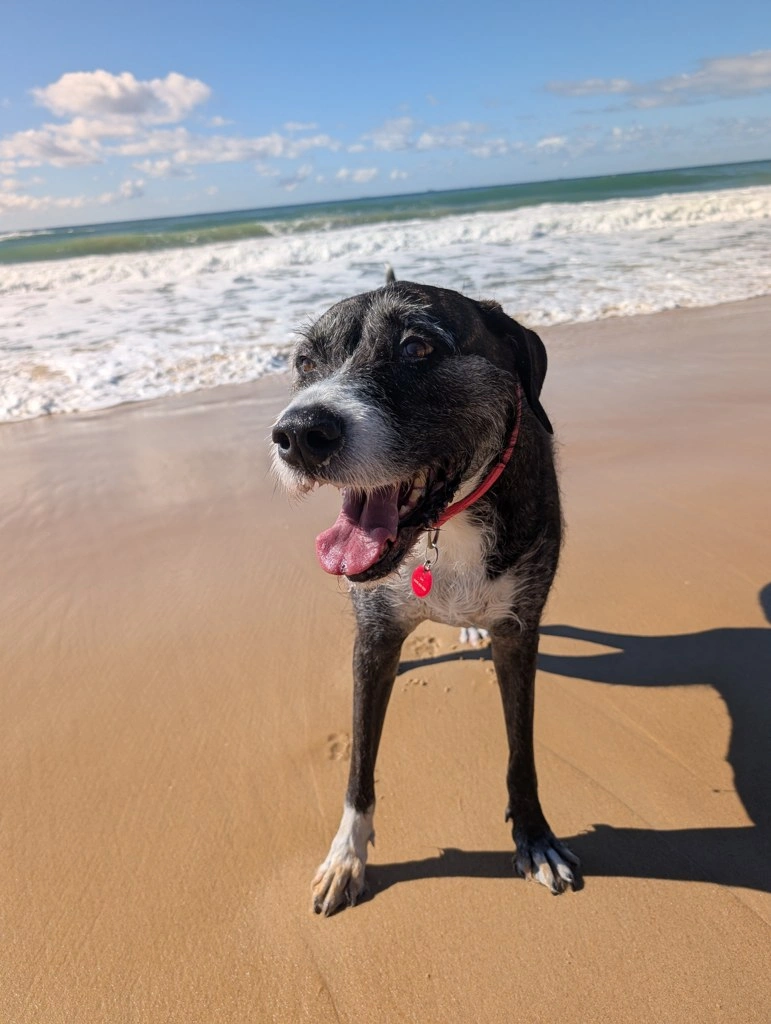 |  |  |
The input and both complete SVG responses. All images keep their original proportions.
Observation
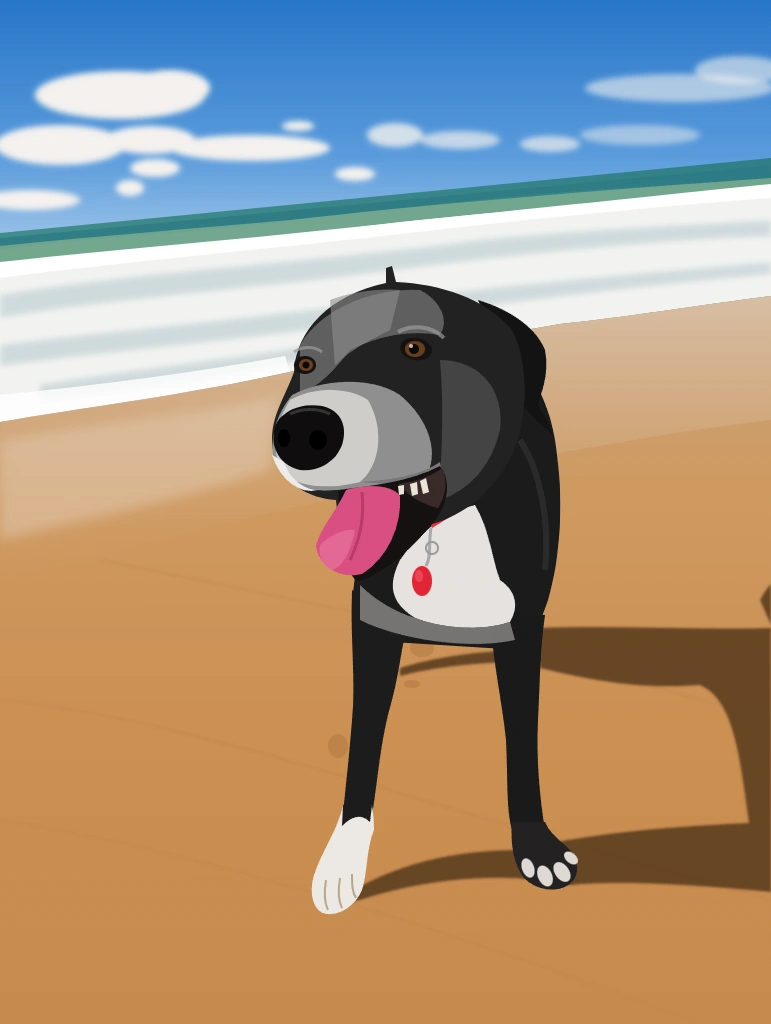
Fable retains the dog’s long legs, pale muzzle, white chest, red collar, pink tongue, and the tilted shoreline. Its broad shapes turn the photograph into a much simpler cartoon, with a changed head outline and little coat texture.
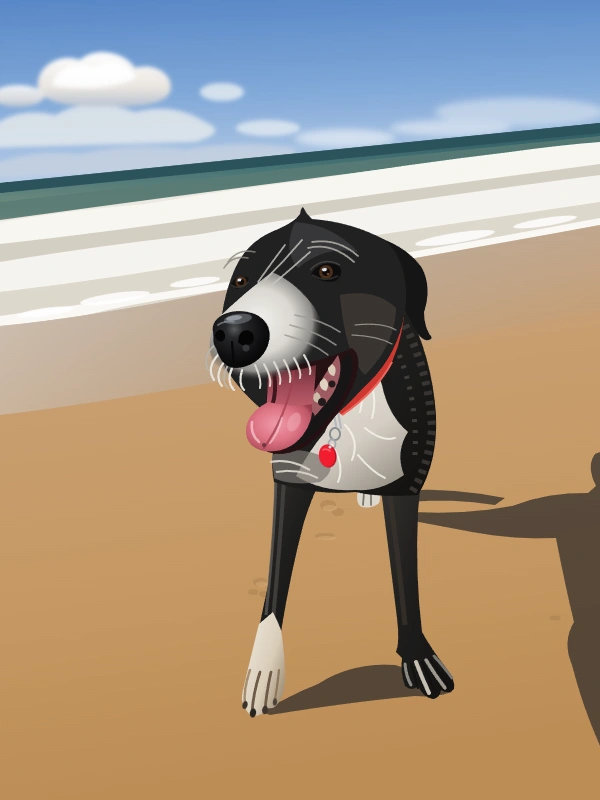
Argon adds individual whiskers, visible teeth, muzzle shading, chest strokes, and more detail around the collar and tag. It keeps the long legs and the diagonal beach composition, though the muzzle is exaggerated and the coat remains a collection of smooth shapes and repeated strokes.
Argon is closer to the photograph in this run, especially around the mouth and collar. Neither reconstruction preserves the original fur texture or face precisely. Both are vector interpretations of the photo.
4. Explaining a mortgage within 120 words
A good explanation needs an appropriate reading level as well as correct facts. This task adds a strict word limit, so the model has to choose what a younger reader needs first.
Prompt
Explain how a mortgage works to a 12-year-old, in under 120 words.
Fable 5.2 Response summary
Argon 4 Response

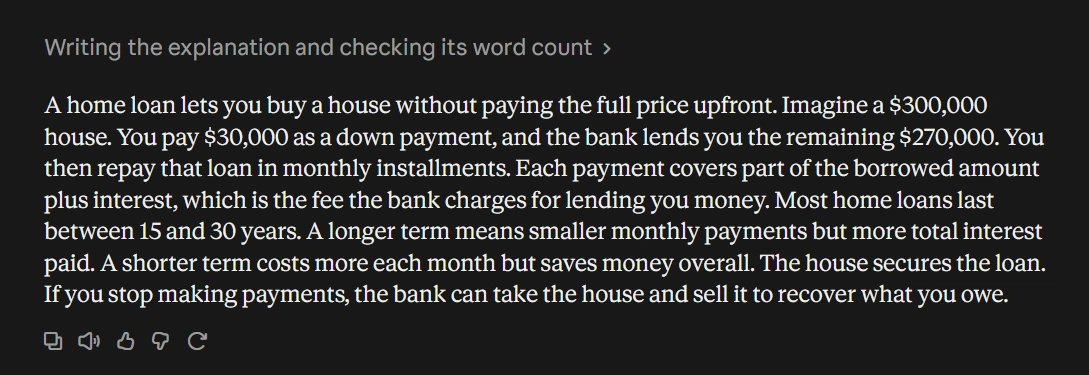
The complete Argon response captured directly from the Gemini web app.
| Check | Fable 5.2 | Argon 4 |
|---|---|---|
| Words counted by whitespace | 118 | 111 |
| Under 120 words | Yes | Yes |
| Concrete house-price example | Yes | Yes |
| Taxes, insurance, and repairs mentioned | No | No |
Observation
Both meet the word limit and explain the loan, down payment, interest, monthly repayment, and risk of losing the home after stopping payments. Argon uses a ₹50 lakh house, a ₹10 lakh down payment, and a ₹40 lakh loan. Its use of lakh suits an Indian audience; a global beginner may need that amount spelled out.
Fable’s answer has 118 words and Argon’s has 111. Both make the idea concrete through numbers. Neither includes ongoing ownership costs such as taxes, insurance, and repairs, so this round is a close result rather than a clear win.
How the runs were compared
| Task | Published Fable run | Fresh Argon run |
|---|---|---|
| Pelican SVG | Xhigh through llm-anthropic | High in Gemini web app |
| Single HTML file | OpenRouter catalog default; effort not explicitly set | High in Gemini web app |
| Photo to SVG | High; supplied photo | High; same photo |
| Mortgage explanation | OpenRouter defaults | High in Gemini web app |
Each Argon task ran in a fresh temporary chat on November 10, 2026. The core task prompts and photo were reused exactly. A separate anonymity instruction was appended to each message. For the photo task, the SVG instruction appeared as a separate paragraph because the app has no system-instruction field.
The first complete Argon response was kept, with no follow-up, regeneration, or repair. Fable’s original results and settings are unchanged. Matching effort labels do not equalize computation, and these app runs are not a controlled API benchmark.
The published SVG sweep also includes a Max attempt that exhausted 128,000 thinking tokens without returning an illustration. The comparison therefore uses the completed Xhigh output, with that failure kept in view. Turning the setting up is not automatically an upgrade.
The response screenshot comes from the actual Gemini conversation. The SVGs are complete renders of the original drawing code. Both HTML videos record real interactions with unchanged files. Generation costs and latency were not measured for this paired comparison.
Benchmark comparison
Published benchmarks provide broader context than these four tasks. The charts compare the actual named models and retain their reported settings. They are separate evaluations, rather than scores generated by this article’s hands-on runs.
Aggregate capability
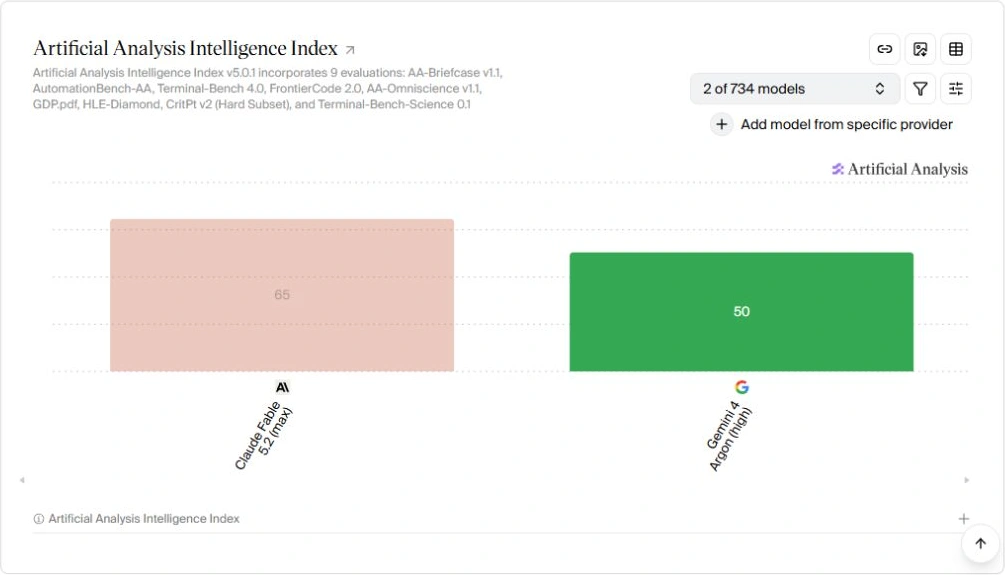
Intelligence Index v5.0.1. Fable scores 65 at Max with Default Fallback; Argon scores 50 at High. Higher is better.
Fable leads by 15 index points on this aggregate of nine evaluations. That supports a broader capability advantage at the reported settings, while the individual outputs above still show why the task matters.
Benchmark task cost
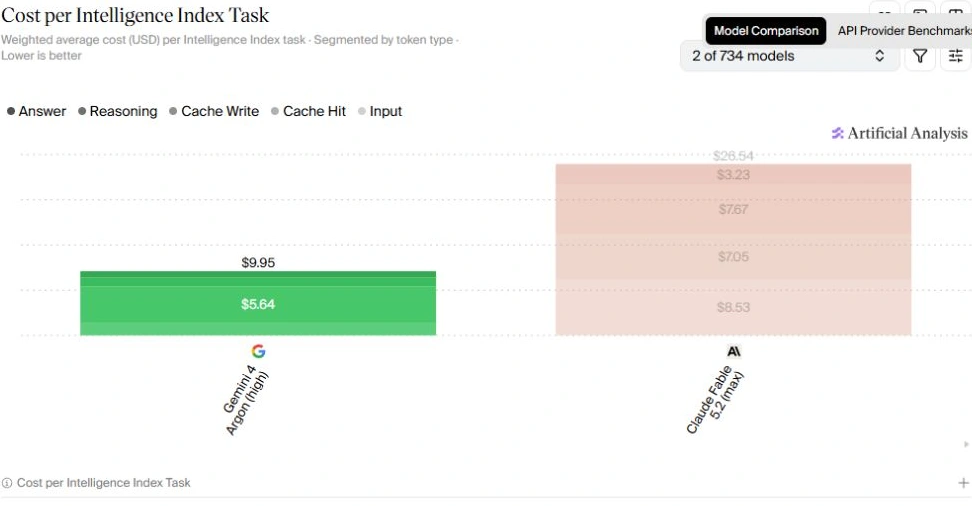
Weighted average cost in US dollars per Intelligence Index task at the displayed settings. Lower is better.
The reported weighted task cost is $26.54 for Fable and $9.95 for Argon, about 2.67 times as much for Fable. This chart uses Argon’s 20 standard token pricing, rather than its temporary introductory rate. These workload averages are different from the bill for an ordinary chat.
Simulated robot control
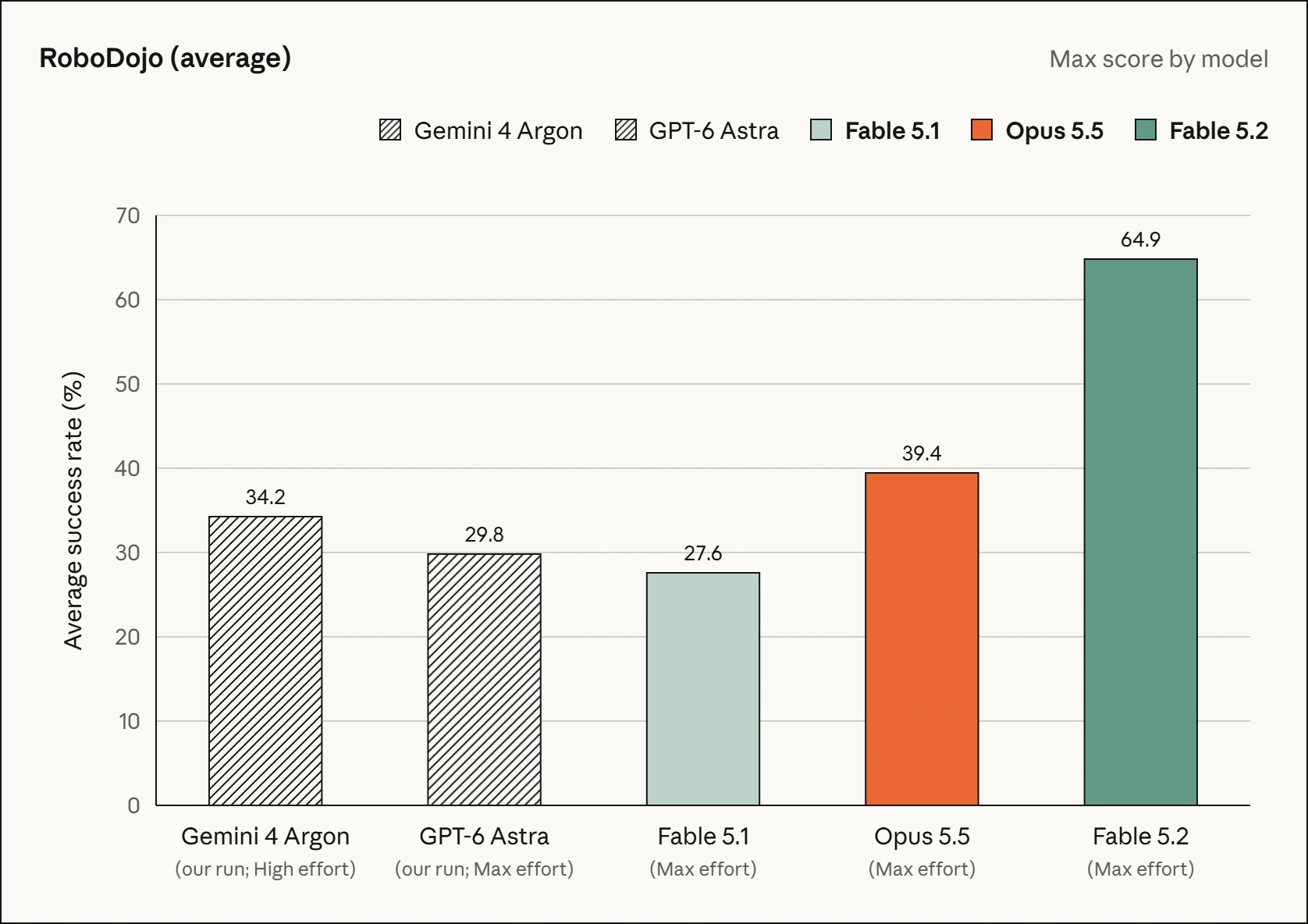
RoboDojo Sim average success rate in the reported internal runs. Fable uses Max effort; Argon uses High.
Fable scores 64.9% against Argon’s 34.2%, a 30.7-percentage-point gap. The reported internal runs use the same harness to control a simulated two-arm robot from camera images. This measures a different job from drawing or writing and does not establish performance on a deployed physical robot.
Price and context window
| Standard API specification | Fable 5.2 | Gemini 4 Argon |
|---|---|---|
| Input per million tokens | $8 | $2 introductory |
| Output per million tokens | $40 | $10 introductory |
| Context window | 1 million tokens | 1,048,576 unified tokens |
| Maximum output | 128,000 tokens | 65,536 synchronous |
Rates are in US dollars, checked on November 10, 2026. Argon’s introductory 10 pricing runs through November 30; 20 is scheduled from December 1. Fable’s published standard rates are 40. These are API rates, separate from consumer subscription fees.
Argon’s context allowance combines input and output. A separate long-decode route supports larger output limits; this was not part of the web-app tests. For these short tasks, context capacity was not a deciding factor.
For long documents or repositories, this explanation of the context window in an LLM is a useful starting point. Total cost still depends on thinking, response length, tools, caching, and retries.
Which model would I choose
I would choose Fable for the richer pelican illustration and the aurora scene. Argon gives me the more detailed photo reconstruction and an HTML page with more controls to explore. The short explanation is a close result: both use a concrete example and stay within the limit.
The published benchmarks favor Fable at the reported settings, while Argon’s introductory API token rates are lower. Start with the task you repeat most, inspect the complete result, and judge how much editing it needs. These four outputs give you a more useful starting point than one overall winner.
Frequently Asked Questions
Were the same prompts used?
Yes. The core prompts and photo were unchanged. Each Argon message also included an anonymity instruction.
Are these fresh account runs?
Argon ran in the Gemini web app at High thinking. Fable’s retained outputs come from published tests.
Can the HTML pages work offline?
Fable loaded locally. Argon’s controls worked offline with font fallbacks; its HTML requests Google Fonts.
Which model costs less per token?
Argon’s introductory API rates are lower. Total generation costs were not measured across both models.