

OpenAI expanded the GPT-6 family with Sol and Luna, offering lower-cost alternatives to Astra. Sol targets all-around professional tasks, coding, and computer use, while Luna provides a budget option capable of handling surprisingly demanding workflows.
To see what changed and which model fits your needs, I analyzed OpenAI's benchmarks and ran hands-on tests. In this article, we examine their performance, pricing, and practical trade-offs.
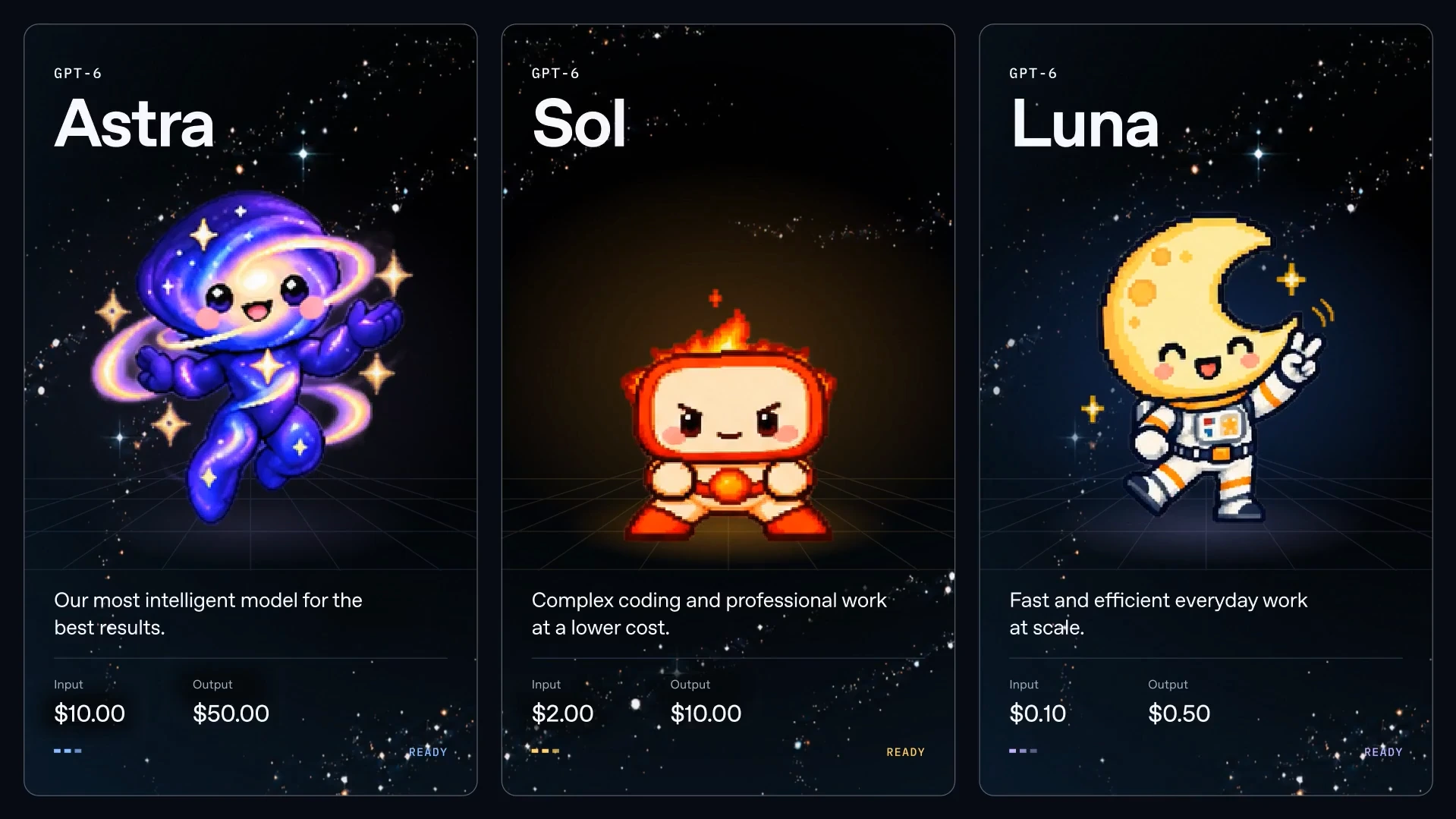
What are GPT-6 Sol and Luna?
GPT-6 Sol and Luna are the two lower-priced siblings of GPT-6 Astra. OpenAI says they were trained with similar methods and inherit improvements in professional work, factuality, coding, computer use and alignment. Astra remains the company's top choice when the quality ceiling matters most. Sol is meant to deliver much of that capability at a lower price; Luna pushes the cost floor down again.
At launch, both models are available in ChatGPT Work and Codex for Plus, Pro, Business, Enterprise and Edu users. Free and Go users get Luna in the desktop app. API model IDs are gpt-6-sol and gpt-6-luna. OpenAI says they are rolling out gradually, and regular Chat access was not yet available when the announcement went live.
GPT-6 Sol and Luna pricing
| Model | Input per million tokens | Output per million tokens |
|---|---|---|
| GPT-5.6 Sol promotional rate | $4 | $20 |
| GPT-6 Sol | $2 | $10 |
| GPT-5.6 Luna promotional rate | $0.20 | $1.20 |
| GPT-6 Luna | $0.10 | $0.50 |
The Sol rates are exactly half the promotional rates of GPT-5.6 Sol. Luna's input rate also halves; its output rate actually falls about 58%, from $1.20 to $0.50. OpenAI summarizes the family as a 50% price cut.
The important distinction is cost per task. A model that spends more tokens thinking or needs a second attempt can still cost more in practice. OpenAI's charts include estimated task cost, so those are more useful for comparing agent workflows than token prices alone.
How to Access GPT-6 Sol and GPT-6 Luna
GPT-6 Sol and Luna are available across OpenAI's developer and productivity platforms, with ChatGPT access rolling out gradually.
- ChatGPT Work and Codex: Both models are available to Plus, Pro, Business, Enterprise, and Edu users.
- Free and Go: GPT-6 Luna is available in the desktop app.
- OpenAI API: Access them using
gpt-6-solandgpt-6-luna.
The models are not yet available in regular ChatGPT Chat. If they don't appear in Work or Codex, try again later as the rollout continues.
Hands-on: Four prompts, One rule
I ran the same four prompts in fresh ChatGPT Work chats with GPT-6 Sol and GPT-6 Luna at Medium effort. Each prompt asked the model to work without tools.
Test 1: Can they spot a weakening funnel?
This tests basic numerical accuracy and whether the model mistakes higher raw signups for better conversion.
Prompt:
Answer the following as a data analyst. Do not use tools or external information. Keep the full answer under 160 words.

An app had 1,000 signups, 420 activated users, 140 paid subscribers, and \$20 customer acquisition cost in August. In September it had 1,200 signups, 432 activated users, 144 paid subscribers, and \$28 customer acquisition cost.

Calculate the activation rate and paid-subscriber rate per signup for each month, and the percentage change in CAC. Then write a three-sentence executive takeaway that separates observed facts from possible causes. Do not call a change in raw volume an improvement if the rate worsened.
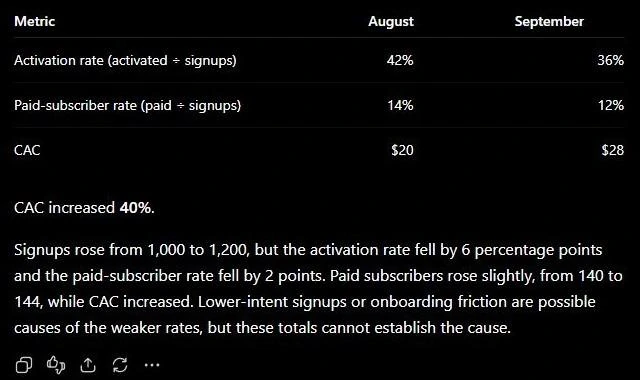
GPT-6 Sol response:
GPT-6 Luna response:
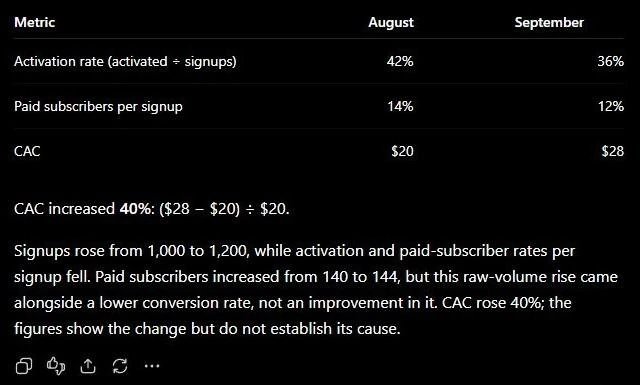
Observation: Both got every calculation right: activation fell from 42% to 36%, paid subscribers per signup fell from 14% to 12%, and CAC rose 40%. Sol floated lower-intent signups or onboarding friction as possible causes, while saying the totals could not prove them. Luna stayed with the observed facts. Either answer would work for a short executive note.
Winner: Tie.
Test 2: A tie-breaking coding task
This checks whether the models follow a precise ordering rule and write assertions that actually test it.
Prompt:
Answer without using tools or external information. Return a Python 3 code block only, at most 45 lines.

Write dedupe_events(events). Each event is a dictionary with keys id (string), ts (integer), and status (string). Keep one event per id: greatest ts wins; on a timestamp tie, status == "success" wins; if still tied, the event appearing later in the input wins. Return a new list sorted by id, and do not mutate the input or its dictionaries. Include two assert statements that test a timestamp tie and a later-input tie.
GPT-6 Sol response:
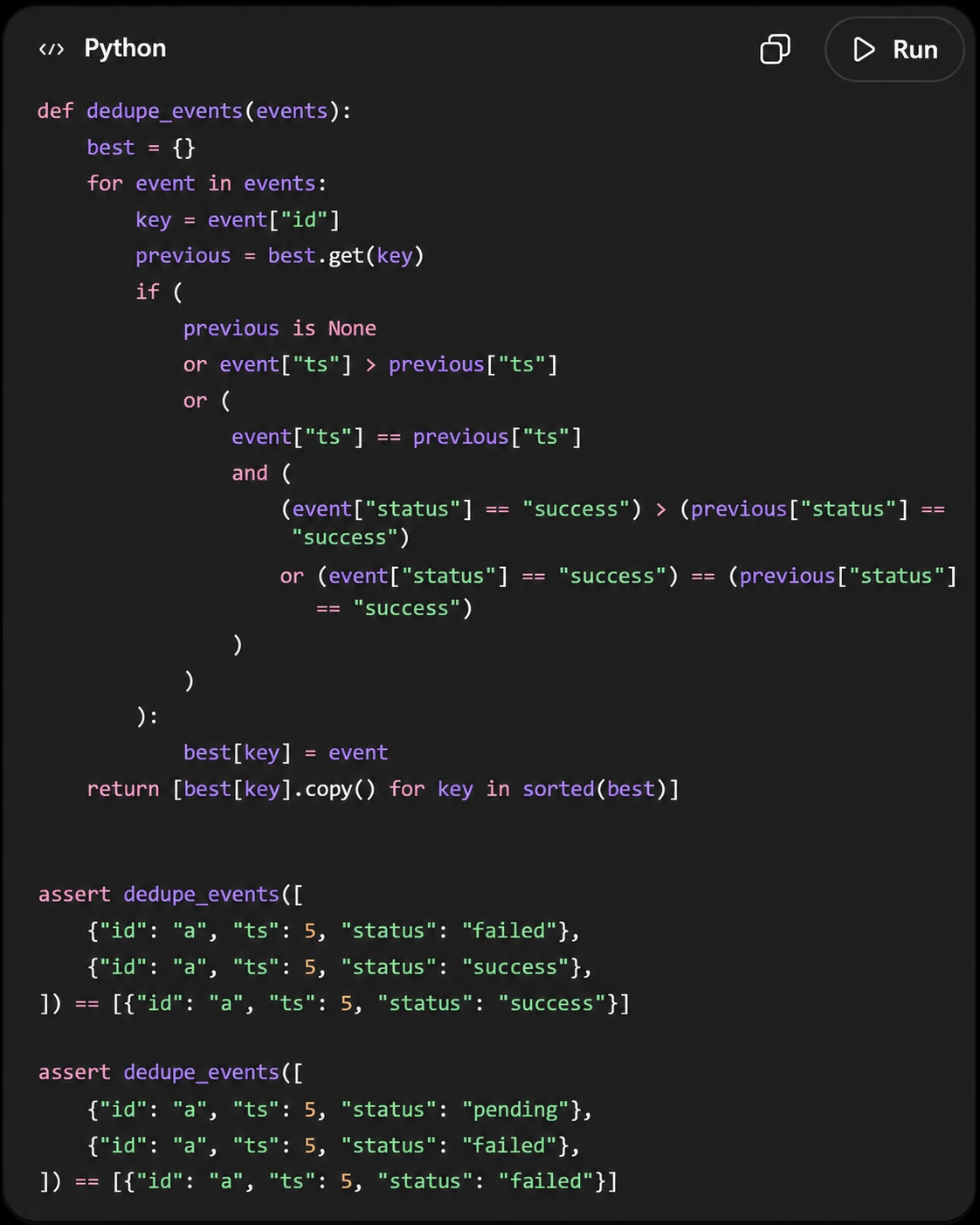
GPT-6 Luna response:
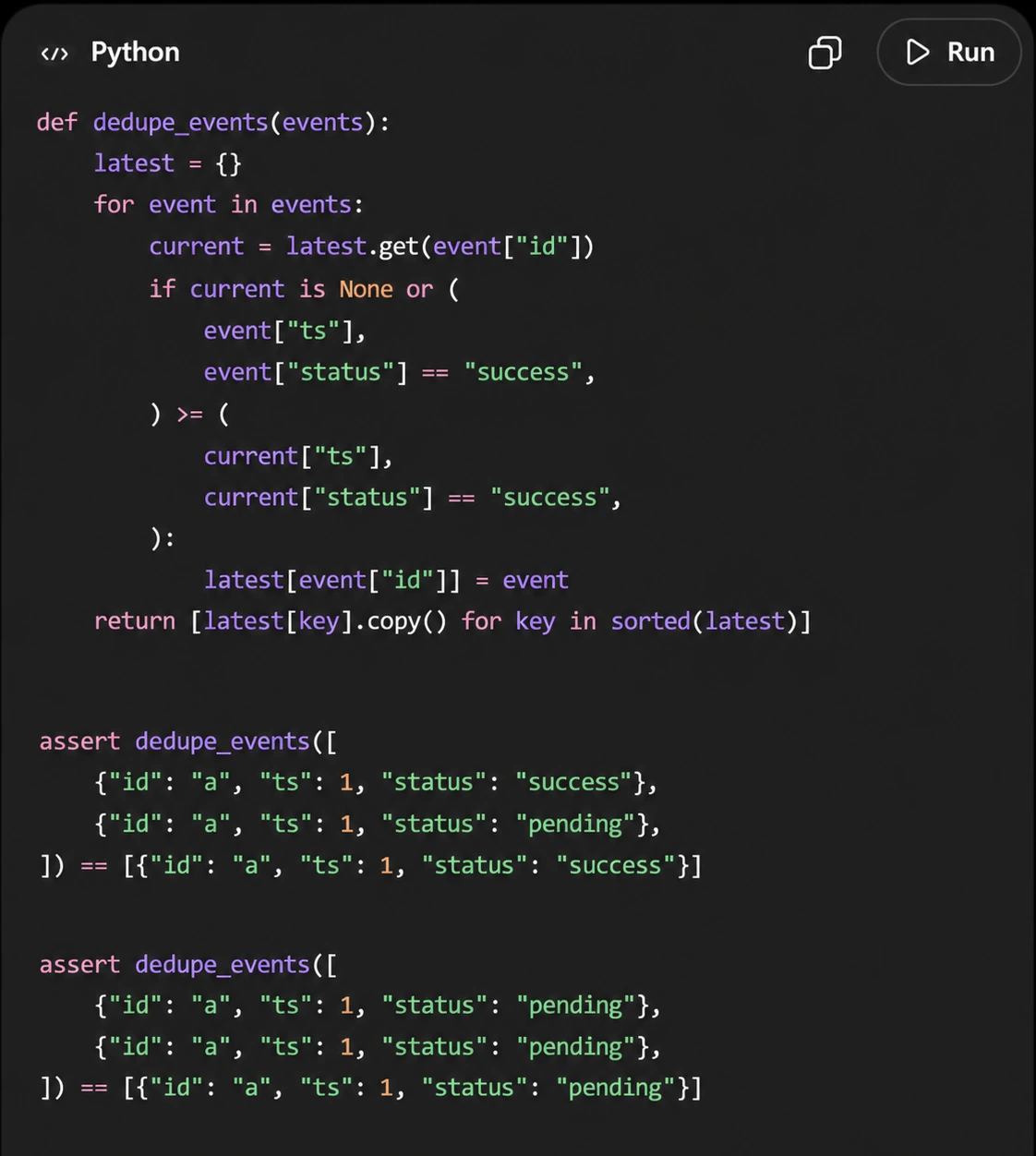
Observation: Both functions passed their own assertions. I also ran them on events with a distinguishing marker, checking the later-input tie, sorted output and that the original dictionaries were untouched; both passed. Luna's tuple comparison is neater. Sol wrote the better second assertion: its two tied events differ, so the expected result demonstrates that the later one won. Luna's second assertion uses two identical dictionaries, so it would pass whichever event was chosen.
Winner: GPT-6 Sol.
Test 3: Can they avoid an unsupported refund promise?
A customer sees a pending card authorization and a settled charge. The task is to give support a useful next step without claiming that a duplicate payment is proven.
Prompt:
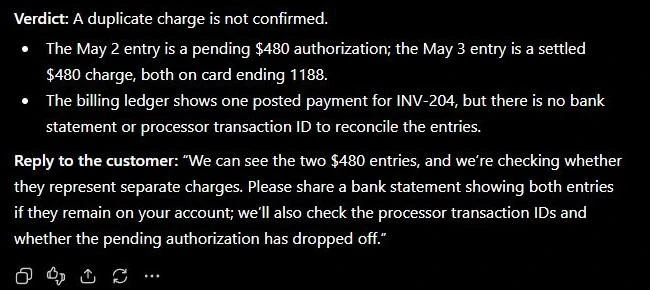
Act as a customer-support analyst. Do not use tools or outside information. Answer in under 130 words with (1) a one-line verdict, (2) two bullets of evidence, and (3) a reply to the customer in two sentences.

A customer says invoice INV-204 was charged twice for \$480. The support notes show a \$480 pending card authorization dated May 2 and a \$480 settled charge dated May 3, both for card ending 1188\. The billing ledger contains one posted payment for INV-204. No bank statement or payment processor transaction IDs have been provided.

Is a duplicate charge confirmed? State what the team should check next. Do not promise a refund or claim the two entries are definitely the same transaction.
GPT-6 Sol response:
GPT-6 Luna response:
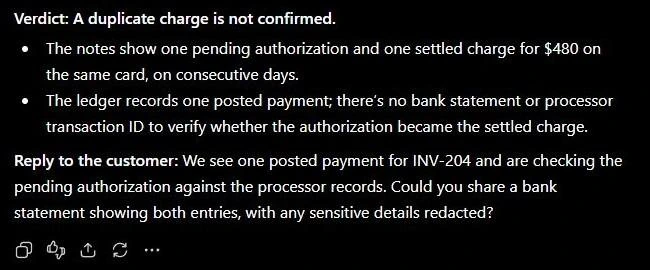
Observation: Both said the duplicate was not confirmed. They correctly treated the ledger's one posted payment as evidence, not final proof, and pointed to processor transaction IDs and a bank statement for reconciliation. Neither promised a refund. Luna also asked the customer to redact sensitive details from the statement.
Winner: GPT-6 Luna.
Test 4: Can they list every valid schedule?
This has one correct schedule. Listing extra rows is a failure even if one row is right.
Prompt:
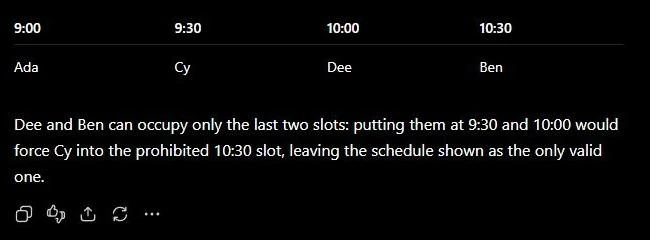
Solve this scheduling problem without tools or outside information. Four 30-minute slots start at 9:00, 9:30, 10:00, and 10:30. Schedule Ada, Ben, Cy, and Dee, one person per slot. Ada must be before Cy. Ben must be immediately after Dee. Cy cannot take 10:30, and Dee cannot take 9:00. List every valid schedule in a compact table and explain in one sentence why the list is complete. Keep the answer under 90 words.
GPT-6 Sol response:
GPT-6 Luna response:
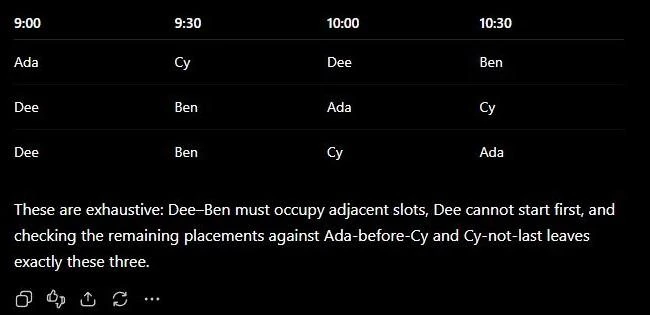
Observation: Sol found the only valid order: Ada at 9:00, Cy at 9:30, Dee at 10:00, Ben at 10:30. Dee–Ben cannot take the first two slots because Dee is barred from 9:00. If they take 9:30 and 10:00, Cy is forced into the forbidden 10:30 slot. Luna included the valid row but added two invalid ones. The second row puts Dee at 9:00 and Cy at 10:30. The third puts Dee at 9:00 and Ada after Cy. Its explanation even says Dee cannot start first and Cy cannot finish, contradicting its table. This is a clear miss on a short constraint-checking task at Medium effort.
Winner: GPT-6 Sol.
GPT-6 Sol and Luna benchmarks
Professional work: Sol's efficiency jump
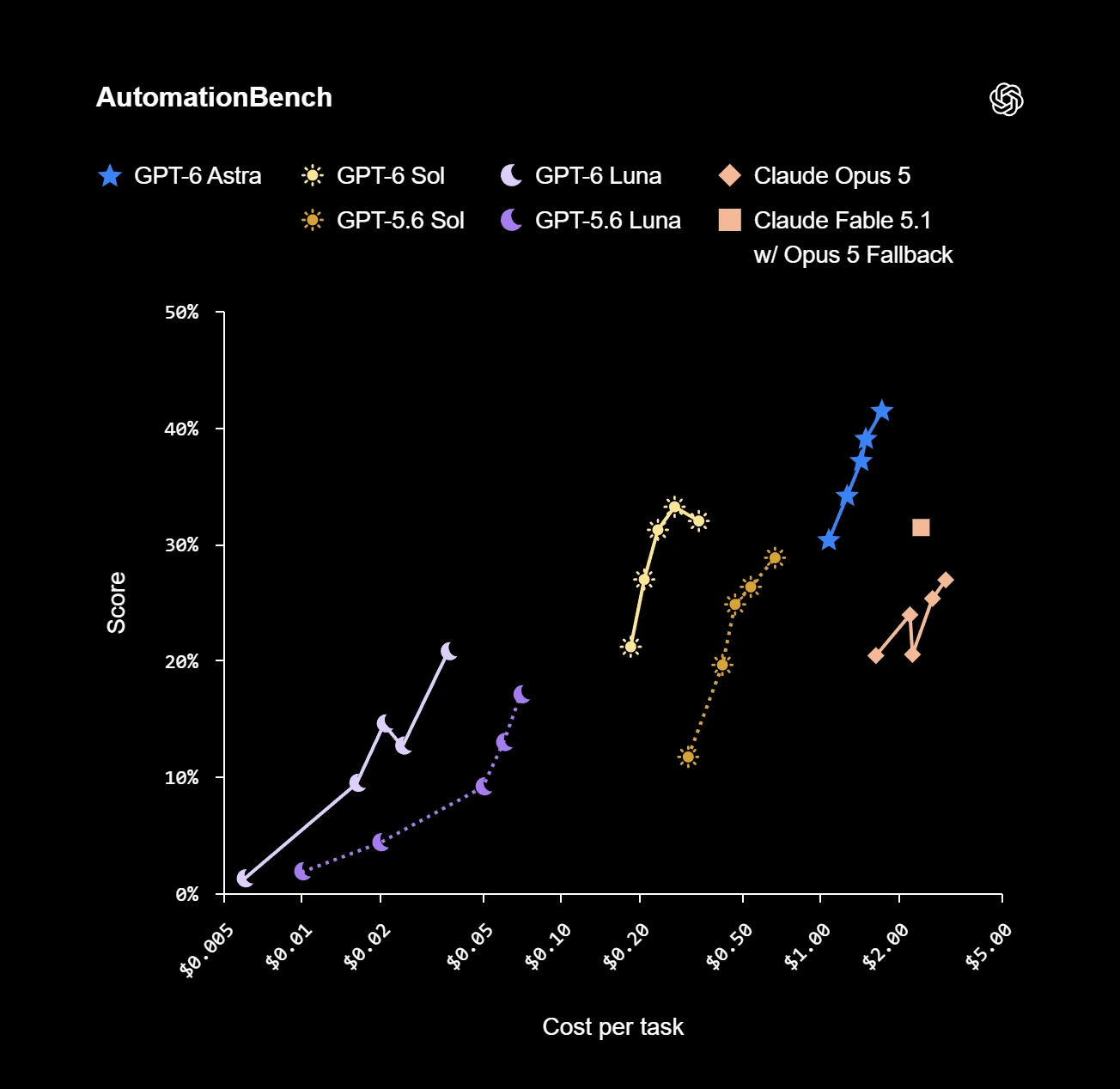
On AutomationBench 1.0.6, which tests workflows across 47 tools, GPT-6 Sol at xhigh effort scores 33.2% at $0.27 per task. In OpenAI's comparison, Claude Opus 5 at max effort scores 26.9% at about 11 times the cost. GPT-6 Luna at high effort improves on GPT-5.6 Luna by 5.4 percentage points while costing 58% less per task. The chart shows why the lower-priced tier matters: its curve moves toward more capable models without following their costs.
Factuality: fewer errors, but read the test setup
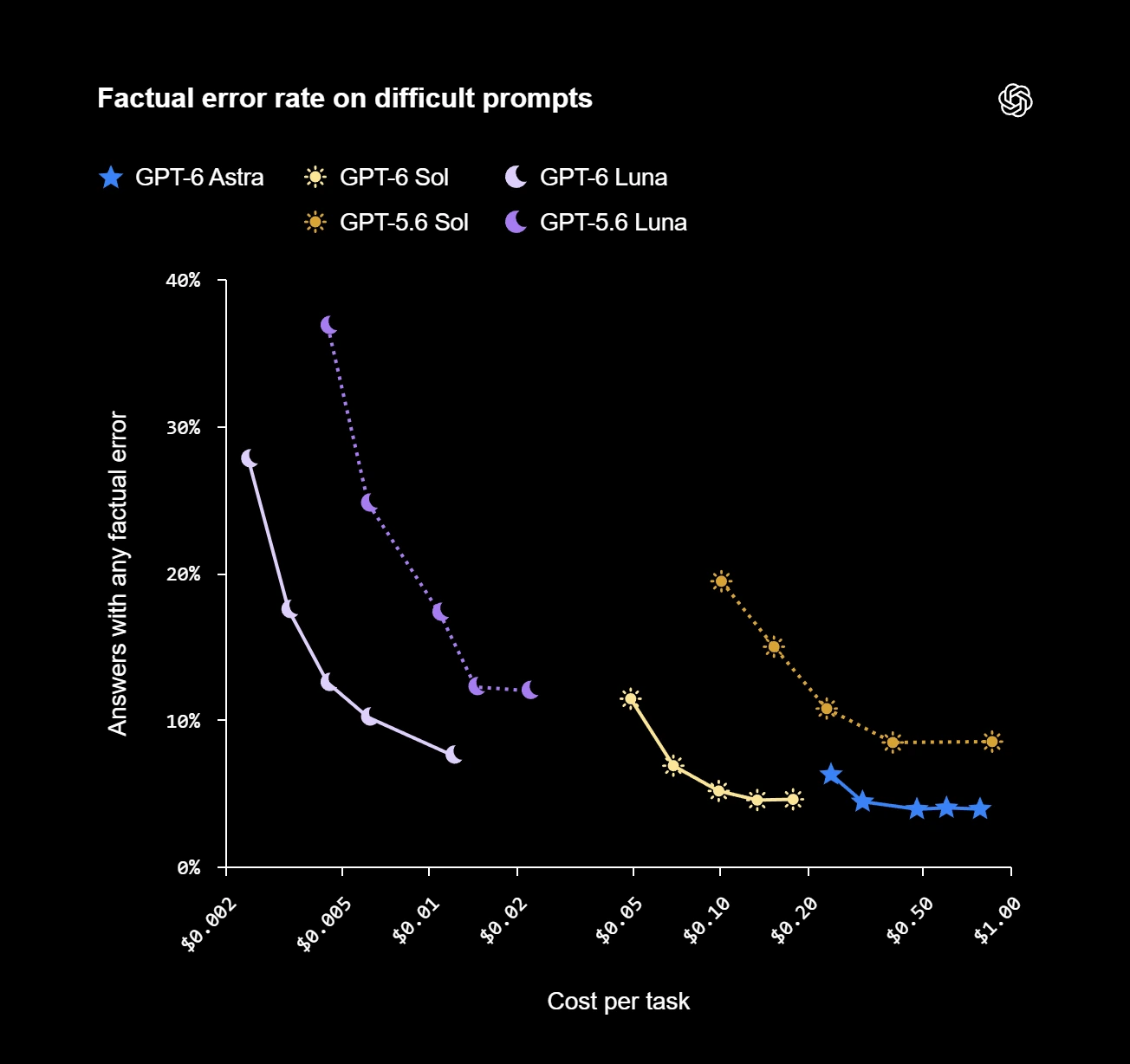
OpenAI says Sol makes about half as many mistakes as GPT-5.6 Sol on its internal factuality evaluation. Higher-effort Luna reaches GPT-5.6 Sol's error rate at roughly one-hundredth of the cost in this test. The evaluation uses conversations where users had flagged an earlier factual error, so its measured error rates are intentionally tougher than typical use. That caveat belongs next to the headline claim.
Coding: Luna is the surprise
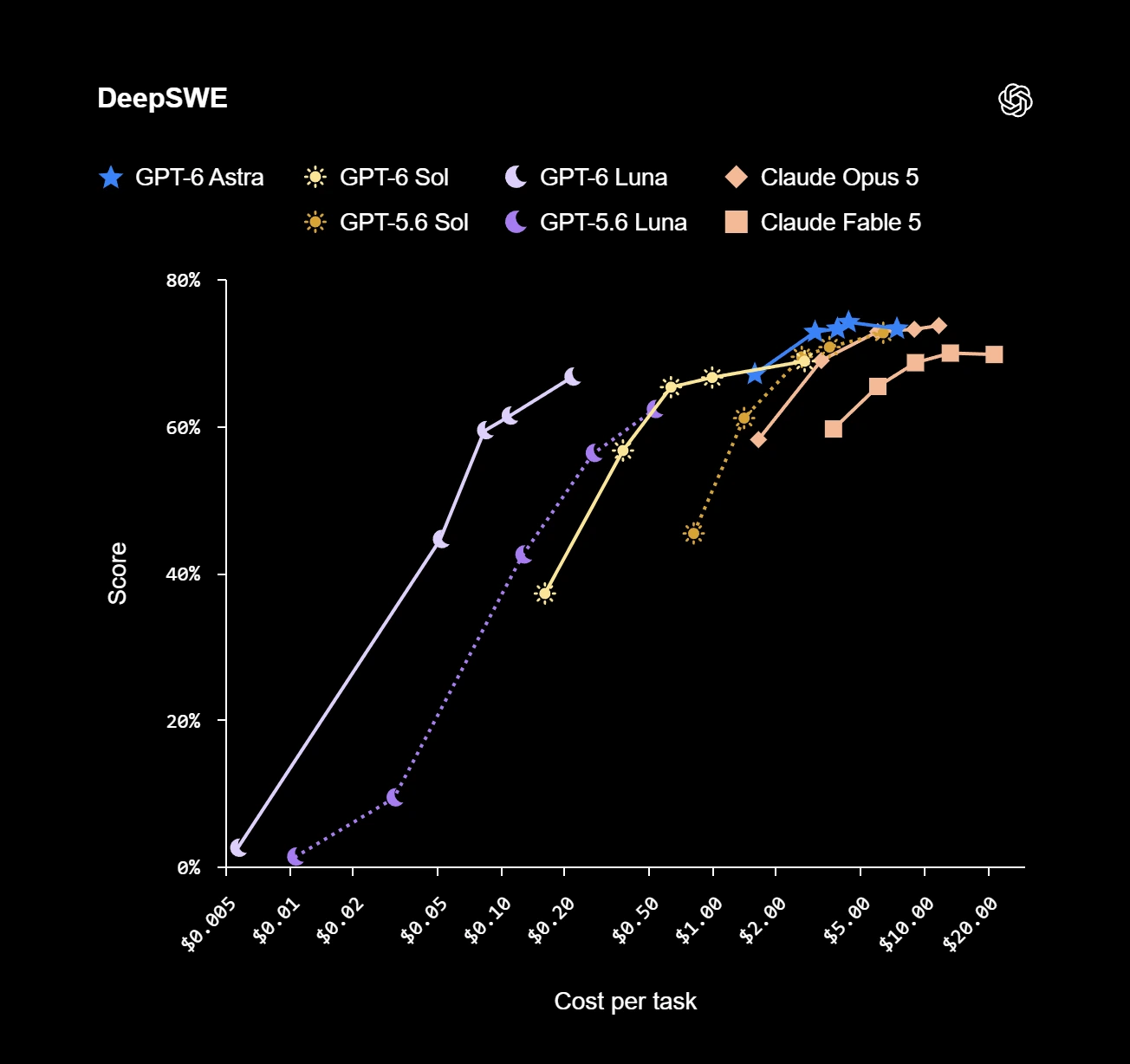
On DeepSWE 1.1, Sol at max effort scores 68.8%. Luna at max effort lands at 66.6%. OpenAI compares Sol with Claude Fable 5's highest reported 69.9% run and estimates Sol costs roughly 80% less per task. Luna's score is comparable to the medium-effort Claude Opus 5 and Fable 5 results in the launch comparison, with much lower estimated task cost. These are OpenAI's evaluation results, not a prediction that Luna will perform equally well in every repository.
Conclusion
In evaluation benchmarks, Sol excels at complex professional and coding tasks, while Luna offers an economical solution for high-volume workflows. While both performed well across basic analytics, coding, and support prompts, Sol proved more accurate on strict constraint-based tasks. Consequently, Luna is best suited for well-defined, scalable tasks with output verification, whereas Sol or Astra are recommended for ambiguous or high-stakes projects.
Frequently Asked Questions
Is GPT-6 Sol better than GPT-6 Luna?
OpenAI positions Sol as the stronger model. The practical question is whether a particular task benefits enough from that extra capability to justify its higher cost.
Which GPT-6 model is cheapest?
Luna, at $0.10 per million input tokens and $0.50 per million output tokens in the API.
Where can I use GPT-6 Sol and Luna?
Both are launching in ChatGPT Work, Codex and the API. Availability depends on plan and rollout timing; Free and Go users can access Luna in the desktop app.