

A pelican on a bicycle. A beautiful web page. Neither request needs a complicated brief, which makes them useful starting points for comparing what Fable 5.2 and Astra actually produce. On these two prompts, both delivered attractive results, but their choices were quite different.
The Fable side uses unchanged outputs from published tests. Astra was given the same task prompts in fresh runs for this comparison. The illustrations are complete browser renders; the web pages are shown through short recordings of real interactions.
TLDR: Fable 5.2 is way more efficient than Astra across all tasks.
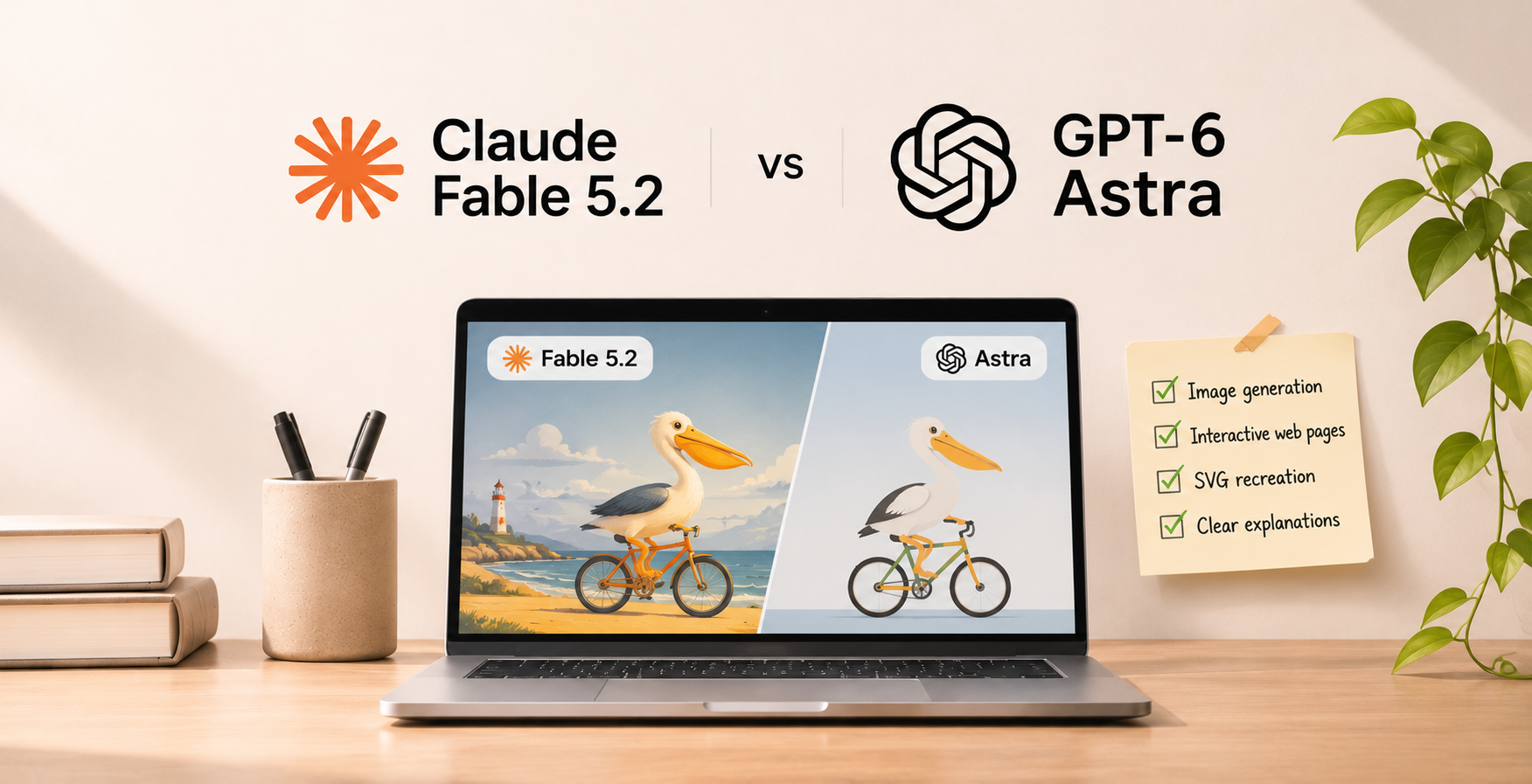
1. Drawing a pelican riding a bicycle
This tiny brief tests whether the model can assemble a recognizable subject and a coherent object from drawing instructions. The wheels, frame, feet, and handlebars all need to belong to the same scene.
Prompt
Generate an SVG of a pelican riding a bicycle
Response
| Claude Fable 5.2 at Xhigh | GPT-6 Astra at Xhigh |
|---|---|
 |  |
The complete SVG outputs rendered without changes to their drawing code.
Observation
Fable builds a whole seaside scene around the bird: a road, water, a small boat, clouds, and a scarf. The bicycle has a conventional frame, and the feet visibly meet the pedals. Its wing ends in a finger-like grip, which is a little odd for a bird, but the overall drawing reads immediately.
Astra chooses a quieter composition with broad outlines and a pale background. The pouch and long bill make the subject recognizable, and the wing reaches the handlebar. Its bicycle frame has extra crossing diagonals, though, making the structure less convincing than the rest of the illustration. The result is still a usable cartoon rather than a broken sketch.
Fable takes this round for scene detail and clearer bicycle construction. Astra’s cleaner style would suit a small illustration, but the frame would benefit from an edit.
2. Creating a beautiful single HTML page
Here the prompt leaves the subject open. The models have to choose a concept, compose the page, and make their own design decisions. Matching the prompt does not mean they will create the same kind of scene.
Prompt
Create the most beautiful and stunning single HTML file you can possibly imagine
Fable 5.2 Response
Astra Response
Observation
Fable has the stronger natural scene; Astra has the clearer web layout. Both loaded without page errors in the browser checks, and the tested interactions responded. These are different answers to an open-ended creative prompt, so a single visual winner would hide a useful distinction.
For a visual experience that fills the screen, I prefer the aurora. For a designed page with readable typography and obvious controls, I would start from Astra’s response. Neither result was edited to improve its appearance or behavior before capture.
3. Recreating a photo as an SVG
This time, the model receives a photograph rather than a description. The job is to preserve the subject, pose, markings, background, and composition while turning the scene into vector shapes.
Prompt
Recreate this photo as an SVG, as close to the original as you can. System instruction: Return a complete, self-contained SVG document.
Response
| Input photo | Fable 5.2 at High | Astra at High |
|---|---|---|
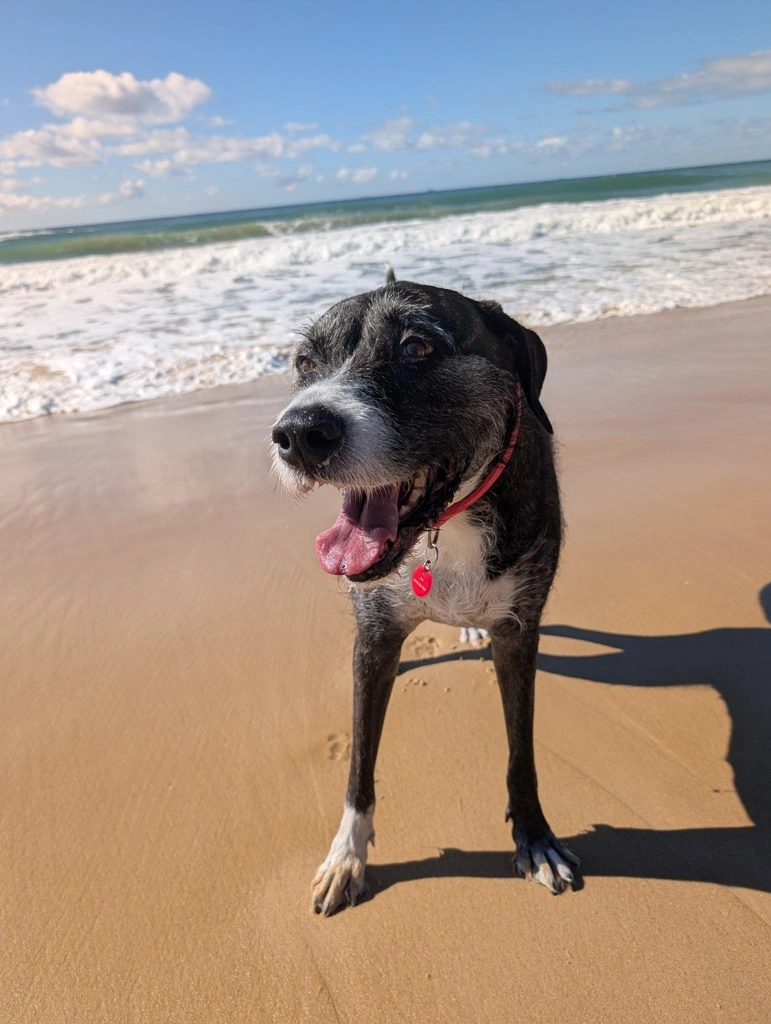 |  | 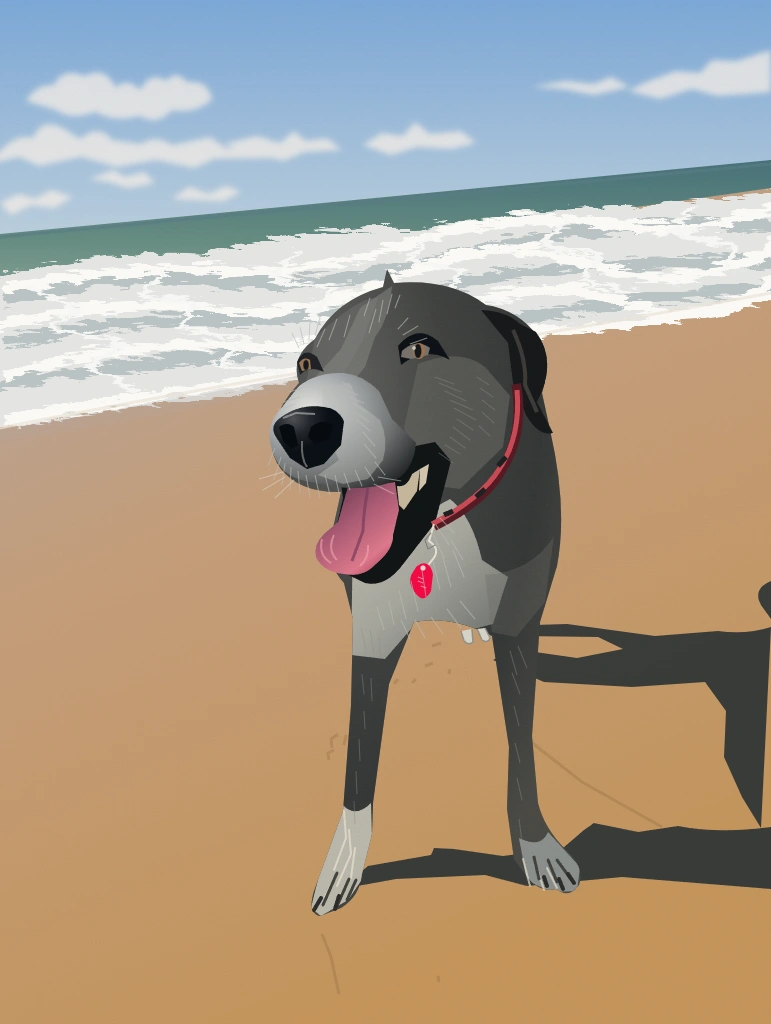 |
The input and both complete SVG responses. All images keep their original proportions.
Observation
Fable retains the dog’s long legs, pale muzzle, white chest, red collar, pink tongue, and the tilted shoreline. Its broad shapes turn the photograph into a much simpler cartoon, with a changed head outline and little coat texture.
Astra keeps more of the visual information: grey muzzle shading, whisker-like strokes, collar detail, and broken white surf. Its angular drawing still changes the face and smooths much of the fur. On this input, Astra gets closer to the reference, particularly around the muzzle and background.
4. Explaining a mortgage within 120 words
A good explanation needs an appropriate reading level as well as correct facts. This task adds a strict word limit, so the model has to choose what a younger reader needs first.
Prompt
Explain how a mortgage works to a 12-year-old, in under 120 words.
Fable 5.2 Response summary
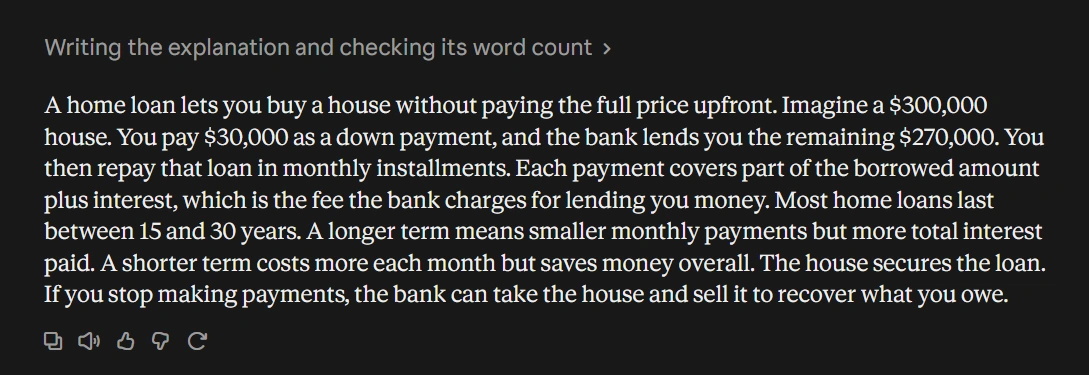
Astra Response
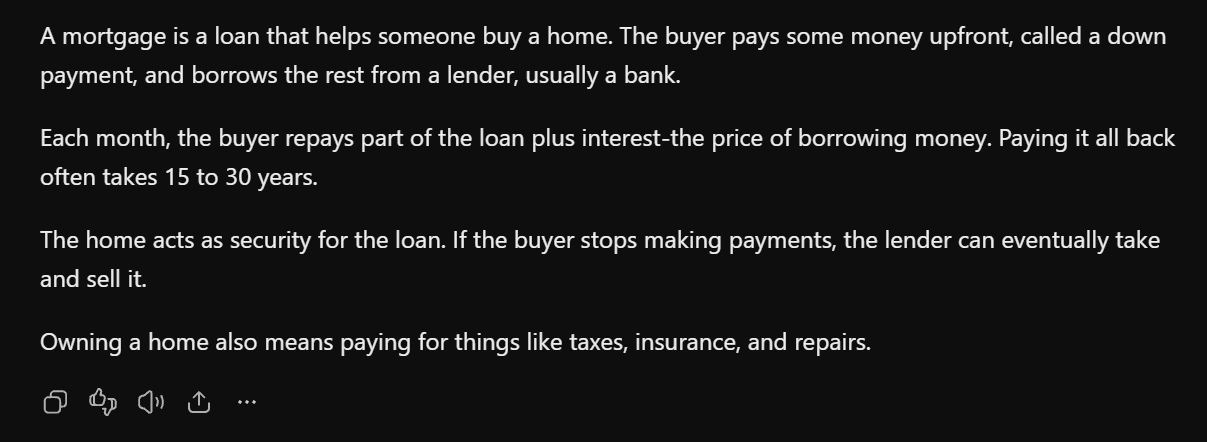
The complete Astra response displayed from the unchanged saved output.
| Check | Fable 5.2 | Astra |
|---|---|---|
| Words counted by whitespace | 118 | 91 |
| Under 120 words | Yes | Yes |
| Concrete house-price example | Yes | No |
| Taxes, insurance, and repairs mentioned | No | Yes |
Observation
Both meet the length requirement and cover borrowing, repayment, interest, and the home securing the loan. Fable’s numerical example makes the down payment easier to picture. Astra uses fewer words and adds ongoing ownership costs. I would use Fable’s approach when a concrete example matters, and Astra’s when the priority is a concise overview.
How the runs were compared
| Task | Published Fable run | Fresh Astra run |
|---|---|---|
| Pelican SVG | Xhigh through llm-anthropic | Xhigh in Codex |
| Single HTML file | OpenRouter catalog default; effort not explicitly set | High in Codex |
| Photo to SVG | High; supplied photo | High; same photo |
| Mortgage explanation | OpenRouter defaults | High in Codex |
Astra received each prompt in a fresh anonymous Codex session without browsing or access to the Fable output. Its first artifact was kept, with no follow-up or repair. Matching effort names do not equalize computation.
The published SVG sweep also includes a Max attempt that exhausted 128,000 thinking tokens without returning an illustration. The comparison therefore uses the completed Xhigh output, with that failure kept in view. Turning the setting up is not automatically an upgrade.
Both files were opened unchanged and their demonstrated controls checked. Astra’s generation time and bill were not measured, so no speed or cost-per-result winner is assigned. The videos are real recordings; Astra’s visible pointer is a synchronized annotation.
Benchmark comparison
The charts below are published evaluations, separate from the four hands-on tasks above. They cover aggregate capability, coding, and robot control. Read the settings and metric labels with the scores.
Aggregate capability
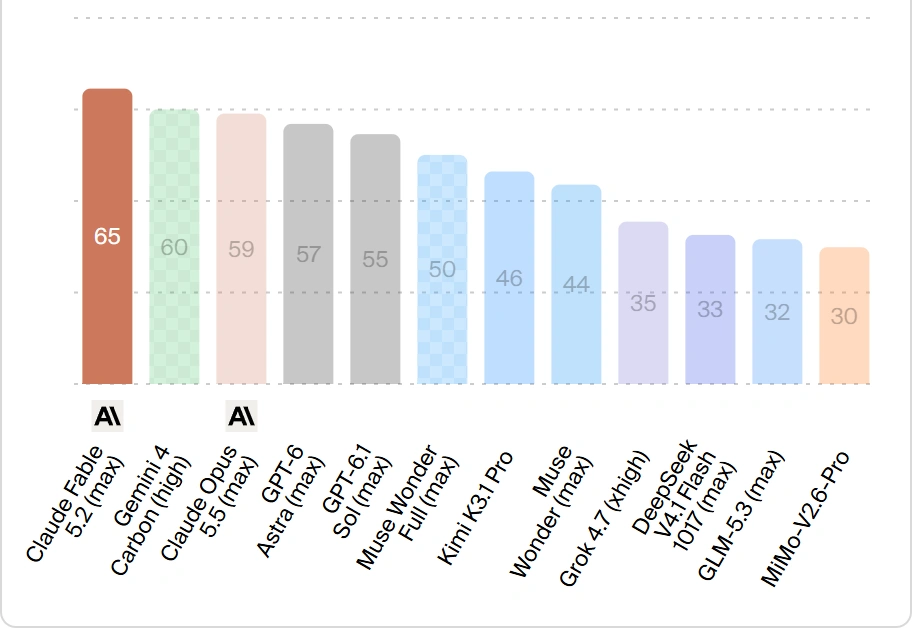
Intelligence Index v5.0.1. Fable is shown at Max with Default Fallback; Astra is shown at Max. Higher is better.
Fable scores 65 against Astra’s 57 on this aggregate of nine evaluations. That is an eight-point index gap, rather than an eight-percent win rate.
Benchmark task cost
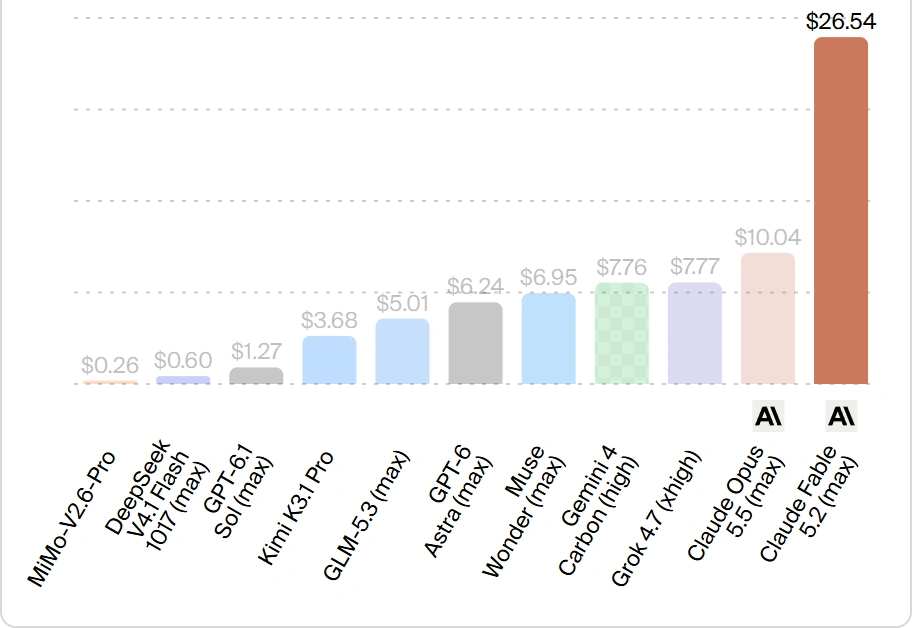
Weighted average cost in US dollars per Intelligence Index task. Fable uses Max with Default Fallback; Astra uses Max. Lower is better.
The associated weighted cost per index task is $26.54 for Fable and $6.24 for Astra, about 4.25 times as much for Fable at these settings. These are benchmark-workload averages, not prices for a normal chat.
Coding accuracy and task cost
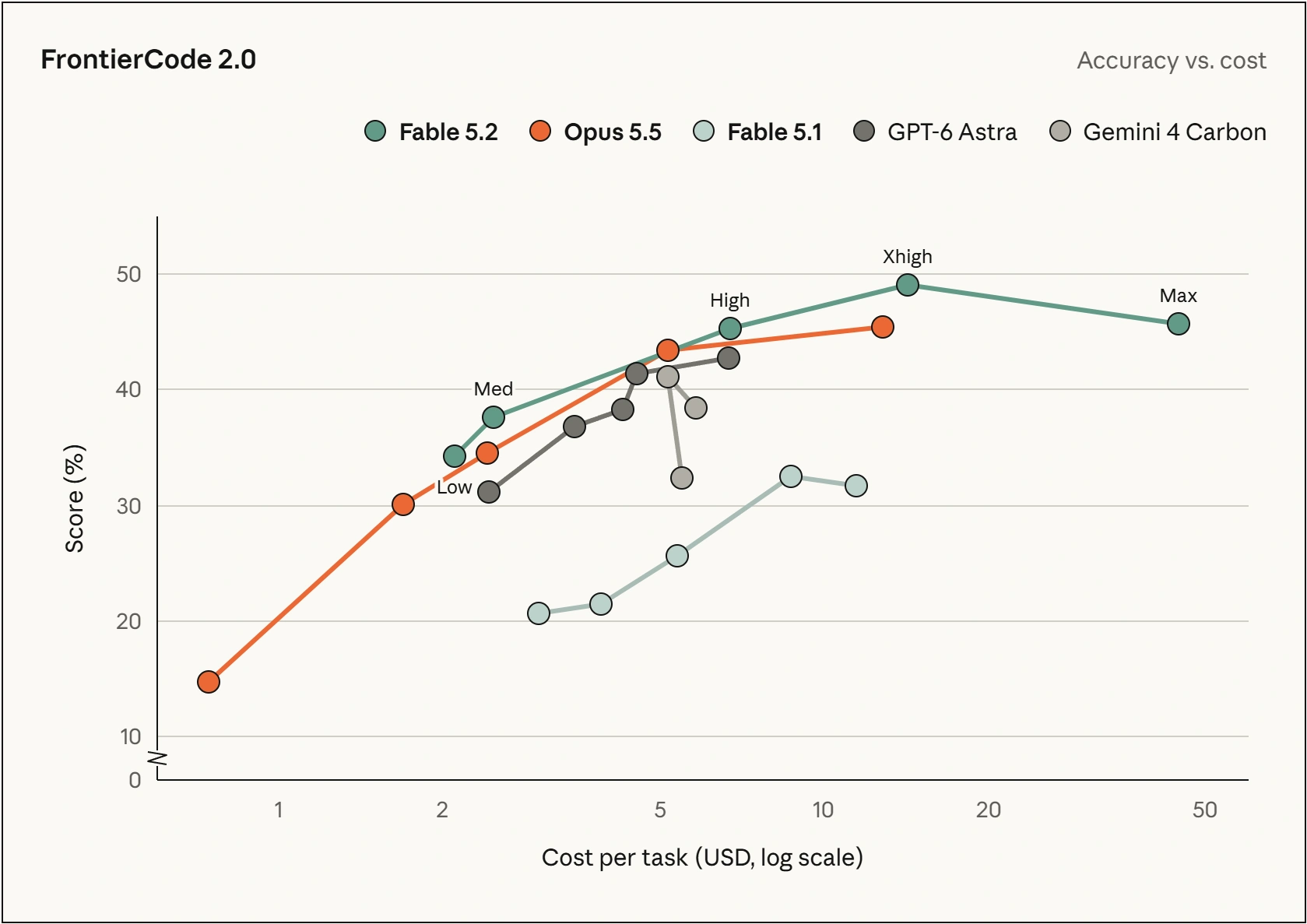
FrontierCode 2.0 scores against task cost at the displayed effort levels. The horizontal cost axis is logarithmic.
Fable reaches 49.1% at Xhigh, compared with Astra’s best plotted score of 42.8%. At High, Fable reaches 45.3% at roughly the same cost as that Astra result. The Fable curve drops at Max while cost rises, showing why the effort setting belongs in the comparison. These are vendor-reported coding results.
Simulated robot control
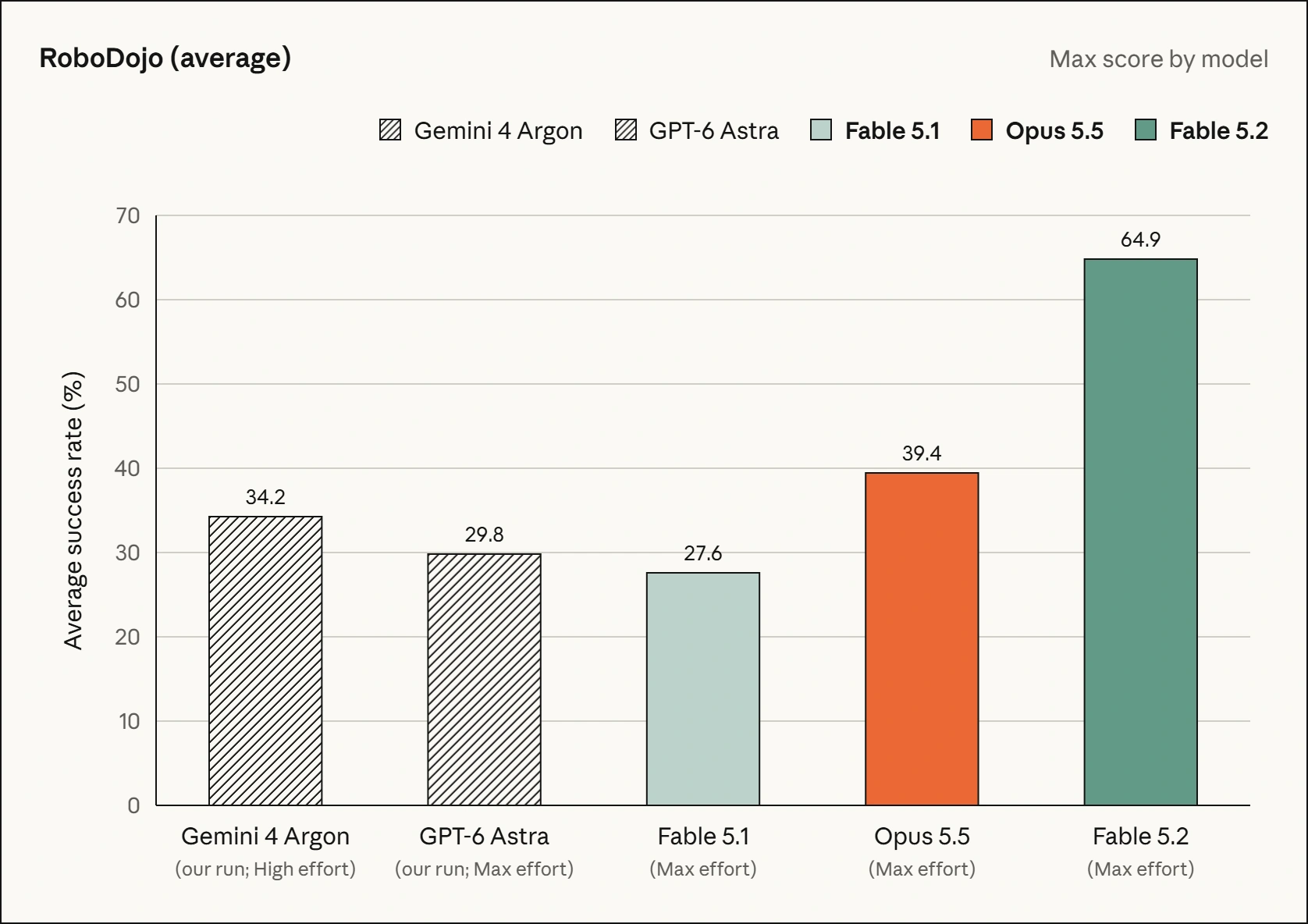
RoboDojo Sim average success rate in the reported internal runs. Fable and Astra both use Max effort.
In the reported internal runs using the same harness, Fable scores 64.9% and Astra 29.8%, a 35.1-percentage-point gap. The task controls a simulated two-arm robot from camera images. It tests a different capability from drawing or writing and does not establish performance on a deployed physical robot.
Price and context window
| Standard API specification | Fable 5.2 | GPT-6 Astra |
|---|---|---|
| Input per million tokens | $8 | $10 |
| Output per million tokens | $40 | $50 |
| Context window | 1 million tokens | 1.05 million tokens |
| Maximum output | 128,000 tokens | 128,000 tokens |
These are published standard API rates in US dollars, checked on November 10, 2026. Fable is 20% cheaper per input and output token at these rates. The total bill also depends on thinking, output length, caching, tools, and retries; attractive output alone tells you little about that bill.
Both have large input capacity, but it matters less for these short creative briefs than for long documents or repositories. If you are comparing that kind of work, this explanation of the context window in an LLM is a useful starting point.
Which model would I choose
Fable wins the illustration round here. For the HTML task, choose according to the deliverable: an immersive scene or a page with explicit navigation. Both produced working results in the tested browser.
The added tests give Astra the closer photo reconstruction and show both models meeting the writing limit. The next useful test is a brief you actually repeat: inspect the full result, check its details, and judge how much editing it needs.
Frequently Asked Questions
Were both models given the same prompts?
Yes. All four task prompts were reused verbatim. The surrounding tools and recorded effort settings differed.
Can these HTML pages run offline?
Both loaded locally without external resources. Graphics support and device performance can affect the result.
Did an image generator make the illustrations?
No. The models wrote SVG and HTML code, which the browser rendered into the displayed results.
Is Fable cheaper than Astra?
Its standard API token rates are lower. These tests did not measure total generation costs for both models.