

Gemini 4 Argon or GPT-6.1 Sol: which model needs less cleanup for everyday work? We put both through five hands-on comparisons covering data analysis, Python debugging, support policies, and planning, checking whether their answers held up beyond a convincing first impression.
We used identical prompts and inputs in the Gemini app and ChatGPT Work at Medium effort. In this article, we compare the responses, share screenshots and independent checks, and explore pricing and benchmarks to help you choose between the two.
TLDR: Sol was the more dependable first pass on these five briefs. Coding and support were ties on their central requirements. Argon's native audio and video input remain useful reasons to try it, but those capabilities were outside this test set.
GPT-6.1 Sol vs Gemini 4 Argon: Technical Comparison
GPT-6.1 Sol is OpenAI's reasoning model for code and professional work, with API name gpt-6.1-sol. It launched on September 29, 2026. Gemini 4 Argon is Google's flagship reasoning model, with API name gemini-4-argon; it was announced September 30 and became broadly available October 13.
| Documented capability | GPT-6.1 Sol | Gemini 4 Argon |
|---|---|---|
| Native input | Text and images | Text, images, audio, video and PDF |
| Generated output | Text | Text |
| Context limit | 1,050,000 tokens | 1,048,576, shared by input, thinking and output |
| Output allowance | 128,000 tokens maximum | 65,536 synchronously; longer with long decode |
| Setting in our tests | Medium | Medium |
Testing Gemini 4 Argon vs GPT-6.1 Sol
We'd be testing the two models across 5 multimodal tests:
Test 1: Find the misleading winner in an onboarding experiment
A raw completion rate can reward the variant that received easier work. This task checks whether the model notices the mix, calculates a fair comparison and avoids treating a nonrandom experiment as causal proof.
Prompt
Analyze this fictional onboarding dataset. Teams were not randomly assigned to variants; short setups are easier than long setups.


variant,setup,attempts,completed
A,short,90,72
A,long,10,4
B,short,20,17
B,long,100,45


Return a table with A and B as columns and exactly these four rows: Overall completion rate, Short-setup completion rate, Long-setup completion rate, Completion rate at a 50/50 short/long mix. Round percentages to two decimals. Compute the overall rate from total completions divided by total attempts; the equal-mix rate uses each variant's within-setup rates.

Then explain the apparent winner reversal and recommend the next product decision in no more than 70 words. Distinguish an observed association from a proven causal effect. Keep the entire answer under 200 words.
GPT-6.1 Sol response
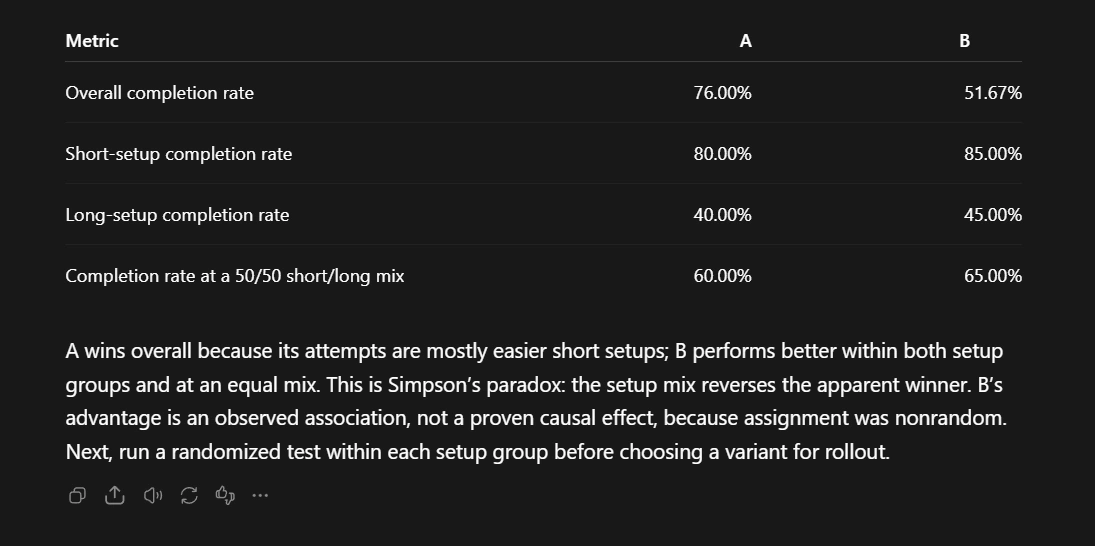
Sol's response gives the correct rates and explains why the aggregate winner is misleading.
Gemini 4 Argon response
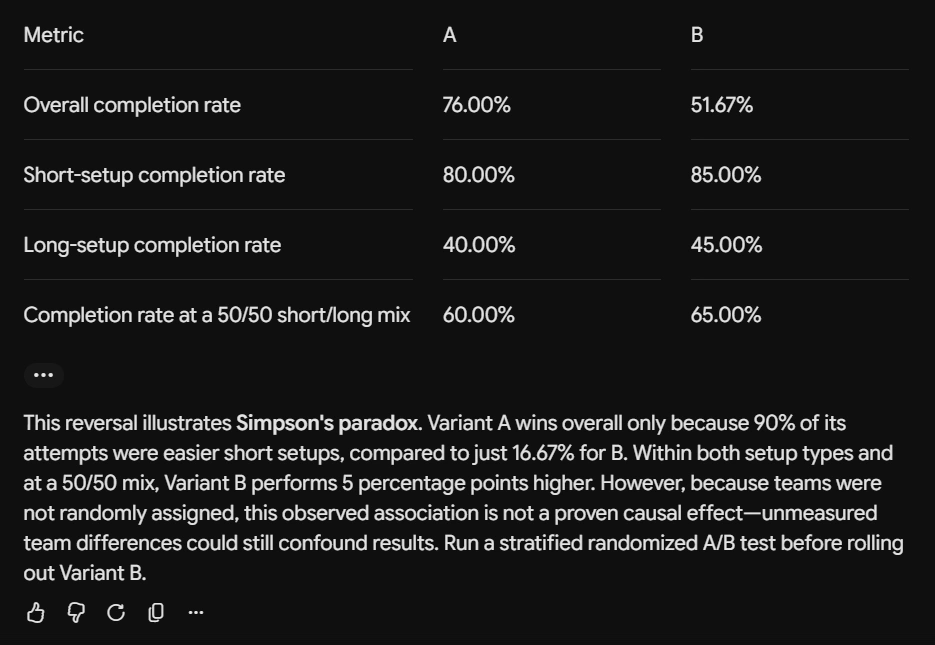
Argon reaches the same numerical result and identifies the nonrandom assignment problem.
Observation. Both returned all four rows correctly: overall completion was 76.00% for A and 51.67% for B; short setups were 80.00% versus 85.00%; long setups were 40.00% versus 45.00%; the equal mix was 60.00% versus 65.00%. A's easier mix explains its aggregate lead. Both recommended a randomized test within setup groups rather than claiming B had proved causal superiority.
The difference was compliance with the brief. Sol's explanation was 64 words; Argon's was 74 against the explicit 70-word cap. Both full responses were under 200 words. Argon's extra detail was relevant, but it still needed trimming.
Verdict: Tie on analysis; Sol wins on following the requested length.
Test 2: Repair a UTF-8 batching function
A character count is not a UTF-8 byte count. This repair also has to handle newline separators, exact fits, empty strings, one-pass generators and validation before input consumption.
Prompt
Fix this Python 3 function. Return the corrected function in one code block, followed by one sentence explaining the main errors. Keep the answer under 300 words.


def pack_lines(lines, limit):
   groups, group, used = [], [], 0
   for line in lines:
       if used + len(line) >= limit:
           groups.append(group)
           group = []
       group.append(line)
       used += len(line)
   return groups

Contract: lines is a finite iterable of strings, possibly a generator. Return list[list[str]], preserving every string exactly once and in order, without mutating the caller's data. A group's size is the UTF-8 byte length of '\n'.join(group), including one separator byte between consecutive strings. Greedily put the largest possible consecutive prefix in each group. Equality with the limit is allowed. Never return an empty group; empty strings are valid records. Empty input returns []. If a single string exceeds limit, raise ValueError. limit must be a positive integer; reject bool, non-integers, and values <= 0 with ValueError before consuming lines. Use only the standard library.
GPT-6.1 Sol response
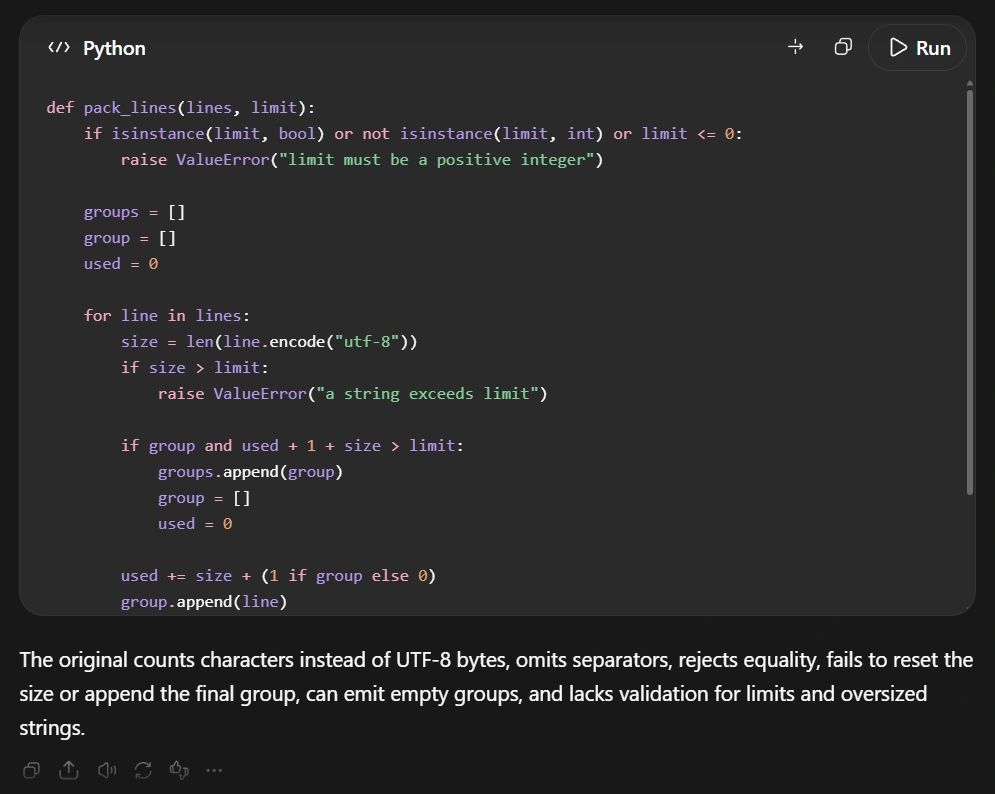
Excerpt from Sol's fix: limit validation, UTF-8 sizing, separator accounting and group rollover.
Gemini 4 Argon response
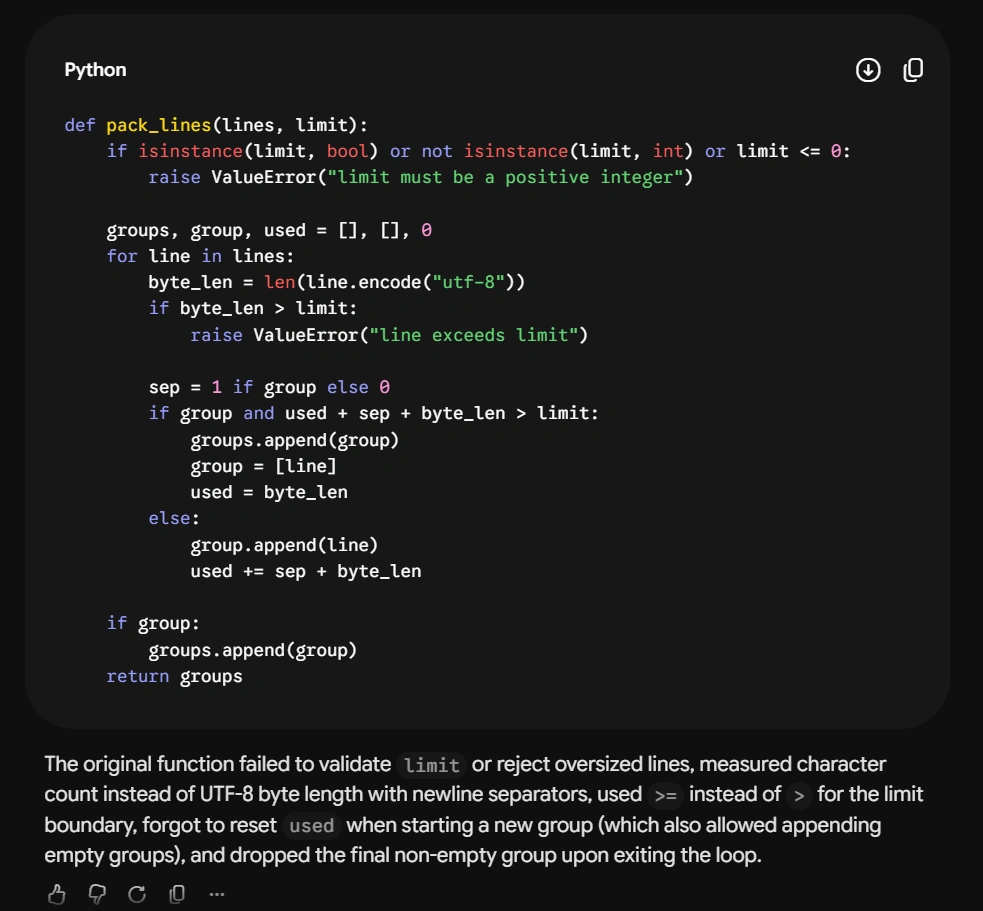
Excerpt from Argon's fix: byte-length checks, overflow handling and the final-group flush.
Observation. Both functions passed all 389 independent checks. The checker enumerated possible contiguous partitions for short inputs instead of copying either model's greedy implementation. It covered lists and generators, multibyte characters, embedded newlines, empty strings, exact fits, oversized records and invalid limits. Both preserved the input.
Sol resets the group and byte counter, then appends the current line. Argon starts the new group immediately with that line and its byte length. Those are different implementations of the same contract, and both worked. Neither dropped the final group. Both supplied the requested one-sentence diagnosis.
Verdict: Tie. The 389 checks validate this one coding task; they are not 389 separate hands-on tests or proof of general coding superiority.
Test 3: Create a 10-second model hype video
A hype video needs movement, pacing and a memorable finish. This task checks whether each model can use its available tools to deliver a playable video and respond to creative feedback when the first attempt falls short.
Prompt
Generate a video introduction [model_name] that isn’t over 15 seconds long, and appears as if made by a professional motion designer. Make it in orange/yellow color palette.
GPT-6.1 Sol Ultra response
Gemini 4 Argon response
Sol delivered a playable 10-second video, but the first version felt too static. After the follow-up, it rebuilt the sequence with staggered letter animations, oversized zooms, a rotating tunnel, whip transitions and music timed to the cuts. The revised MP4 was 1080p at 60 fps. Sol responded well to the feedback, although the stronger result required a second prompt.
Test 4: Write a safe incident update from conflicting notes
The newest message is not automatically the authoritative one. We gave the models a sales instruction that conflicted with Operations and Engineering, plus a customer asking for a guarantee the evidence could not support.
Prompt
You are support at the fictional company Northstar Export. Draft a customer email of at most 110 words, then an internal note with exactly two action bullets. Do not invent facts, links, or recovery times.

Customer: "My CSV export job J-418 started today at 09:45. Is my data gone? Should I run it again? I need you to guarantee a correct export by noon."

Today's verified notes (all times in the same timezone):
- Operations, 10:10: Exports started between 09:20 and 10:00 may be missing rows. Stored source records remain intact. Preserve existing jobs; do not rerun them until Operations approves recovery.
- Sales, 10:20: Tell customers it is resolved and they should rerun now.
- Engineering, 10:25: The fix is still deploying. Resolution is unconfirmed, and there is no approved recovery ETA. Engineering owns deployment confirmation; Operations owns affected-job verification and permission to rerun.

Engineering and Operations are authoritative for technical status and recovery guidance. Address all three customer questions, explain the safe next step, and separate what is confirmed from what still needs verification. Keep internal disagreement and staff notes out of the customer email. The internal bullets must name the responsible team and its specific next action.
GPT-6.1 Sol response
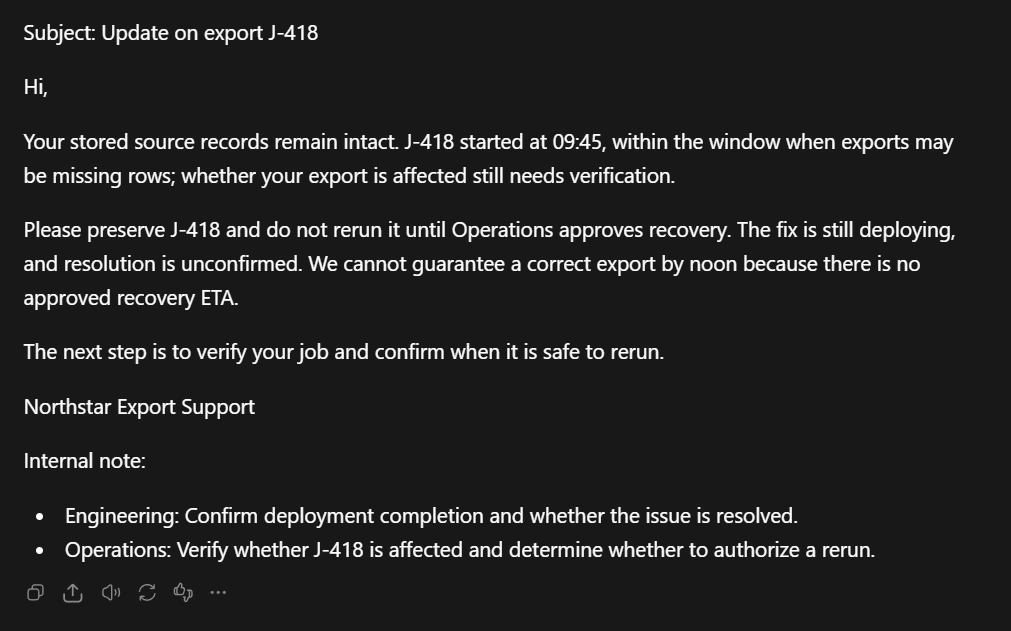
Sol's reply body and internal actions preserve the job and keep reruns subject to Operations approval.
Gemini 4 Argon response
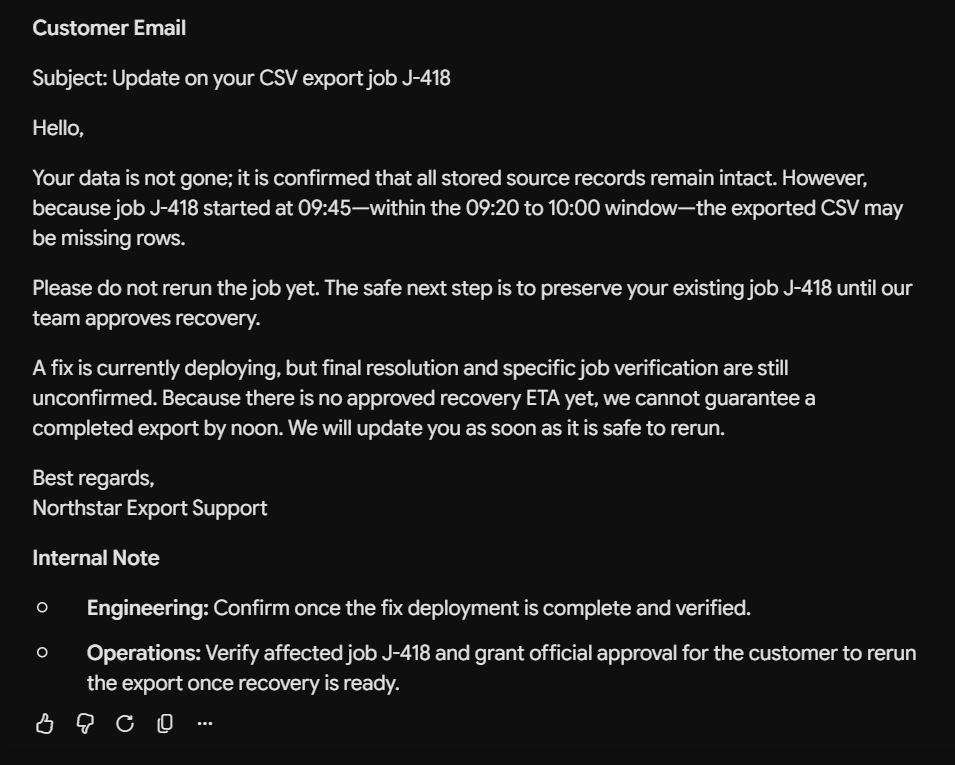
Argon also distinguishes intact source records from a potentially incomplete export.
Observation. Both said the stored source data was intact while J-418 might be missing rows. Both kept the fix in a deploying, unconfirmed state, declined the noon guarantee and advised preserving the job until recovery approval. Neither repeated the sales instruction or exposed the internal disagreement to the customer.
Each internal note had exactly two bullets: Engineering to confirm deployment, Operations to verify J-418 and authorize recovery. Sol's email body was 79 words and Argon's 99, both within 110. Including subject, greeting and signature gives 87 and 112 words respectively; Argon needs a small trim if the limit covers the complete email rather than its body.
Verdict: Tie on the support boundary; Sol is more concise. Both drafts handled the uncertainty without pretending recovery had happened.
Test 5: Find the shortest valid workshop schedule
This is a resource-allocation problem, not just a dependency chain. Two benches can work simultaneously, but one technician cannot attend B and E at the same time. We asked for an optimum and a proof.
Prompt
Schedule these six fictional workshop jobs starting at hour 0. Jobs start at integer hours, run without interruption, and occupy their listed bench for the whole duration. Red and Blue can run simultaneously. Technician Quinn must attend B and E for their whole duration, so B and E cannot overlap. Other staffing is unrestricted. A dependency means the predecessor must finish before the next job starts.

Job | Duration (hours) | Bench | Must follow
A | 1 | Red | none
B | 2 | Red | A
C | 2 | Blue | none
D | 2 | Blue | B and C
E | 1 | Blue | C
F | 1 | Red | D and E

Find the earliest possible finish time for all jobs. Return a table with one row per job showing start, end, and bench, followed by a short argument that a faster schedule is impossible. Do not change durations, resources, dependencies, or staffing constraints. Keep the entire answer under 220 words.
GPT-6.1 Sol response
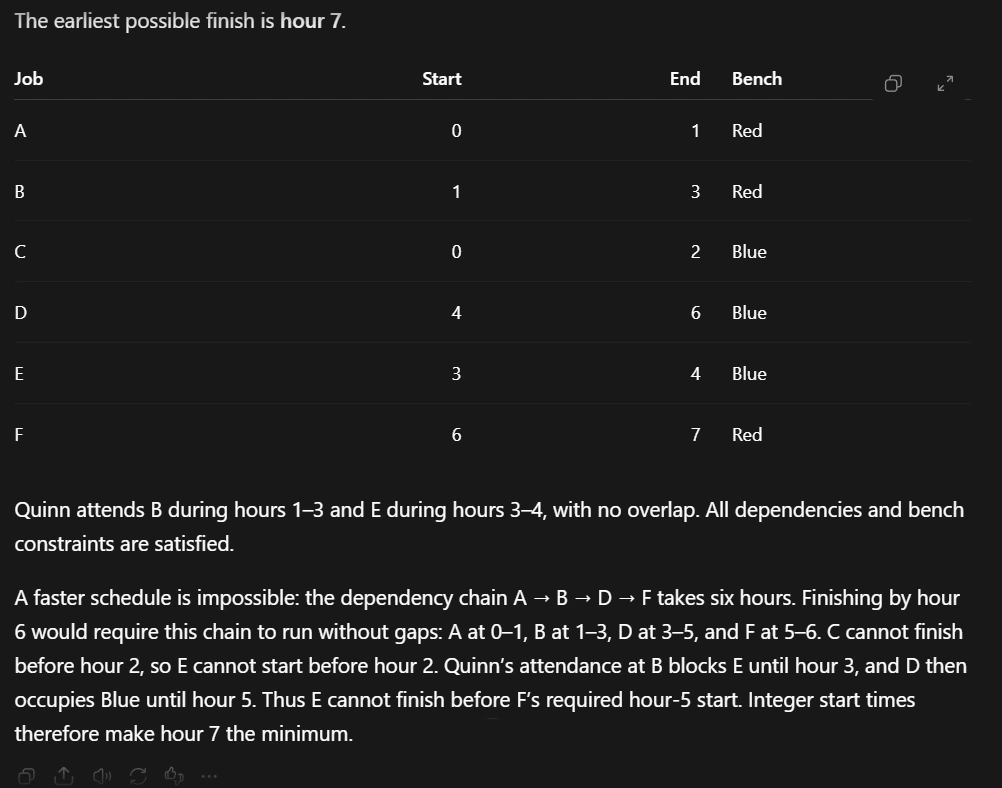
Sol's complete schedule finishes at hour seven and starts D after B has finished.
Gemini 4 Argon response
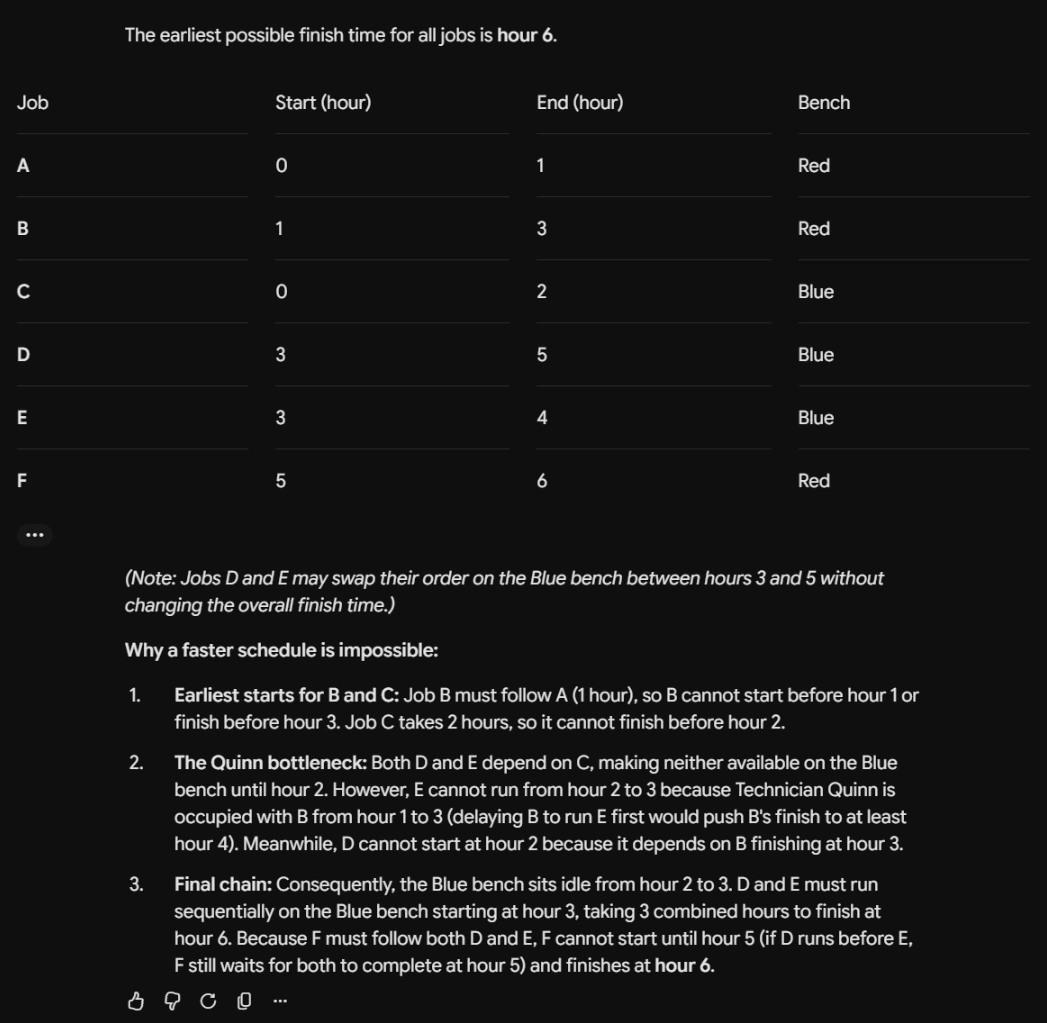
Argon's proof heading claims six hours, while the same response concludes that seven hours is the earliest valid finish.
Observation. Sol gave one valid seven-hour schedule: A 0-1, B 1-3, C 0-2, E 3-4, D 4-6 and F 6-7. It respected both benches, every dependency and Quinn's attendance. Independent enumeration confirmed seven as the optimum, and the schedule passed all 21 resource and dependency checks.
Its proof was useful. The A-B-D-F chain takes six hours, but a gap-free six-hour chain leaves nowhere to put E after C without conflicting with Quinn or the Blue bench. With integer starts, seven is therefore the earliest finish.
Argon's response opened with hour six, printed an incomplete first table, then produced a valid seven-hour table. It subsequently offered another 'optimal' six-hour table where B and D both ran from 3 to 5. That violates D's dependency on B: D starts two hours before B finishes.
Argon's final two-case proof correctly concluded seven hours. That correct conclusion matters, but it does not remove the contradictory claims and invalid table still in the answer. The response also ran to 314 words against 220; Sol's was 147 using the same count without Markdown table delimiters.
Verdict: Sol wins on a usable first pass. Argon eventually found the right reasoning, but its delivered answer required reconciliation and cleanup.
What the hands-on results actually show
| Task | GPT-6.1 Sol Medium | Gemini 4 Argon Medium |
|---|---|---|
| Experiment analysis | Correct; 64-word explanation | Correct; 74 words against 70 |
| Python repair | 389/389 checks passed | 389/389 checks passed |
| Incident reply | Correct boundaries; 79-word body | Correct boundaries; 99-word body |
| Workshop planning | One valid optimum and proof | Correct final proof; conflicting claims and invalid later table |
Sol needed less cleanup on these four prompts. The two clear differences were the analysis length limit and the internally consistent schedule. The code and policy results were much closer. This is a small editorial comparison at Medium, not a leaderboard: we did not test repository-scale agents, audio, video or scientific research.
The same token price does not mean the same bill
Argon's introductory standard API rates match Sol's: $2 per million input tokens and $10 per million output tokens. The introductory window ends on November 30, 2026. From December 1, Argon's rates become $4 and $20.
| Per 1M tokens, USD | Sol Standard* | Argon through Nov 30 | Argon from Dec 1 |
|---|---|---|---|
| Input | $2.00 | $2.00 | $4.00 |
| Output | $10.00 | $10.00 | $20.00 |
| Cached input | $0.10 | $0.10 | $0.20 |
*Sol's base rates apply to prompts with up to 272,000 input tokens. Above that threshold, input and cache rates double and output rates increase by 50% for the full request. Budget a large-document workflow against that band.
For an illustrative uncached request using 100,000 input tokens and 20,000 billable output tokens, both cost $0.40 at today's standard rates. The same token counts cost $0.80 on Argon from December 1. This calculation excludes tools, retries and other processing premiums.
Actual token consumption changes the comparison. The benchmark's weighted cost per task is $1.99 for Argon versus $0.72 for Sol, about 2.8 times higher at the tested settings. That is a result for that suite, not a forecast for your app. Reasoning tokens, cache hits and answer length all affect the total.
Argon includes thinking tokens in its output bill. Its caching is implicit only; you cannot create an explicit cached-content object. Sol supports cache writes, charged separately at $2.50 per million tokens in the base band. A repeated project brief can therefore behave differently in each system.
How the published benchmarks compare
The independent Intelligence Index v4.3.2 comparison tests Argon at High and Sol at Max. Those settings differ from our Medium app runs, and the index is primarily an English, text-based suite. Keep its results separate from the four responses above.
| Independent measure | Sol 6.1 Max | Argon High |
|---|---|---|
| Intelligence Index | 52 | 53 |
| AutomationBench-AA | 65% | 78% |
| Terminal-Bench 4.0 | 56% | 57% |
| GDP.pdf | 31% | 22% |
| AA-LCR v1.1 | 83% | 80% |
Argon leads the automation row; Sol leads document reasoning and long-context reasoning. Terminal coding is close. Google's own launch chart uses GPT-6 Astra, so its GPT scores must not be relabeled as Sol results. Google's AutomationBench also differs from AutomationBench-AA.
Which model should you use?
- Start with Sol for code and document tasks in an existing OpenAI workflow. Our four runs gave it the cleaner overall first pass, and both its base API prices and measured benchmark task cost make it a sensible baseline. That does not guarantee the same advantage on your prompts.
- Try Argon when native audio or video input matters, or when its published automation advantage matches your work. Its model specification supports those input types directly; Sol accepts text and images. Argon's long decode can also extend reasoning beyond the default output allowance, within its shared context budget. Those are documented capabilities, not wins measured in this test set.
For access, Sol 6.1 is available in the API, ChatGPT Work and Codex where enabled; it is not a selectable model in ordinary ChatGPT Chat. Argon is available in the paid Gemini API and AI Studio. Google's consumer announcement names Pro and Ultra access in Gemini, while the API pricing page separately excludes Free-tier and Google AI Pro access. Check the surface and billing route you intend to use.
Give both models a job with a known success condition, then inspect the entire answer. Our schedule test is the useful reminder: a correct final sentence can sit beneath an invalid table. The model you choose should leave you with less work to resolve, not merely a convincing last line.
Frequently Asked Questions
Which model performed better in these four tests?
Sol needed less cleanup. Coding and support tied; Argon retained schedule contradictions despite reaching the correct final conclusion.
Did you test Argon in the Gemini app?
Yes. We used Argon Medium in Gemini and Sol Medium in ChatGPT Work, with fresh chats and matched prompts.
Do their API prices match?
Base standard rates match through November 30, 2026. Argon doubles them December 1; token consumption and tools affect actual cost.
Do four tests prove a universal winner?
No. They support bounded observations on these tasks and settings. Validate both models against your own workload.