

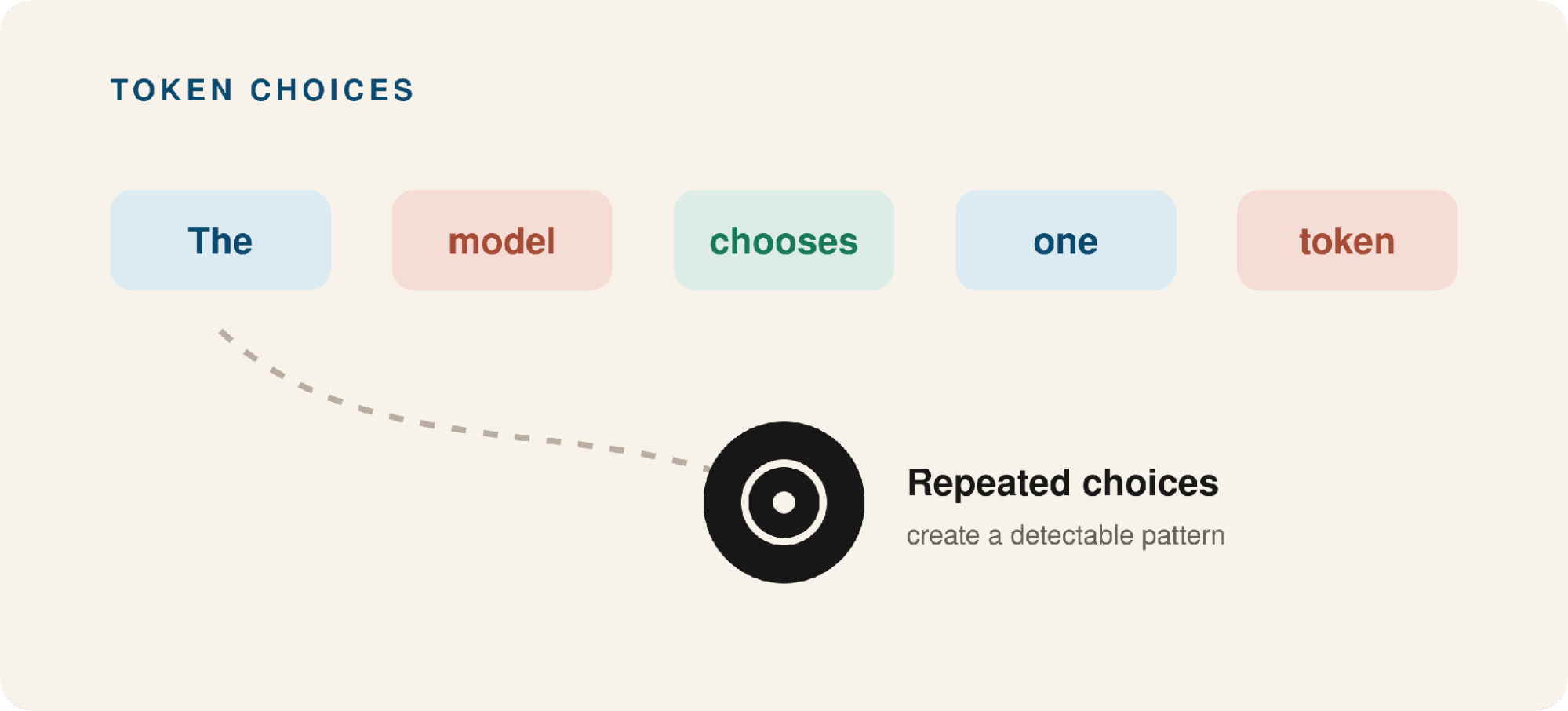
AI-generated text looks ordinary, but the way a model chooses each word has a statistical pattern behind. That pattern is called a text watermark.
It is not a hidden character, writing style, or file label. It is created during generation and checked using a matching detector. This article explains two separate methods called green-list watermarking and SynthID-Text, before covering Claude’s implementation, detection, and what happens when the text is edited.
What Is an AI Text Watermark?
A language model chooses one token at a time. When several options fit, a watermark subtly changes which one wins. Repeated across a long passage, those choices form a measurable pattern.
The finished text looks normal. A matching detector checks the token sequence using the watermark's method and key.
- Not hidden characters. Nothing invisible is inserted.
- Not formatting. Fonts and file types do not change the words.
- Not C2PA. That is separate file metadata.
- Not a style guess. The detector checks a keyed signal.
The next two sections cover separate watermarking methods. Green-list watermarking does not lead into SynthID-Text.
1. Green-List Watermarking
A green-list system splits valid next tokens into two temporary groups. Green tokens receive a small probability boost. Red tokens remain available. Read the original paper.
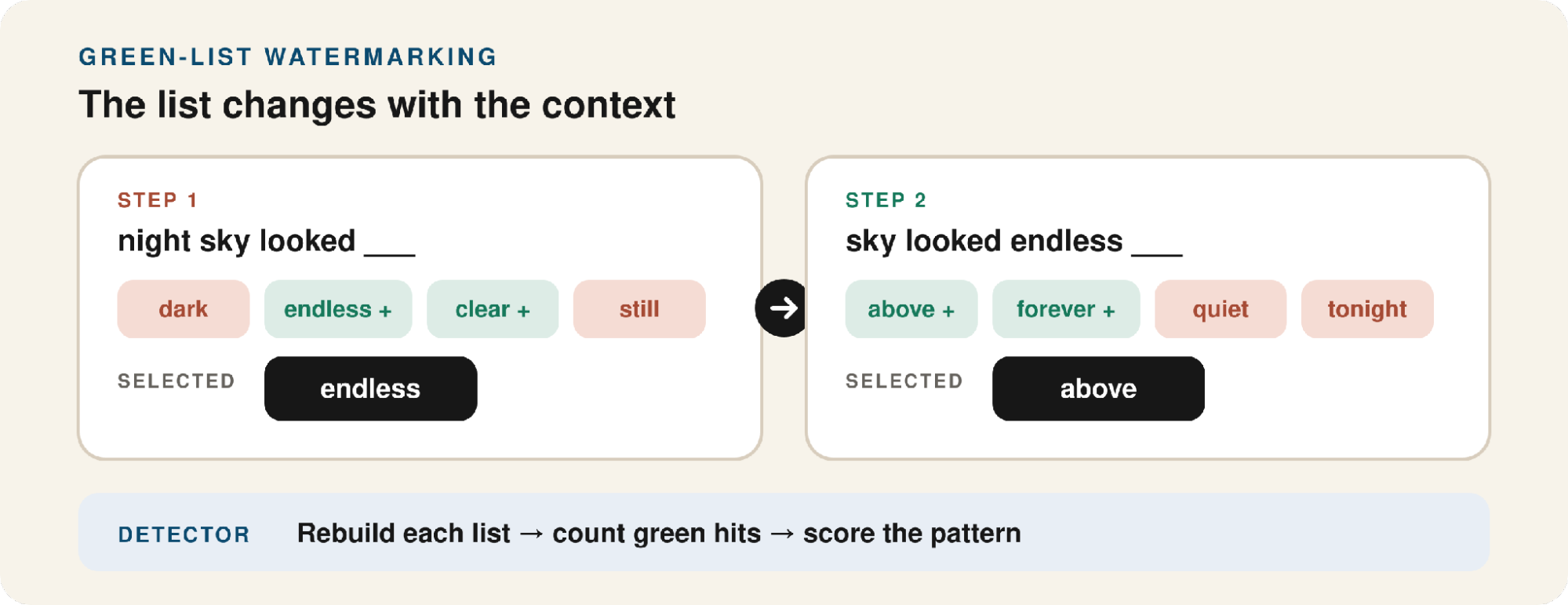
For each position, the recent context and a secret key create a fresh green list. Suppose the model can continue 'The night sky looked' with dark, endless or clear. If endless is green at that position, it receives a small score bonus.
The nudge is soft. Dark can still win if it is clearly the better choice. Once a token is selected, the context changes and the system creates a new split. The same word can be green once and red later.
The detector repeats this process over the finished passage. It rebuilds each list, checks where the observed token landed and counts the green hits. A sustained excess produces the signal; one green token proves nothing.
If you’re interested in learning more about Green-list watermarking, refer to the plain-English walkthrough.
2. SynthID-Text
SynthID-Text leaves a keyed pattern through a different sampling rule. It does not use the green-list process. Instead, it draws candidates from the model's normal next-token probabilities and lets them compete.
- Sample candidates. Likely words still appear more often because the draw follows the model's normal odds.
- Score them. The recent context and a private key generate pseudorandom scores.
- Run the tournament. Candidates compete in pairs; a winner advances from each round.
- Choose the winner. The final survivor becomes the next token.
In the simplified example below, dark starts as the most likely word, but bright is also sampled and wins the keyed rounds. The key does not permanently favour bright. The scores change with the context at every step.
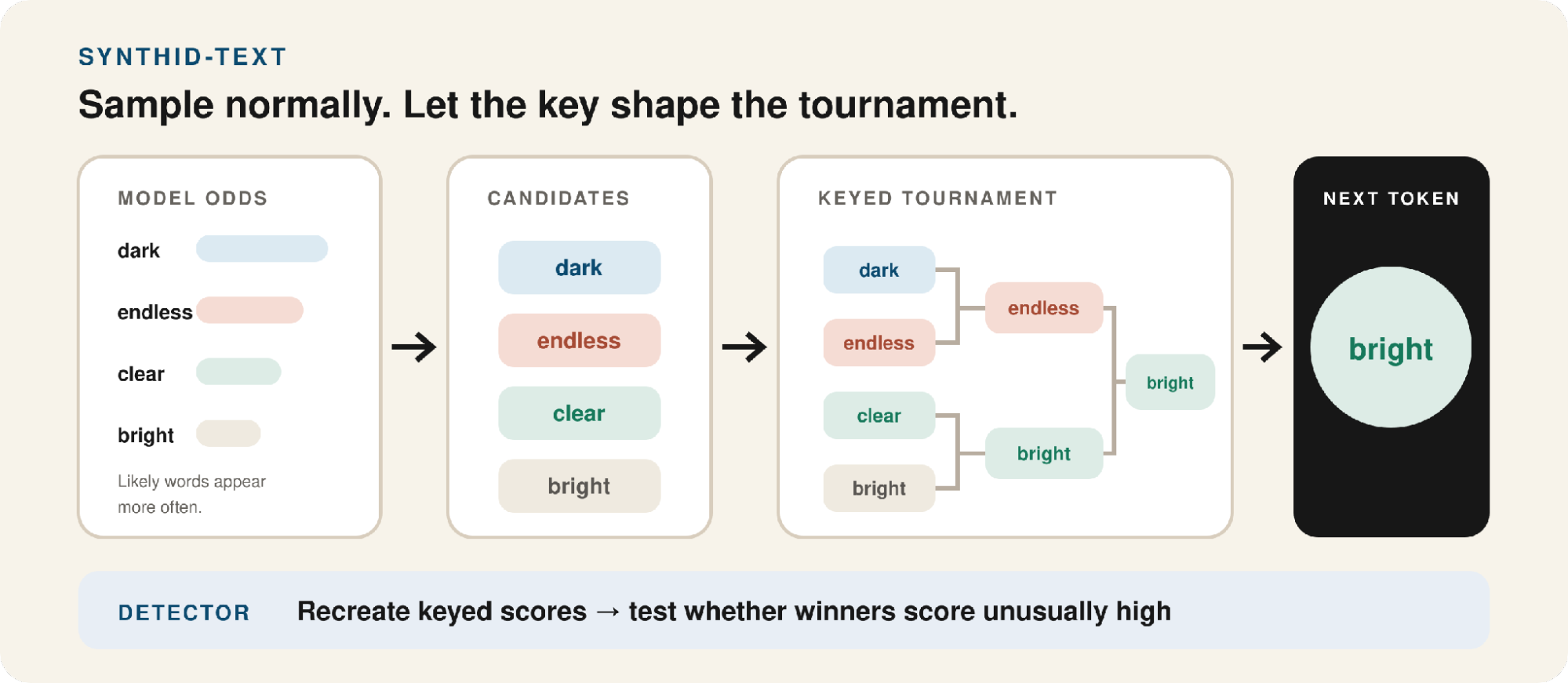
For detection, the system recreates those keyed scores over the finished passage and checks whether the selected tokens score unusually high. It does not need to rerun the full language model. Longer, flexible text provides more evidence.
Google DeepMind reported negligible added latency and no statistically significant change in user quality ratings across roughly 20 million Gemini responses. Read the peer-reviewed study for more.
Note: The translucent Gemini logo at the bottom right of the images generated using Gemini is also SynthID in practice (albeit for images).
Claude Uses SynthID-Text
Anthropic confirmed on August 14, 2026 that Claude uses a version of SynthID-Text. It changes the randomness behind valid word choices without adding characters or extra tokens.
Anthropic says the mark stores no user, organisation, prompt or chat information. Models launched on or after August 2, 2026 support marking at launch. Older-model support and a detection API are being added.
The implementation is global wherever supported Claude models are offered. Read Anthropic's explanation.
Where the Signal Is Strongest
The watermark needs both choice and length.
- Stronger: Explanations, marketing copy and creative prose.
- Weaker: Short answers, facts, quotations, proofreading and code.
Code leaves less room because syntax and behaviour constrain the output. Comments and flexible names can carry more signal than functional code.
Because the evidence accumulates with every token, book-length output sits at the far end of this scale. Work drafted end to end with an AI book writing tool hands a detector tens of thousands of scored choices instead of the few hundred in a short answer, which is why length matters more than any single sentence in the passage.
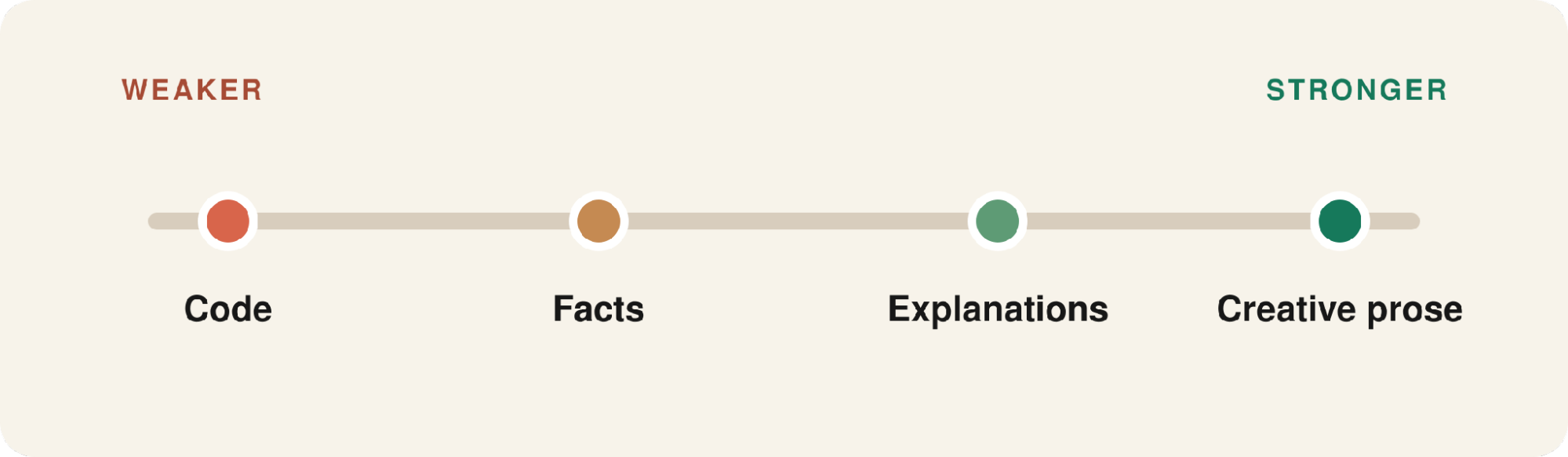
Long writing gives the watermark more room to repeat.
What Editing Changes
Copying, formatting or changing the file type does not alter the words, so the text watermark remains.
- Light edits: The signal can weaken.
- Heavy rewriting: Paraphrasing, translation and mixing can prevent detection.
- Complete rewrite: The marked sequence is replaced.
NO FIXED PERCENTAGE There is no universal 25% removal rule for Claude or SynthID-Text. It’s just a statistical estimate as to when the source starts becoming markless.
What Detection Proves
A watermark detector checks for one provider's keyed signal. A normal AI detector only estimates whether the writing resembles AI output.
SAFE CONCLUSION The identified system probably processed part of the passage.
A positive result does not prove the model created the ideas. A negative result does not prove human authorship. Watermarks are provenance evidence, not a complete authorship test.
Final Takeaway
Green lists bias token groups. SynthID-Text runs keyed tournaments. In every case, the signal lives in repeated token choices and is strongest in longer, creative writing. That also means the watermark is not tied to a single word, phrase, or formatting quirk.
Therefore, texts that are high in word count would have a stronger confidence score on whether AI was used on it or not. Similarly, smaller texts would give a score based on limited factors and their confidence wouldn't be that high, due to limited sample size.
But if you’d use the methods described in this article, then you can easily manage the text markers left by Claude AI (and any other watermarking AI in general).
Frequently Asked Questions
Does Claude hide characters in its text?
No. The watermark is a statistical token pattern.
Does copying remove it?
No. Copying preserves the marked word sequence.
Does Claude use green lists?
No. Anthropic says Claude uses a version of SynthID-Text.
Can every AI detector find it?
No. Watermark detection needs the matching method and key.