


The first time someone asks a simple question about an agent, the gap shows up fast: who told it to do that, and can you prove it?
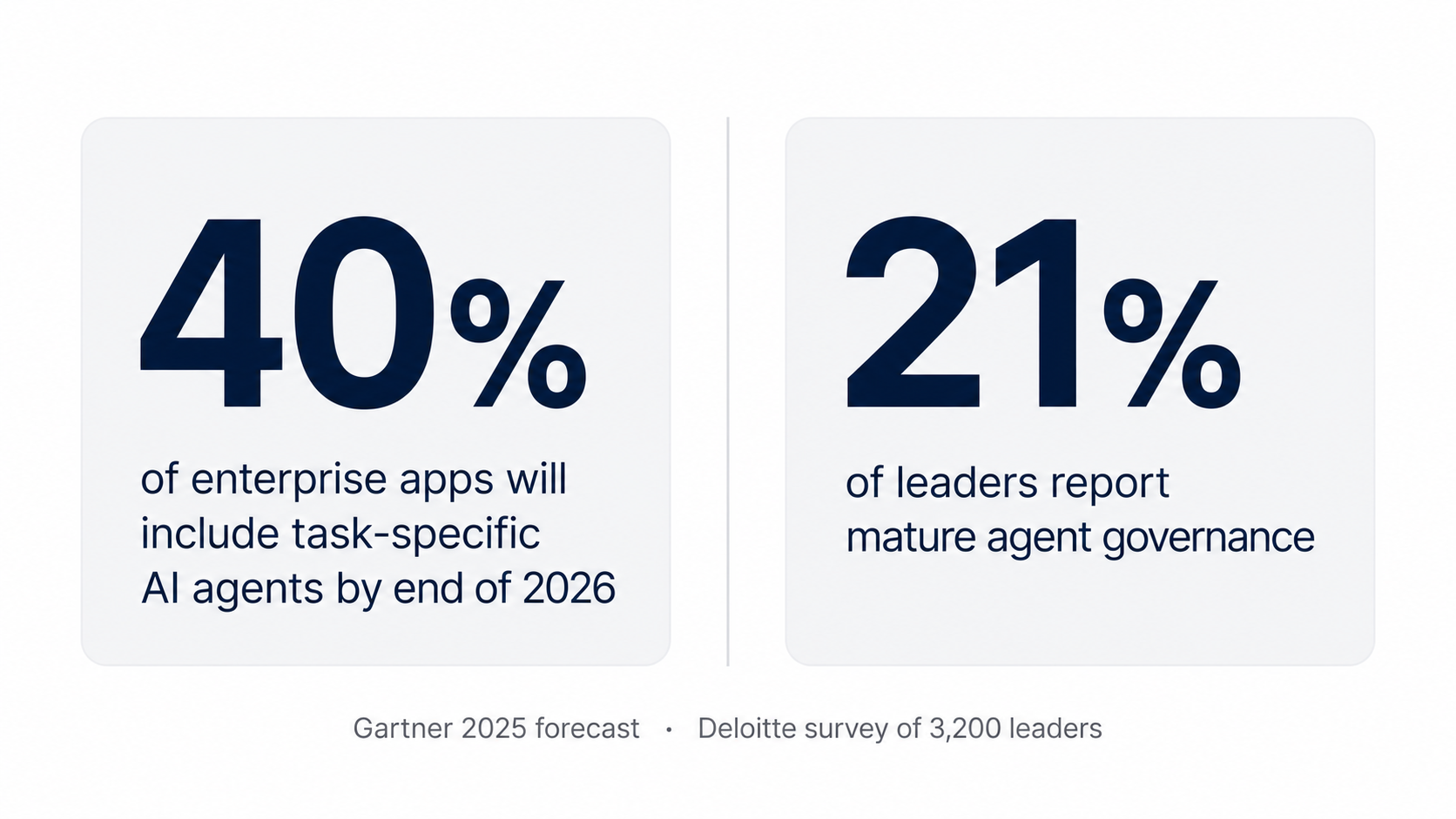
Gartner says up to 40% of enterprise applications will include task-specific AI agents by the end of 2026, up from under 5% in 2025. A Deloitte survey of 3,200 leaders found only 21% reporting mature governance.
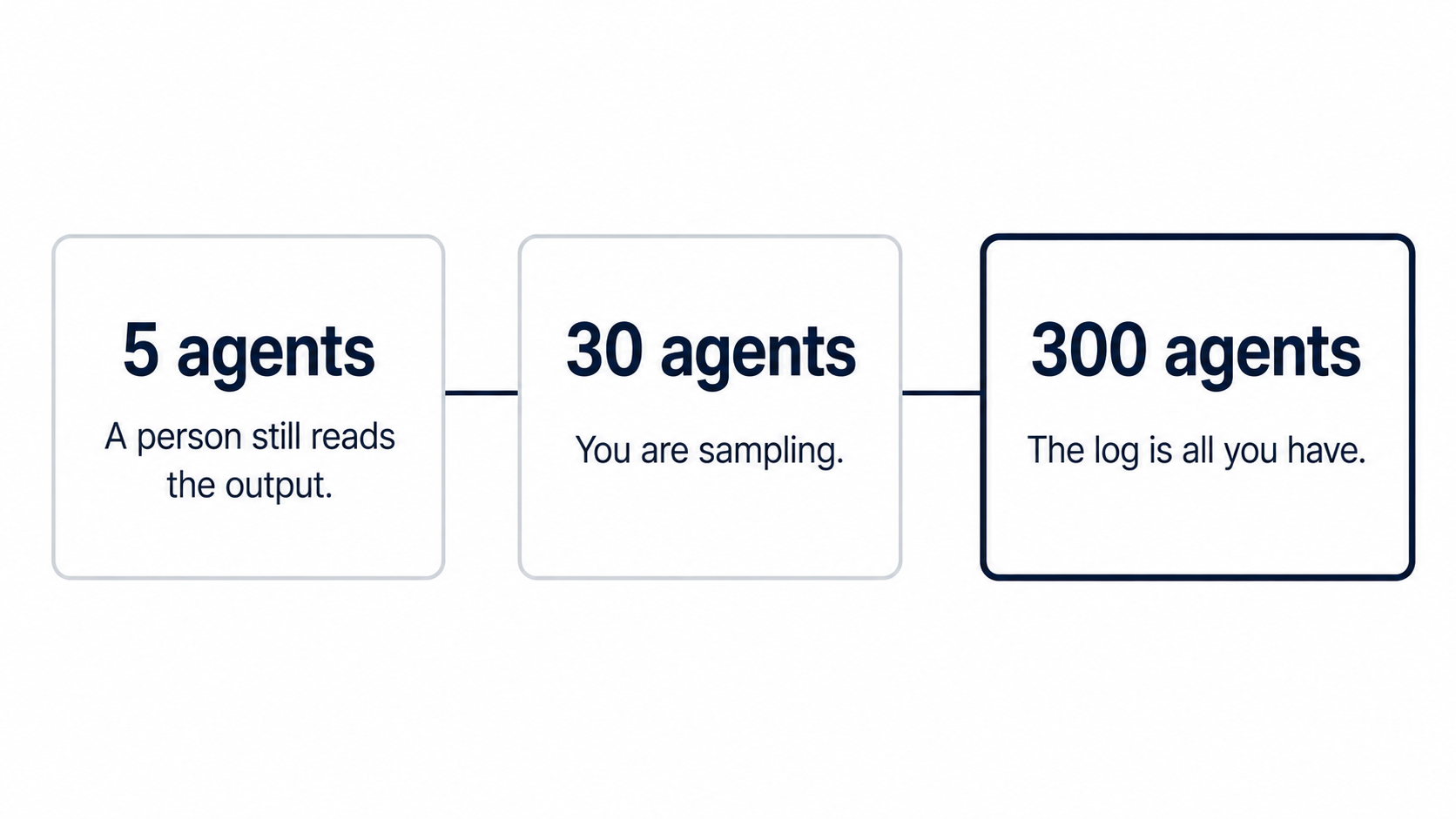
One useful scale for the same problem: at five agents a person still reads the output. At 30 you are sampling. At 300 the log is all you have.
Most teams already log model input and output. That is not an audit trail. An auditor reconstructing an agent action needs the identity chain, the grant that was in force, every tool call, the policy decision, and any human approval. If those pieces live in three different systems with no shared trace id, you do not have a trail. You have fragments.
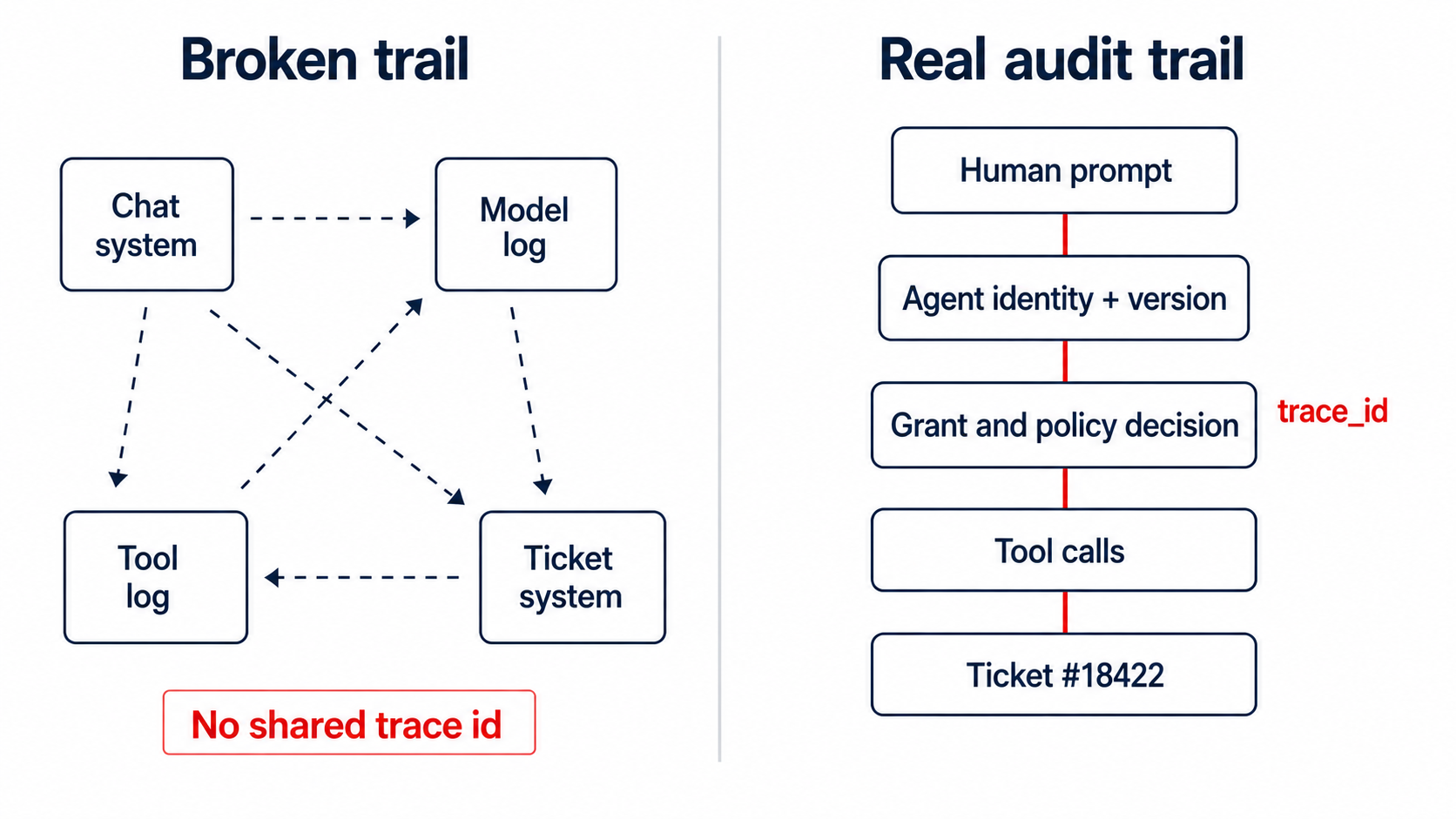
One caveat up front. Several of the field lists below come from vendors that sell agent observability or compliance products. The regulations they cite are real. Their product pitch is not the requirement. I am using the field lists because they match what SOC 2, HIPAA, ISO 27001, and EU AI Act Article 12 actually ask you to be able to reconstruct.
The question auditors start with
Josef Kamara put the first test in plain language: show me a decision this agent made yesterday, and walk me backward to the human who authorized it. If that walk takes more than a few minutes, the trail has a structural gap.
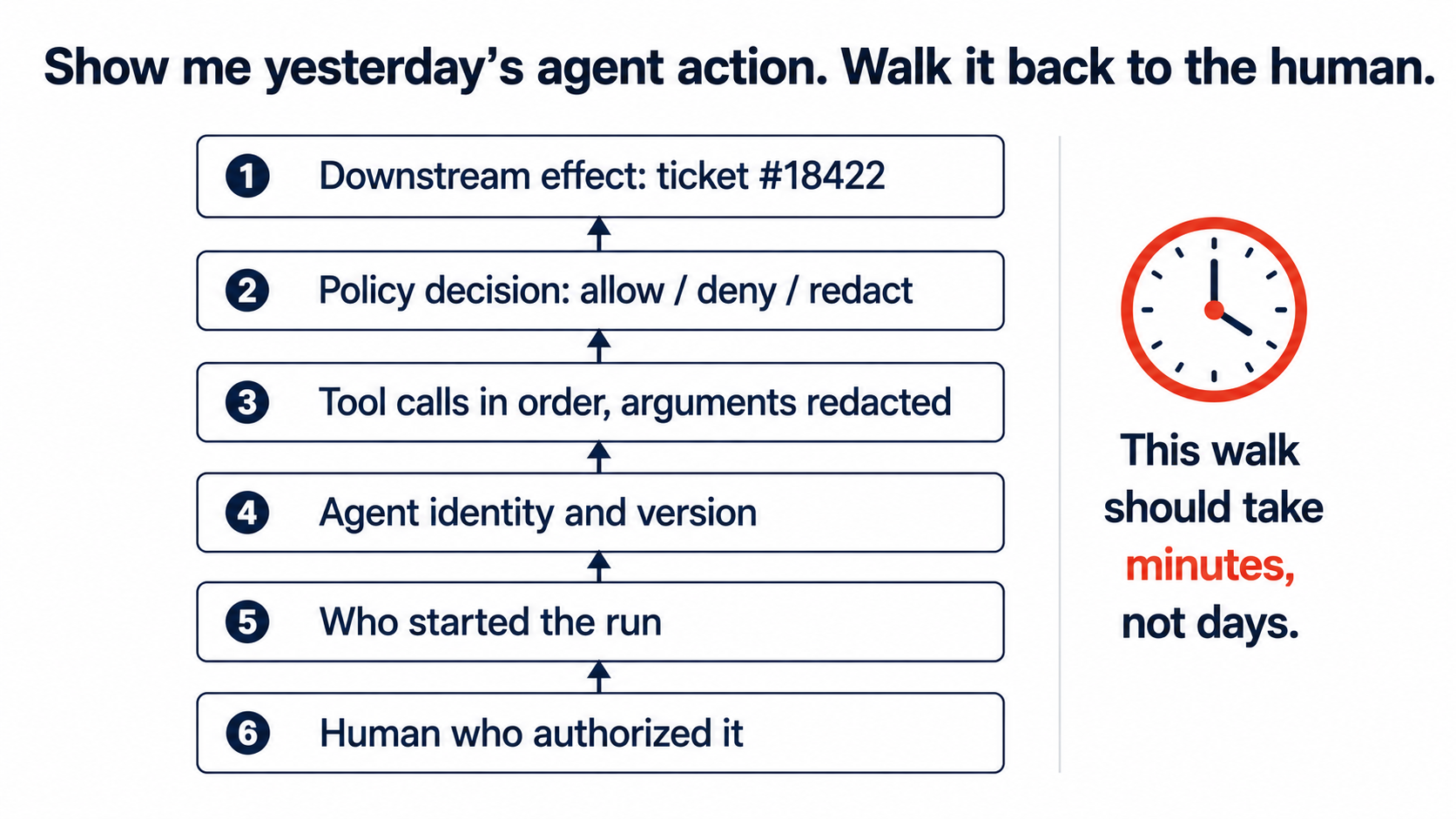
TrustLogix described the same test for financial services: a compliance officer looking at an agent interaction from six weeks ago should reconstruct it in minutes, not days. FINRA's 2026 Annual Regulatory Oversight Report now treats AI agents as their own supervisory risk category. The report calls out agents acting without human validation, authority that exceeds what users intended, auditability problems in multi-step reasoning, and misuse of client data.
SOC 2 auditors sampling agent actions typically want evidence that access policy was enforced on each action, that data stayed inside the documented boundary, that change management covered agent updates, and that incident response fired on flagged actions. They often ask for about 12 months of that evidence even though SOC 2 does not name a fixed retention number.
For high-risk systems under the EU AI Act, Article 12 requires automatic recording of events over the system lifetime. Article 19 adds start and end timestamps, input data, reference databases checked, and the identity of the natural persons who verified results. Deployers must keep those logs at least six months. Sector rules can run much longer. HIPAA audit controls for ePHI sit at six years. SOX financial records commonly sit at seven.
Those regimes do not all use the word "agent." They still expect a reconstructable record of who acted, on what, under which authority.
What to log on every agent action
A useful record is structured, append-only, and queryable by task. Application stdout is not enough.
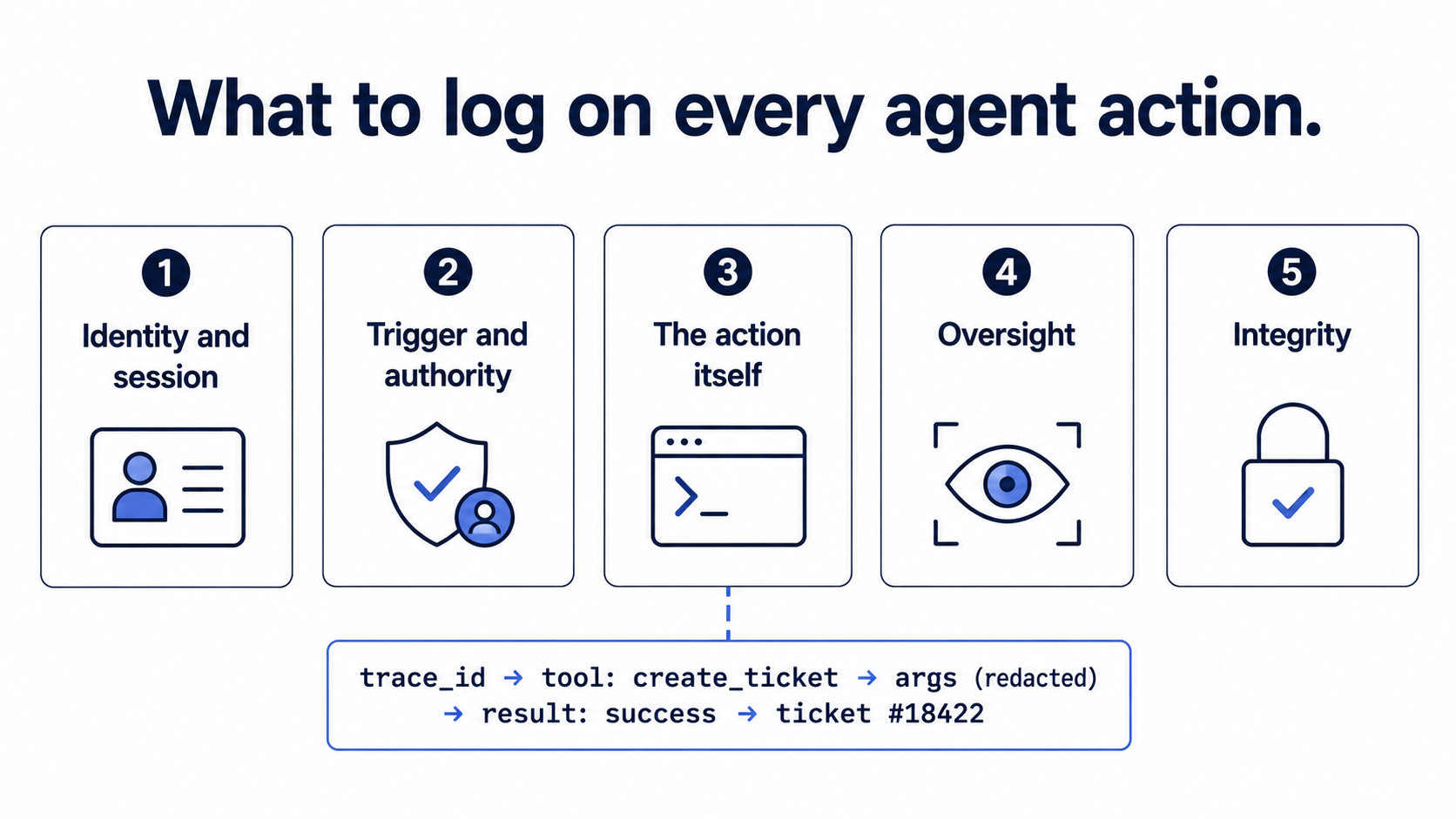
Identity and session
- The human or system that started the run
- The agent identity, not a shared service account
- Agent version or build
- Tenant or workspace
- A trace id shared by every event in that run
- A span or step id for each tool call inside the run
Trigger and authority
- What started the run: user message, schedule, webhook, or parent agent
- The grant in force: scopes, tools allowed, time bound
- Policy version that produced the allow, deny, redact, or escalate decision
- Delegation chain if a planner handed work to another agent
The action itself
- Event type: prompt, model call, retrieval, tool call, write, approval
- Tool name, target system, and operation (read, write, delete, send)
- Arguments, with secrets and raw PII hashed or redacted
- Model name and version when a model call happened
- Result: success, failure, blocked, error code
- Duration
- Downstream effect: email sent, ticket created, record updated, webhook fired
Oversight
- Whether a human saw the action before it landed
- Who approved, rejected, or overrode it, and when
- What the reviewer was shown
Integrity
- UTC timestamp with enough precision to order events across systems
- A hash or signature so a later edit is visible
- Log write time, which is not always the same as action time
NHI Management Group's short answer matches this list: who initiated the session, which agent ran it, what the agent was authorised to do, the exact tool calls and results, and whether a human approved the action. Keep the delegation chain and the session bound so the record still makes sense six months later.
What you should not dump into the same file
Full prompt text with customer names, card numbers, or health data creates a second copy of regulated information. Hash or tokenize those fields and keep the mapping in a tighter store. Same rule for API keys and session tokens that show up in tool arguments.
Do not let the agent write or rotate its own audit log. If the workload that takes the action can also edit the trail, the trail is not evidence. AWS's agentic guidance says the same thing in infrastructure language: structured JSON, PII redaction before write, and immutable storage for the compliance copy.
Do not log only the final answer. The interesting failure is usually three tool calls earlier: a retrieval that pulled the wrong folder, a planner that spawned a helper with a wider grant, or a policy check that never ran.
A reconstruction test you can run this week
Pick one production agent action from yesterday. Pull:
- The trace id for that run
- The human who started it
- The agent identity and version
- Every tool call in order, with redacted arguments
- The policy decision on the write or send
- The human approval record, if that action required one
- The downstream effect in the target system (ticket id, message id, commit sha)
If any of those seven is missing, that is the gap to close first. Do this for a read-only action and for a mutating one. Reads are where teams skip fields. Writes are where auditors spend time.
Retention without turning logs into a landfill
A practical split that shows up across SOC 2 and ISO 27001 write-ups:
- Hot: 30 to 90 days, full detail, fast query
- Warm: about 12 months, the window SOC 2 reviewers usually ask for
- Cold: whatever your sector floor is (six months under EU AI Act Article 19 for high-risk systems, six years under HIPAA for ePHI, longer for financial records)
Record the deletion of a log as its own event. GDPR data minimisation still applies to the trail itself.
Why rooms and fleets make this harder
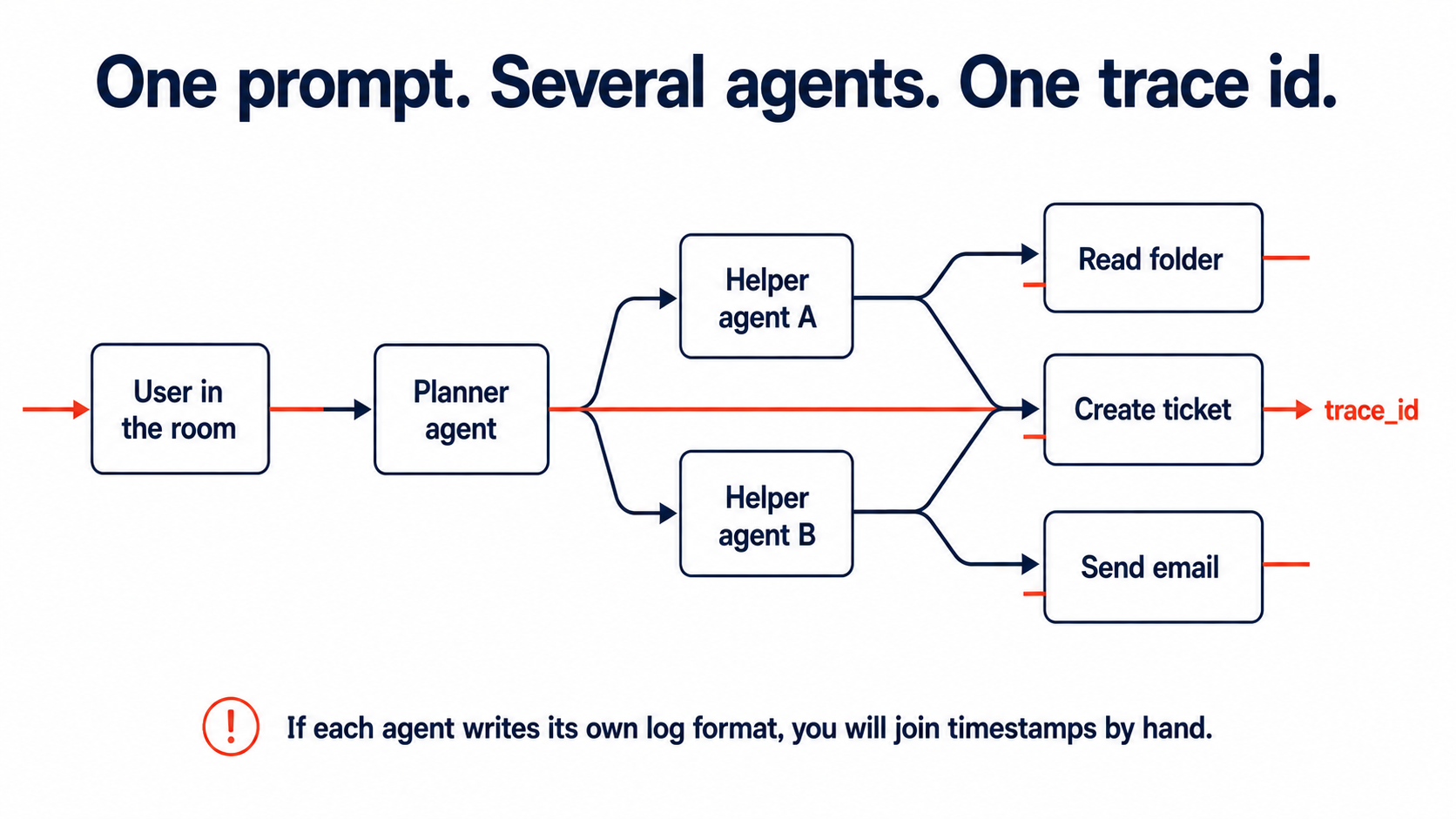
On a platform where humans and agents share a room or a fleet, one user prompt can fan out across several agents and several tools. The audit question does not change. You still need one trace id that follows the work from the person in the room, through the agent that planned the steps, to the agent that called the API.
If each agent writes its own log in its own format, you will spend the investigation joining timestamps by hand. That is the failure mode auditors notice first.
A short checklist
- Give every agent a stable identity and log it on every event.
- Stamp a trace id on the run and propagate it through tool calls.
- Record the grant and policy version next to the action.
- Log tool name, redacted arguments, result, and downstream effect.
- Record human approvals with reviewer identity and timestamp.
- Write the compliance copy to append-only storage the agent cannot edit.
- Prove you can reconstruct yesterday's action in minutes.
You do not need a new category of product to start. Most of this is structured events, a correlation id, redaction, and a store that will not accept updates. The product decision comes later, when the volume of agents makes manual joins impossible.
Frequently Asked Questions
What are AI agent audit logs?
They are structured, append-only records of an agent run. A complete log covers who started the session, which agent and version ran it, the grant and policy version in force, each tool call with redacted arguments, the result, any human approval, and the downstream effect in the target system. A shared trace id ties those events together so an auditor can walk backward from a write to a person.
Is logging prompts and model output enough for an audit trail?
No. Prompt and completion text shows what the model said. It does not show which identity held the grant, which policy version allowed the write, which tool arguments went out, or whether a reviewer approved the action. Those fields live outside the model call. If they sit in three systems with no shared trace id, you have fragments.
How long should you keep AI agent audit logs?
Keep a hot copy for 30 to 90 days so investigations stay fast. Keep a warm compliance copy for about 12 months, which is the window SOC 2 reviewers often request. Then keep a cold copy for the sector floor: six months under EU AI Act Article 19 for high-risk systems, six years under HIPAA for ePHI, and commonly seven years for SOX financial records. Record each deletion as its own event.
Can the agent write its own audit log?
It should not. If the same workload can take an action and later edit the record of that action, the file is not evidence. Write the compliance copy to append-only storage the agent cannot rotate. Redact secrets and raw PII before the write. Hash or tokenize regulated fields and keep the mapping in a tighter store.
What do SOC 2 and the EU AI Act actually ask you to reconstruct?
SOC 2 sampling usually looks for enforced access policy, data staying inside the documented boundary, change management on agent updates, and incident response on flagged actions. EU AI Act Article 12 requires automatic event recording over the system lifetime for high-risk systems. Article 19 adds timestamps, input data, reference databases checked, and the identity of the people who verified results. Neither text has to say "agent" for those duties to apply to agent actions.