

Whenever a new massive AI model drops, there's always excitement to figure out what it is capable of doing. We wonder what data it was trained on. How many parameters did it need to work so well?
I have observed that there's a common belief suggesting an AI model only knows what it has been trained on and has no idea about your personal documents or your company's policies. Yes, it's true, but with a catch.
Even though AI hasn't seen your data, this doesn't mean we have to retrain the entire LLM model and update its weights to update our knowledge. Do not fall for that misconception. That would be an unnecessary expense.
The strength of an LLM is not only to remember what it learned during the training phase, but also to learn new things in real time. How? From the prompt that you send.
This concept is known as In-Context Learning, and it's about time we broke it down and understood it.
The Open-Book Test
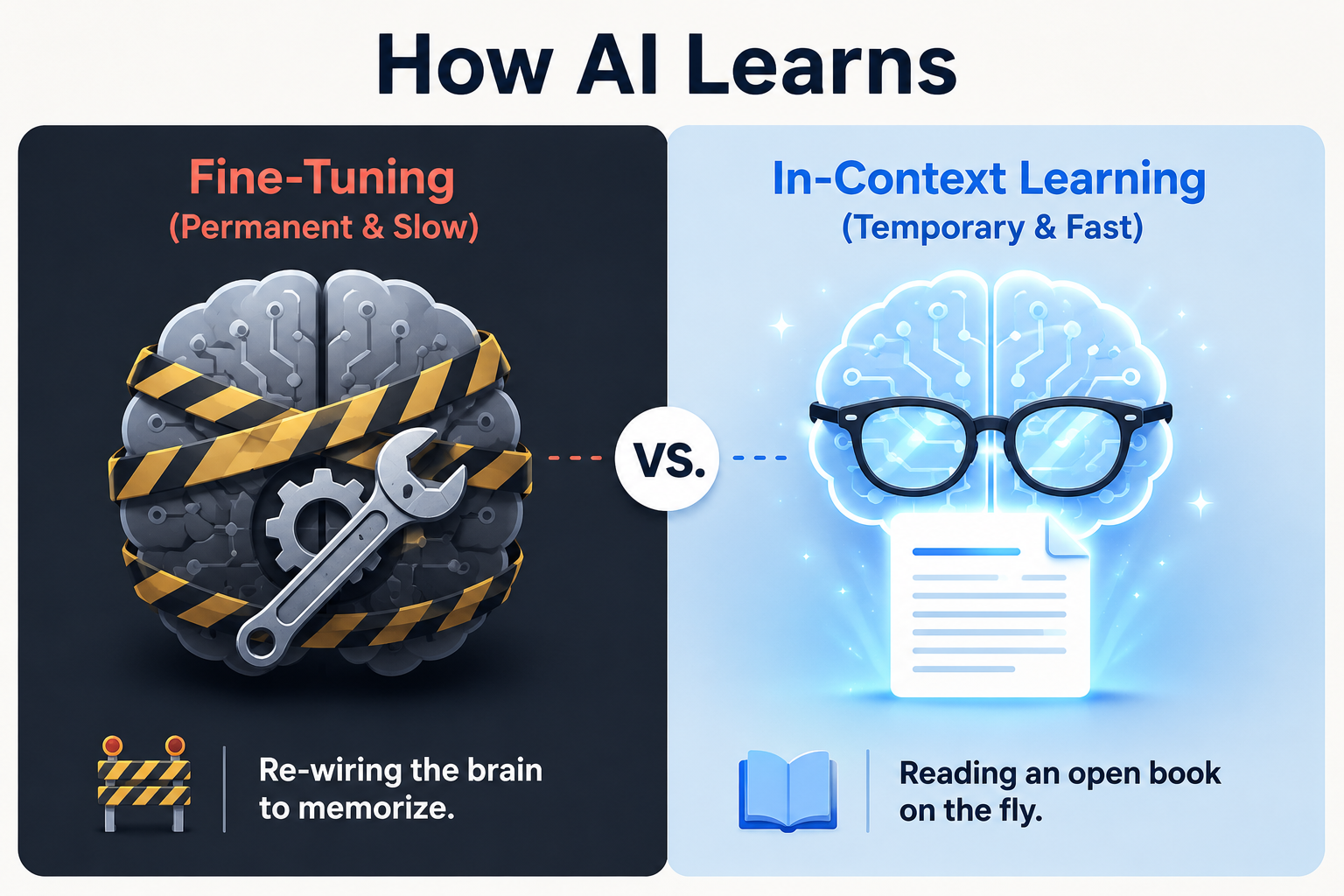
To understand the significance of In-Context Learning, let me first compare it with fine-tuning.
Let's suppose you're managing a Formula 1 driver. As the manager, there are a couple of scenarios you look forward to.
1. The Fine-Tuning Approach
As the manager of the Red Bull Formula 1 Team, you want one of your rookies to master the brand new racetrack in Austria. You want him to know the ins and outs of the track. This is why you send him to practice that track for months. As he drove repeatedly, he mastered every turn. Now he masters that track.
But we have one problem. Suppose one fine day, Austria decides to modify the track. Now you might have to make the rookie practice on that newly modified track all over again.
Fine-tuning works similarly. The model is trained on new data, so it can permanently learn from it.
It's an effective approach, but it requires additional training, time, and computational resources.
Though it's important to know that fully retraining an LLM from scratch is even more expensive.
2. The In-Context Learning Approach
We are a few hours away from the actual race. In this situation, you choose to simply hand the map to your driver before the race and not ask him to practice on the track for months. This map includes every important detail. Stuff like weather, turns, what to expect before driving.
The driver already knows how to race. He is simply using this new information to navigate the track successfully.
That's exactly how in-context learning works.
The model isn't retrained. Instead, you're providing the information directly in the prompt. The model reads the prompt, understands the new information, and uses it to answer your question.
But then it moves on. This means that once the conversation ends, the LLM would not permanently retain the new information.
Imagine in-context learning as an open-book exam. The AI model simply uses the information you've added in the prompt.
How In-Context Learning Works
1. Pattern Recognition (Zero-Shot, One-Shot, and Few-Shot)
LLMs are extremely good at pattern recognition. Based on how much context you provide, in-context learning can take different forms.
Zero-shot prompting: You only provide an instruction. An example of this is: "Summarize this article in three bullet points."
One-shot prompting: You provide one example before asking the model to perform the task.
Few-shot prompting: You provide multiple examples so the model learns from examples before generating the final answer.
For example, suppose you want your AI model to convert customer reviews into your own custom format. Instead of retraining the model, you just show the model three to four examples. The model recognizes the pattern and applies it to the next review.
It's the prompt that takes care of the learning. Once the conversation ends, the model moves on and doesn't remember that pattern.
2. Knowledge Injection (RAG)
Suppose the company you work for has a 50-page legal contract. It was created this morning. Since the document is new, the AI model has never seen it during training.
So do you retrain the AI model? Absolutely not. Instead of retraining the model, you simply provide the document as context and ask:
"Based only on this contract, what is the termination clause?"
The AI reads the document, understands the legal language using its existing knowledge, and finds the relevant section to answer your question.
Notice what's happening here. The AI didn't permanently learn the contract. It's simply using the information you've given it for that conversation. Once the conversation ends, it forgets the document.
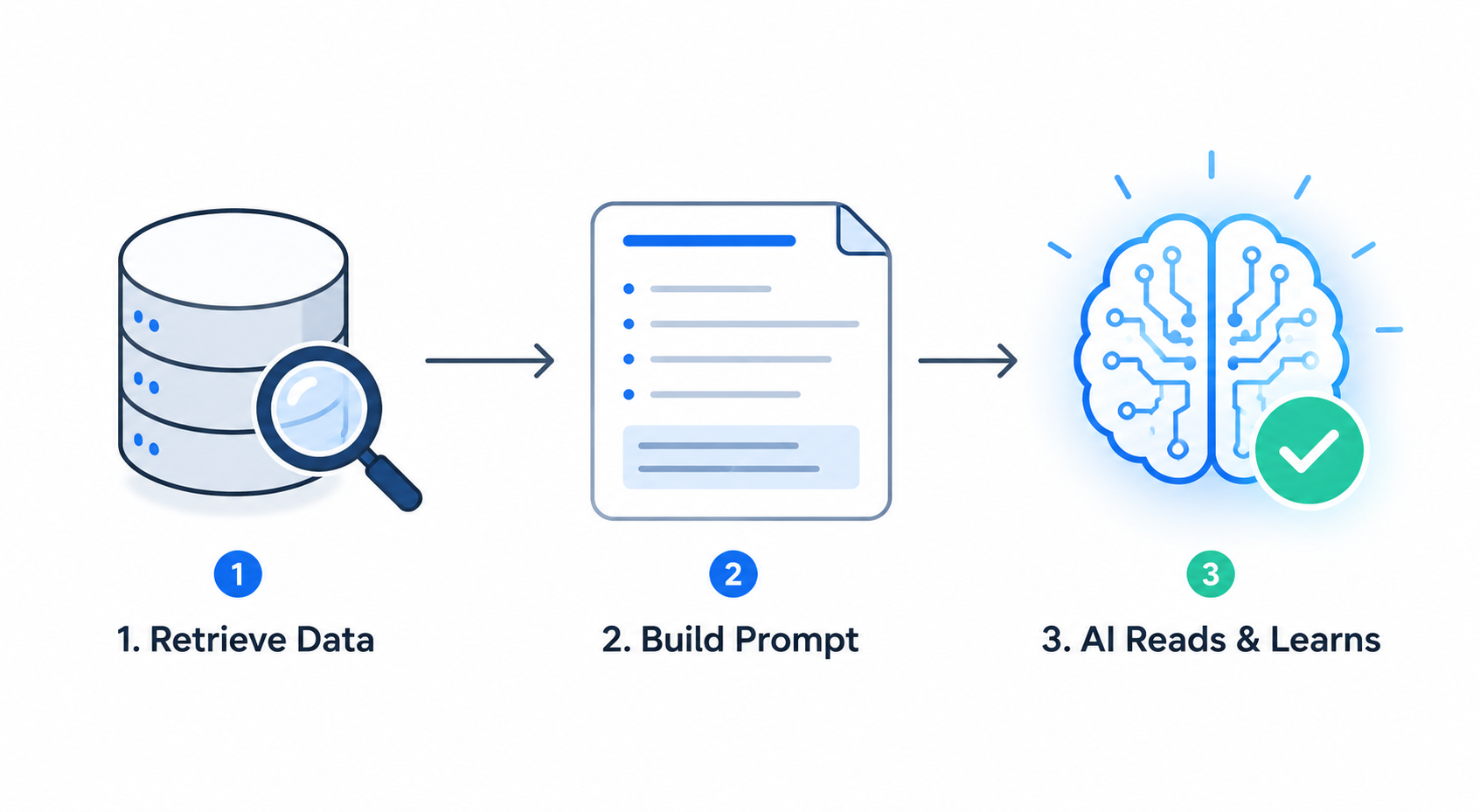
This is exactly how Retrieval-Augmented Generation (RAG) works. The role of a retriever is to search the knowledge base (often using vector similarity search), fetch the most relevant information, and add it to the prompt.
The LLM then uses that context to answer your question without changing its underlying knowledge.
From My Experience: Building with RAG and LangGraph
The significance of in-context learning becomes clear when you build AI applications.
For example, while I was building the Formula 1 Race Intelligence Platform, I wanted the LLM to answer questions using live race information.
Retraining the LLM for every race would be madness. I had to come up with a solution to tackle this problem.
So I used Retrieval-Augmented Generation (RAG).
So, suppose a user asks, "Why did Ferrari lose pace in Sector 2?"
My Python app searches a vector database for the most relevant data from that race. The retrieved data is added to the prompt along with the user's question.
Now, the LLM reads that information and generates an explanation based on the context it was given.
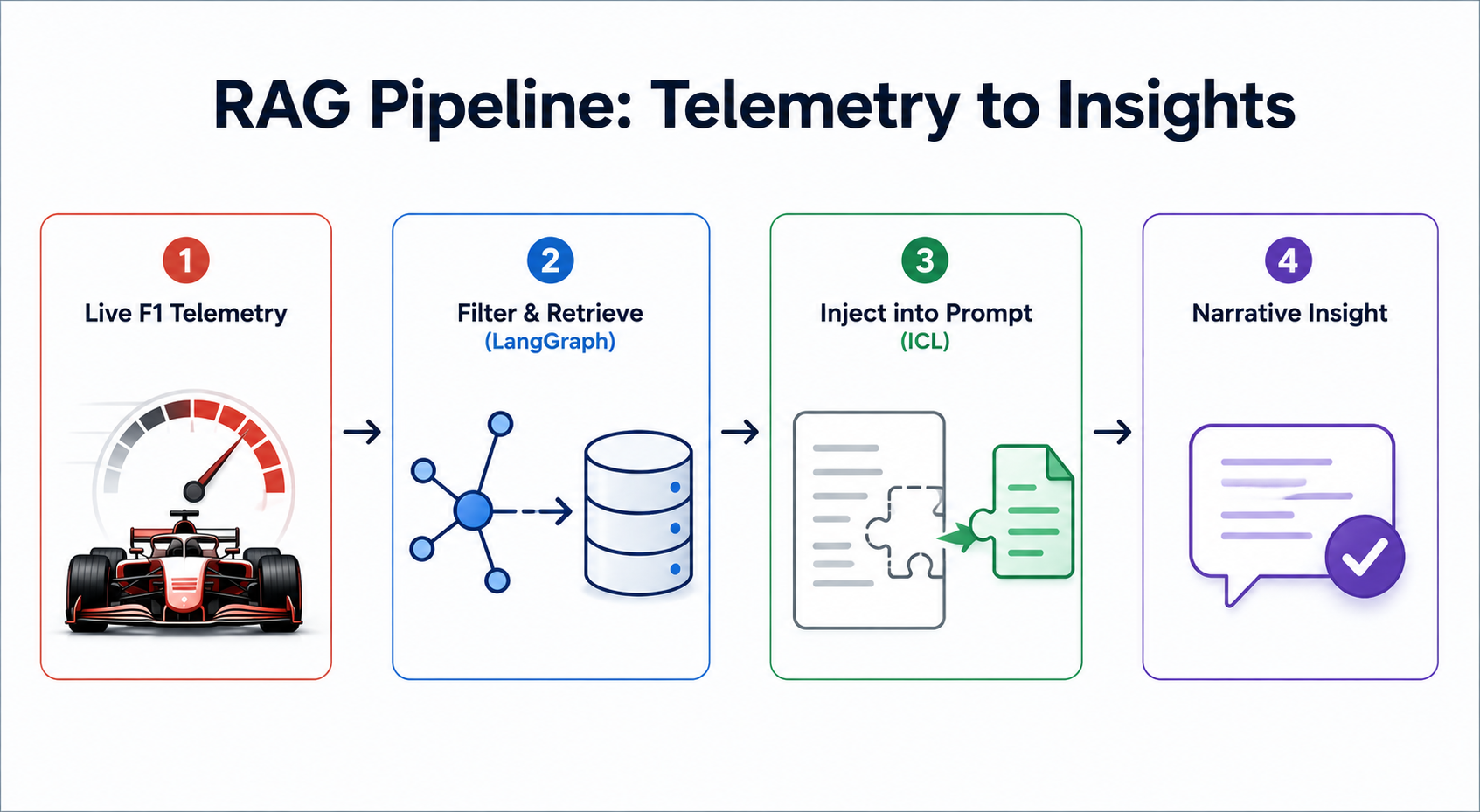
Notice something important. The model didn't already know what happened in that race. It read the context from the prompt to answer your question.
That's the power of in-context learning. Instead of teaching the model new knowledge permanently, you give it the information it needs at the right time. The model uses it to answer your question and moves on.
So we can acknowledge the fact that RAG works because of in-context learning.
Conclusion
In-Context Learning is one of the biggest strengths of modern AI models.
Instead of retraining a model every time you receive new information, you can simply provide the information as context. The model reads and uses it to answer your question. And then moves on without permanently changing what it has learned.
This idea ranges from document chatbots to customer support assistants and enterprise RAG systems.
As AI continues to evolve, the focus is not solely on building better models. It's crucial to provide those models with the right information at the right time.
Frequently Asked Questions
What is the difference between In-Context Learning (ICL) and RAG?
In-Context Learning is the model's ability to understand and use the information provided in the prompt.
RAG (Retrieval-Augmented Generation) is a system that retrieves information from sources such as PDFs, documents, or vector databases and adds relevant context into the prompt.
RAG provides the information, and In-Context Learning allows the model to use it.
Does the AI remember information learned through In-Context Learning?
No. The information is only available while the conversation is active. Once the conversation ends, the model forgets that information.
If you want the model to use the same information again, you'll need to provide it again.
Does In-Context Learning replace Fine-Tuning?
Not completely. In-Context Learning is preferred when you want the model to learn some updated information, such as company documents or recent reports.
Fine-tuning is still useful when you want to permanently change how a model behaves, responds, or writes.
Both techniques solve different problems and are often used together.
Is there a limit to how much information I can provide?
Yes. Every language model has a context window. This window limits how much information the LLM can process at once.
Modern models can handle very large amounts of text. However, providing unnecessary information can make it harder for the model to focus on important details.
That's why it's important to provide only relevant and well-organized context.