

If you've been keeping tabs on the AI landscape this year, you've felt the tension. The top spot is being fought for by two major competitors: Google and OpenAI.
The gap between ChatGPT and Gemini in 2026 is about ecosystems. We're choosing between OpenAI's reasoning-first powerhouse versus Google's multimodal, workspace integrated platform.
Both companies are shipping faster than anyone can track. One week Google drops a new Gemini model, the next week OpenAI counters with another upgrade, and suddenly choosing between them feels impossible.
This article would help make that decision for you. What follows is a definitive guide of the two models when compared across their features, benchmarks and performance on practical workloads.
ChatGPT: The Pioneer
ChatGPT's influence on the AI ecosystem is hard to overstate. Launched in November 2022, it single-handedly brought large language models into the mainstream and turned OpenAI into a household name almost overnight.
Since then, ChatGPT has evolved through a rapid succession of model upgrades: GPT-4, GPT-4 Turbo, GPT-4o, and now the GPT-5 family. Expanding from a conversational chatbot into a broad productivity platform with image generation, voice, browsing, computer use, and agentic workflows.
| Model | Release | What It Does Best |
|---|---|---|
| GPT-3.5 | 2023 | Fast conversational AI for everyday writing, explanations, and basic coding |
| GPT-4 | 2023 | Major jump in reasoning, coding, and long-form analytical tasks |
| GPT-4o | 2024 | Real-time multimodal model with voice, vision, and fast response times |
| GPT-5 family | 2025–2026 | Next-generation reasoning, reliability, and agentic capabilities across tools |
| GPT-5.5 | April 2026 | OpenAI's first fully retrained base model since GPT-4.5, built specifically for agentic workflows |
As of mid-2026, GPT-5.5 is the default model for ChatGPT Plus, Pro, Business, and Enterprise users — OpenAI's most capable and agentic flagship yet.
Gemini: The Multimodal Challenger
Google's Gemini emerged as one of the most popular challengers to ChatGPT in 2024. Unlike OpenAI's approach of building multimodal features on top of a text-first model, Gemini was designed from the ground up to natively process text, images, video, and audio within a single model.
The thing that sets apart Gemini from its competitors like Claude and ChatGPT, is its deep integration with Google Workspace apps. You can work with Gmail, Drive, Photos and many more Google apps directly from Gemini natively.
| Model Family | What It Does Best |
|---|---|
| Gemini 1.0 | Early multimodal model with text, image, and code understanding |
| Gemini 1.5 Pro | Breakthrough long-context model with up to 1 million token input |
| Gemini 2.0 Flash | Fast, agentic model with real-time Google Search integration |
| Gemini 2.5 Pro | Strong reasoning, coding, and multimodal understanding |
| Gemini 3.1 Pro | Current flagship with native multimodal understanding and massive context window |
As of 2026, Gemini 3.1 Pro is Google's frontier model.Offering a 1 million token window as standard, native video and audio processing, and deep integration with Google Workspace.
Hands-On
Theory only goes so far. To see where each model actually shines we put their flagship models through four real-world tasks:
- Email Refinement
- Code Debugging Test
- Structured Reasoning
- Strict Instruction Following
Task 1 – Email Refinement
Purpose: Tone correction and clarity improvement in a real-world writing task.
Email:
Hi Sarah,

Just wanted to follow up on the project timeline we talked about last week.
We still haven't received the updated specs from your team and it's causing
delays on our end. The deadline is coming up and we can't really proceed without them.

Also some of the files sent earlier were incomplete so we'll need updated
versions of those too. Can you send everything over when you get a chance?

Thanks, David
Prompt:
Rewrite the email so it sounds more professional and clear.

Requirements:
• Keep the message polite but firm
• Improve grammar and clarity
• Keep the email concise
• Preserve the original intent
• Do not significantly increase the length
ChatGPT Response:
Gemini:
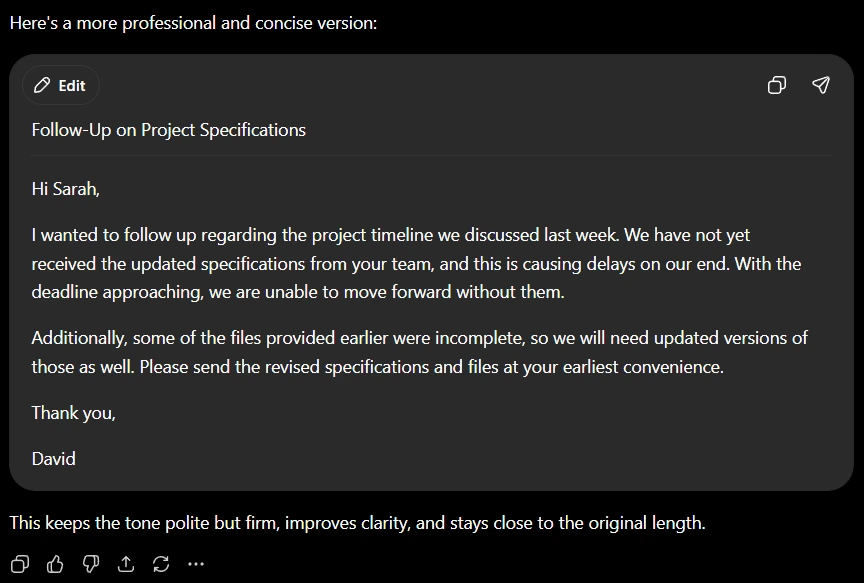
ChatGPT produced a clean, well-structured rewrite. The tone was professional and the message was clear. It added a closing that slightly exceeded the original length, but the output was immediately usable.
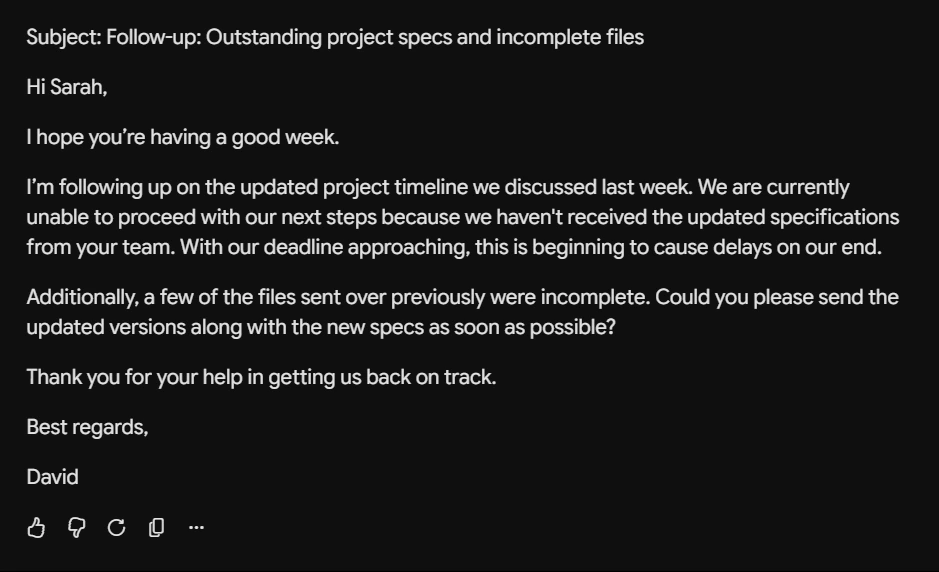
Gemini also delivered a strong rewrite, matching the firm-but-polite tone well. Notably, Gemini's deep Google Workspace integration means you can send the rewritten email directly from the interface via Gmail — a meaningful workflow advantage for users already in the Google ecosystem.
Verdict: Both models handled this well. The choice here comes down to ecosystem: Gmail users will find Gemini's native integration a genuine time-saver.
Winner: Both
Task 2 – Code Debugging Test
Purpose: Tests logical reasoning and coding accuracy.
Python Script:
def calculate_discount(price, discount):
    discounted = price - discount
    return discounted / price

item_price = 200
discount_amount = 50
print("Final price:", calculate_discount(item_price, discount_amount))
Prompt:
The following Python script is supposed to calculate the final price after applying a discount.

1. Identify the bug
2. Explain why it happens
3. Provide a corrected version of the program
4. Suggest one improvement to make the function more robust
ChatGPT:
Gemini:
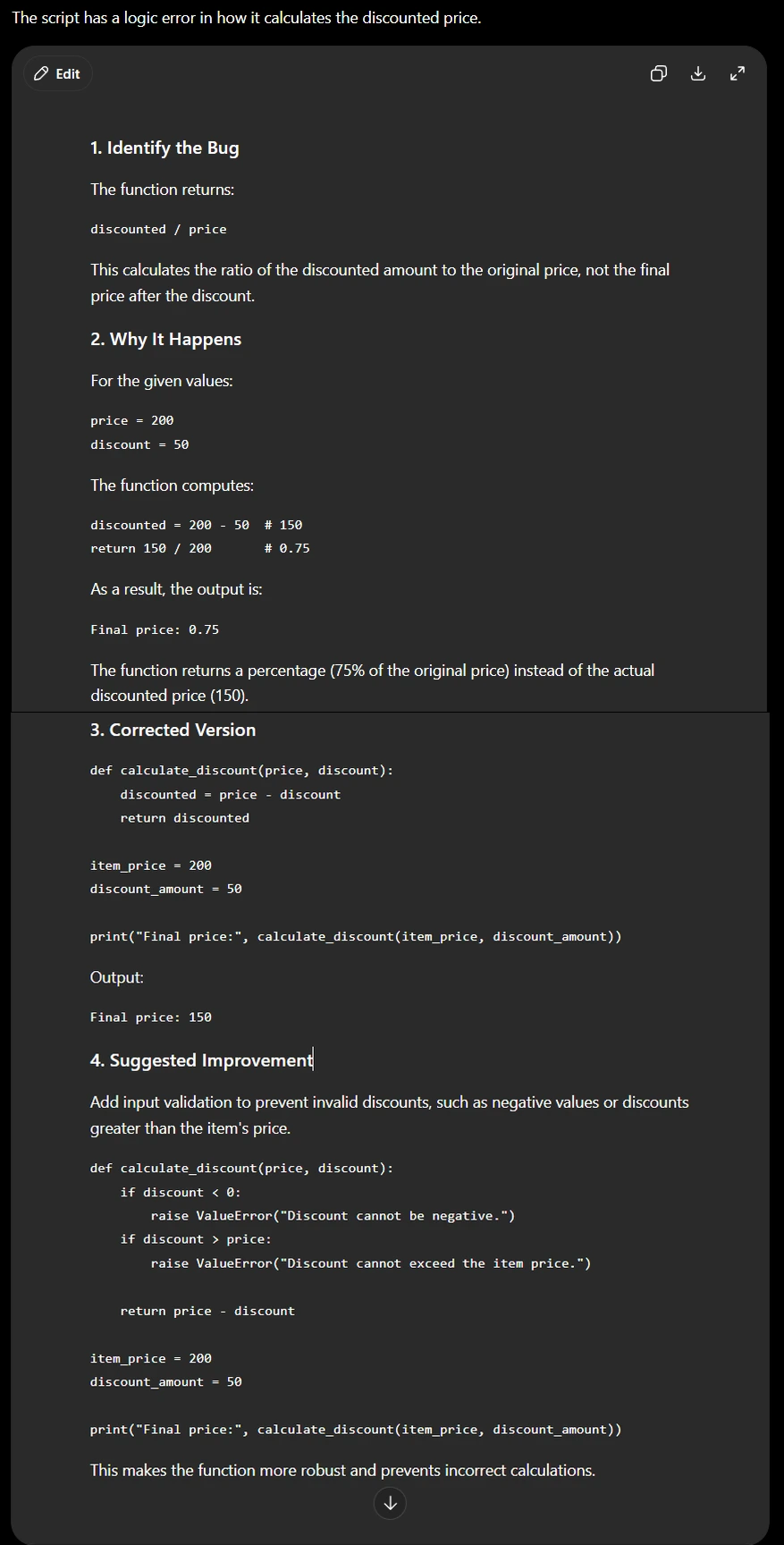
ChatGPT identified the logic error correctly — the function returns a ratio instead of the discounted price — and provided a detailed, well-explained fix with comments. The response was thorough but verbose; beginners would appreciate the handholding, while experienced developers might find it excessive.
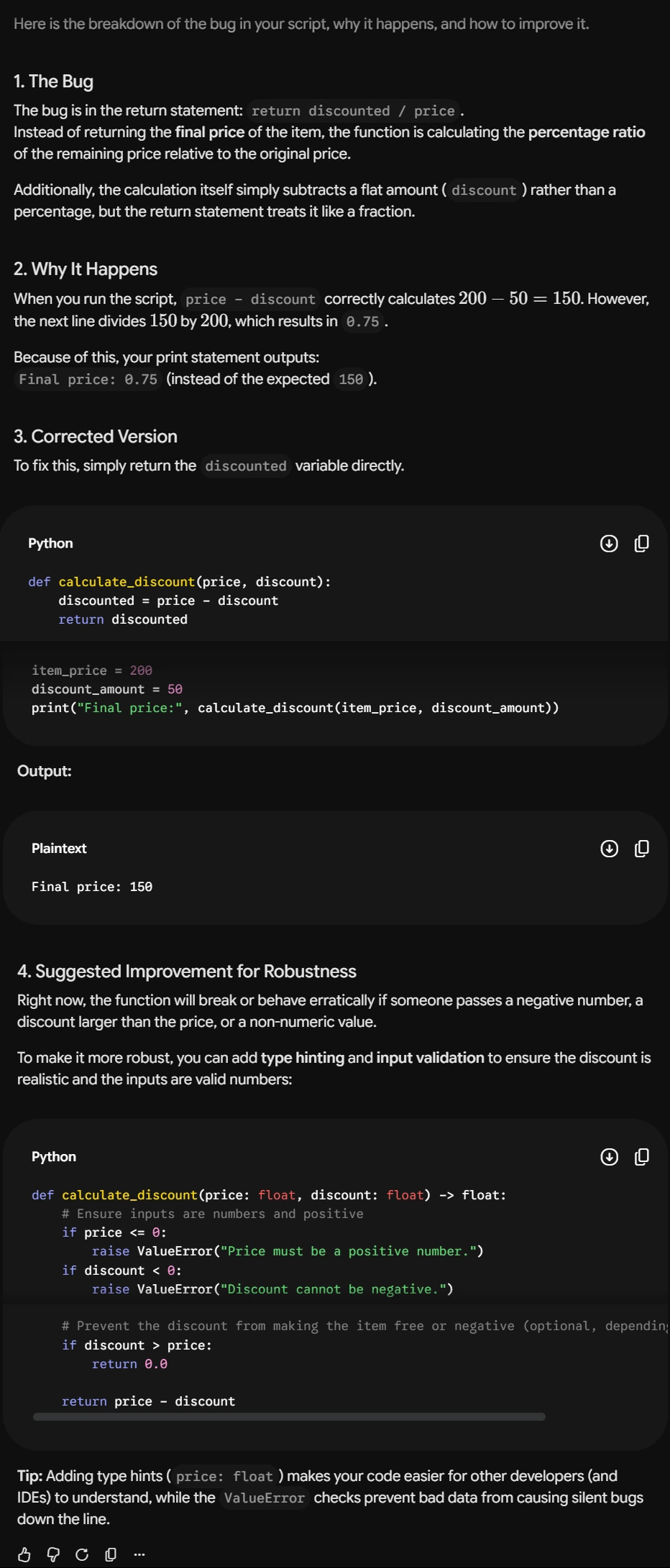
Gemini caught the same bug and delivered a more concise response. Its correction was clean, and it offered a practical robustness improvement (handling a zero-price edge case) without padding the answer with unnecessary explanation.
Verdict: Gemini's conciseness gives it an edge for experienced developers. ChatGPT's detailed walkthrough is better suited for learners. For professionals, Gemini wins.
Winner: Gemini
Task 3 – Structured Reasoning
Purpose: Tests multi-step reasoning and decision-making.
Dataset:
| Region | Q1 Revenue | Q2 Revenue | Growth Rate |
|---|---|---|---|
| North | $420,000 | $480,000 | 14.3% |
| South | $310,000 | $295,000 | -4.8% |
| East | $530,000 | $610,000 | 15.1% |
| West | $280,000 | $275,000 | -1.8% |
Prompt:
You are a business analyst reviewing regional sales performance.

Using the dataset above:
1. Identify the top-performing and underperforming regions.
2. Analyze the growth trends.
3. Recommend resource allocation changes for Q3.
4. Provide a clear step-by-step explanation for your decision.
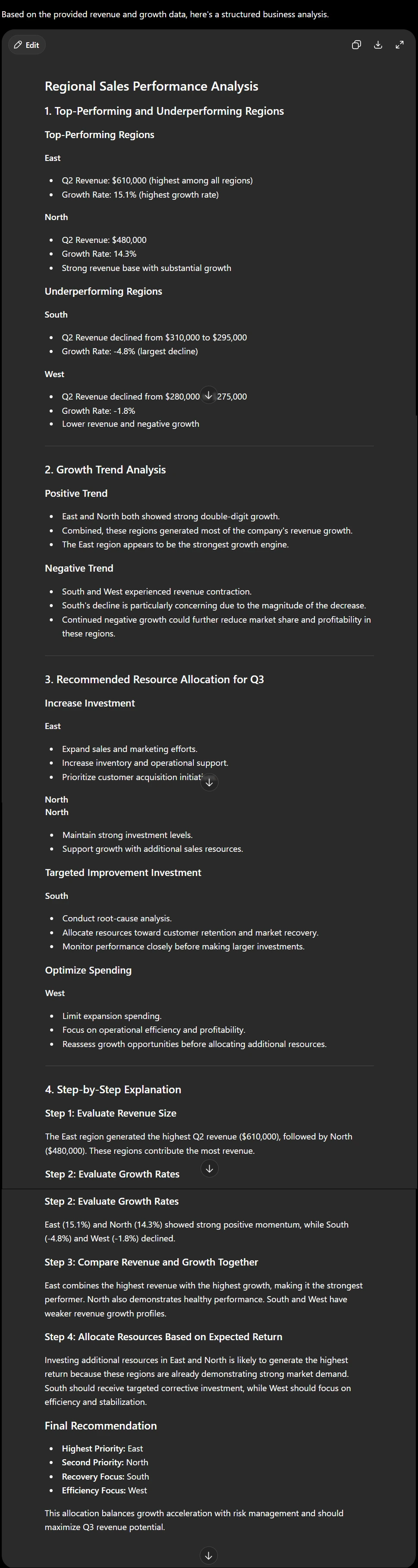
ChatGPT:
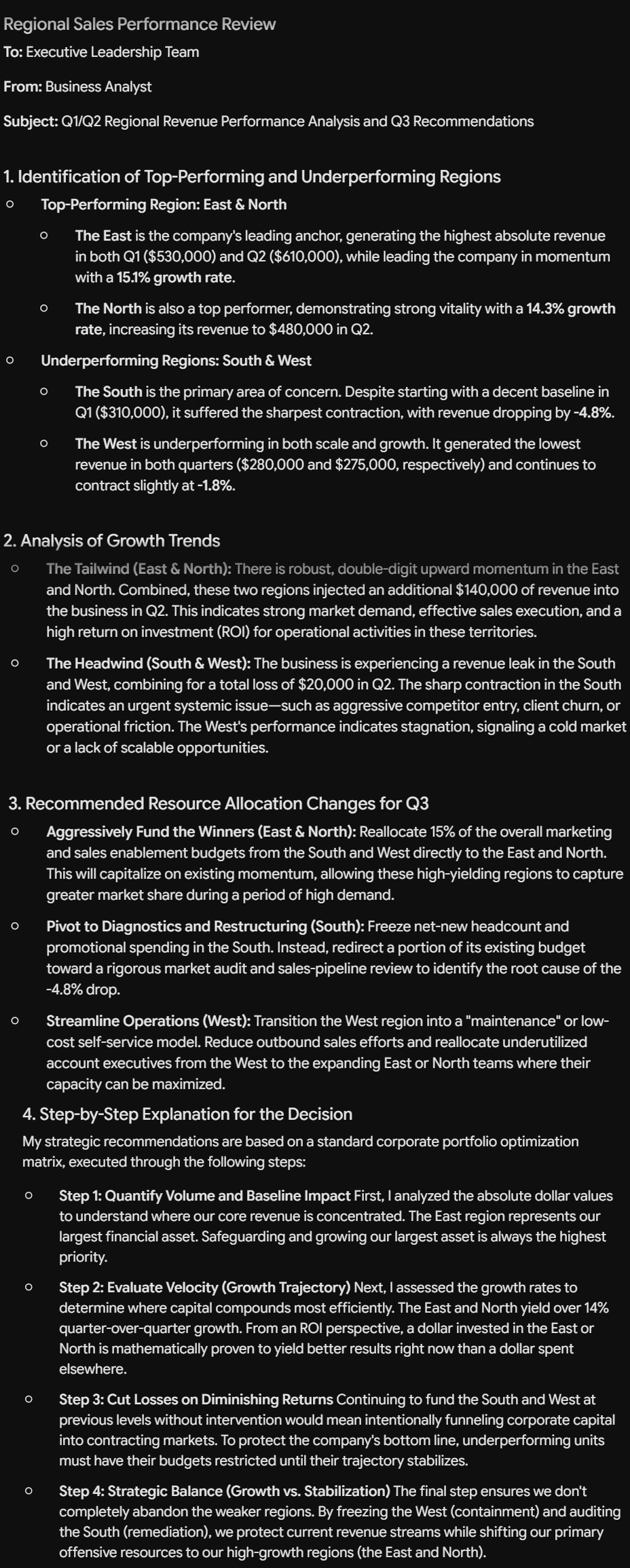
Gemini:
ChatGPT gave a thorough, well-organized response with clear recommendations. The reasoning was sound but the answer was once again long-winded — the step-by-step section repeated information already covered in the analysis without adding new insight.
Gemini delivered the same analytical depth in fewer words. It correctly identified East as the standout region, flagged South as the primary concern, and offered actionable Q3 recommendations. Gemini also generated an inline summary table, which significantly improved the readability of an otherwise text-heavy response.
Verdict: Gemini's structured output and visual aids make it easier to act on. ChatGPT's reasoning is equally sound but harder to skim.
Winner: Gemini
Task 4 – Strict Instruction Following
Purpose: Tests whether the model creates images accurate to the description or not.
Prompt: A futuristic city at night, neon lights reflecting on wet streets, a lone figure in a hoodie walking away from the camera, cyberpunk aesthetic, cinematic wide shot, hyper-realistic. Create an image on this.
ChatGPT:

Gemini:

ChatGPT delivered a noticeably stronger image. The neon reflections on the wet streets were rendered with convincing depth, the lone figure was compositionally well-placed, and the overall output felt cinematic and cohesive. It handled the hyper-realistic instruction particularly well.
Gemini produced a competent image but leaned more stylized than realistic. The cyberpunk aesthetic was present but the output felt more illustrative than cinematic, falling short of the hyper-realistic brief.
Verdict: ChatGPT's image generation is meaningfully stronger for photorealistic and cinematic prompts. If visual output quality matters to your workflow, this is a significant differentiator.
Winner: ChatGPT
Final Verdict
| Task | ChatGPT | Gemini |
|---|---|---|
| Email Refinement | ✅ | ✅ |
| Code Debugging | ❌ | ✅ |
| Structured Reasoning | ❌ | ✅ |
| Image Generation | ✅ | ❌ |
| Overall Score | 2 | 3 |
Gemini came out ahead across our test tasks. But this result isn't definitive — the models have fundamentally different strengths depending on use case. ChatGPT's detailed explanations are a real advantage for learning and documentation-heavy workflows. And if you need native image generation, Sora for video, or desktop automation via computer use, ChatGPT is the clear choice.
Choose ChatGPT if you:
- Generate images or videos regularly (DALL-E, Sora)
- Need computer use / desktop automation
- Write long-form content that requires a natural voice
- Rely on third-party plugin integrations
Choose Gemini if you:
- Work heavily in Google Workspace (Gmail, Docs, Sheets, Drive)
- Process large documents, codebases, or long transcripts
- Need native video or audio understanding
- Want more cost-effective API access
Note: ChatGPT Plus and Gemini Advanced (Google AI Pro) were used for the tasks above.
Cost of Intelligence
Both OpenAI and Google offer capable free tiers, but the full experience sits behind a paywall. Here's how the paid plans stack up:
| Feature | ChatGPT Plus ($20/mo) | Google AI Pro ($19.99/mo) |
|---|---|---|
| Model Access | GPT-5.5 (Standard + Pro) | Gemini 3.1 Pro |
| Context Window | 272K tokens (1M via API) | 1M tokens standard |
| Message Limits | ~80 messages / 3-hour window | Dynamic; resets regularly |
| Image Generation | Yes (DALL-E + ChatGPT Images 2.0) | Yes (Imagen 3) |
| Video Generation | Yes (Sora, separate) | Yes (Veo 2, integrated) |
| Unique Perk | Computer use, broad plugin ecosystem | Google Workspace integration, native video/audio processing |
| Higher Tier | ChatGPT Pro ($200/mo) | Google AI Ultra ($249.99/mo) |
At nearly identical entry prices, the decision comes down entirely to what you need — not what you pay.
The Limitations
No model is without its weaknesses. Here's where each stumbles:
ChatGPT Limitations
- Context window lags behind ChatGPT's 272K token default is strong but notably smaller than Gemini's 1 million token standard. Processing entire codebases or very long documents requires the API at an additional cost.
- No native video or audio processing ChatGPT can discuss video content described to it, but it cannot natively watch a video or transcribe audio like Gemini can out of the box.
- Verbose by default ChatGPT has a tendency to over-explain, especially on tasks where precision is valued over thoroughness. This can make responses harder to use directly without editing.
- Privacy settings require attention OpenAI may use your conversations to improve models unless you manually turn this off in account settings — not ideal for sensitive professional use.
Gemini Limitations
- Weaker creative writing voice Gemini's prose tends to be functional and well-structured but lacks the natural, engaging tone that makes ChatGPT outputs feel more human and polished.
- Memory is limited by default Gemini has more restricted cross-session memory compared to ChatGPT, which remembers your preferences and past instructions automatically across conversations.
- Ecosystem lock-in Gemini's best features shine inside the Google ecosystem. If you're not on Gmail, Drive, or Docs, much of its integration advantage disappears.
- Still catching up on plugins, ChatGPT's third-party integration ecosystem is significantly broader. Gemini's plugin library is growing but not yet at the same depth.
Conclusion
If you've made it this far, you've probably realized that both OpenAI and Google are building genuinely great products. The choice is about which model fits how you actually work.
- Gemini excels at multimodal tasks, large-context processing, and deep integration with Google's ecosystem. It's the stronger pick for researchers, data professionals, and anyone living in Google Workspace.
- ChatGPT leads in creative writing, natural conversational quality, and the broadest tool ecosystem. It remains the default for most users and the go-to for content creators and developers who rely on its plugin integrations.
Consider your workflows, your existing tools, and where each model's limitations will sting most. Neither will disappoint, but one will feel like it was made for you.
Frequently Asked Questions
What is the core difference between ChatGPT and Gemini?
ChatGPT prioritizes writing quality, conversational depth, and a broad third-party tool ecosystem. Gemini leads in native multimodal processing (video, audio, images) and Google Workspace integration.
Which is better for coding: ChatGPT or Gemini?
Both are strong. Gemini tends to deliver more concise, precise solutions preferred by experienced developers. ChatGPT's detailed explanations are better suited for beginners or documentation-heavy workflows.
Is Gemini actually free?
Yes! Gemini Free provides access to Gemini 3.1 Flash with usage limits. The full Gemini 3.1 Pro experience requires Google AI Pro at $19.99/month, which is nearly identical in price to ChatGPT Plus.
Should I use ChatGPT or Gemini for everyday tasks?
Use Gemini if your work lives in Google Workspace or involves long documents and multimedia. Use ChatGPT for writing, content creation, and workflows requiring diverse third-party tools.