

If you've been watching tech content lately, you've likely come across the term "agent". Agent has become the industry's new favourite buzzword.
But because of this hype, people have started confusing a chatbot with an agent. People believe they are both similar and that an agent is just a sophisticated name for a chatbot. Is that true? The answer is absolutely not.
Behind the scenes, they both work differently depending on the use case. In this article, I will break them down and ensure you understand the difference between the two.
If there is one thing I would like you to remember from this article, it is that chatbots respond, but agents take action.
The Chatbot
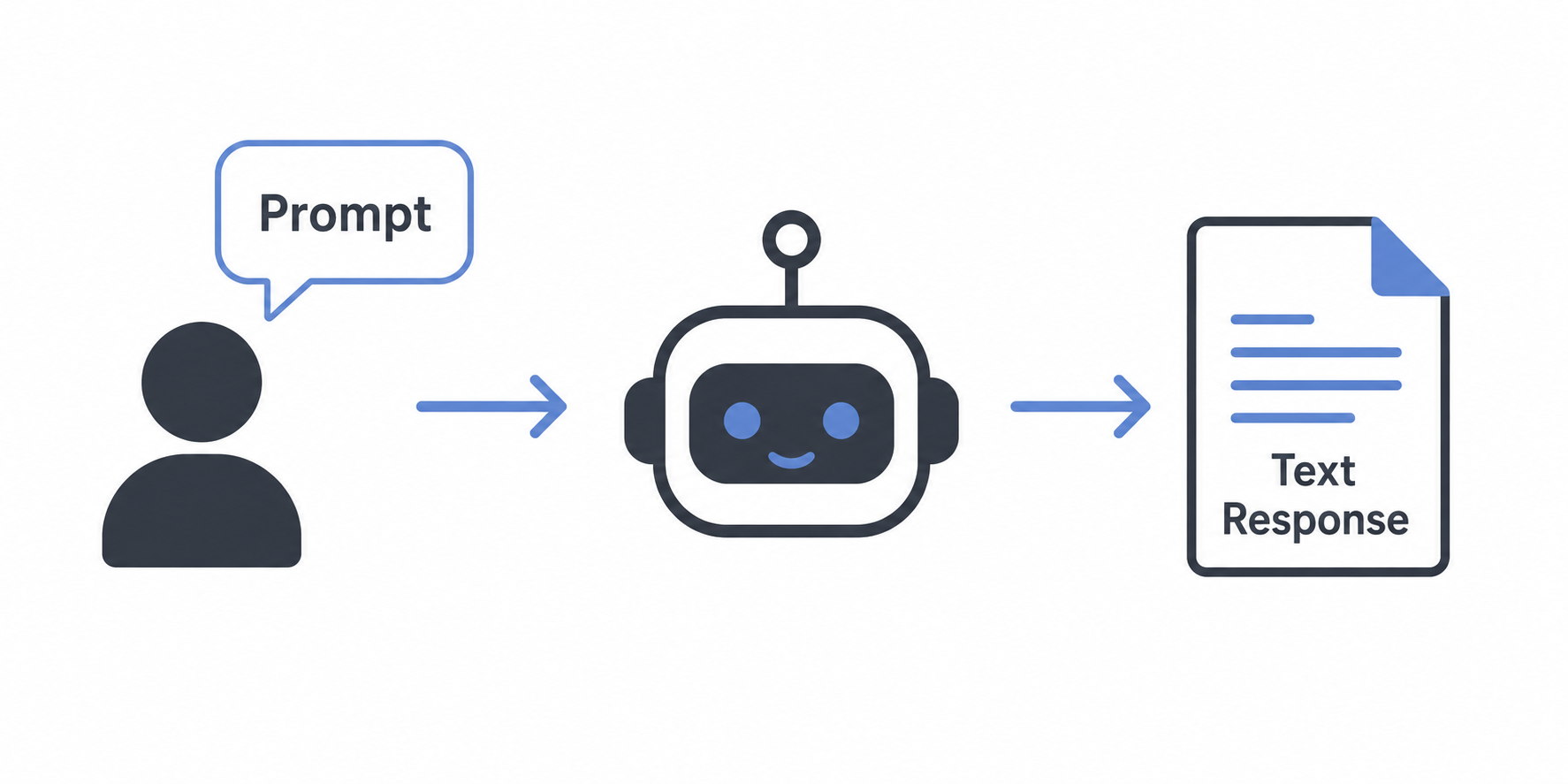
Before the AI boom, the word "chat-bot" literally meant a bot that could chat with users. These chats were based on strict rules.
You might even have interacted with these older, rule-based chatbots on banking or telecom websites. They operated like a massive decision tree. For example, if the user types "billing", show the billing link. They just followed the script.
Today, thanks to Large Language Models (LLMs), modern AI chatbots have become brilliant conversationalists. Instead of following a script, you simply type in a question, and the chatbot searches its training memory (or a connected company document) to generate a fluent, contextual answer.
However, even with this massive upgrade in intelligence, the prominent feature of a chatbot remains the same:it is reactive. This means a chatbot sits idle until you prompt it.
For instance, if you ask a standard customer service chatbot, "What is your return policy?", it will generate a paragraph explaining the 30-day return rules. But that is where it hits the wall. If you reply, "Please process my return," the chatbot won't be of any help. This is because it can only provide you with information and can't execute the actual work.
The AI Agent
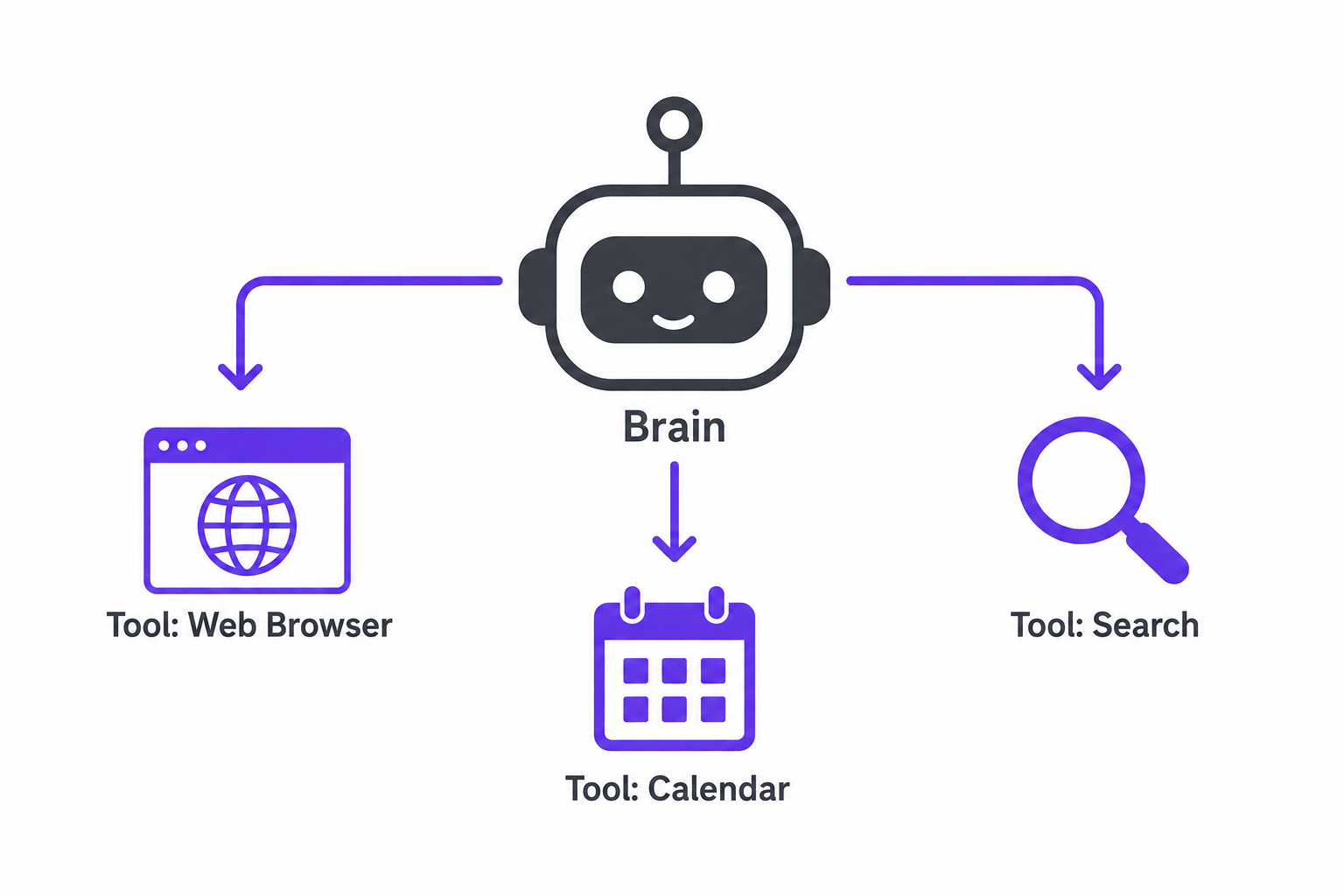
Interestingly, an AI agent uses the same brain (LLM) as a chatbot. But what differs is that we’ve given it hands (tools) to take action.
These tools are simply functions, APIs, or pieces of code that allow the agent to interact with external systems. Instead of only generating text, an agent can make a plan, make decisions, call tools, and execute tasks through a series of steps. If you want to understand how a model decides to run a function, check out Anthropic's official guide on Tool Use.
For example, let's say you ask an AI agent to book a hotel in London. Instead of just suggesting a few websites, the agent can check your calendar for available dates, search for hotels, compare prices, make the booking, and send the confirmation to your email. It's not just giving you the information. It actually gets the job done.
So the key difference that you must have identified by now is that a chatbot tells you what to do, while an AI agent can actually do it for you.
The Head-to-Head Breakdown
Here is the ultimate cheat sheet for spotting the differences between a chatbot and an agent.
I would say the main differences come down to four main operational pillars:
1. The Intent: A chatbot is designed to provide information, summarize documents, and handle conversational flow. An AI agent is designed to execute tasks, call tools, and complete entire multi-step business operations.
2. The Execution: A chatbot remains idle until a user types a prompt. An AI agent is autonomous. Meaning it can trigger itself in response to real-world events, such as a new customer email arriving or a database change.
3. The Mindset: A chatbot follows a straightforward path. Generates answer upon getting a question. An AI agent runs a loop of continuous reasoning. It assesses the Goal, selects the appropriate tool, executes it, and verifies the output.
4. The Memory: Standard chatbots generally treat every new conversation as a blank slate. AI agents maintain state and context across multiple software systems. This allows them to recall past steps and safely transfer data between systems.
If you look at the comparison above, the difference between a chatbot and an AI agent comes down to one simple idea: chatbots answer questions, while agents complete tasks.
It's true that a chatbot is excellent at providing information. It can explain a company's return policy, answer FAQs, or summarize a document if it has seen that data. But that's the end of its job.
An AI agent goes a step further. It understands the goal, determines the necessary actions, and uses external tools to complete the task. It's not waiting for you to manually tell it what to do. It can interact with other available systems and carry out the work on your behalf.
This pattern of thinking is based on a framework known as ReAct(Reason + Act). You can read about the same in the original Princeton and Google Research paper.
Applications
Understanding this difference is not just about improving your knowledge. It also helps you understand how a business can save time and money. Let's look at a few real-world cases where these two could be used for their respective tasks.
Let's begin with customer support. So, in the real world, chatbot use in customer support is excellent. It can answer simple questions like "What are your store hours?" so your human team doesn't have to. An AI agent can actually step in to handle issues like missing shipments with the courier and issue a refund directly to the customer's credit card.
When it comes to Sales and Marketing, a chatbot is great at capturing an email address when someone lands on your website. The work of an AI agent would be to take that email, research the person on LinkedIn, determine whether they are a high-value lead, create a new profile in your sales software, and draft a personalized outreach email.
My Experience Building Both
The difference between simply chatting and acting became clear to me when I was developing a project called RaceSense AI, an intelligence platform I built to analyze Formula 1 data.
Initially, when I tried building this using a standard language model, I ended up with an F1 chatbot. It was fantastic for conversation, as the chatbot could summarize race history or explain the rules of aerodynamics. But it couldn't calculate a live strategy based on changing weather conditions.
That's when I transitioned the architecture into an agentic workflow. By giving the LLM specific tools to pull live race telemetry and adjust retrieval parameters, the system got an upgrade. It's no longer just talking. It's actively computing strategies.
It needed hands to interact with the raw data. That shift from generating text to using tools is what turns a hobby project into a production-ready application.
Conclusion
When you need to decide which one to choose, it depends entirely on what problem you are trying to solve. If your team is exhausted from answering the same simple questions 50 times a day, a chatbot is the perfect lightweight solution. But if your problem is to get actual work done and ease your team's frustration in manual work, you need an AI agent.
Frequently Asked Questions
Are AI agents going to replace chatbots completely?
No! They actually work best together. This is because most companies use a chatbot as a friendly system to chat with the user. Once the chatbot understands that the user needs a complex task done, it passes the job to the AI agent to run in the background and complete it.
Is ChatGPT a chatbot or an AI agent?
The standard version of ChatGPT that we use is a chatbot. You ask something, and it answers back. It's really good at it. However, when you give it access to tools such as the ability to search the live internet, run Python code, or connect to your Google Drive, it begins to behave like an agent.
Which one is harder to build?
AI agents are significantly more complex to build. With a chatbot, you just need to connect the LLM to some text documents it can draw on to answer. With an agent, you have to write code for the tools, manage various permissions, and build safety guardrails to prevent it from accidentally executing the wrong action in your real-world systems.
Can I upgrade my current website chatbot into an AI agent, or do I have to start from scratch?
The good news is that you don't have to rebuild everything from scratch. In most cases, you can keep the same UI your customers already use. The real change happens behind the scenes.
Instead of connecting the chat window to a traditional chatbot, you connect it to an AI agent. That means integrating an agent framework, such as LangGraph, and giving the agent the tools it needs to interact with your business systems.
In simple terms, it's like replacing a car's engine. From the outside, everything looks the same. But inside, you've replaced a basic engine with one that's far more powerful and capable.