

In the past few years, I am sure you must have seen AI generate some stunning images like never before. These images are generated from nothing more than a short text prompt.
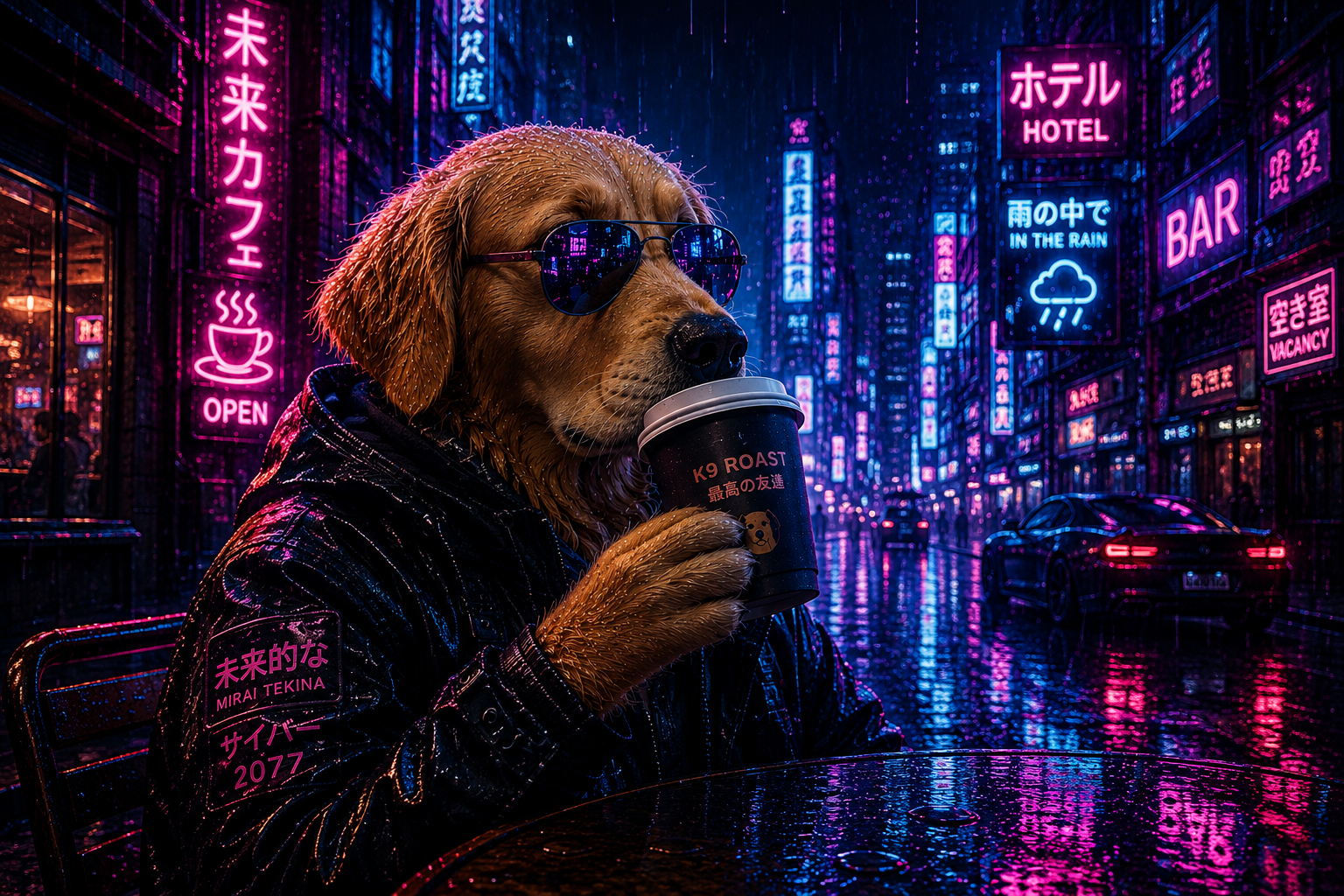
Let's say you type something like: A cyberpunk golden retriever drinking coffee in neon rain. Within a few seconds, you get a detailed image that never existed before.
The image for that text prompt would look something like this:
I know it sounds crazy, but tools like Midjourney, DALL·E, and Stable Diffusion have completely changed the landscape of AI-driven art creation.
Image generation is a process that works very differently compared to how text is generated using LLMs.
Since the results are so impressive, many people assume these models simply search through a huge database of images, capture parts of them, and combine them into a new picture.
But that's not how they work.
Image generation models do not store billions of images that they paste together. Even without an internet connection, they can generate entirely new images.
So the question is: where do these images come from?
The answer to this is a type of AI called a diffusion model. Rather than copying existing images, a diffusion model learns how to create them from random noise.
Let's understand how this process works in a simple way.
The Idea
To understand diffusion models, think of a glass of clear water.
Now drop a small amount of black ink into it.
At first, you can clearly see the ink. But after a while, it spreads throughout the water until everything becomes cloudy and mixed together. The original drop is no longer visible. That drop has dissolved into what looks like random noise.
In the real world, this process naturally moves in one direction. Once the ink has spread, you can't just reverse time and make it gather back into a perfect drop.
But guess what? Diffusion models learn to do exactly that.
Instead of starting with a blank canvas, they begin with pure random noise and gradually remove it. This is done one step at a time, until a clear image appears.
An easy way to think about this is a sculptor working with a block of marble. The final statue is revealed by carefully removing what doesn't belong.
In the same way, a diffusion model removes noise step by step until the desired image appears.
How Diffusion Models Work
To understand how a diffusion model creates an image, let's break down the process in three simple stages.
Phase 1: Adding Noise
This is the first stage of training.
Developers start with millions of real images, such as photos of animals, cars, or landscapes. The model then gradually adds small amounts of random noise to each image.
For example:
Step 1: The image looks slightly grainy.
Step 50: Most of the image is covered with noise.
Step 1000: The original image has completely disappeared and looks like random TV static.
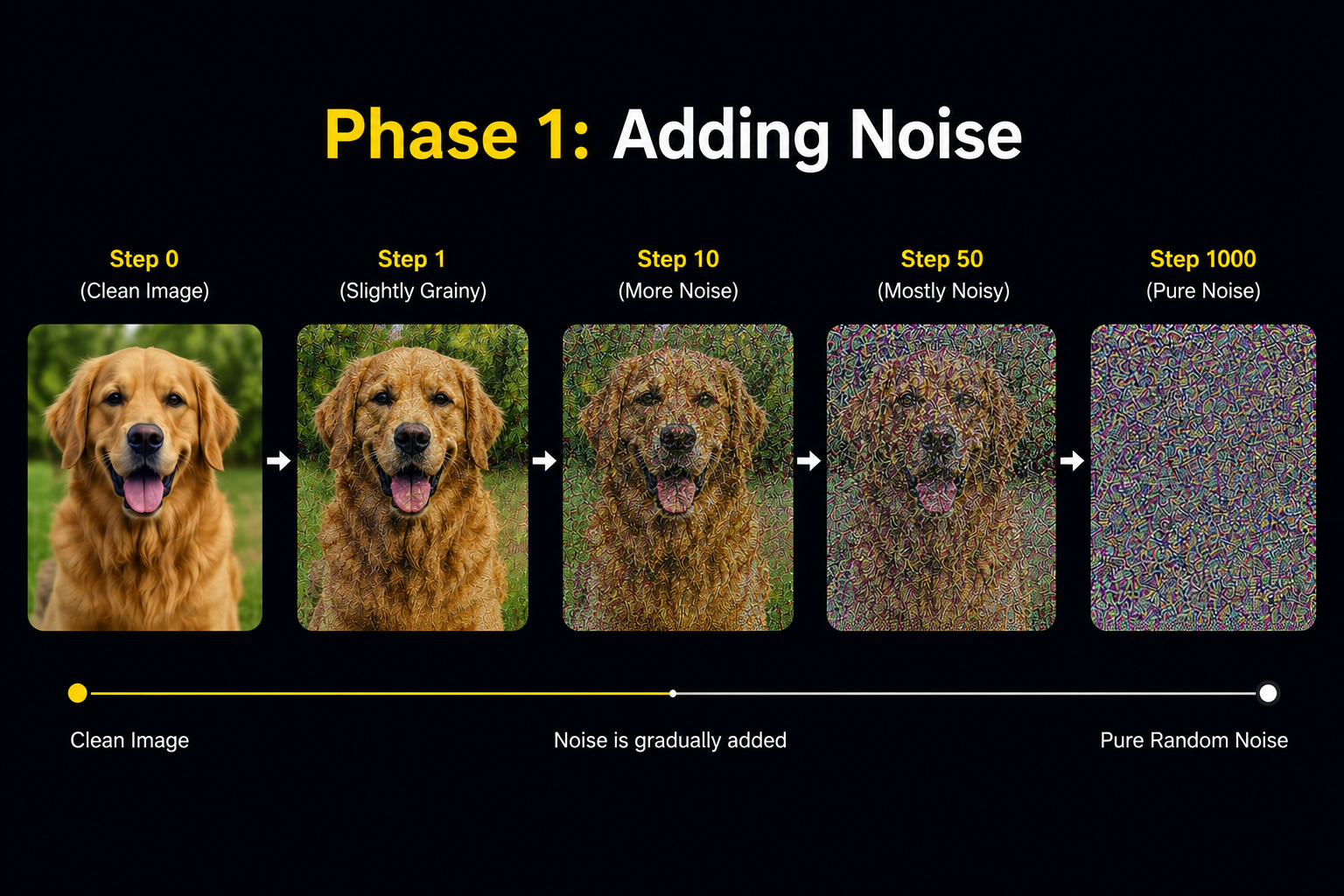
By repeating this process across millions of images, the model learns how clean images gradually become noisy.
Phase 2: Learning to Remove Noise
This is the most interesting part. I call it the learning process.
Here, the model is shown a noisy image and asked a simple question:
"Can you figure out which part of this image is just noise?"
At first, the model makes incorrect guesses. During training, the model is corrected after every prediction. Over time, it becomes extremely good at separating the actual image from the noise.
This is the most important skill a diffusion model learns.
Phase 3: Creating a New Image
This is the stage that happens when you type a prompt.
In this stage, the model starts with nothing but random noise. It then reads your prompt. For example, "A golden retriever wearing sunglasses."
Using everything it learned during training, the model slowly removes the noise while shaping the image to match your prompt. It repeats this multiple times.
With every step, the image becomes a little clearer until the desired image appears.
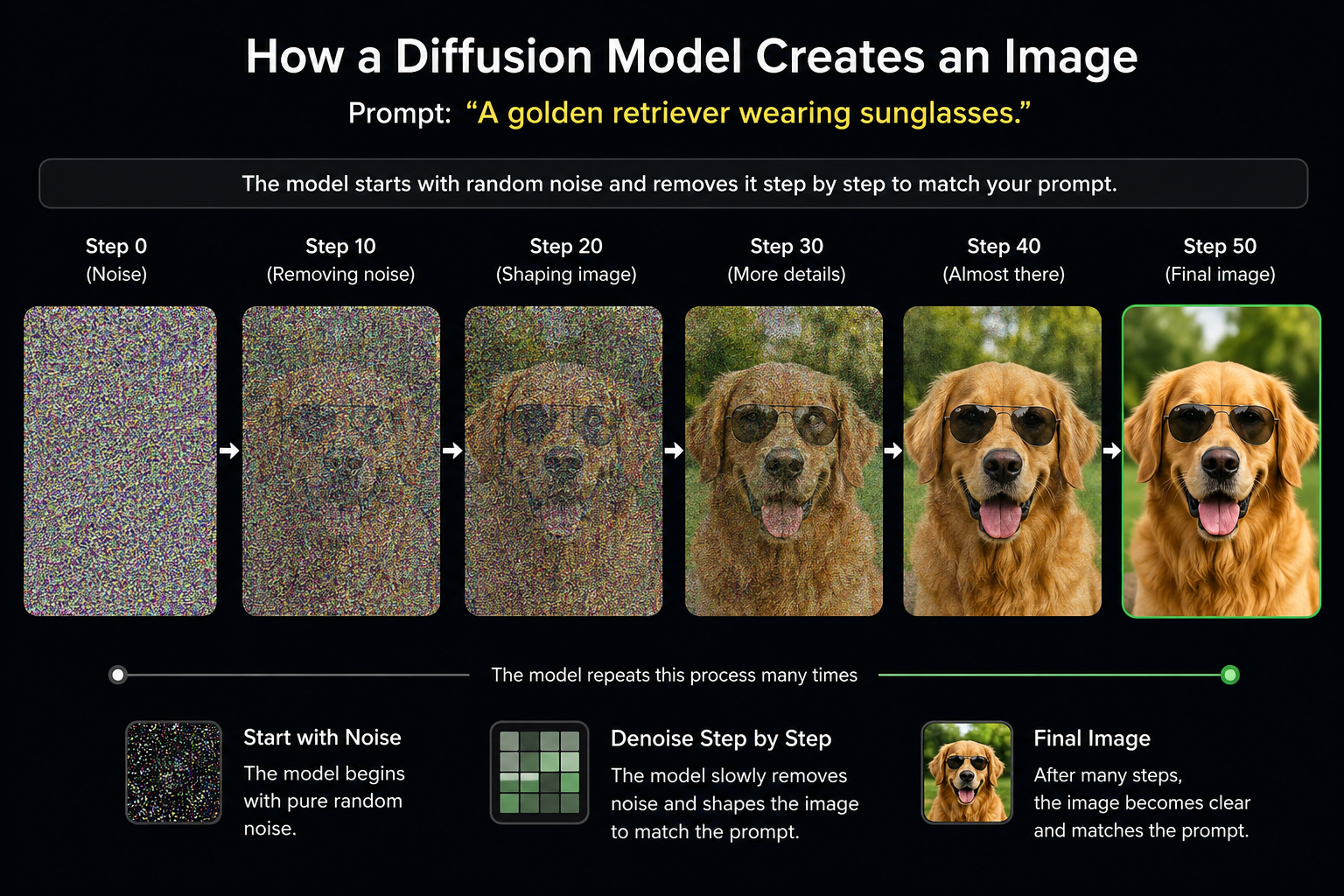
You might notice a difference in the numbers here. While the training phase adds noise over many steps (e.g., 1,000), the generation phase is optimized to remove it in far fewer steps (typically 30-50).
This allows the AI to produce a high-quality image in just a few seconds, so you don't have to wait for hours.
So, as you can see, instead of drawing an image from scratch, the model gradually transforms random noise into a meaningful image.
Building Real Applications with Diffusion Models
Building applications with diffusion models is very different from building applications with language models.
With LLMs, one of the biggest challenges is reducing hallucinations and making sure the model is highly accurate. With diffusion models, the biggest challenge is usually speed.
Unlike text models, which can generate responses quickly, diffusion models repeat the denoising process many times before producing an image.
As a result, generating a single image can take several seconds. So, for applications where users expect results quickly, this delay becomes a challenge.
Another challenge is consistency.
Every AI image starts from a layout of random noise. What controls this layout is a specific number called a seed.
I want you to think of this seed like a coordinates map for the initial random static.
Different Seed + Same Prompt = Different Images: By default, AI tools randomly generate a new seed number every time you submit. Now, because the starting noise pattern is random every time, typing "a golden retriever" twice will give you two different images.
Same Seed + Same Prompt = The Exact Same Image: If you lock in a specific seed number (like seed: 42), the AI is forced to start with the exact same layout of noise. If you combine that locked seed with the exact same prompt, the model will produce the same image every single time.
Understanding how prompts and seeds correspond is essential for developers. If you are building an application that requires consistent characters, products, or marketing images, prompts alone aren't enough.
You have to lock and manage the seed numbers across generations, or use advanced structural techniques like ControlNet to keep important parts of the image consistent.
Conclusion
Diffusion models have transformed the way images are now created.
Instead of copying existing images, they learn the patterns behind millions of examples and use that knowledge to gradually transform random noise into the desired image.
This simple idea has powered various tools such as Midjourney, DALL·E, and Stable Diffusion.
As these models continue to improve, they'll do much more than generate images. They're already moving ahead with video generation, 3D content creation, and most of the creative tools we'll use in the future.
Frequently Asked Questions
If AI is not copying images, why do some generated images contain fake watermarks?
During training, the model comes across millions of images, including stock photos with watermarks. It doesn't know what a watermark actually is. It only learns visual patterns.
As a result, there may be times when it generates fake watermarks because it has learned that many professional images contain them.
Why do AI-generated images sometimes have weird hands or incorrect text?
Diffusion models don't understand human anatomy or language the way we do. They only learn patterns from images.
Producing hands can be difficult because fingers can bend, overlap, or be hidden from different angles. Similarly, generating readable text can be challenging because the model treats letters as visual patterns rather than actual words.
That's why older image models often produced incorrect hands and unreadable text.
Are diffusion models copying artists' work?
No, diffusion models are not copying or storing existing images. Instead, they learn patterns from millions of training images and use those patterns to generate new ones.
However, there have been ongoing legal debates about whether training AI models on copyrighted content is allowed.
Can I run a diffusion model on my own computer?
Yes. Some models, such as Stable Diffusion, are open source and can run locally if your computer has a reasonably powerful GPU.
Other tools, such as Midjourney and DALL·E, run on cloud servers, so you access them via an online service instead of downloading the model.
Is the same technology used to generate AI videos?
Yes, although it's more advanced.
Instead of generating a single image, video models generate multiple frames while ensuring consistency from one frame to the next.
This creates a smooth flow and prevents objects from randomly changing shape or appearance throughout the video.