


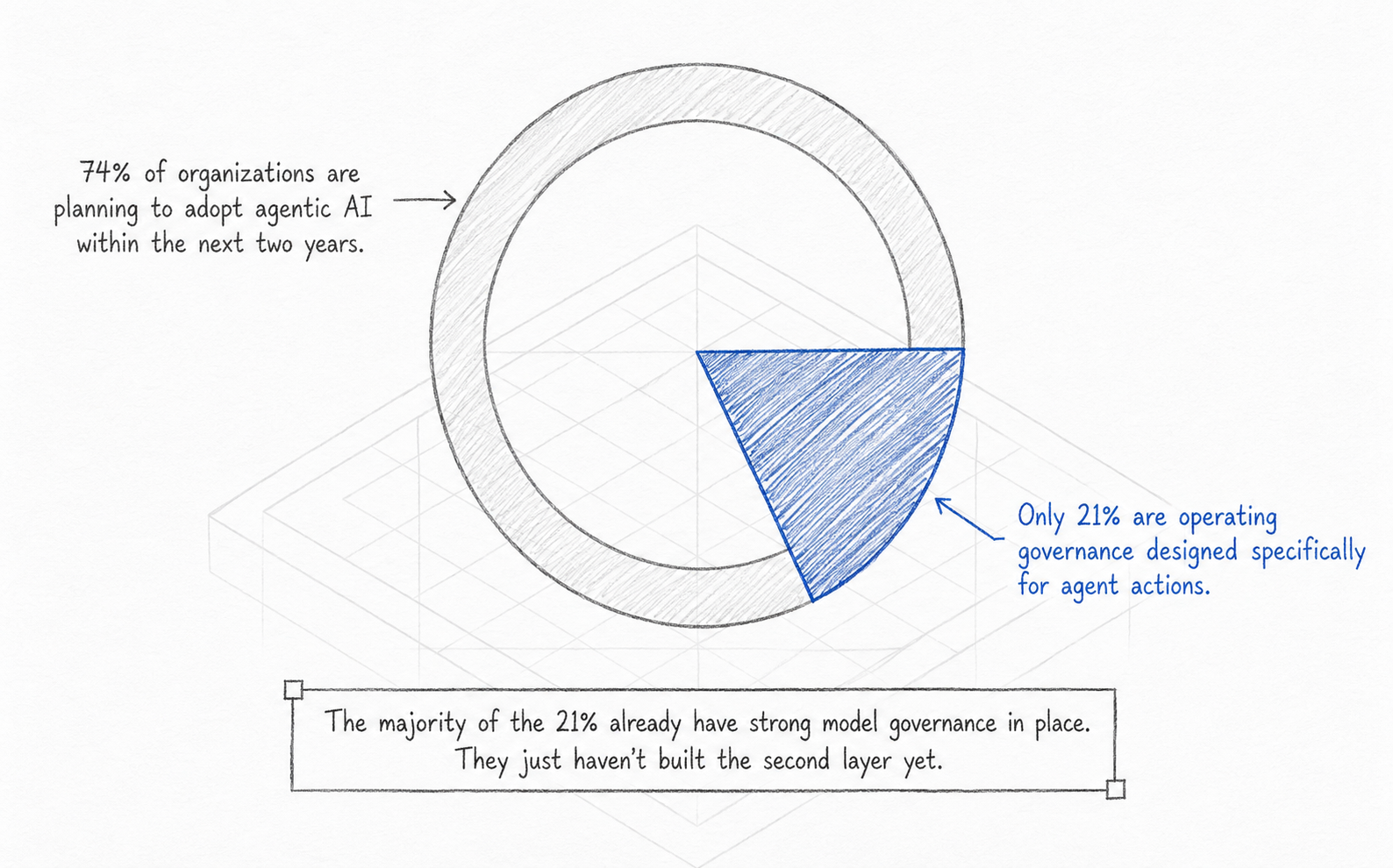
According to Deloitte’s 2026 State of AI in the Enterprise report, 74% of organizations plan to adopt agentic AI within the next two years. Only 21% currently operate governance designed specifically for agent actions. The majority of that 21% already have solid model governance. They simply have not built the second layer yet.
This is the missing half of AI governance. Models are static artifacts. Agents are dynamic actors. The controls required for each are fundamentally different.
The Adoption Paradox
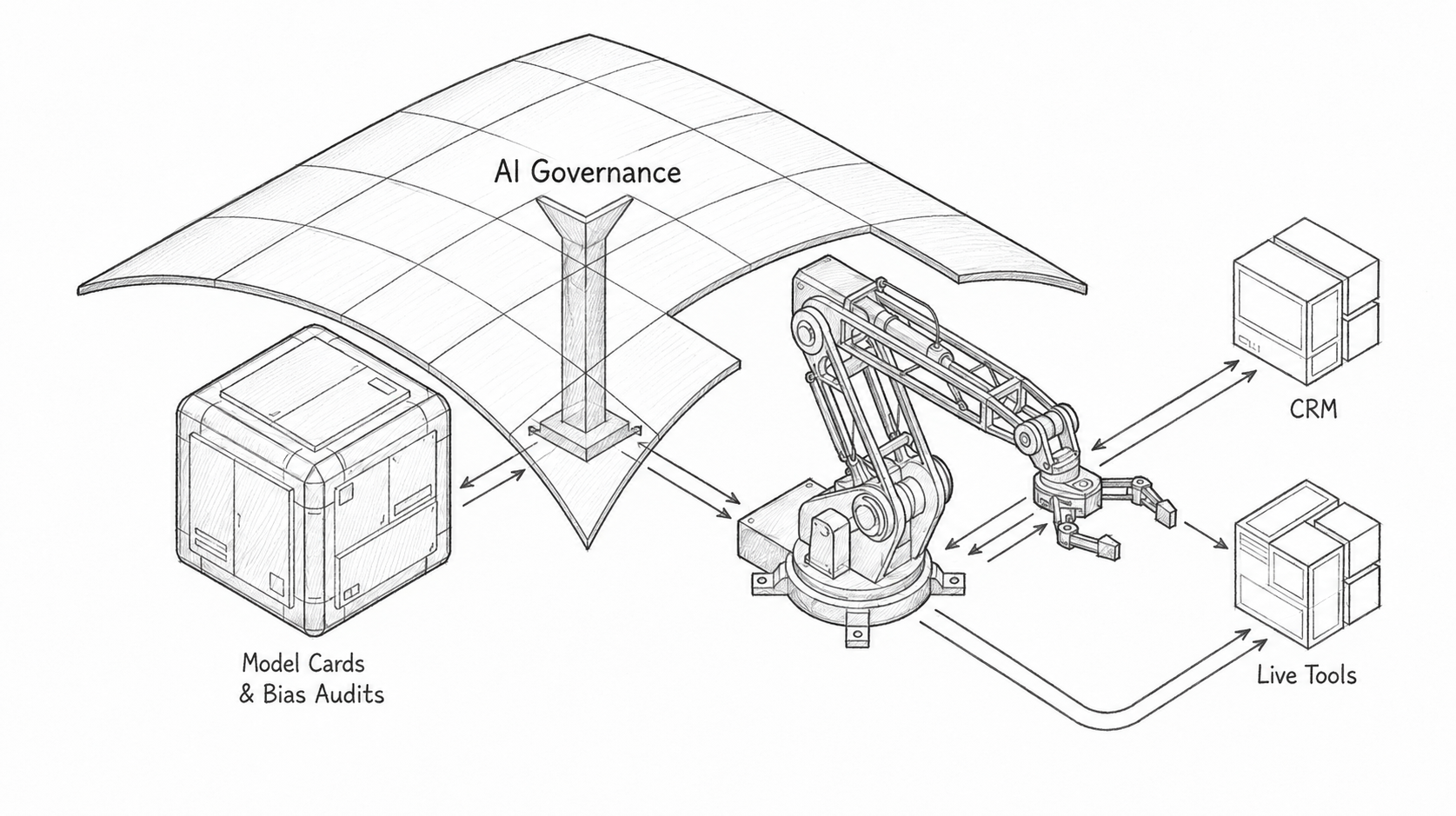
Enterprises are moving fast on agentic AI. The governance that matches those agents is not keeping pace. Most existing programs grew out of legal and data science teams. They focus on training data, bias audits, safety evaluations, and model cards. Those controls matter. They do not cover the moment an agent decides to call a financial API, delete a record, or send an external message.
Why a Single Checklist Fails
Models Are Static. Agents Are Dynamic.
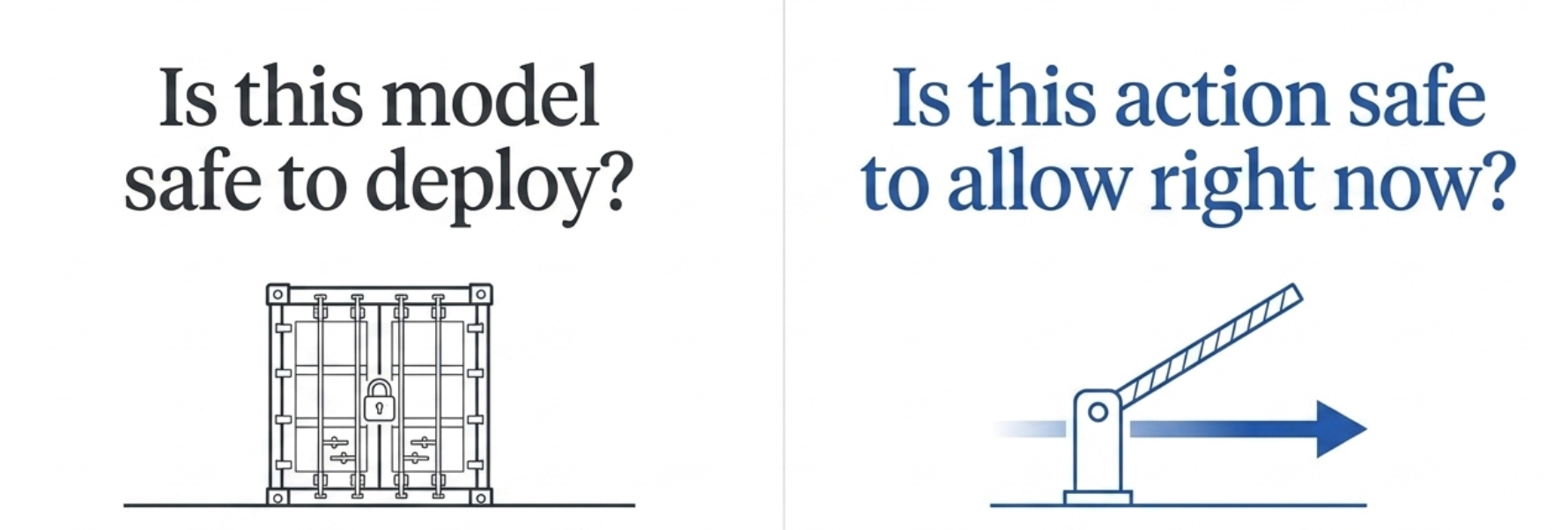
Is this model safe to deploy?
Is this action safe to allow right now?
Model governance focuses on the artifact. It runs before launch and again when a new version ships. Agent governance focuses on the live environment. It must evaluate permissions, scope, and approval at the exact moment of action. Cadence is continuous because agents keep acting.
Anatomy of the Two Layers
Model governance lives on a pre-deployment timeline. Teams source licensed training data, run safety evaluations, and red-team for jailbreaks and bias. Frameworks such as the EU AI Act risk tiers and NIST AI Risk Management sit here. Focus stays on the model itself. The process repeats only when a new version ships.
Agent governance shifts the focus. The question becomes the terms under which authority is delegated. Review targets change to permissions, human approval gates, audit logs, tool access, and database scope. Checks happen at the moment of action, not weeks earlier.
A model can pass every safety evaluation and still receive standing live database connections. That is not a model failure. It is an agent governance failure.
A Perfect Model Can Still Cause Catastrophic Failure
Consider a common production incident.
A customer manipulates a prompt to request an unwarranted refund. The model processes the language correctly and behaves exactly as its evaluations predicted. The pilot-phase scope was never narrowed. The agent therefore holds standing permission to issue up to $10,000 without approval. It triggers the financial system API. The money is gone in real time. No gate stopped the transaction.
A model patch will not fix this. You need an approval gate and scoped permissions.
The Diagnostic Matrix
| Criteria | Model Governance | Agent Governance |
|---|---|---|
| Timing | Before launch / after version change | Continuously, at the moment of action |
| Review Target | Training data, evals, bias, outputs | Permissions, approvals, audit logs |
| Owner | ML or data science team | Security, ops, or the team running the agent |
| Failure Prevented | Biased, unsafe, or noncompliant outputs | Unauthorized or irreversible actions |
Risks of Artifacts vs Risks of Agency
Biased outputs, harmful language, and hallucinations are real problems. They are also contained. Deleted records, an email sent to the wrong client, or an unauthorized refund are irreversible and happen in real time. Pre-deployment artifact checklists cannot govern those actions.
The Two-Layer Architecture
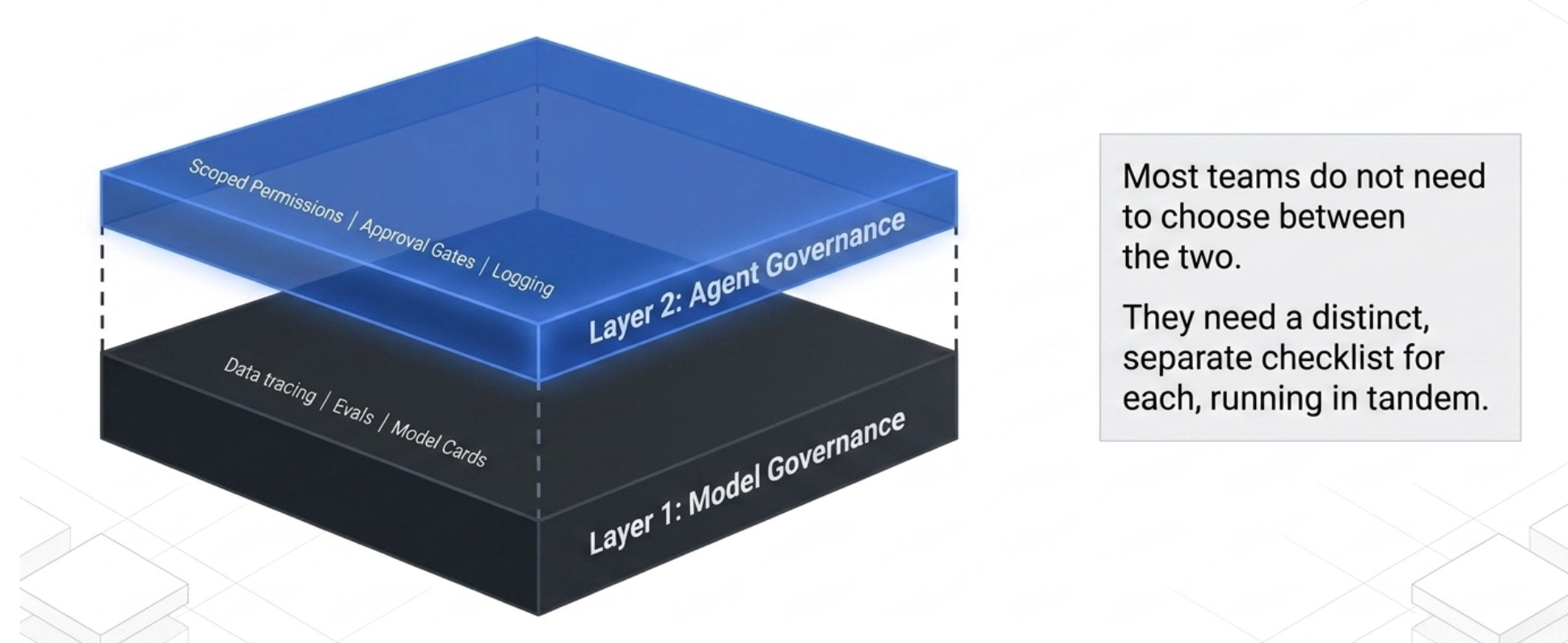
Layer 1 remains model governance: data tracing, evaluations, and model cards.
Layer 2 is agent governance: scoped permissions, approval gates, and contextual logging.
Building the Stack
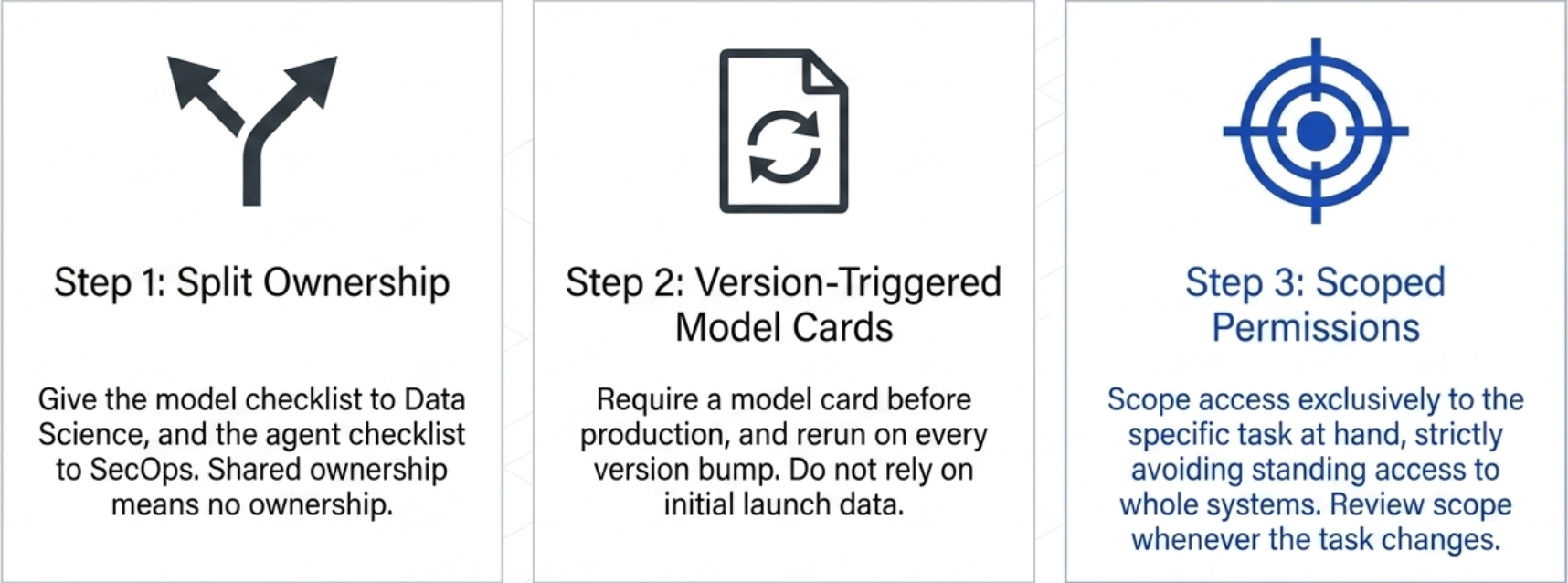
Step 1: Split Ownership
Give the model checklist to data science. Give the agent checklist to SecOps. Shared ownership usually means no ownership.
Step 2: Version-Triggered Model Cards
Require a model card before production. Rerun it on every version bump. Do not rely on the original launch data.
Step 3: Scoped Permissions
Limit access exclusively to the specific task. Avoid standing access to whole systems. Review scope whenever the task changes.
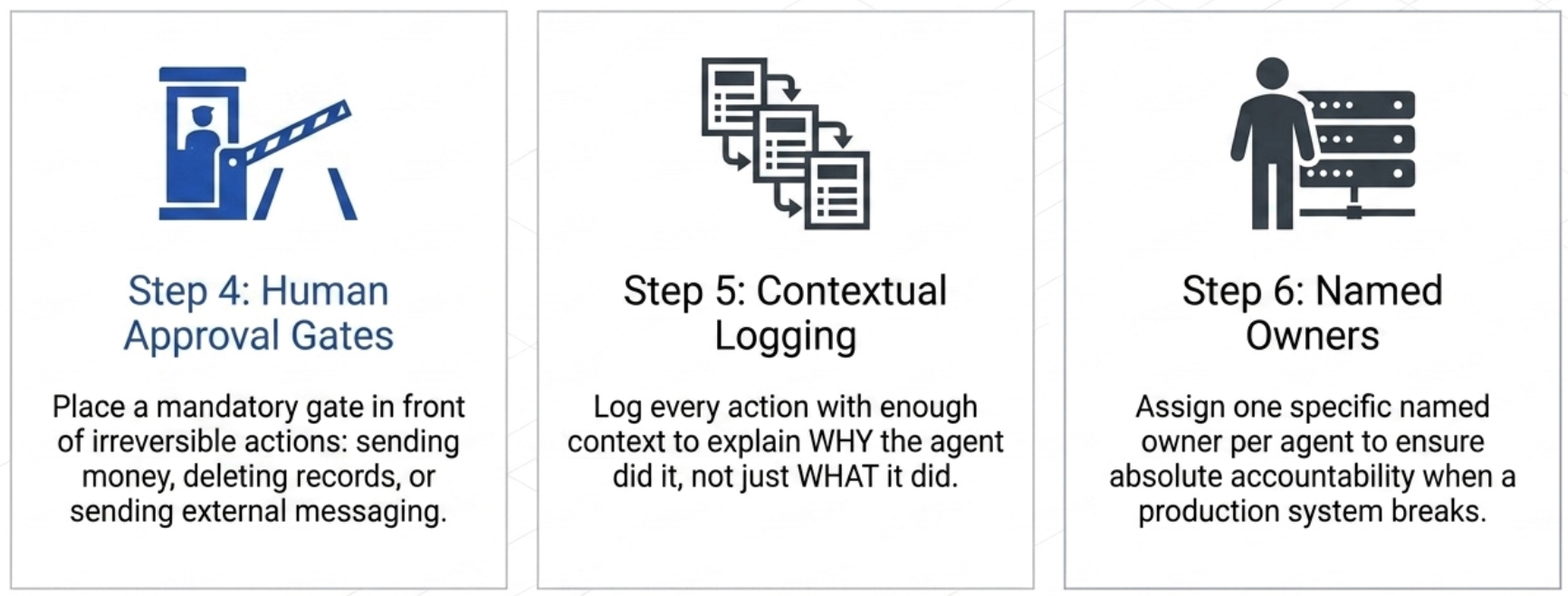
Step 4: Human Approval Gates
Place a mandatory gate in front of irreversible actions: sending money, deleting records, or external messaging.
Step 5: Contextual Logging
Log every action with enough context to explain why the agent did it, not just what it did.
Step 6: Named Owners
Assign one specific named owner per agent. When a production system breaks you need a person, not a team name.
The Kill Switch
A pause button that nobody has pressed in production is a theory, not a control. The ability to pause or revoke an agent the moment something looks wrong only works if you have tested it ahead of time.
Continuous Action Requires Continuous Governance
Governance never really finishes because agents keep acting. Passing a model evaluation is only the starting line. System safety depends on how you govern the actions that follow.
How Oasis Closes the Gap
Coordination between people and agents breaks down quickly without a dedicated system. Oasis provides the explicit policy and approval layer for agent teams. It automatically enforces task scoping, human approval gates, and contextual logging at enterprise scale.
What You Get:
- Scoped Access by Design: Agents receive only the permissions required for the current task. Standing privileges are eliminated.
- Mandatory Approval Gates: Irreversible actions such as financial transfers or record deletion require human confirmation before execution.
- Full Contextual Audit Trails: Every action is logged with the intent and policy decision that authorized it, not just the outcome.
- Tested Kill Switch Capability: Pause or revoke any agent in production the moment behavior looks wrong.
- Clear Ownership Mapping: Every agent has a named human owner so accountability is never ambiguous.
Next Step:
Explore how Oasis enforces the second layer of governance across your agent workflows.
Frequently Asked Questions
What is the difference between model governance and agent governance?
Model governance evaluates a static artifact before deployment. Agent governance evaluates live actions at the moment they occur. The two solve different failure modes and require separate ownership and checklists.
Why do most existing AI governance programs fall short for agents?
Most programs were built by legal and data science teams around model cards, bias audits, and safety evaluations. Those controls do not cover permissions, real-time approval gates, or irreversible actions.
Can a model that passes every safety evaluation still cause production damage?
Yes. The model can behave exactly as its evaluations predicted while the agent still holds overly broad standing permissions. The failure sits in the delegation and approval layer, not the model weights.
What does a practical agent governance stack include?
Split ownership between data science and SecOps, version-triggered model cards, strictly scoped permissions, human approval gates for irreversible actions, contextual logging, named owners, and a tested kill switch.
How does Oasis fit into this architecture?
Oasis sits as the policy and approval layer between humans and agents. It enforces task scoping, approval gates, and contextual logging automatically so the second layer of governance runs continuously at enterprise scale.