

Most AI systems today operate like solo performers. They receive a task, complete it and… that’s about it.
This works surprisingly well for straightforward tasks. Write an email, book a hotel room, turn on my Spotify playlist. But business operations are rarely straightforward.
Modern workflows involve multiple tools, shifting context, approvals, memory, execution steps, and constant decision-making. As operational complexity increases, relying on a single AI agent quickly becomes inefficient.
This is where multi-agent systems come in. In this blog, we’ll explore what multi-agent systems are and why they’re the future of enterprise AI automation.
AI Agents and their Struggle with Complexity
A single AI agent can already perform impressive tasks. It can summarize reports, write emails, retrieve information, interact with APIs, and automate repetitive work. The problem begins when one agent is expected to manage entire operational pipelines end-to-end.
Consider something as simple as outbound sales. The workflow itself is not singular, and a typical one looks like this:
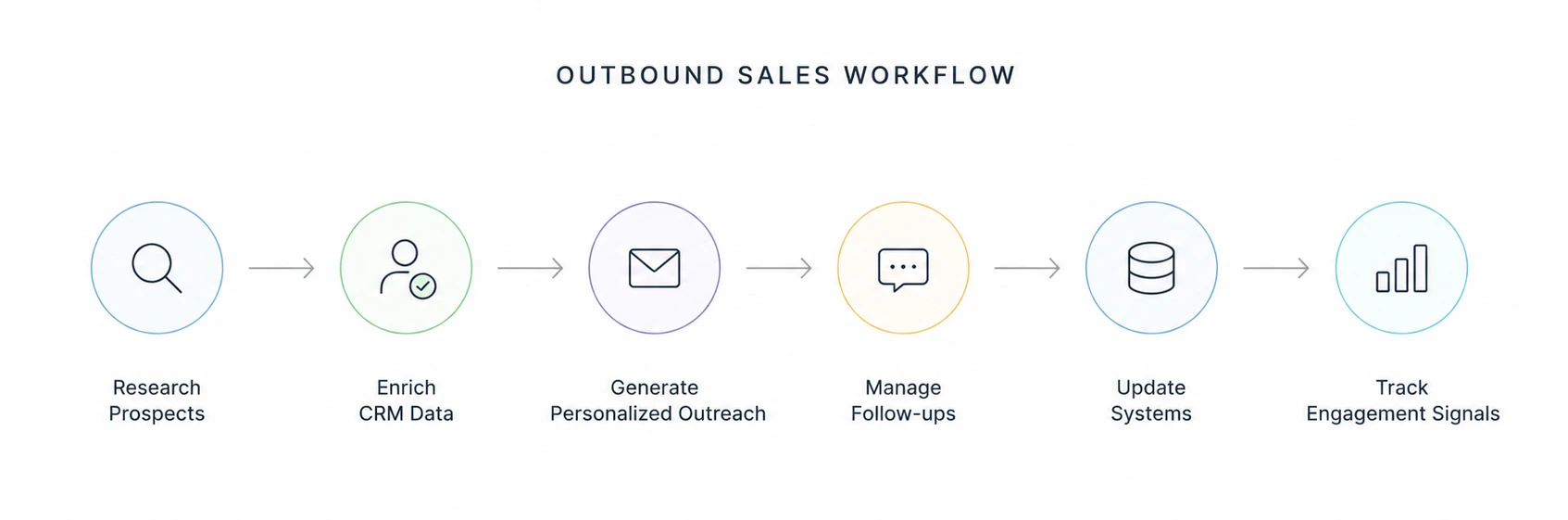
A typical sales workflow
Trying to make one AI agent handle all of this creates several problems:
- overloaded context windows
- inconsistent reasoning
- reduced reliability
- poor memory persistence
Eventually, the agent becomes less effective because too many responsibilities are concentrated into one system.
The issue is not necessarily intelligence. The agent by itself would’ve completed its job satisfactorily. It is a lack of coordination.
What is a Multi-Agent System?
A multi-agent system is an AI architecture where multiple specialized agents collaborate within a shared workflow. Instead of relying on a single agent to perform every task, responsibilities are distributed across agents with distinct roles.
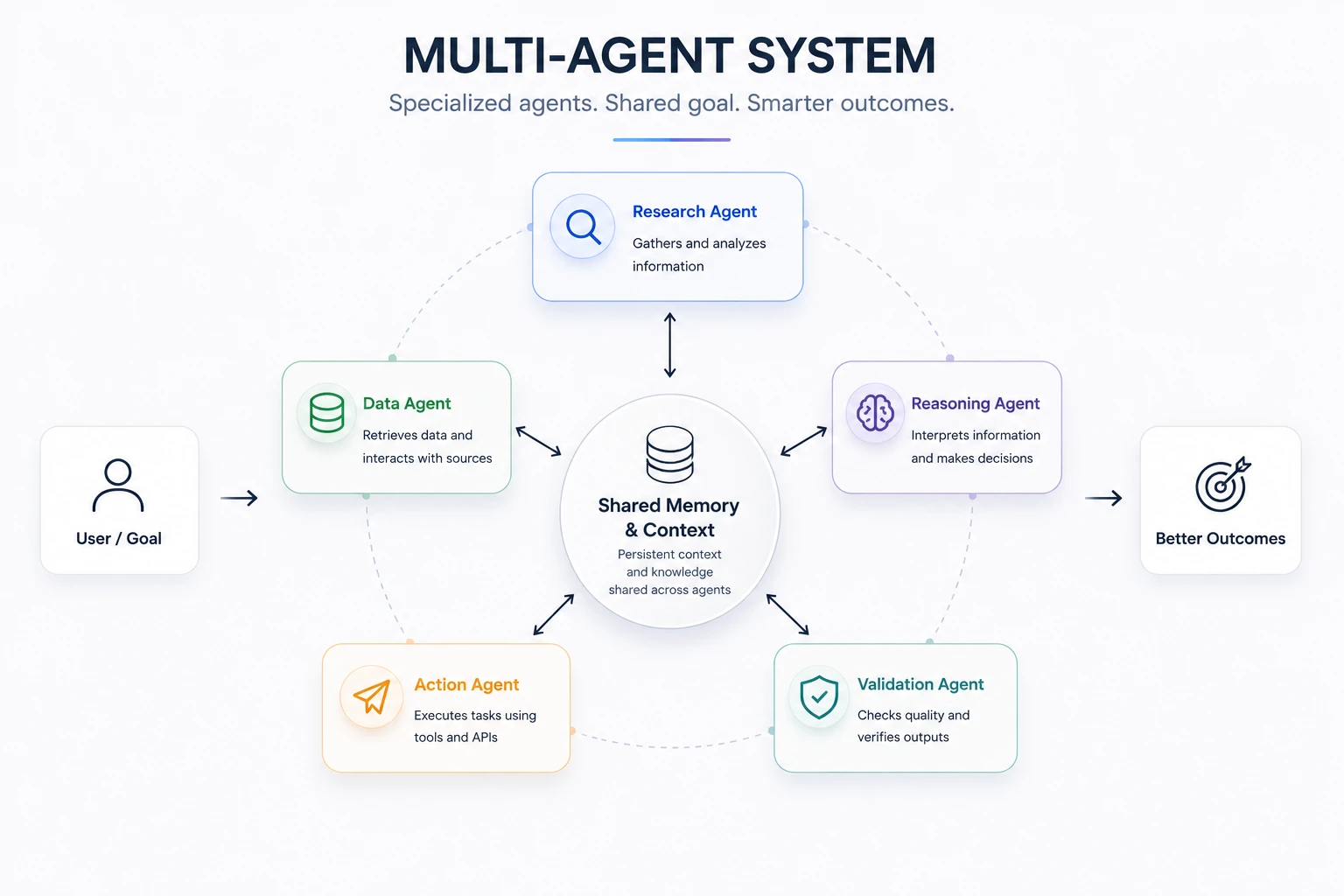
A system in which specialized agents work towards a shared goal
One agent may gather information, another may reason through decisions, while others interact with tools, retrieve data, or validate outputs. Working together, these agents share context, coordinate actions, and contribute toward a common objective.
This distributed approach improves scalability, reliability, and adaptability, enabling AI systems to handle more complex workflows than a single agent could ever manage alone.
Single Agent vs Multi-Agent Systems
| Single Agent | Multi-Agent | |
| Intelligence | One generalist | Multiple specialists |
| Planning | Individual | Collaborative |
| Memory | Local | Shared |
| Execution | Sequential | Parallel |
| Scalability | Limited | High |
| Reliability | Lower | Higher |
| Coordination | None | Built-in |
| Best For | Simple tasks | Complex workflows |
The two can be described in the following manner:
While single-agent systems excel at isolated tasks, multi-agent systems unlock greater scalability and reliability by enabling specialized agents to collaborate toward a shared objective.
Why AI Works Better in Teams
Most business workflows aren't a single task. They're a sequence of interconnected decisions.
Consider something as simple as outbound sales. Before an email is sent, someone needs to research prospects, enrich CRM data, generate outreach, manage follow-ups, and track engagement. Expecting one AI agent to handle every step is possible, but not always efficient.
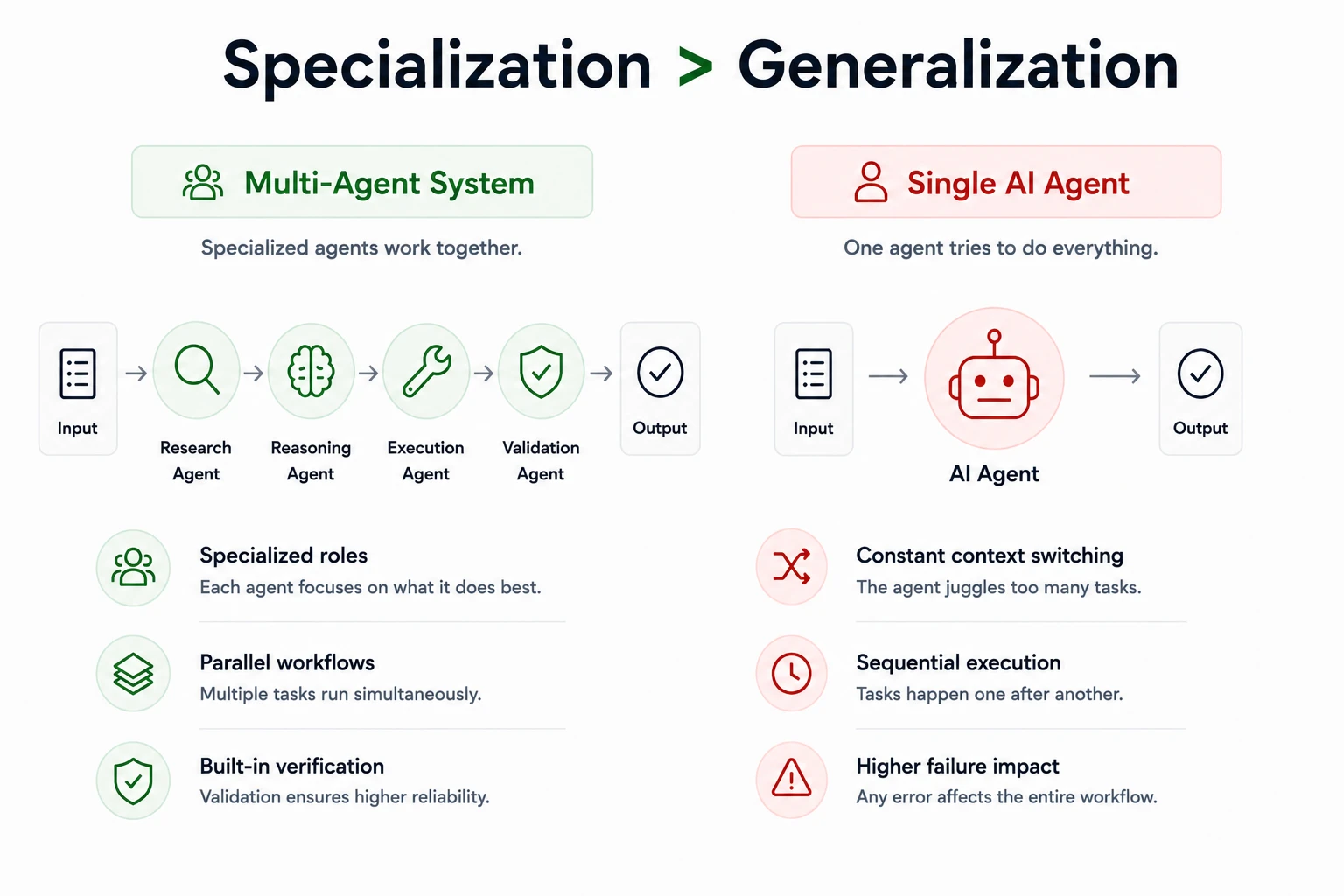
Multi-Agent systems vs Single Agent systems
This is where multi-agent systems shine.
Instead of relying on a single generalist, work is distributed across specialists:
- A research agent gathers information.
- A reasoning agent decides what matters.
- An execution agent interacts with tools and systems.
- A validation agent checks outputs before action.
No single agent needs to carry the entire workflow.
This division of labor reduces context switching, improves reliability, and allows multiple tasks to run simultaneously. More importantly, it mirrors how high-performing teams operate in the real world: specialists handling specific responsibilities while working toward a shared outcome.
The result isn't necessarily smarter agents. It's a smarter system.
Real-World Examples of Multi-Agent Systems
Multi-agent systems are already being deployed across a wide range of business functions, particularly where workflows involve multiple decisions, tools, and stakeholders.
- Sales & Marketing
Outbound sales workflows often involve separate agents for prospect research, CRM enrichment, lead scoring, personalized outreach, and follow-up management, creating a highly automated revenue pipeline. - Customer Support & Success
Support operations can leverage multiple agents to classify tickets, retrieve documentation, draft responses, route requests, and escalate complex cases to the appropriate teams. - Research & Intelligence
Research workflows frequently involve one agent gathering information, another identifying patterns, another validating findings, and another compiling structured reports for decision-makers. - Software Development & Engineering
Engineering teams increasingly use specialized agents for code review, bug detection, test generation, documentation, and deployment assistance throughout the software lifecycle. - IT Operations & Monitoring
Infrastructure workflows can distribute responsibilities across agents focused on monitoring systems, detecting anomalies, investigating incidents, and coordinating remediation efforts. - Finance & Analytics Financial operations can use multiple agents to collect data, reconcile records, generate reports, identify anomalies, and surface insights for business leaders.
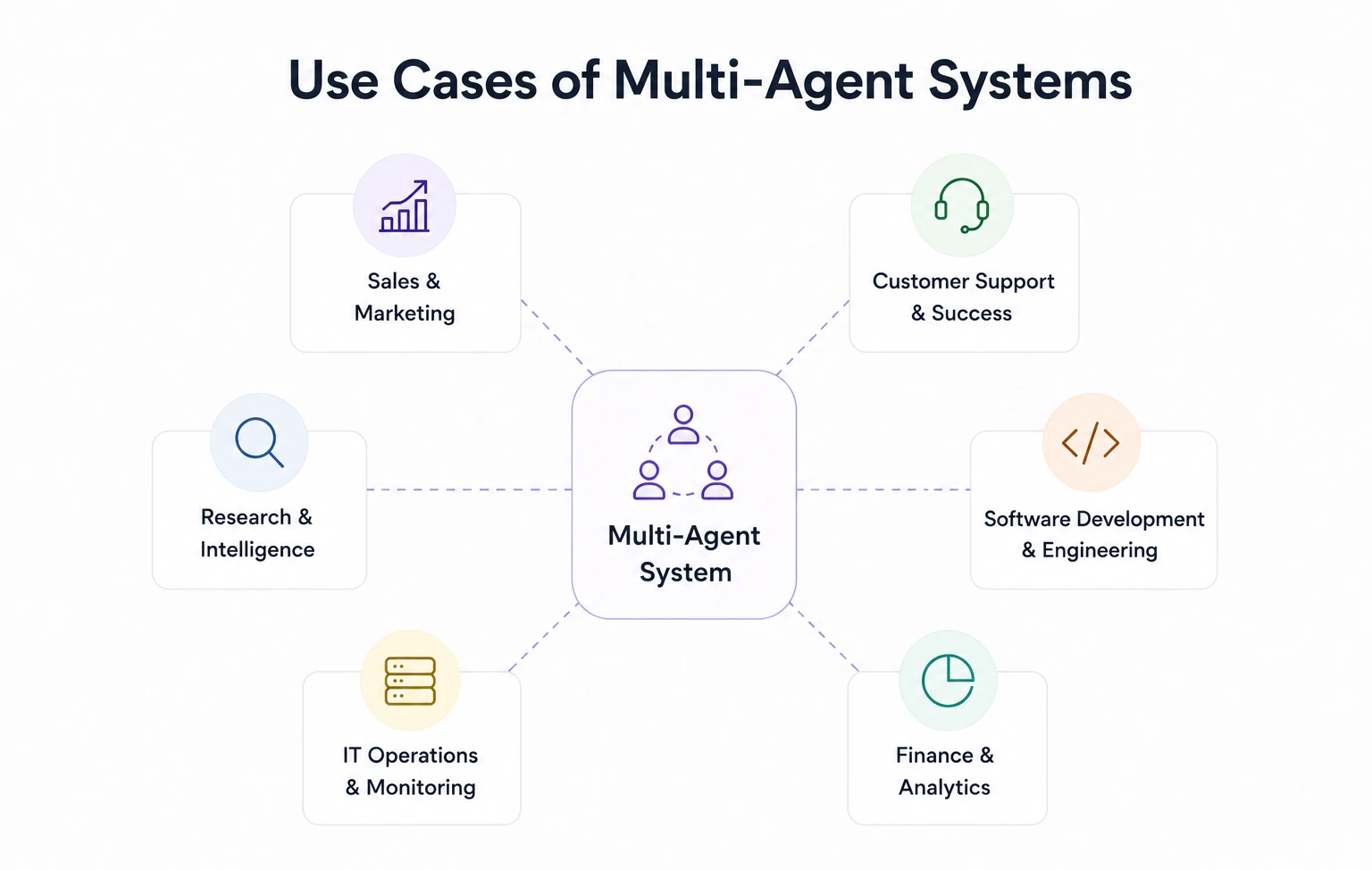
Multi-Agent Systems being used across domains
Advantages of Multi-Agent Systems
Multi-agent systems offer several advantages over traditional single-agent architectures, particularly when dealing with complex, dynamic, or large-scale workflows.
- Parallel Execution
Multiple agents can work on different parts of a problem simultaneously, reducing bottlenecks and accelerating workflow completion. - Specialized Expertise
Instead of relying on one general-purpose agent, organizations can deploy agents optimized for research, planning, analysis, execution, or quality assurance. - Improved Decision-Making
Agents can validate, challenge, and build upon each other's outputs, helping reduce errors and improve the quality of final outcomes. - Operational Scalability
As workflows become more complex, additional agents can be introduced to handle new responsibilities without overloading existing systems. - Resilience and Reliability
Workloads are distributed across multiple agents, reducing dependence on a single point of failure and improving overall system robustness. - Continuous Context Sharing
Agents can operate with access to shared memory, enabling smoother collaboration and reducing information loss between workflow stages.
Challenges of Multi-Agent Systems
While multi-agent systems offer significant advantages, they also introduce new layers of complexity that organizations must manage carefully.
- Coordination Overhead
As the number of agents increases, ensuring effective communication and alignment becomes more difficult. Poor coordination can lead to duplicated work, conflicting actions, or inefficient workflows. - Error Propagation
Many multi-agent workflows depend on the outputs of preceding agents. If an early-stage agent produces inaccurate information, those errors can cascade through the entire system. - Unpredictable Outcomes
Autonomous agents often make decisions independently. In complex environments, their interactions can produce unexpected behaviors that are difficult to anticipate or troubleshoot. - Shared Model Limitations
When multiple agents are built on the same underlying model, they may inherit the same weaknesses, biases, or reasoning failures, increasing the risk of system-wide mistakes. - Monitoring and Governance As workflows become more distributed, maintaining visibility into agent decisions, actions, and interactions becomes increasingly challenging. Robust monitoring and oversight mechanisms are often required.
- Resource Consumption Running multiple agents simultaneously can increase infrastructure costs, latency, and computational requirements compared to simpler single-agent systems.
Why Businesses Are Investing in Multi-Agent AI
Businesses are slowly realizing that the real value of AI is not content generation. It is operational execution.
Single agents are useful assistants. Multi-agent systems are closer to autonomous operational infrastructure. They can coordinate across tools, manage workflows continuously, retain memory, and adapt dynamically as conditions change.
This creates several advantages:
- faster operational execution
- lower manual workload
- improved scalability
- more reliable automation
- better decision-making pipelines
The broader implication is important. AI is gradually moving from an assistance layer into an execution layer sitting on top of enterprise operations.
Conclusion
Single AI agents are powerful for solving isolated problems. Multi-agent systems solve complex problems by distributing responsibilities across specialized AI agents coordinated through orchestration layers.
This approach improves operational efficiency, making AI systems significantly more practical for production grade business environments.
As enterprise AI adoption grows, multi-agent systems are likely to become the industry standard powering autonomous business operations.
Read more: 10 Agentic Workflows Businesses can Automate Today!
Frequently Asked Questions
What is a multi-agent system in AI?
A multi-agent system is an AI architecture where multiple specialized AI agents collaborate to complete tasks, share information, and execute complex workflows more effectively than a single agent.
What is the difference between a single-agent and multi-agent system?
A single-agent system relies on one AI agent to perform all tasks, while a multi-agent system distributes responsibilities across multiple specialized agents that coordinate and collaborate.
What are the benefits of multi-agent systems?
Multi-agent systems offer improved scalability, specialization, reliability, and workflow automation by enabling multiple AI agents to work together toward a shared objective.
What are some real-world applications of multi-agent systems?
Common use cases include customer support automation, sales outreach, market research, software development, IT operations, and financial reporting workflows.
How do AI orchestration platforms support multi-agent systems?
AI orchestration platforms manage agent communication, shared memory, task delegation, tool usage, and workflow coordination, allowing multiple AI agents to operate as a unified system.