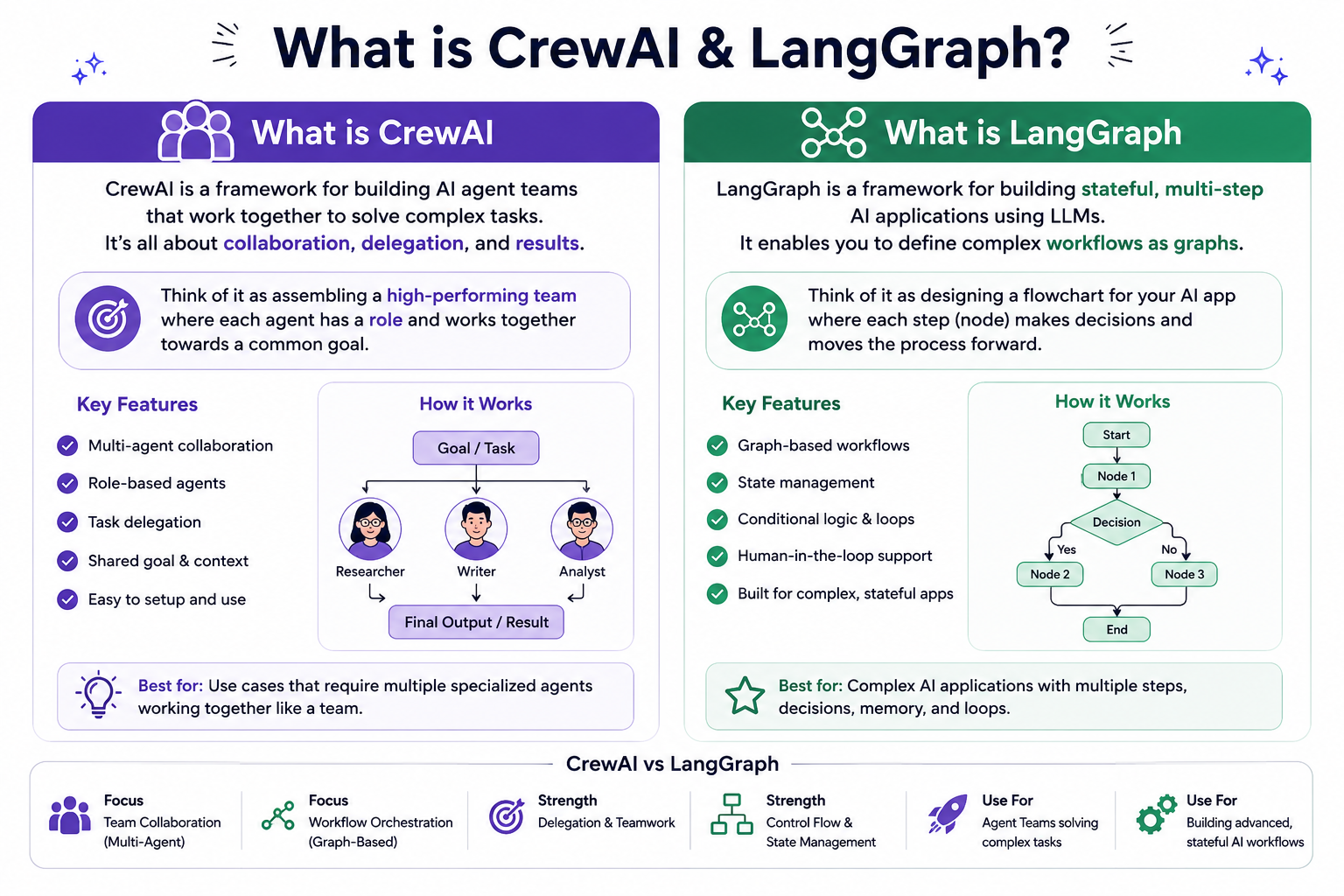
LangGraph gives you explicit, graph-based control over multi-agent systems and wins on production reliability; CrewAI trades some of that control for a role-based model that gets you to a working prototype much faster.
Introduction
Picking between LangGraph vs CrewAI is one of the first real architecture decisions a team makes once it moves past a single chatbot and starts building systems where multiple AI agents work together. Both frameworks orchestrate multi-agent workflows, but they start from different assumptions about how much control a developer should own versus how much the framework should handle automatically. LangGraph treats your system as a directed graph you design node by node. CrewAI treats it as a team of specialized agents with roles, goals, and tasks. In this blog, we'll break down how each framework actually works, where each one wins, and how to decide which fits your project.
What LangGraph and CrewAI Actually Are
LangGraph comes out of the LangChain ecosystem and gives developers a low-level, explicit way to build stateful agent workflows. You define a state schema, write nodes as plain Python functions, and connect them with edges some direct, some conditional, based on logic you write yourself. Because cycles are natively supported, an agent can loop, retry a failed step, or reflect on its own output before moving forward. Nothing routes silently behind the scenes; every path through the system is something you drew yourself.
CrewAI takes the opposite starting point. Instead of graphs, it gives you Agent objects with a role, a goal, and even a backstory, grouped into a Crew and assigned Task objects. Call .kickoff() and the crew executes, either in sequence or through a manager agent that delegates work hierarchically. The mental model maps closely to how a human team is organized, which makes it unusually easy to explain to non-engineers a legal reviewer agent, a compliance checker agent, and a report writer agent are legible in a way that a graph of nodes and conditional edges is not.