

We've all heard about a RAG pipeline whose job is to retrieve relevant documents and pass them to the LLM as context. And it has worked great for many systems.
But the moment a user asks a complex query, our traditional RAG might not be able to provide the desired answer.
Our RAG system might pick the wrong context, the LLM may confidently give the wrong answer (hallucination), and the worst part is that it does not admit the mistake it has made.
This is because traditional RAG is static. It's one-way traffic. Receive a prompt, pick up relevant pieces of the answer, send the context and query to the LLM, and let the LLM generate the answer.
This is where Agentic RAG steps in.
It introduces a major architectural shift. Instead of a single-pass pipeline, it provides a dynamic loop powered by autonomous AI agents.
Interestingly, these agents build a plan, reason, use tools, evaluate, and execute the task. Let's understand the need for Agentic RAG and why traditional RAG isn't enough.
The Problem with Traditional RAG
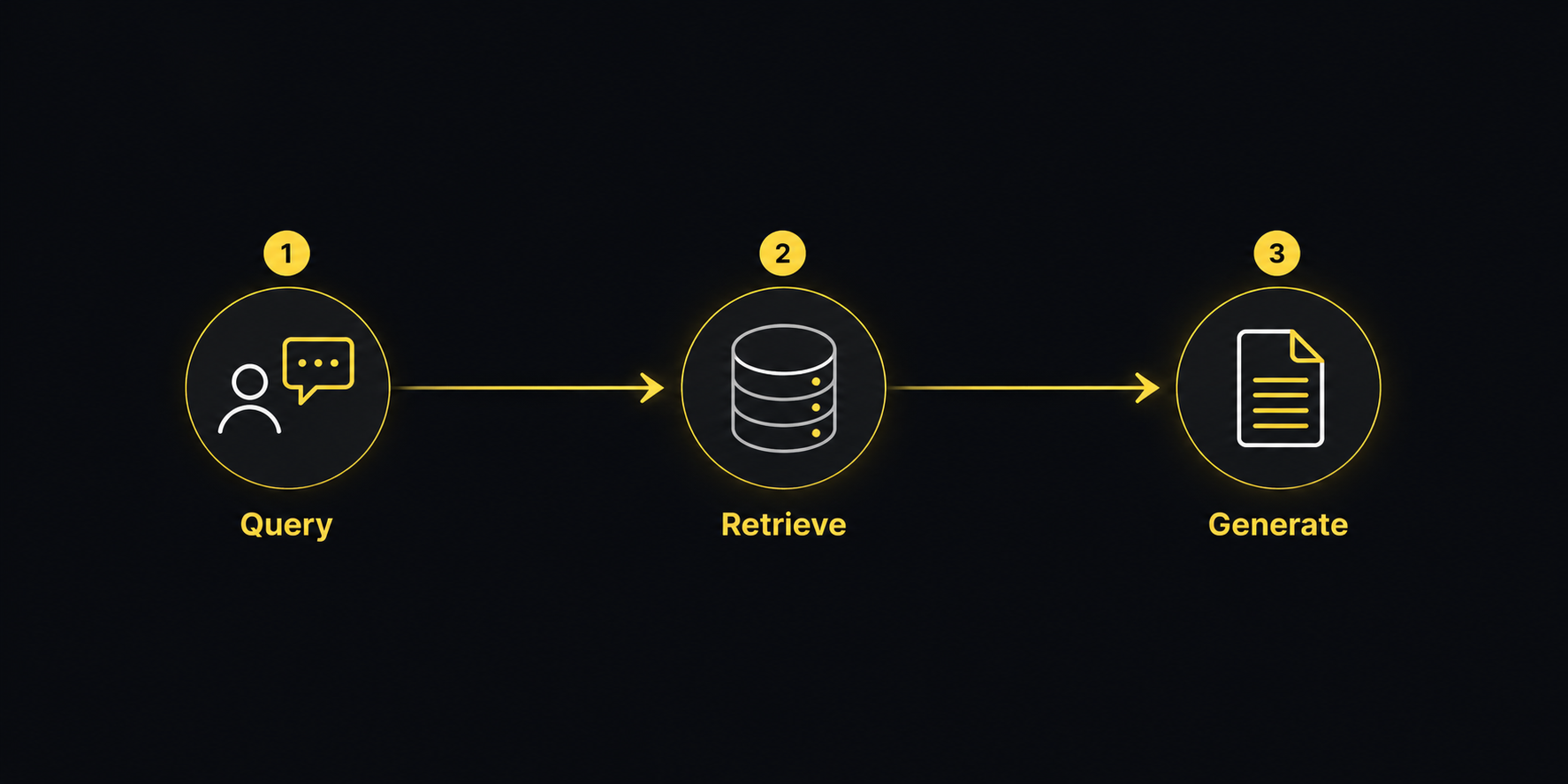
I want you to think of Agentic RAG as a junior intern who has joined your company. When you ask it, "How was our company's Q3 revenue compared to the Q2 revenue?", it pulls the first document that contains words like "Q3 revenue", "Q2 revenue", and "Company revenue" and shows it to you.
But what happens if the document has only half the answer? Instead of thinking and going back to find the other half, it just guesses the rest. And this is a big problem.
Traditional RAG follows a fixed sequence:
1. Retrieve: Search the vector database for text matching the user's query.
2. Augment: Paste that text as a prompt to the LLM
3. Generate: The LLM then generates an answer and stops.
This sounds good, but it fails when the user's query is ambiguous. It may also fail when the answer has to be pulled from multiple sources or when the initial search results are poor.
The problem here is not being able to pause, think again, and try searching something else.
What is Agentic RAG?
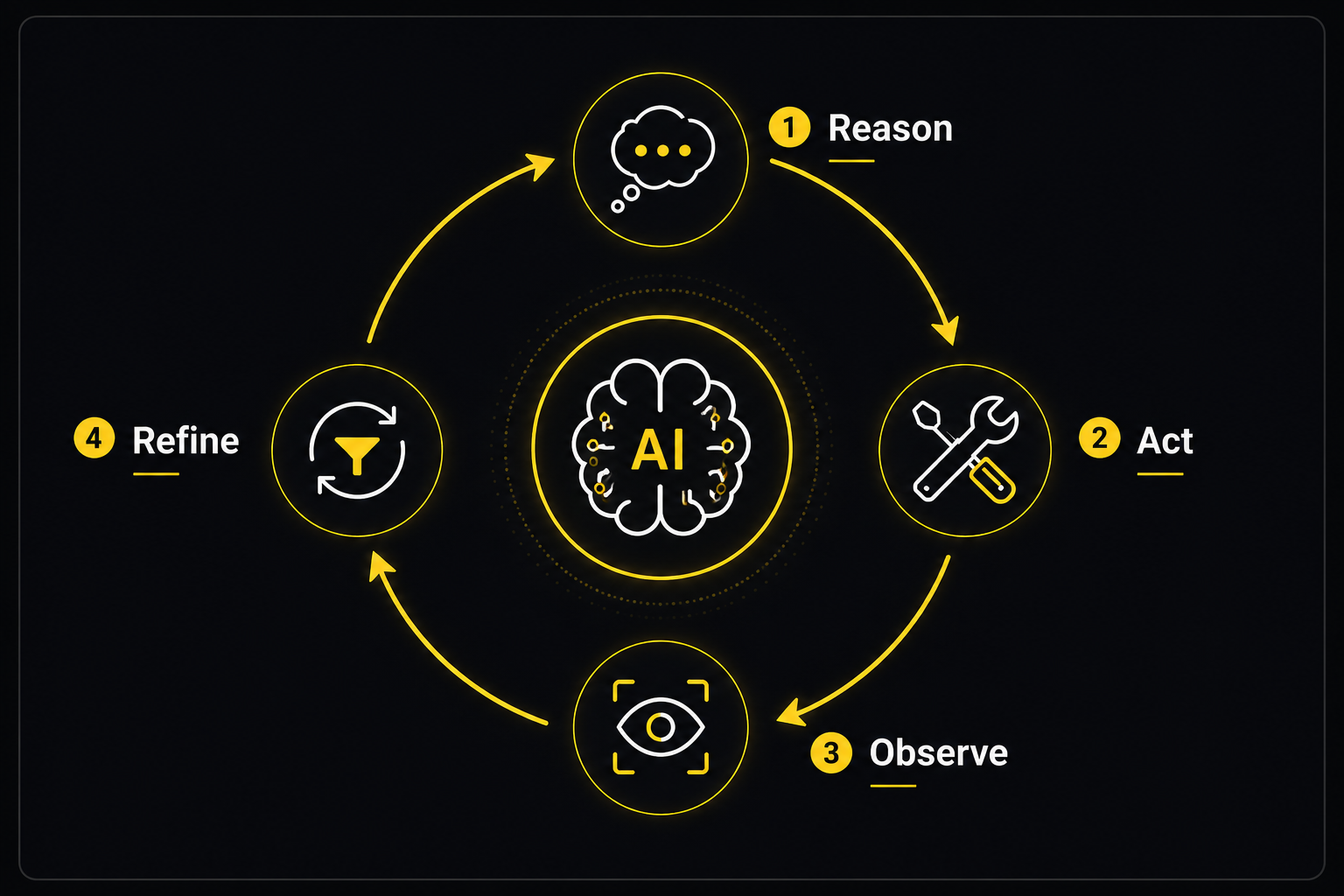
Agentic RAG changes the landscape of RAG systems. The significance of Agentic RAG is that it replaces the single-pass pipeline with a control loop.
This means that, instead of simply answering the user query, an autonomous agent (a specialized language model) is placed between the user and the database. Think of this as the project manager.
When it receives a question, it doesn't search directly. Instead, it enters a loop of reasoning and acting known as ReAct:
1) Reason: "The user wants to compare European Q3 revenue to Asian Q4 revenue. I need to find the Q3 report first, then the Q4 report."
2) Act: It queries the financial database for the Q3 report.
3) Observe: It reads the retrieved data. "Okay, I have Q3 Europe. I still need the Q4 Asia report."
4) Act: It queries again. A completely new query for Q4 Asia.
5) Decide: "I now have all the facts. I will generate the final answer."
This is the strength of Agentic RAG systems. It can think, ask queries, switch data sources, validate information, and fix mistakes before coming up with the final answer.
The Main Components of Agentic RAG
This system is made up of multiple specialized components. Let's break them down.
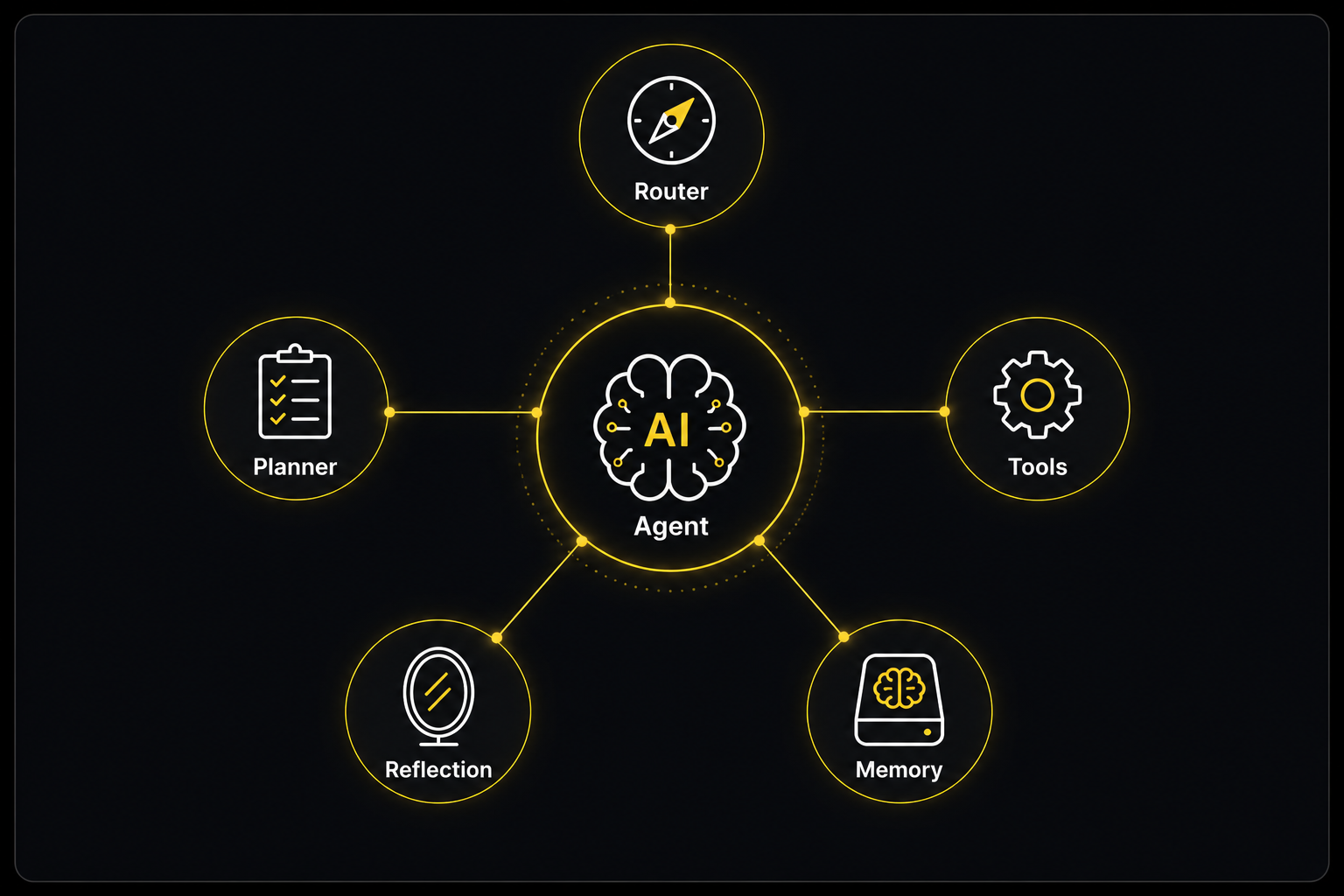
1. Routing Agents
These act as the traffic controllers. In traditional RAG, every query went to the same vector database. In Agentic RAG, a routing agent analyzes the user's prompt and decides where the query should go.
Meaning, if the user asks about a company policy, the router sends the query to the HR database. If a query is about real-time stock prices, the query goes to a live web-search API.
2. Query Planning Agents
This component is crucial when the queries become complex and come in multiple parts. The query planning agent breaks it down into sub-tasks.
Instead of trying to find a single document that answers the big question, it issues multiple sub-queries to different agents or databases and finally combines the results together.
3. The Tool Library
Traditional RAG was focused on reading text embeddings. Agentic RAG gives the AI hands. Through a mechanism called function calling, the agent can use various external tools to perform actions.
So let's say, when a user asks a math question based on retrieved data, the agent can write and execute Python code to calculate the exact answer instead of guessing.
It can connect to Model Context Protocols (MCP), query SQL databases, or even browse the internet.
4. Reflection Agents
This has to be one of most important components. Reflection agents focus on automated quality control. This means, before the final answer is shown to the user, a reflection agent reviews the retrieved data.
If it detects missing context, a hallucination, or a low-confidence result, it ensures the system goes back, improve its search and refine the final answer.
5. Memory
Agentic RAG systems maintain memory. We can break it down into two parts:
1) Short-term memory: It keeps track of the current conversation history, the documents it just retrieved, and the tools it just used within the session.
2) Long-term memory: It works across sessions by storing past user interactions in an external database. This allows the agent to learn a user's preferences. It can also reference previous tasks to update the future workflows.
Tradeoffs
Everything in the world of tech comes with a cost. While Agentic RAG sounds like the perfect solution, it is no exception. There is a cost for autonomous agents too. Let's see its tradeoffs.
1) Latency: This one is obvious because the system is thinking, looping, and retrieving multiple times, it takes much more time to give the final response.
2) Cost: Every time an agent thinks or calls a tool, it consumes API tokens. Things can go wrong when loops are uncontrolled as they can increase your costs.
3) Debugging Complexity: When standard RAG fails, we usually fix the vector search parameters. But when Agentic RAG fails, you have to debug the agent's logic, its tool-calling choices, and its stop conditions.
When to use Traditional vs. Agentic RAG?
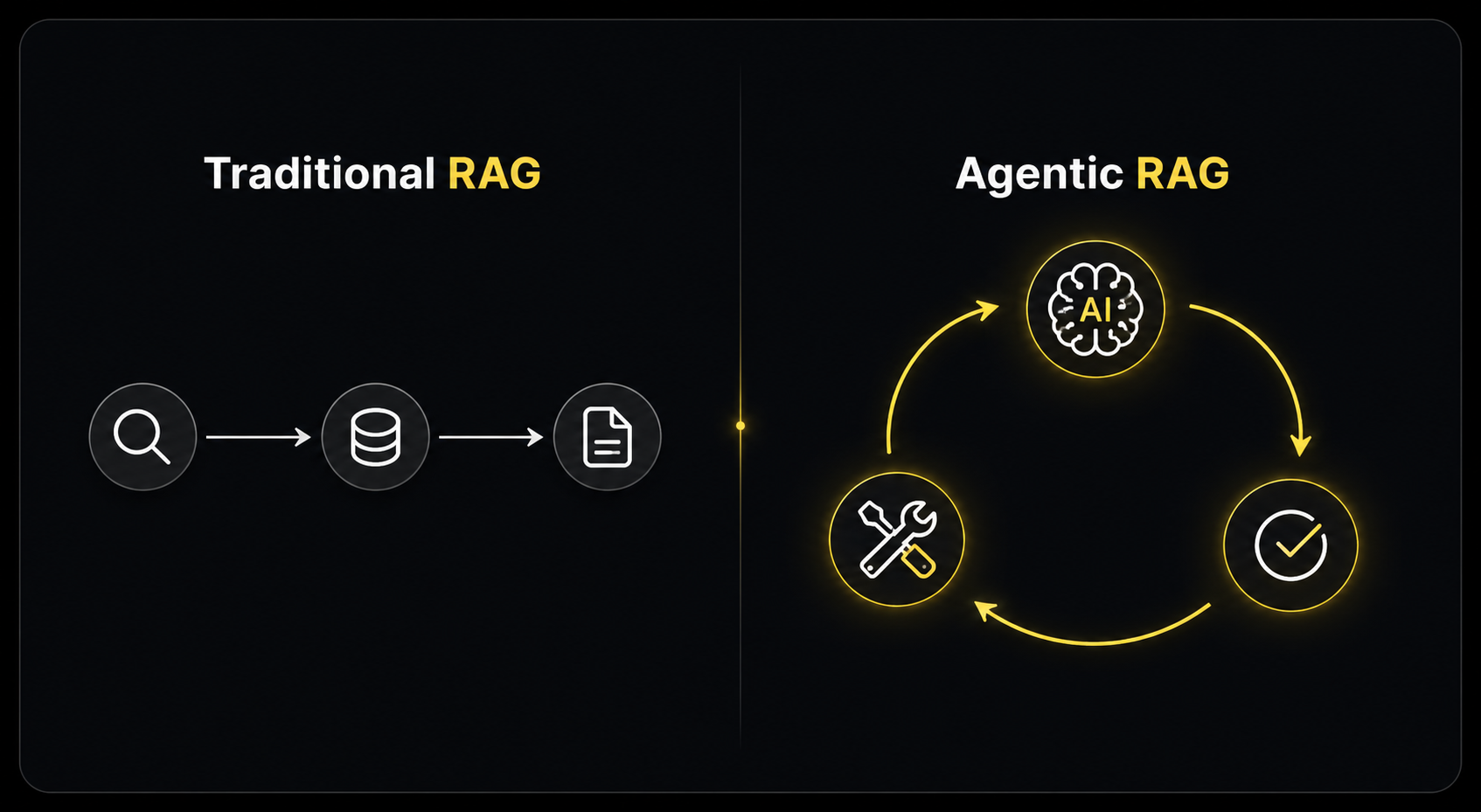
I believe this choice comes down to query complexity and your tolerance for errors.
If you are building a simple FAQ bot or an internal tool for searching single-document policies, Traditional RAG is the best choice. It is fast, predictable, and cost-effecient.
However, if you are building something compelx like a multi-database analytics assistant, Agentic RAG has to be your choice. The system's ability to self-evaluate and verify its own work is crucial when the stakes are high.
Conclusion
Agentic RAG has evolved AI away from being a simple search engine to an autonomous worker. By giving language models the ability to plan, use external tools, and evaluate their own mistakes, we are entering a new era of AI applications.
This shows that teh future of technology is about is about building smarter agents.
Frequently Asked Questions
Will Agentic RAG replace traditional RAG completely?
No. Traditional RAG is still highly effective for simple lookup tasks where speed and low latency are the main requirements. Agentic RAG is built on top of traditional RAG principles but is used for complex tasks that needs multi-step reasoning.
What frameworks are best for building Agentic RAG?
Frameworks like LangChain, LlamaIndex, and orchestration tools like LangGraph are teh current industry standards for building agentic architectures. They provide amazing support for routing, tool calling, and state management.
How does Agentic RAG reduce AI hallucinations?
It reduces hallucinations through reflection and iterative retrieval. Meaning, if the retrieved content is low in confidence, the agent recognizes the gap and begins a new search instead of guessing the answer.