

Most AI systems today are stateless by default. Every request starts from zero. For isolated tasks, that's fine. But for anything spanning sessions personal assistants, coding agents, customer support bots statelessness is a fundamental flaw. A 2025 analysis of enterprise AI deployments found that nearly 65% of agent failures were caused by context drift or memory loss, not by the underlying model being incapable.
In this blog, we break down how agent memory works, the types your agent needs, and the implications of getting the architecture right.
What Is Agent Memory?
Agent memory is the persistent system that enables an AI agent to encode, store, retrieve, and synthesize information over time. The concept borrows from cognitive science the CoALA paper (Princeton/CMU, 2023) formally translated human memory types into an AI agent framework, and most major frameworks like LangChain, Letta, and Mem0 use a version of this model today.
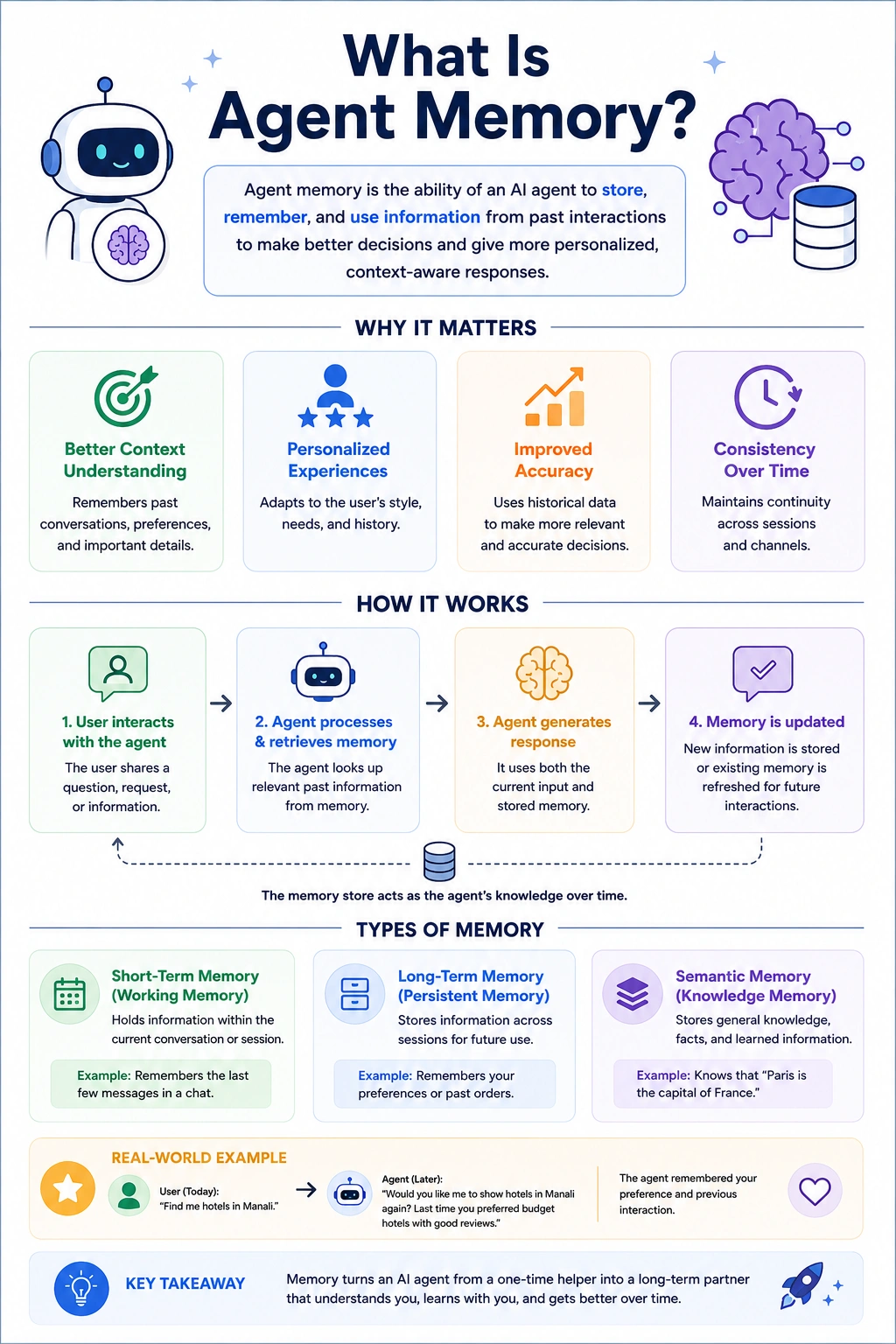
"Agent Memory is a computational exocortex for AI agents — a dynamic process that integrates an agent's LLM context with a persistent memory management system to encode, store, retrieve, and synthesize experiences." - MongoDB AI Research
Without it, even the most powerful model suffers from four hard limitations: no conversational continuity, no behavioral adaptation, no persistent objectives, and no personalization. Microsoft and Salesforce's 2025 study "LLMs Get Lost in Multi-Turn Conversation" validated this showing significant performance drops in extended conversations because models make premature assumptions they can't recover from.
Short-Term Memory
Short-term memory covers everything available to the agent within a single session. It's bounded by the model's context window. Larger windows delay the fundamental limitation they don't remove it. Research found that 11 of 12 tested models dropped below 50% of their short-context performance once sessions crossed 32,000 tokens. Anthropic calls this "context rot" performance degrades nonlinearly as sessions grow longer.
Working Memory
Working memory is the agent's active scratchpad the system prompt, current conversation, tool call outputs, and reasoning chains in progress. It disappears when the session ends. For agents handling multi-step workflows like MCP servers executing live tool chains working memory fills up fast. Memory has to be selective.
Semantic Cache
A semantic cache stores recent query-result pairs so the agent skips recomputing answers it has already generated. When a new query is semantically similar to a cached one, the cached result loads directly. This reduces latency and cost significantly in production especially for customer support bots, documentation assistants, and internal knowledge tools.
Long-Term Memory
Long-term memory is what makes an agent genuinely intelligent over time rather than just capable in the moment. The CoALA framework identifies three core types, each handling a different category of knowledge.
Episodic Memory
Episodic memory stores records of specific past events conversations, tool calls, and outcomes. Think of it as the agent's autobiographical log: not just what happened, but when, why, and in what context. An agent that summarizes at write time collapses distinct events into generalizations, destroying the episodic signal. Good episodic memory preserves nuance.
Semantic fact: "User is frustrated with their brother." Episodic memory: "On Tuesday, the user expressed frustration that their brother always forgets their birthday. I responded with empathy."
The episode provides nuance the fact alone cannot.
Semantic Memory
Semantic memory captures what is true facts, preferences, and domain knowledge the agent has accumulated, decoupled from when it was learned. This is where custom Claude Skills shine: they inject semantic knowledge brand guidelines, coding standards, workflows directly into the agent's behavior without any retraining.
Procedural Memory
Procedural memory encodes how to do things action patterns, successful strategies, and known failure modes. Anthropic formalized this with the Agent Skills standard (late 2025): a skill.md file describing what a skill does and how to execute it step by step, using progressive disclosure so full instructions only load into working memory when a task actually needs them.
Shared Memory
Shared memory is a cross-agent layer multiple agents can read from and write to simultaneously. In a multi-agent coding pipeline, a planning agent, coding agent, and review agent all need the same project context. Shared memory makes this possible without each agent maintaining its own full copy of state.
How Agent Memory Works in Practice: RAG
Most production memory systems use Retrieval-Augmented Generation (RAG) to move information between long-term storage and working memory. RAG externalizes information into a vector store, then fetches relevant items at query time and injects them into active context making it possible to give an agent a large memory store without keeping everything in the context window at once.
The three main retrieval mechanisms are dense vector retrieval (semantic similarity, fast but imprecise), sparse retrieval / BM25 (keyword-based, precise but limited), and hybrid retrieval (combining both what most production systems use). The harder challenge isn't retrieval; it's memory writing deciding what's worth persisting in the first place.
The architecture should match the job:
- Single-session tasks → working memory is sufficient
- Repeat-user interactions → add episodic memory
- Domain-specific knowledge → add semantic memory (or custom Claude Skills)
- Complex recurring workflows → add procedural memory (skills, tool definitions)
- Multi-agent pipelines → add shared memory for coordination
Agents built on MCP servers benefit especially from episodic memory the agent recalls which tool calls succeeded, which sources proved reliable, and which approaches led to dead ends, compounding capability with every interaction.
Conclusion
Agent memory is the foundation of what makes an AI agent genuinely useful over time. The four memory types working, episodic, semantic, and procedural each handle a different category of knowledge on different timescales. The best architectures combine all four, surfacing the right context at the right moment without overflowing the active window.
Frequently Asked Questions
What is agent memory in AI?
Agent memory is the persistent system that enables an AI agent to retain, recall, and reuse information across interactions. It's what separates a stateless chatbot from an intelligent, adaptive agent that improves over time.
What are the four main types of agent memory?
The CoALA framework defines: working memory (active session context), episodic memory (specific past events), semantic memory (facts and domain knowledge), and procedural memory (skills and action patterns). Most production systems also add a semantic cache and shared memory layer for multi-agent coordination.
Why do AI agents need long-term memory?
Without it, agents can't personalize responses, learn from past mistakes, or maintain goals across sessions. A 2025 enterprise study found 65% of agent failures came from context loss, not capability gaps. Long-term memory directly addresses each of these failure modes.
What's the difference between semantic and episodic memory?
Semantic memory captures what is true facts decoupled from when they were learned. Episodic memory captures what happened specific events with full context. Semantic memory knows a user prefers Python. Episodic memory remembers the conversation where they explained why.
How does RAG relate to agent memory?
RAG is the most common mechanism for connecting long-term memory to working memory. It stores information in a vector database and retrieves semantically relevant content at query time, so an agent can access a large memory store without keeping everything in the context window at once.