

Over the past year I've signed up for, stress-tested, and quietly unsubscribed from more AI tools than I care to admit. Most are noise. These seven are not. Here's exactly what they do, why they made the cut, and who they're built for. Let's get something out of the way first: the AI sales tools market is a mess. Every SaaS product you've ever loved has slapped "AI-powered" on its homepage, and a fresh wave of actually AI-native tools has arrived to compete for your budget and attention. After testing well over a hundred tools from autonomous SDR bots to AI email coaches to full-stack revenue platforms I found that most fall into one of three failure modes: they do one tiny thing, they replicate something your CRM already does, or they require so much setup that the productivity gains never materialise. The seven below are the rare exceptions. Each solves a distinct, real problem in the sales workflow, integrates cleanly with the rest of your stack, and delivers results you can actually see on a dashboard.
- Apollo.io: Best all-in-one prospecting & outreach engine (265M+ contacts)
- Gong: Conversation intelligence that turns every call into coaching
- Clay: Waterfall data enrichment for hyper-personalised outbound
- Lavender: Real-time AI email coach; highest ROI per dollar
- HubSpot Sales Hub: Best all-in-one CRM with Breeze AI agents
- Fireflies.ai: Auto-records calls, updates your CRM instantly
- Artisan (Ava): Autonomous AI BDR agent for 24/7 outbound
"Sales reps spend roughly 72% of their week on work that isn't selling. The right AI stack doesn't replace salespeople it gives them their week back."
Before we dive in, a quick note on how I evaluated these tools. I ran each one through a consistent set of criteria: time-to-value (how quickly does it do something useful?), integration depth (does it talk to Salesforce and HubSpot without duct tape?), actual AI quality (does the output pass a straight-face test?), and pricing transparency. Let's get into it.
Apollo.io - Prospecting & Outreach Engine
Apollo.io
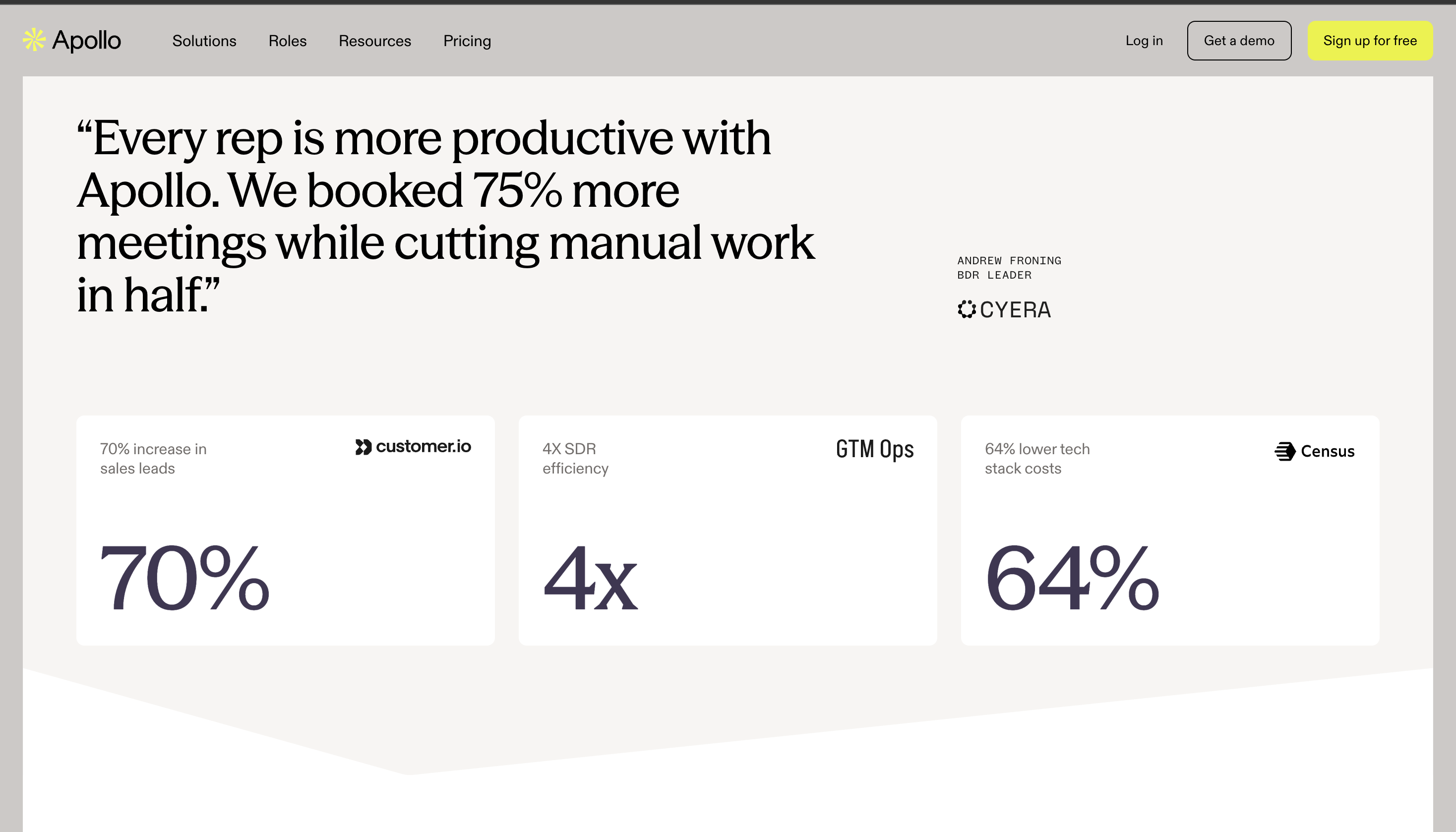
If you only have one AI sales tool in your stack, make it Apollo. It combines a database of over 265 million verified B2B contacts with AI research agents that can build hyper-targeted lists, enrich accounts automatically, and launch outreach sequences all from a single platform.
What separates Apollo in 2026 from older prospecting tools is the quality of its AI research layer. Rather than just pulling static contact data, it surfaces intent signals, job-change alerts, and funding news so your outreach lands at exactly the right moment. The AI-written sequence drafts aren't perfect, but they're a solid first draft that personalises faster than any human could at scale.
Apollo achieved 500% year-on-year growth between 2025 and 2026 for a reason. It's the best-value combination of data and sequencing on the market for SDR teams and growth-stage companies.
- Best for: Outbound prospecting at scale
- Pricing: Free tier available; paid from ~$49/mo
- Integrates with: Salesforce, HubSpot, LinkedIn
Gong - A Conversational Intelligence & Deal Risk
Gong
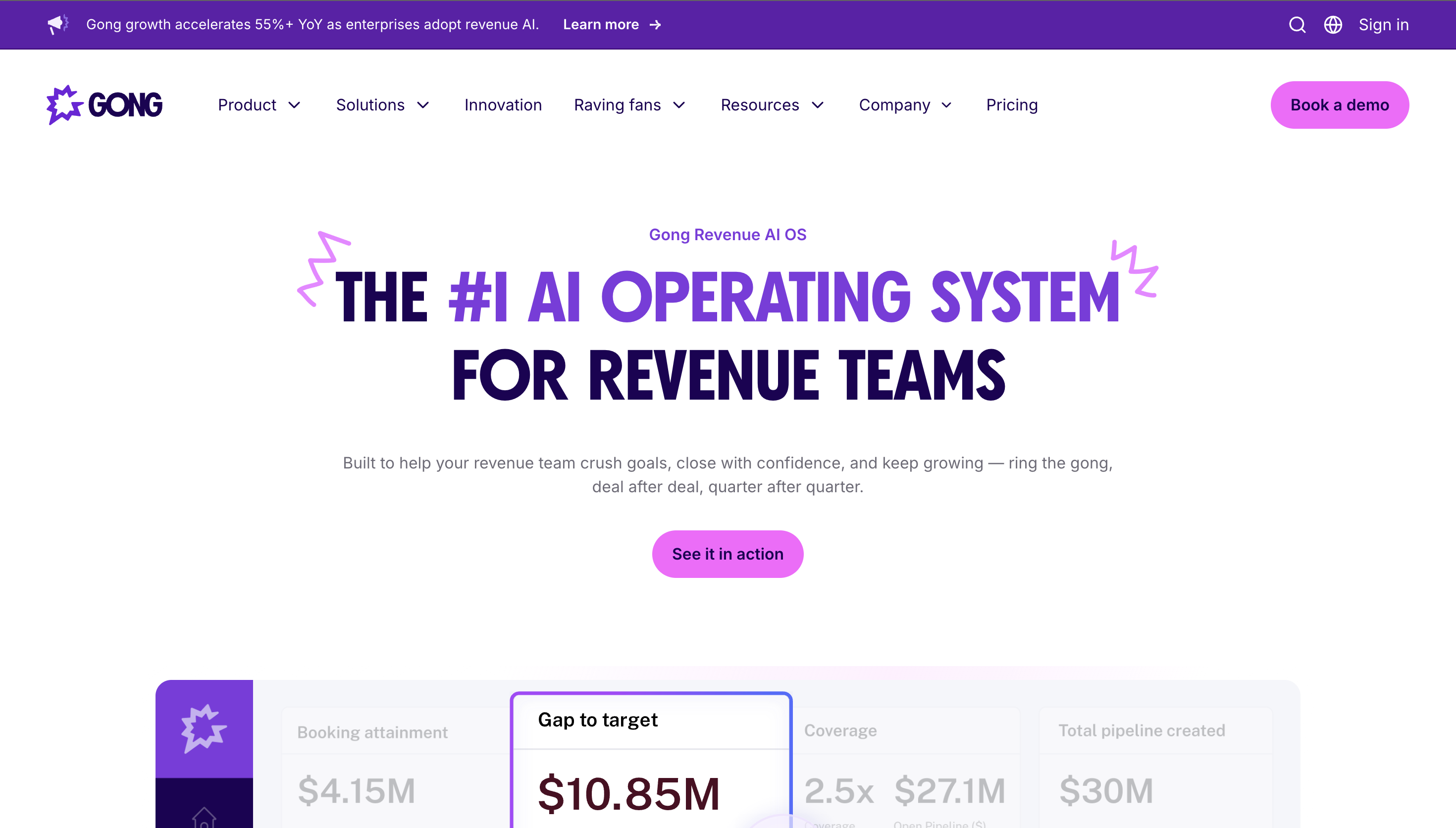
Gong records, transcribes, and analyses every sales call and email thread to surface the patterns that separate won deals from lost ones. It tells you when a prospect went cold, which competitor came up on calls, whether your reps are talking too much, and which deals in your pipeline are quietly dying.
What makes Gong genuinely powerful rather than just a fancy call recorder is its deal intelligence layer. It cross-references conversation signals with CRM data to flag at-risk opportunities before they fall out of the funnel. For managers, the coaching scorecards mean you're not watching hours of call recordings to develop your team; Gong surfaces the moments that matter.
It's enterprise-priced (expect a five-figure annual contract for a meaningful team), but for any organisation running five or more reps with enough call volume to spot patterns, the ROI math tends to work quickly.
- Best for: Teams of 5+ reps; enterprise sales orgs
- Pricing: Quote-based; typically $1,200–$1,600/user/yr
- Integrates with: Salesforce, HubSpot, Zoom, Teams
Clay - Data Enrichment and Hyper Personalisation
Clay
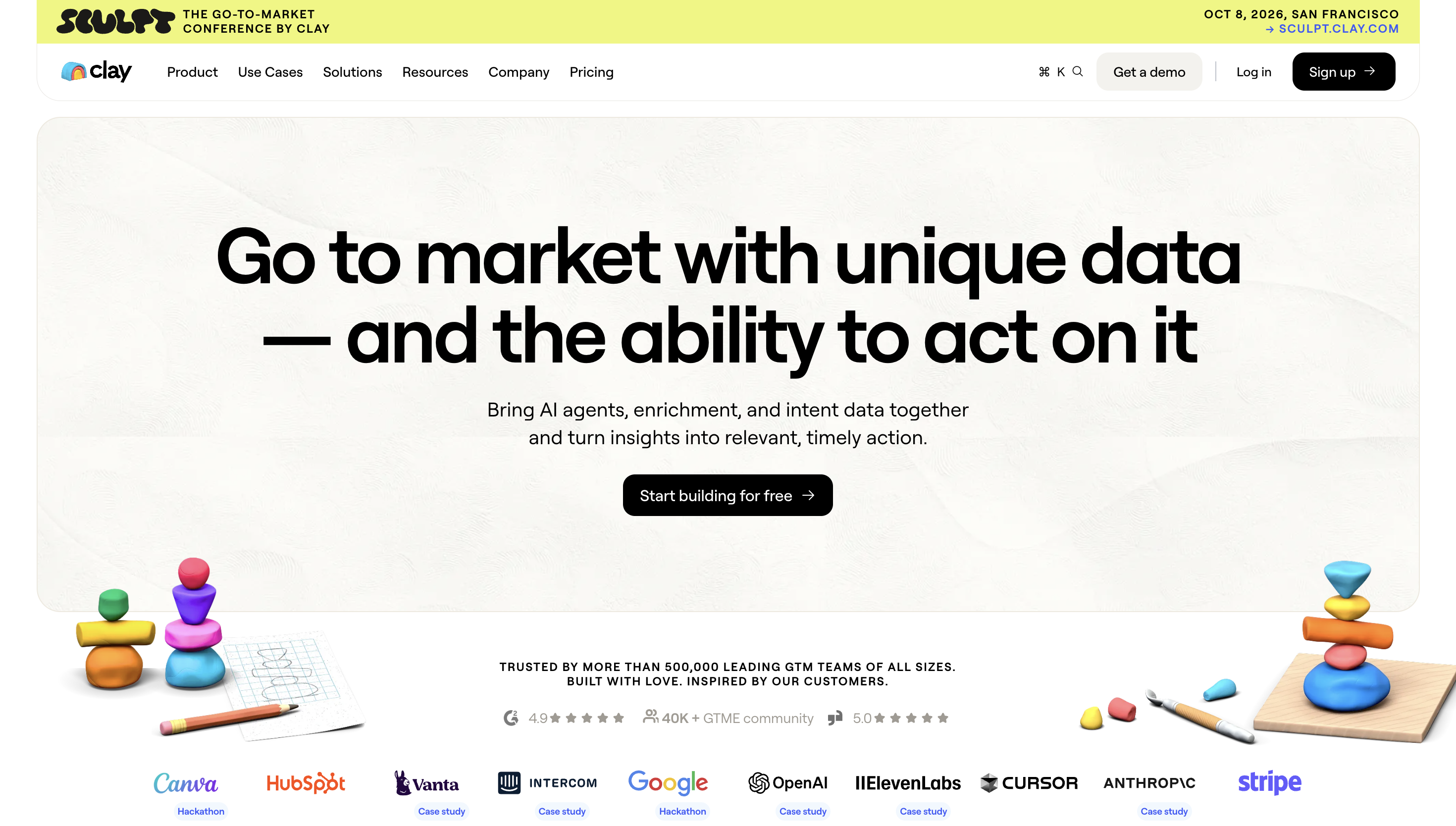
Clay is the power tool that lives behind the scenes of the best outbound teams in the world. It pulls data from over 75 enrichment providers simultaneously a technique called waterfall enrichment so instead of relying on a single source for phone numbers and email addresses, it checks every source until it finds a verified result.
But the real magic is in its AI research agent, Claygent. You can instruct it in plain English: "Find the last thing this prospect posted on LinkedIn, identify their company's most recent product launch, and write a two-sentence personalised opener for each." It does exactly that, at scale, for your entire list.
Clay is best used as a layer on top of Apollo or another data source, not a replacement for one. The learning curve is real, but the teams that master it produce personalised outreach that genuinely stands out in crowded inboxes.
- Best for: RevOps teams; outbound focused on quality over volume
- Pricing: From $149/mo; scales with credit usage
- Integrates with: Apollo, ZoomInfo, HubSpot, Salesforce, Slack
Lavender - AI Email Coach
Landender
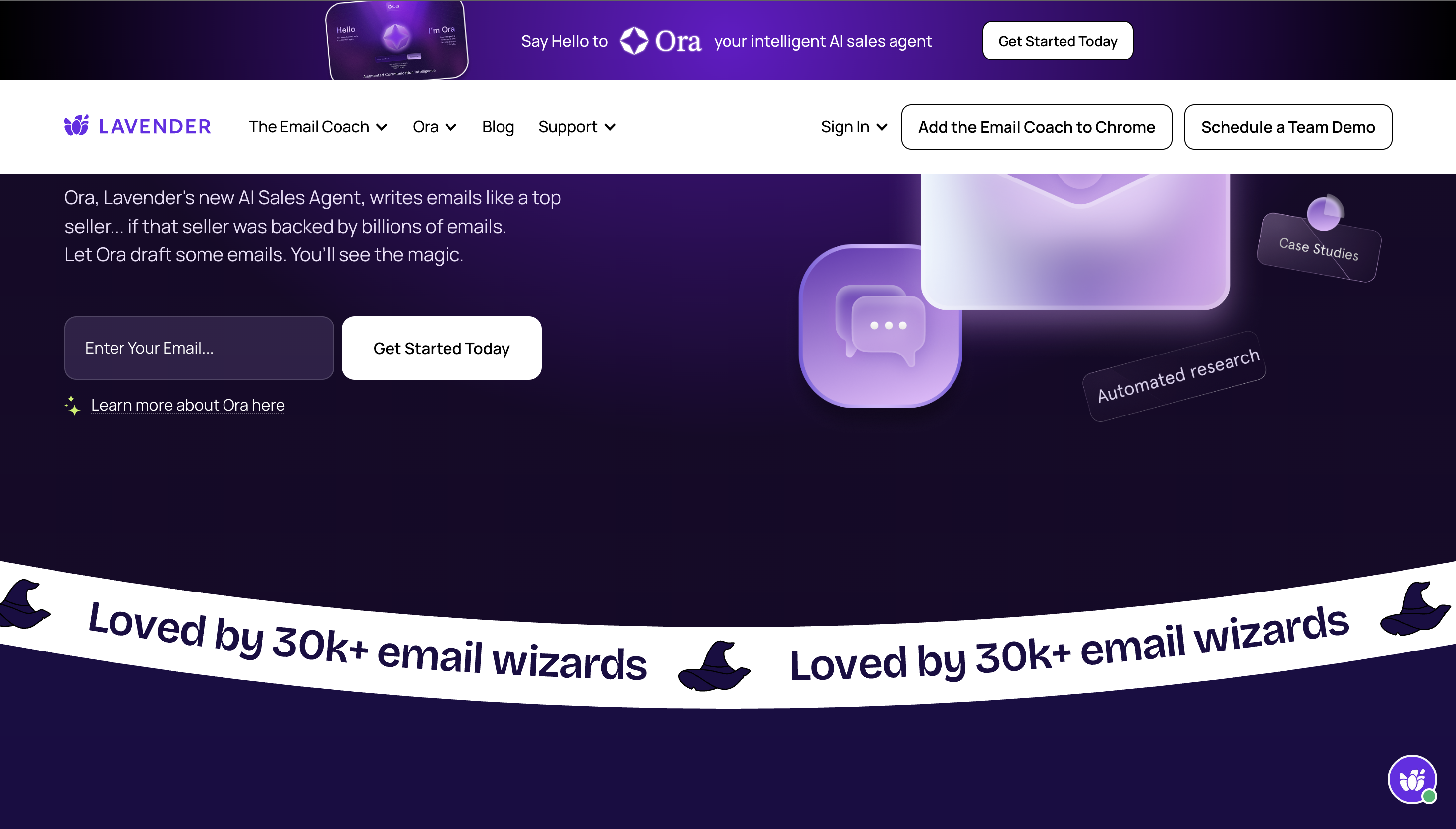
Lavender is an AI coach that lives inside your inbox Gmail and Outlook and grades your cold emails in real time. It scores emails on a scale to 100 based on factors proven to drive reply rates: email length, personalisation, reading level, mobile friendliness, and whether you're asking too many questions in one message.
What makes Lavender sticky is how quickly it changes rep behaviour. Rather than vague feedback in a training session, it gives immediate, contextual suggestions as you're writing. New SDRs ramp faster, and even experienced reps with bad email habits correct them within days.
For teams sending more than 50 prospecting emails per day, Lavender consistently delivers the highest ROI per dollar of any tool in this list. It's also one of the few AI tools that improves your own skills over time, rather than just doing the work for you.
- Best for: SDRs, AEs, individual reps; cold outbound
- Pricing: Free plan; Pro from ~$29/mo per user
- Integrates with: Gmail, Outlook, Apollo, Salesloft, Outreach
HubSpot Sales Hub (with Breeze AI) - All in one CRM + AI Agents
HubSpot
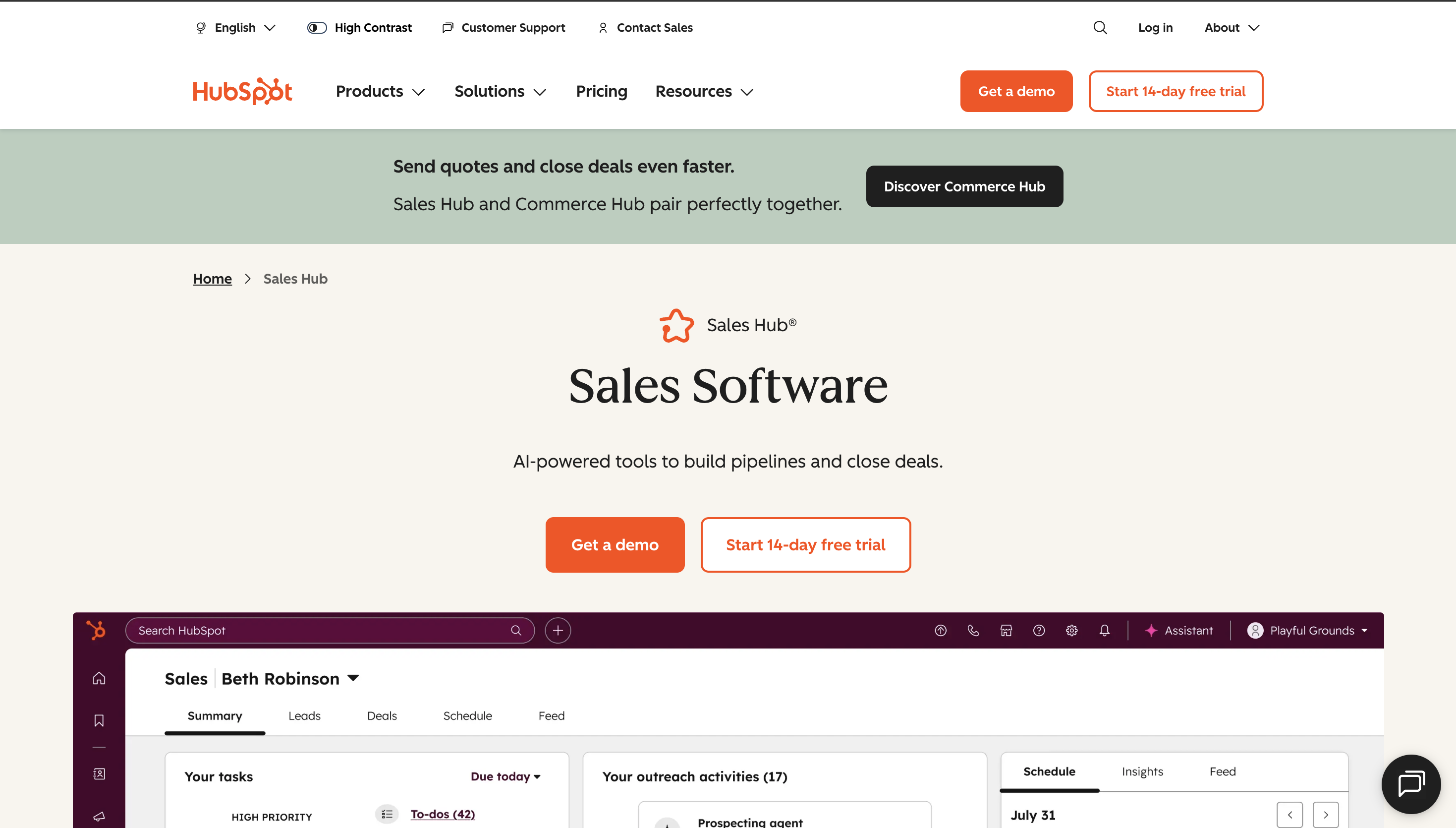
HubSpot's Breeze AI agents, launched with their 2025 platform overhaul, finally make HubSpot a serious contender against the enterprise giants. The AI Prospecting Agent handles first-touch research and personalised outreach inside your existing CRM meaning you don't need to bolt Apollo, Clay, and Outreach on top if you'd rather keep everything in one place.
Breeze also powers predictive lead scoring, deal recommendations, and automated CRM data hygiene. If a prospect visits your pricing page three times in a week, HubSpot flags it. If an opportunity has been sitting untouched for 14 days, it nudges your rep. The UI remains the most approachable of any CRM, which matters when adoption is your biggest challenge.
For SMBs and mid-market teams that want a single platform rather than a complex multi-vendor stack, HubSpot is the most pragmatic choice available in 2026.
- Best for: SMB to mid-market; teams wanting one platform
- Pricing: Starter from $20/mo; Professional from $100/mo per seat
- Integrates with: Everything; 1,000+ native integrations
Fireflies.ai - Meeting Intelligence & Auto CRM Update
Fireflies.ai
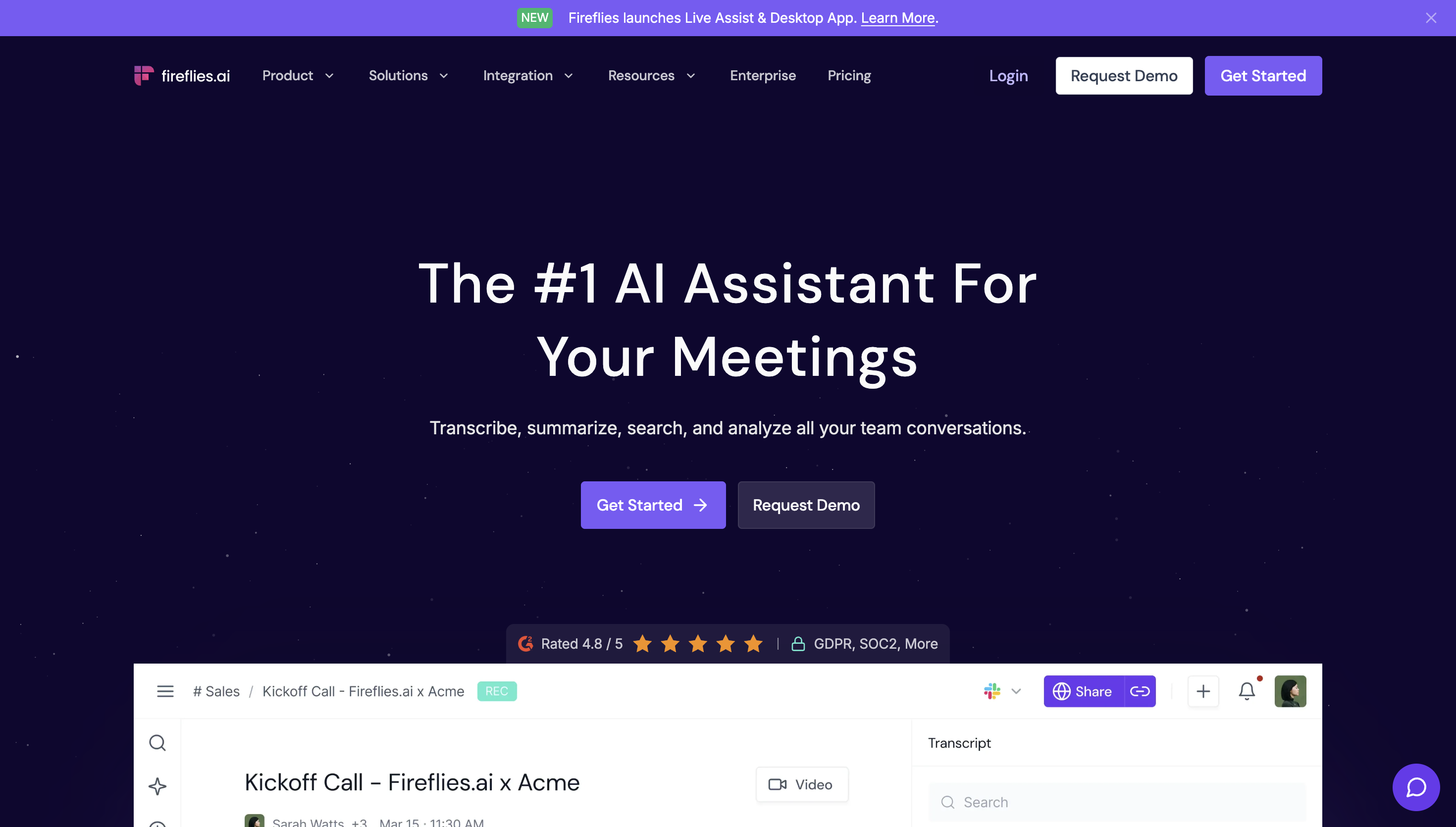
Fireflies joins every call you accept, records it, transcribes it, and this is the part that actually saves time automatically writes your CRM update, follow-up email draft, and action item list the moment the call ends. No more spending 20 minutes after a demo reconstructing what was said and manually updating Salesforce fields.
The AI summaries are genuinely good. Fireflies organises transcripts by topic, flags questions the prospect asked (vital for understanding objections at scale), and creates "soundbite" clips you can share with your manager or champion without asking them to sit through a full recording.
For smaller teams and individual reps who can't justify Gong's enterprise pricing, Fireflies delivers about 80% of the call intelligence value at a fraction of the cost. It's become a near-universal addition to sales stacks in 2025–2026 precisely because the free tier is genuinely useful.
- Best for: Individual reps; small teams; Gong alternative
- Pricing: Generous free tier; Pro from $18/mo per user
- Integrates with: Zoom, Google Meet, Teams, HubSpot, Salesforce
Artisan (Ava) - AI BDR Agent
Artisan
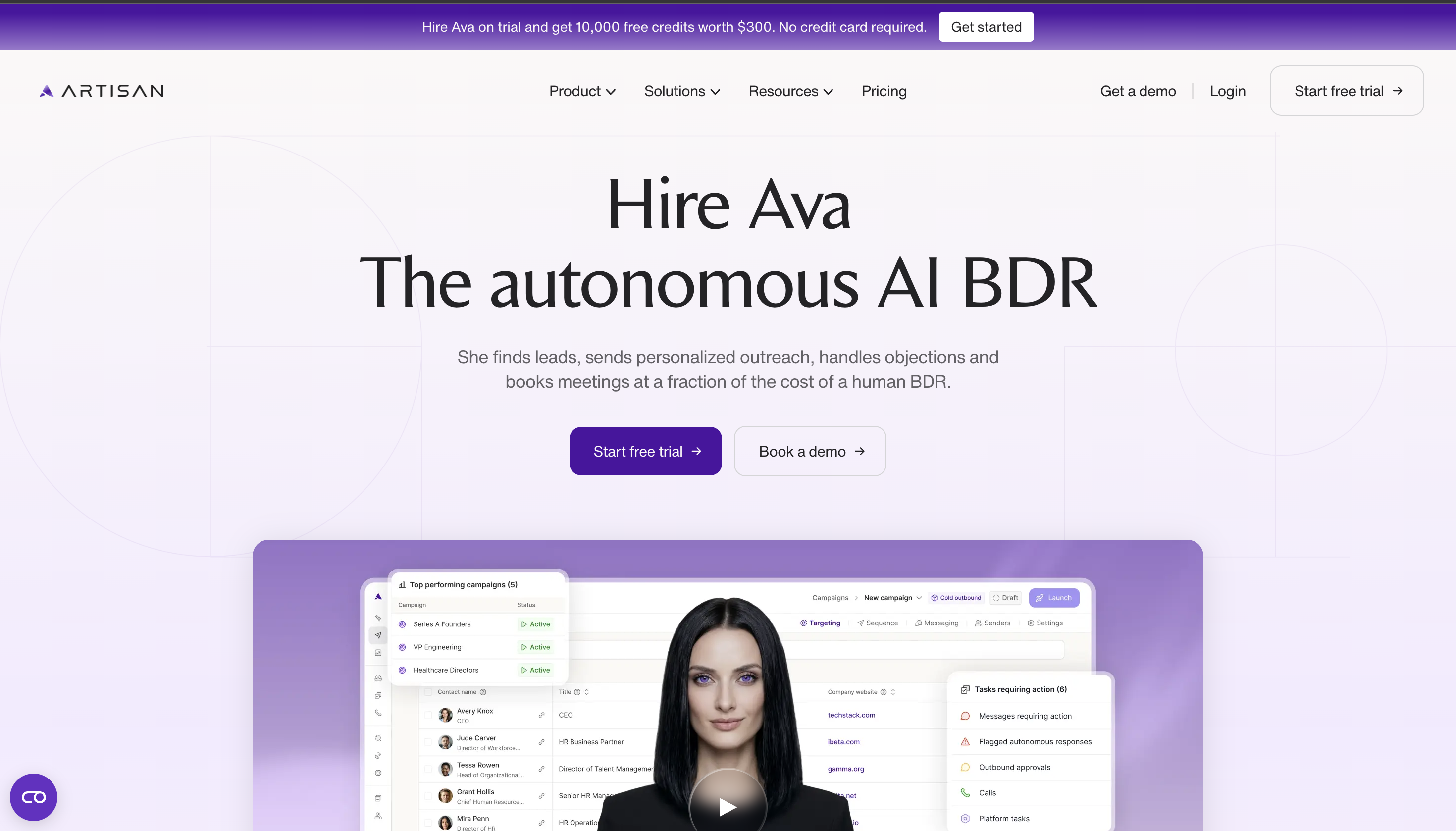
Artisan's AI sales agent, Ava, represents the most ambitious category of tool on this list: the autonomous AI BDR. Ava accesses a B2B database, identifies prospects matching your ideal customer profile, finds intent signals showing who's actively researching solutions like yours, crafts personalised multi-touch outreach sequences, and sends them all without a human in the loop.
The honest caveat: AI BDRs are still maturing. Ava works best for clearly defined ICP segments with straightforward value propositions. For complex, consultative enterprise sales, the personalisation isn't yet deep enough to replace a skilled human SDR. But for high-volume outbound targeting well-defined audiences, Ava runs 24/7 without sick days, ramp time, or attrition and that matters at scale.
Watch this category closely. The improvement curve for AI sales agents is steep, and what feels like a 70% solution today will likely be an 85% solution by year-end.
- Best for: High-volume outbound; scaling SDR capacity
- Pricing: Custom; typically $2,000–$5,000/mo
- Integrates with: HubSpot, Salesforce, LinkedIn, major ESPs
The Bonus Layer: Team Alignment
Here's something most "best AI tools for sales" articles miss entirely: the tools above optimise for individual rep performance and pipeline metrics, but great sales results also depend on a team that's aligned, motivated, and actually knows each other.
If your team is remote or hybrid which, let's be honest, most sales teams are in 2026 the glue that holds a high-performing sales culture together isn't a CRM update. It's genuine human connection.
Team Offsite AI uses AI to plan, personalise, and coordinate team offsite events that actually bring people together. Whether you're planning a quarterly kickoff, a sales training retreat, or a celebration for crushing a target, it handles the logistics so your sales leader can focus on the agenda that matters. Strong sales cultures consistently outperform weak ones, and offsites are one of the highest-leverage investments you can make in team cohesion.
It may not sit in your outbound stack, but it belongs in the broader conversation about what makes a sales team consistently win.
How to Build Your Stack Without Losing Your Mind
Here's the framework I'd use to sequence these tools based on your current stage:
If you're an individual rep, start with Lavender (free) to immediately improve your outbound emails, and add Fireflies.ai (free tier) to stop losing information from calls. These two alone will return hours of your week within the first month.
If you're an early-stage team (under 10 reps), add Apollo.io as your prospecting engine and HubSpot as your CRM backbone. These two platforms now do enough together that you can delay adding further tools until you've identified your specific bottleneck.
If you're a scaling team with 10+ reps and a clearer process, layer in Gong for conversation intelligence and Clay for deeper enrichment and personalisation. These tools become more valuable the more call volume and contact volume you have to work with.
If you're exploring the frontier, run a structured pilot of Artisan's Ava on a defined ICP segment. Treat it as an experiment with a clear success metric meetings booked per month rather than a wholesale replacement of your SDR motion.
Conclusion
The sales teams consistently winning in 2026 aren't the ones with the most AI tools. They're the ones using a connected set of tools that each solve a distinct problem in their workflow. Apollo finds the right people. Clay personalises at scale. Lavender makes the email better. Fireflies captures what happens on the call. Gong turns those calls into coaching. HubSpot keeps the whole picture in one place. And Artisan is testing what comes next.
Pick the one that solves your biggest bottleneck today, and add the next one only when you've exhausted what the first one can do. That's the difference between a focused AI stack and a very expensive set of open browser tabs.
Frequently Asked Questions
1. Will AI tools replace salespeople?
No and the data backs this up. Teams using AI tools are reporting higher revenue, not fewer headcounts. What AI replaces is the administrative layer of the job: CRM updates, prospect research, scheduling, and note-taking. What it can't replicate is the nuanced human work of building trust, navigating complex objections, and developing genuine relationships with buyers. The best salespeople in 2026 are the ones who have offloaded the grunt work to AI so they can spend more time on the parts only they can do.
2. What's the best free AI tool for individual sales reps?
Lavender and Fireflies.ai both offer generous free tiers and are the highest-impact starting points for individual reps. Lavender improves your email reply rates immediately with zero setup; Fireflies joins your calls automatically and stops you from losing context. Apollo.io also has a useful free tier for prospecting. Start with these three before spending anything.
3. Apollo.io vs HubSpot which should I choose?
They solve different problems. Apollo is primarily a prospecting and sequencing engine it's where you find new contacts and run outbound campaigns. HubSpot is a CRM and inbound platform that now includes AI prospecting features via Breeze. The honest answer: if you're doing serious outbound volume, you want Apollo as your prospecting layer and HubSpot (or Salesforce) as your CRM. If you're a smaller team that wants everything in one place and can live with 80% of Apollo's prospecting depth, HubSpot alone is a defensible choice.
4. How much should a sales team expect to spend on AI tools?
It varies enormously by team size and stack depth. An individual rep can build a solid AI stack for under $50/month (Lavender Pro + Fireflies Pro). A 5-10 person team with Apollo, HubSpot Professional, and Fireflies would typically spend $500–$1,500/month total. Add Gong for enterprise conversation intelligence and you're looking at $8,000–$15,000+ annually for the team. The key discipline is resisting the urge to add tools before you've exhausted what you have tool sprawl is one of the most common reasons AI investments don't deliver ROI.