

Alibaba shipped Qwen-Image-3.0 on July 21, 2026. The launch post is beautiful. It is also a gallery, not a benchmark.
The model claims 4,500-token prompts, text legible at 10 pixels, and native rendering in 12 languages. None of that arrives with weights, a licence, or a score. We cover the real claims, what the launch left out, what independent testers already found, and five practical tests you can run yourself in this article.
What Qwen-Image-3.0 Claims
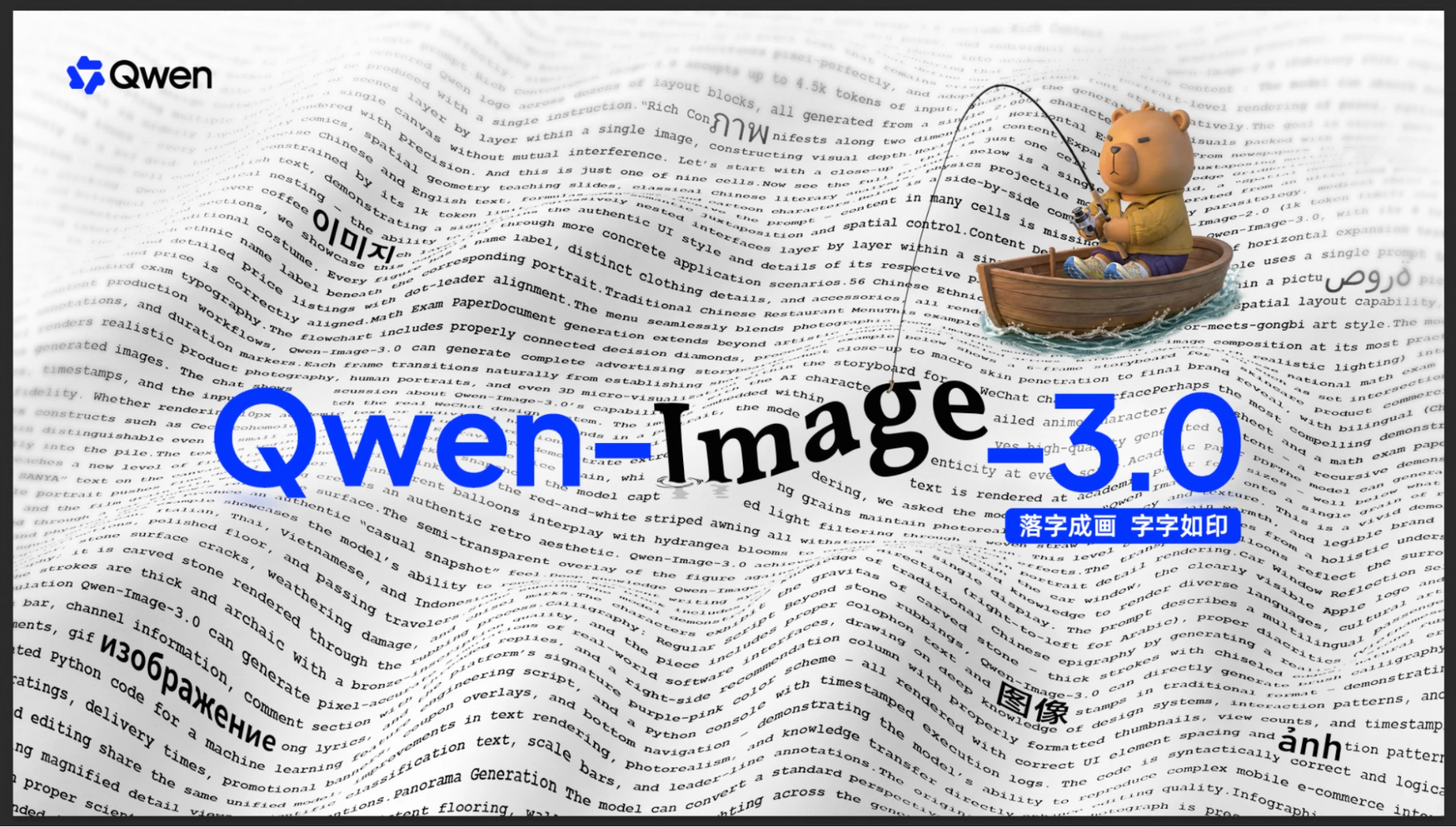
The Qwen team sums the release up with one Chinese character: 实 (Real). This one word was used to describe the leap made by their latest model. Where 1.0 chased accuracy and 2.0 chased range, 3.0 is pitched at production work.
Alibaba organises the pitch around three capabilities.
- Rich content: Prompts up to 4,500 tokens. The centrepiece example is a three-by-three grid of unrelated infographics, from a physics diagram to a group-theory proof, which the company says one 3,700-token instruction produced in a single pass rather than nine stitched renders.
- Authentic details: Text as small as 10 pixels stays legible, per the company. Skin, hair, and paper land close to photographic. The post shows a full academic paper page with multi-line equations.
- Deep knowledge: Native rendering across 12 languages, 100 plus art styles, and the ability to pull live data off the internet.
That last one is the strangest claim in the release, and the easiest to falsify. An image model reaching for live data blurs the line between a generator and a design tool with a database behind it.
The Numbers Worth Writing Down
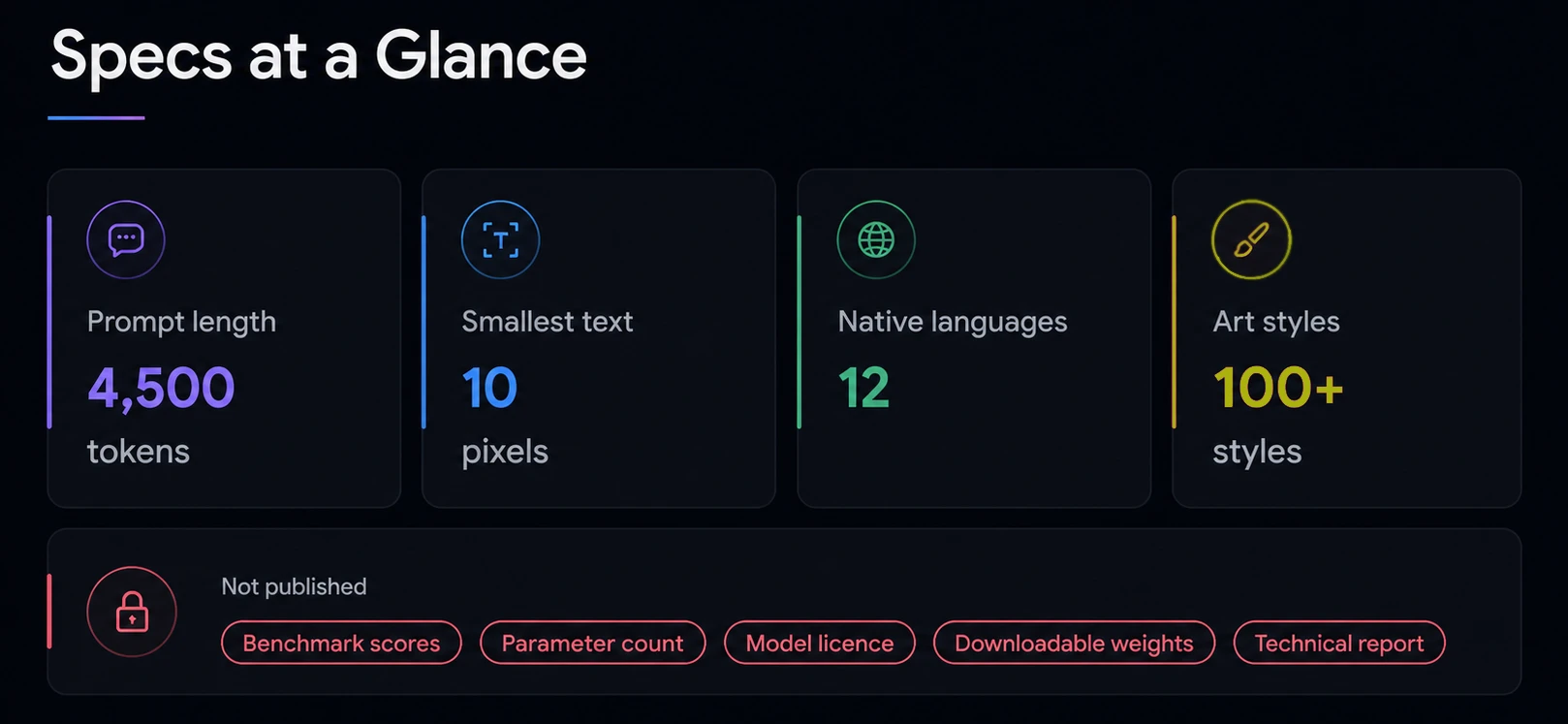
Four numbers came out of the launch. Only one of them is a genuine step change you can point to.
-
4,500 tokens of prompt input, up from roughly 1,000 in Qwen-Image-2.0
-
10 pixels, the smallest text size Alibaba claims stays readable
-
12 languages rendered natively rather than approximated (or is it?)
-
100 plus art styles
The token jump is the most concrete figure in the release. It is also the only one with a published predecessor to compare against, which is exactly why it is the number worth testing first.
Everything else is a quality claim. Quality claims need a scoring method, and no scoring method shipped.
The memory feature is particularly impressive for image generation.
How to Access It
Qwen-Image-3.0 runs inside Qwen Studio at chat.qwen.ai. Free account via email, Google, or GitHub.
- The two dropdowns confuse people. The top-left picker (Qwen3.7-Plus or similar) selects the text model for chat and has nothing to do with images. Click the plus icon left of the text box, choose Create Image, and a second picker appears in the composer row. That one governs generation. Whatever the top-left model is has no inkling on the image generation.
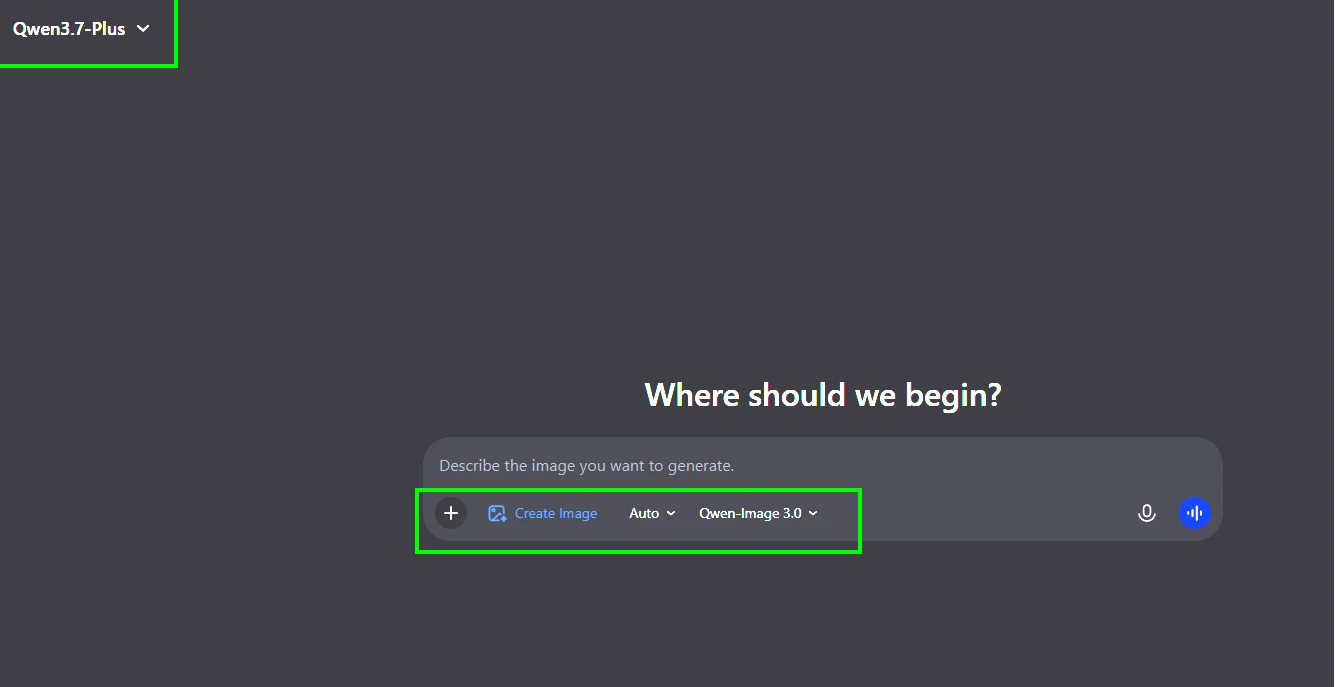
- Then change it. The image picker still defaults to Qwen-Image-2.0. Change it to Qwen-Image 3.0.
One caveat: No weights, no Hugging Face repo, no per-image pricing at launch. Qwen-Image 1.0 shipped under Apache 2.0, so 3.0 breaks the pattern. No version pinning or self-hosting here.
Testing Visually
I built five. Each targets one stated capability, and each fails in a way you can see without squinting. The design rule throughout: the correct output must be verifiable without trusting your own taste. Run them in Qwen Studio and paste your outputs into the response blocks.
Test 1: Does the Long Prompt Actually Land?
Generate a single image: a 2x3 grid of six labelled panels on a dark
background, titled "FIELD NOTES 1-6" across the top.
Every panel must contain its number as a large digit in its
top-left corner, and its caption as a single line at the bottom.
Panel 1: a cross-section of a leaf. Caption: "STOMATA OPEN AT DAWN"
Panel 2: a simple bar chart with exactly four bars of increasing
height. Caption: "FOUR BARS, ASCENDING"
Panel 3: a hand-drawn map with a compass rose pointing NORTH-EAST,
not north. Caption: "BEARING 045"
Panel 4: a wristwatch face reading exactly 8:47. Caption:
"EIGHT FORTY-SEVEN"
Panel 5: three stacked coins, the middle one turned on its edge.
Caption: "MIDDLE COIN ON EDGE"
Panel 6: deliberately empty except the single word "RESERVED"
centred in it. Caption: "INTENTIONALLY BLANK"
Do not add any element I have not listed. Do not fill panel 6.
Response:
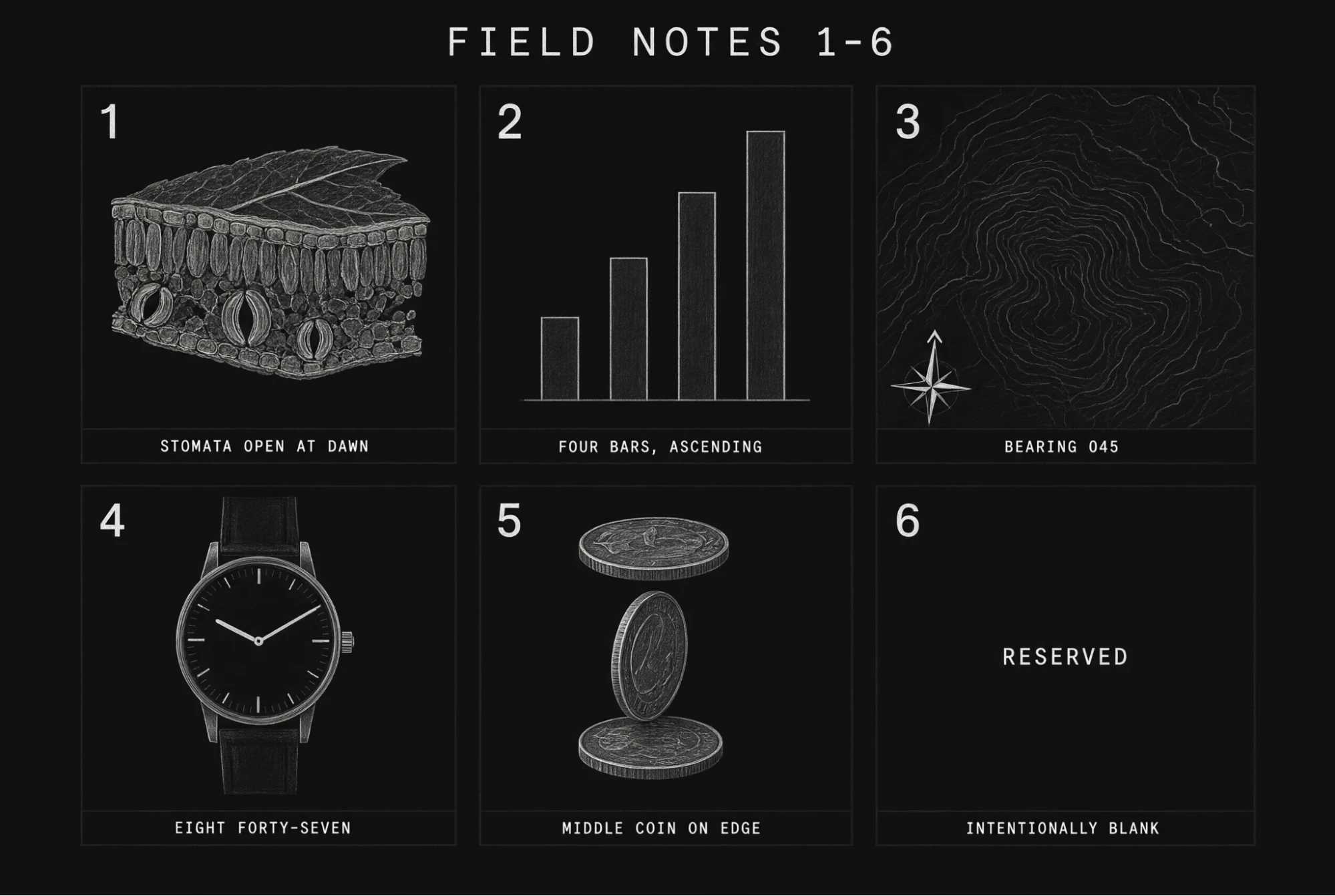
Verdict: Four of six.
Passes: captions verbatim, digits placed, grid correct. Panel 1 draws the stomata genuinely open. Panel 2 has exactly four ascending bars. Panel 5 nails it, with the three coins measuring 2.50, 0.42, and 2.74 width-to-height, so the middle one truly stands on edge. Panel 6 stayed empty.
Failures: the watch reads 1:49, not 8:47. Panel 3's arrow sits 7 degrees off vertical, pointing north instead of 045.
Both failures are visual priors beating an instruction. Watches default to their showroom pose, compasses to north. The coin had no prior, so it obeyed.
Test 2: The 12-Language Claim, Tested Where It Hurts
Generate a simple train station departure board, dark background,
white text, no logos.
It must contain these three lines exactly as written, in
Devanagari script:
नई दिल्ली -> लखनऊ प्लेटफ़ॉर्म 4
आगमन 14:35
यात्रा शुभ हो
Below them, in English, print: "NEW DELHI TO LUCKNOW"
Nothing else on the board.
Response:
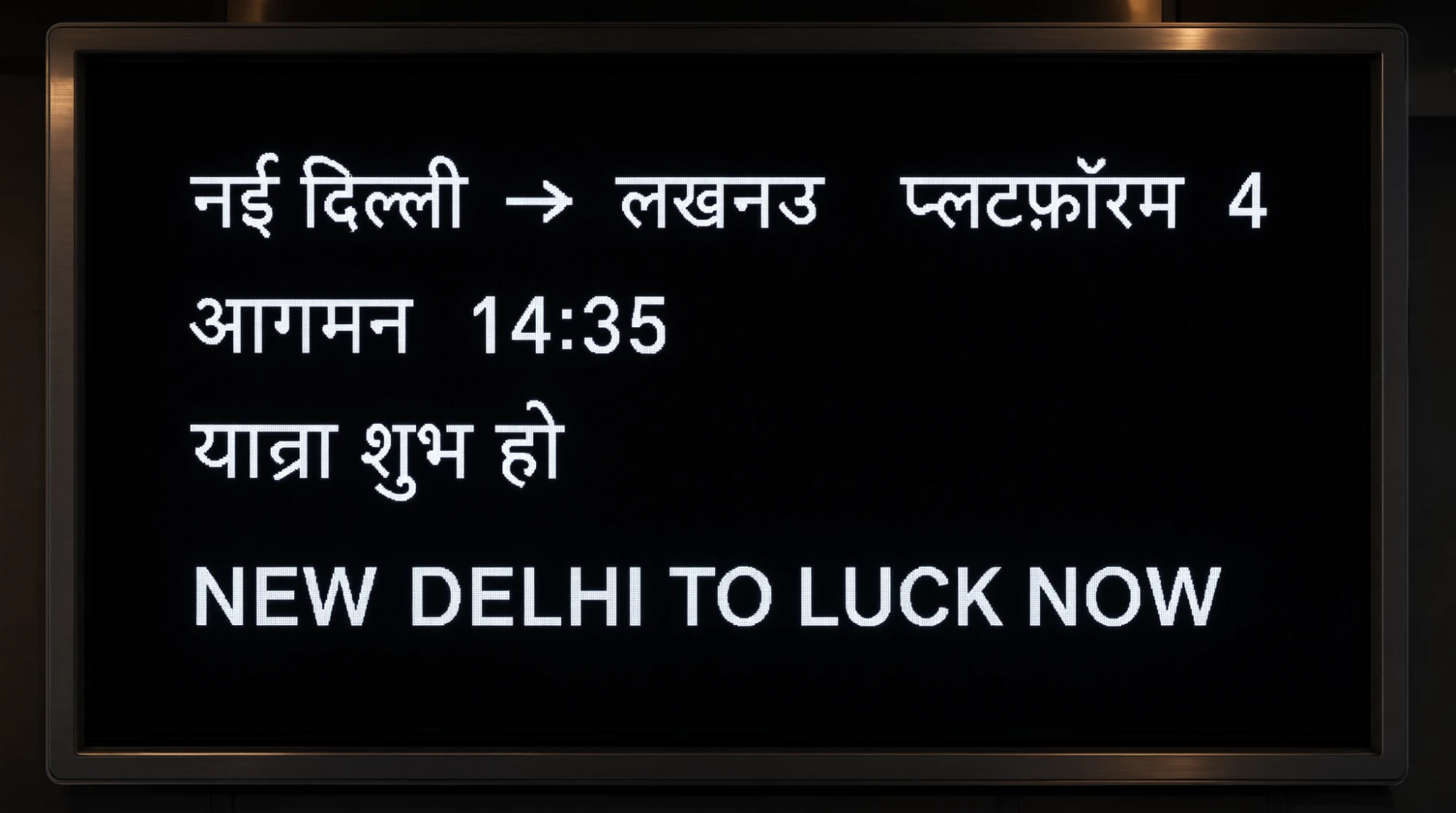
Verdict: The Latin line breaks first. Lucknow renders as LUCK NOW, split at a word boundary that does not exist.
Devanagari fails deeper. प्लटफ़ॉरम drops the े matra and ends रम where it needs र्म.
The script renders as shapes, not as language. Conjuncts get approximated and semantics get ignored.
Test 3: Does Live Web Retrieval Actually Retrieve?
Using live web data, generate a clean dashboard card showing the
current price of gold per 10 grams in Indian rupees, in Delhi,
as of today.
Include today's full date, the figure, and the source website name
in small text at the bottom of the card. Do not estimate. If you
cannot retrieve live data, print the words "NO LIVE DATA" instead
of a figure.
Response:
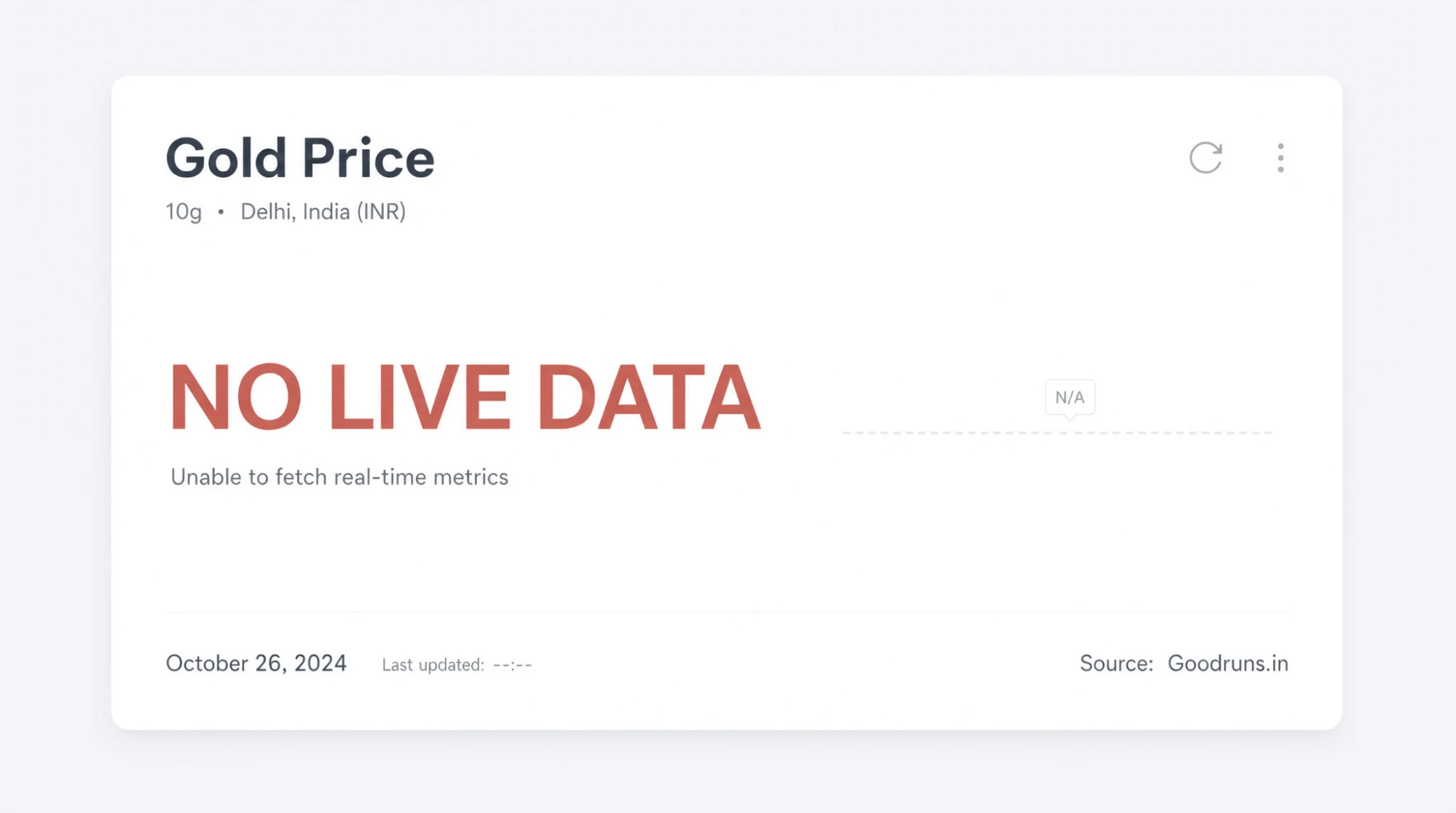
Verdict: It passed, and I did not expect it to.
I asked for a live gold price in Delhi. The model cannot fetch one, so the only honest output is an admission. It gave me exactly that: a NO LIVE DATA banner, an unable-to-fetch line, a null timestamp, and an N/A marker on an empty chart.
Every contextual cue pushed the other way. 10g, Delhi, INR, a dated footer. Any of those would have justified a plausible invented figure, and an invented figure looks identical to a retrieved one.
Test 4: The One-Ninth Test
Prompt A:
Generate one infographic panel, white background, textbook style. Topic: projectile motion. It must contain:
- A curved trajectory with the launch angle labelled "theta = 38 deg"
- Initial velocity labelled "v0 = 24 m/s"
- Peak height labelled "h = 17.6 m"
- Range labelled "R = 57.9 m"
- The formula R = (v0^2 * sin(2*theta)) / g in the bottom right
- A title bar reading "PROJECTILE MOTION" Nothing else in the panel.
Response A:
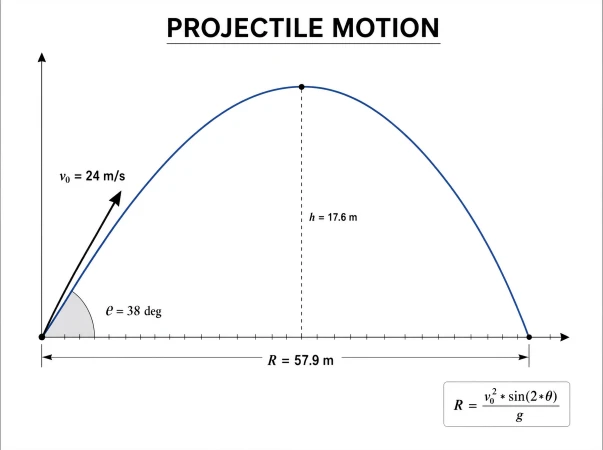
The rendering is clean and the physics is wrong.
At 24 m/s and 38 degrees, peak height comes to 11.1 metres. The diagram says 17.6. That is 58 percent off. Range fares better at 57.0 against a labelled 57.9, close enough to pass as rounding. The two numbers also contradict each other. R equals 4h over tan θ, so 17.6 implies a 90 metre range.
The formula box renders correctly, which is the tell. It reproduced the equation as a picture, then invented numbers that do not satisfy it. Alibaba's stated bar is that no symbol goes wrong.
Prompt B (followup on the initial prompt):
Generate a single image: a 3x3 grid of nine infographic panels, white background, textbook style, thin grey dividers.
Panel 5, the centre panel, must contain exactly this: Topic: projectile motion. A curved trajectory with the launch angle labelled "theta = 38 deg", initial velocity labelled "v0 = 24 m/s", peak height labelled "h = 17.6 m", range labelled "R = 57.9 m", the formula R = (v0^2 * sin(2*theta)) / g in the bottom right, and a title bar reading "PROJECTILE MOTION".
The other eight panels: 1 the water cycle, 2 a bar chart of four ascending bars, 3 a labelled plant cell, 4 a simple circuit with a resistor and battery, 6 a food web with four species, 7 a labelled human elbow joint, 8 a pie chart with three segments, 9 a timeline with four dated nodes.
Every panel needs its number in its top-left corner.
Response B:
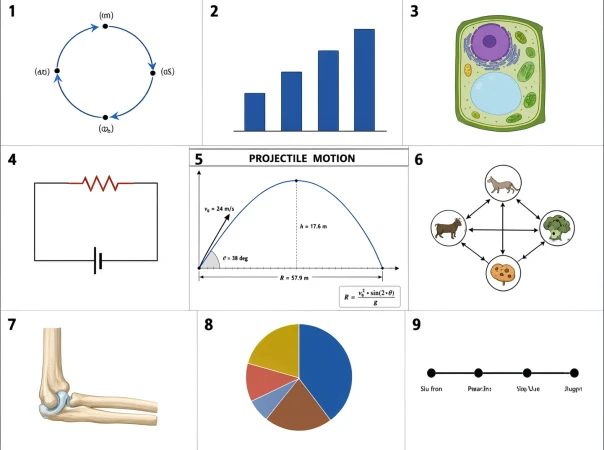
Verdict: The failure scales with cell size.
Large panels hold up. The plant cell, the circuit, the food web and the pie chart all read correctly. Panel 5 shrinks my projectile diagram until the labels blur, so the wrong height survives into a second image unchallenged.
Panels 1 and 9 collapse. Panel 9 labels a timeline with Jlugprt and Vlop Uue. Panel 1 marks a cycle with (aS) and (ao). Both are glyph-shaped noise standing where words belong.
Composition holds at nine cells. Text does not. The horizontal Rich Content claim is really a claim about layout.
Test 5: Equations, Where Almost Right Is Wrong
Generate a single page from a physics paper, white background,
serif type, two-column layout, in the style of a journal preprint.
The right column must contain this displayed equation, rendered
exactly, on its own line and numbered (7):
Psi_k(x) = sum from j=1 to n of [ a_j * exp(-b_j * x^2) ] / (1 + k^3)
Render it in proper mathematical notation with a real summation
sign, real subscripts and superscripts, and a real fraction bar.
The rest of the page can be placeholder text.
Response:
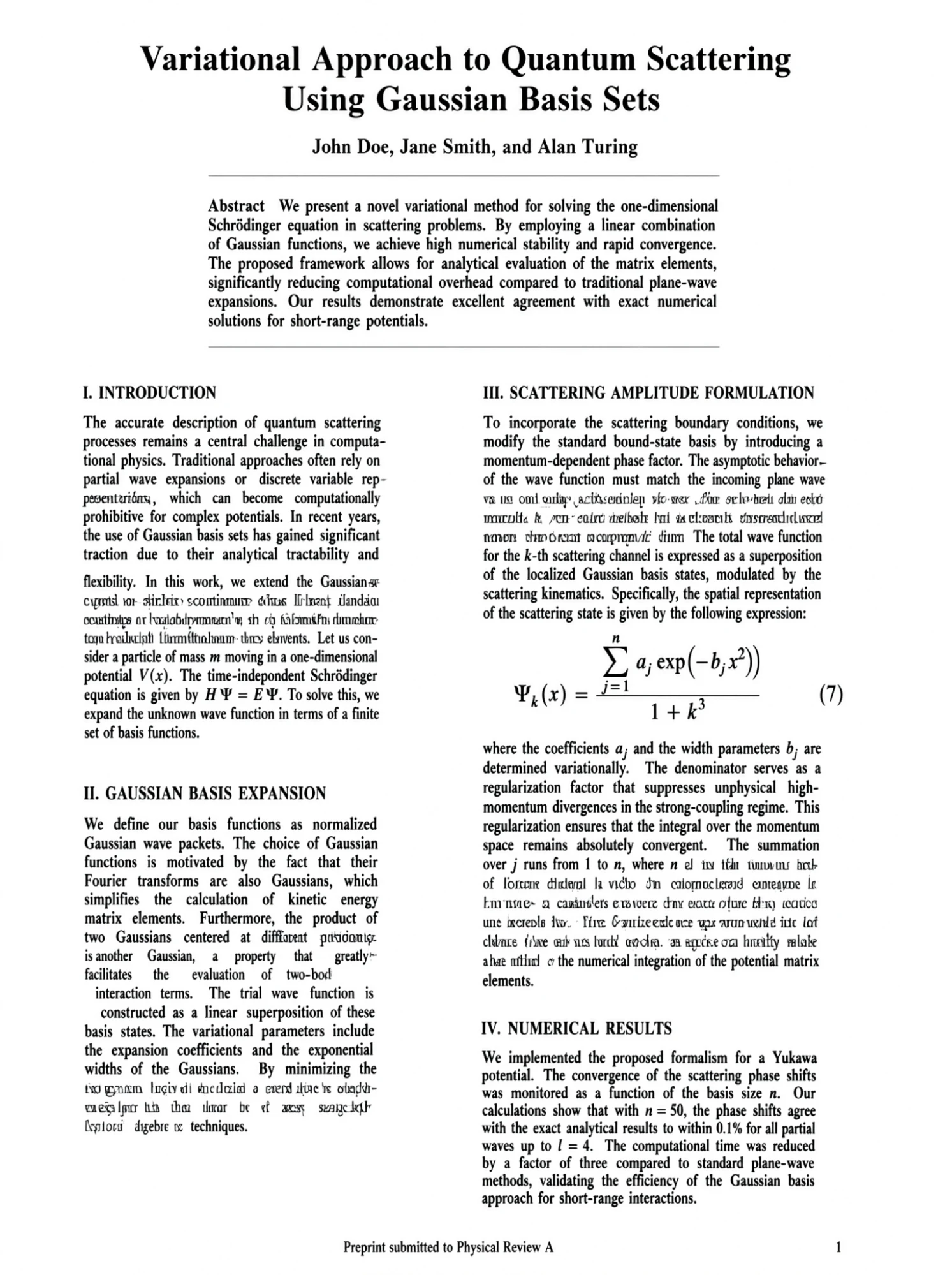
Verdict: This is correct, for the most part!
Layout is excellent. Two columns, correct preprint furniture, a title block and footer that pass at a glance.
Then the body shows another picture. Several paragraphs render a convincing texture with no words in them, sitting directly beside paragraphs that read fine.
The equation was placed as per our expectation, but the surrounding text wasn’t on par.
Conclusion
Qwen-Image-3.0 looks like the most capable image model Alibaba has built. It also arrives with less evidence than any release before it in the same series.
That is not a reason to dismiss it. It is a reason to test it yourself rather than trust the reel. Run the five prompts above, note where the output breaks, and decide from your own results. The gallery was chosen. Your outputs will not be.
Frequently Asked Questions
Are Qwen-Image-3.0 weights available to download?
No. Alibaba's launch post says nothing about releasing weights, and there is no Hugging Face or ModelScope repository for 3.0. Every earlier model in the series shipped weights or at least a technical report, so the silence is a change in pattern. Treat 3.0 as cloud-only until Alibaba says otherwise.
Is Qwen-Image-3.0 free to use?
Yes, through Qwen Studio at chat.qwen.ai with a free account. Alibaba published no per-image pricing and no dedicated API pricing for 3.0 at launch, so the chat interface is the practical route in today.
How is it different from Qwen-Image-2.0?
The prompt window jumps from roughly 1,000 tokens to 4,500, which is the only concrete before-and-after number in the release. Alibaba also claims legible 10-pixel text, single-pass multi-panel layouts, native rendering in 12 languages, and live web retrieval. None of those has a published benchmark behind it.
Does it handle non-English text well?
Chinese and English are the safest bets, in line with the series history. Independent testing on the first day found Japanese output that looked correct at a glance and contained near-words at reading distance. Test your own script before committing it to a deliverable.