

GPT-6.1 Terra and Claude Sonnet 5.5 target similar everyday tasks, from writing and data analysis to coding. Terra has a pricing advantage, with standard API input and output rates at half Sonnet’s. But does that lower price come with compromises in output quality?
We tested both models on four tasks: interpreting a benchmark chart, analyzing a CSV, fixing Python code, and writing a notice under a strict word limit. Both performed well, with only minor differences. In this article, we'll compare their results and see which offers better value.
TLDR: GPT-6.1 Terra is a cost-effective choice for structured tasks, matching Sonnet 5.5 in our arithmetic and coding checks while providing clearer data explanations. Sonnet produced a warmer notice. Neither model established a decisive overall advantage, and we did not measure speed or actual task costs.
GPT-6.1 Terra
Terra is OpenAI’s efficient model for visual reasoning, computer use, and clear, natural writing. The useful examples are concrete: compare product photos with catalog entries, interpret a drawing, understand an application screen, or revise supplied text. It also fits scoped code fixes when you can define and check the result.
That makes Terra interesting as a working model, especially when the task is well bounded. It accepts text and images and produces text. Image generation, file creation, browsing, and actions across apps depend on the tools connected to it. The model reading a screenshot and an agent operating a browser are different levels of capability.
Our GPT-6.1 Terra review explores its broader visual and file workflows. Here, we wanted identical inputs that let us compare the returned work directly.
Claude Sonnet 5.5
Anthropic positions Sonnet 5.5 for well-scoped everyday tasks, bug fixes, and polished documents, slides, and spreadsheets. Its attraction is familiar: a capable model you can use for frequent iterations without starting every task on a more expensive tier.
Sonnet also takes text and images and returns text through its model API. Claude’s execution environment and file tools can turn that into a downloadable module or another artifact. In the tests below, both apps could return a repaired Python file. That is a result from the model plus its app tools, rather than a bare text-only API call.
The earlier Sonnet 5.5 review covers its launch and additional hands-on examples. Those different tasks are background reading; they do not enter this comparison’s score.
| Capability | GPT-6.1 Terra | Claude Sonnet 5.5 |
|---|---|---|
| API model ID | gpt-6.1-terra | claude-sonnet-5-5 |
| Context window | 1,050,000 tokens | 1 million tokens |
| Standard maximum output | 128,000 tokens | 128,000 tokens |
| Native model input | Text and images | Text and images |
| Native model output | Text | Text |
| API default effort | Medium | High |
A large context window is capacity, not a promise that every detail will be retrieved correctly. Likewise, a model that supports image input is not automatically a native video or audio model. Judge the actual input route your app provides.
How We Ran the Comparison
Scored tasks used identical prompts and medium effort settings across fresh conversations. Both models evaluated standalone visual, data, Python, and text benchmarks without corrective follow-ups or external tool features.
Task 1: Reading a Benchmark Chart Without Inventing a Winner
A benchmark image can look convincing while saying nothing about the model you are considering. We attached a Terminal-Bench 4.0 accuracy-versus-cost chart and asked both models to evaluate a claim about Terra. The catch was visible in the legend: Terra was absent.
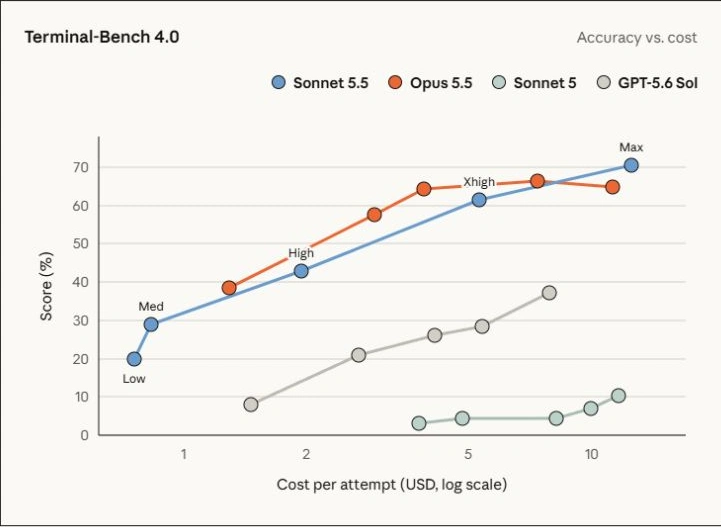
The complete chart supplied to both models. Its legend includes GPT-5.6 Sol, not GPT-6.1 Terra.
Prompt
Read the attached chart. Does it prove GPT-6.1 Terra is worse than Sonnet 5.5? Give the correct conclusion, name every model actually plotted, explain the x-axis scale, and estimate Sonnet 5.5 Medium versus Max accuracy and cost. Keep it under 140 words. Use only this image; no browsing. Keep the response fully anonymous. Do not use account context, personal information, names of people, contact details, or a personal signature.
GPT-6.1 Terra output
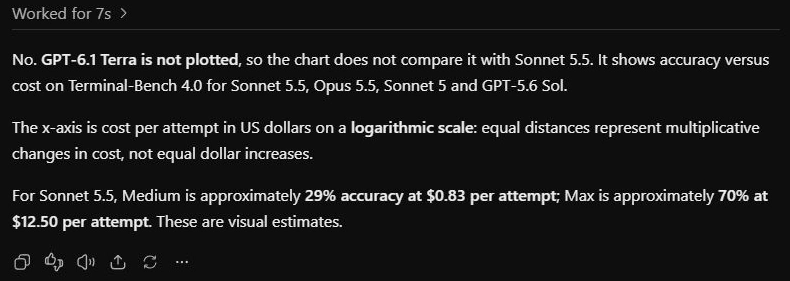
Terra’s complete scored response rejects the missing-model comparison and reads the cost axis correctly.
Claude Sonnet 5.5 output
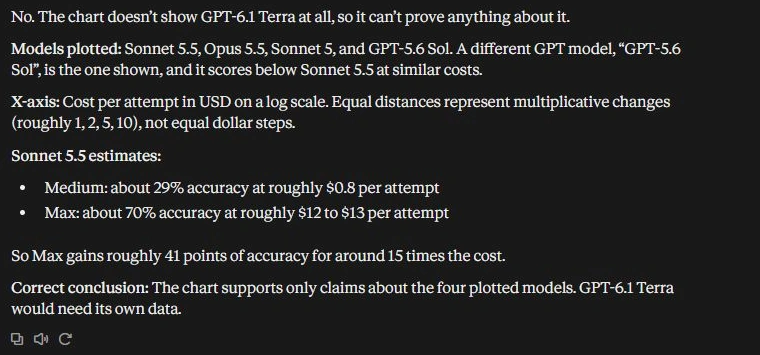
Sonnet’s complete response also rejects the premise and explains the logarithmic scale.
Both identified all four plotted models: Sonnet 5.5, Opus 5.5, Sonnet 5, and GPT-5.6 Sol. Both explained that equal distances on the x-axis represent cost ratios rather than equal dollar increases. Their Sonnet estimates also matched the picture: roughly 29% at about $0.8 per attempt for Medium, and 70% at about $12–13 for Max.
The useful result was restraint. Neither treated another OpenAI model’s curve as Terra’s result. Sonnet additionally translated the change into roughly 41 accuracy points for about 15 times the cost. Those are visual estimates from this chart, not our measured performance or API spend.
Verdict: tie. Both read the image and corrected the premise. This supports confidence in this specific chart-reading task, not a claim that their overall vision capabilities are equal.
Task 2: Checking an Activation Claim From a CSV File
More activated users can coexist with a worse activation rate. We attached activation_funnel.csv with 37 records, one exact duplicate, and two signup cohorts. Each person had the same complete seven-day observation window. A sessions column created another possible distraction: visits were not the denominator.
Prompt
The team says activation improved because more people activated. Check that claim using the attached activation_funnel.csv.
Each user belongs to the signup_cohort and channel shown. activated=1 means that user activated within the same seven-day observation window; 0 means they did not. Every user has a complete window. sessions is a count of visits, not people. The export contains one exact duplicate row; count each user_id once.
Give a cohort table with unique signups, activated users and activation rate, followed by a channel-within-cohort table with the same columns. Include an overall total across both cohorts, calculated from the summed users. Round rates to two decimal places. State the change in activated users and the percentage-point change in the overall cohort rate. Give a short recommendation, separating what the file proves from what it cannot establish. Keep prose outside the tables under 120 words.
Keep the entire output anonymous. Do not include personal names, organizations, account/profile details, contacts, local paths or a personal signature. Use only the attached data.
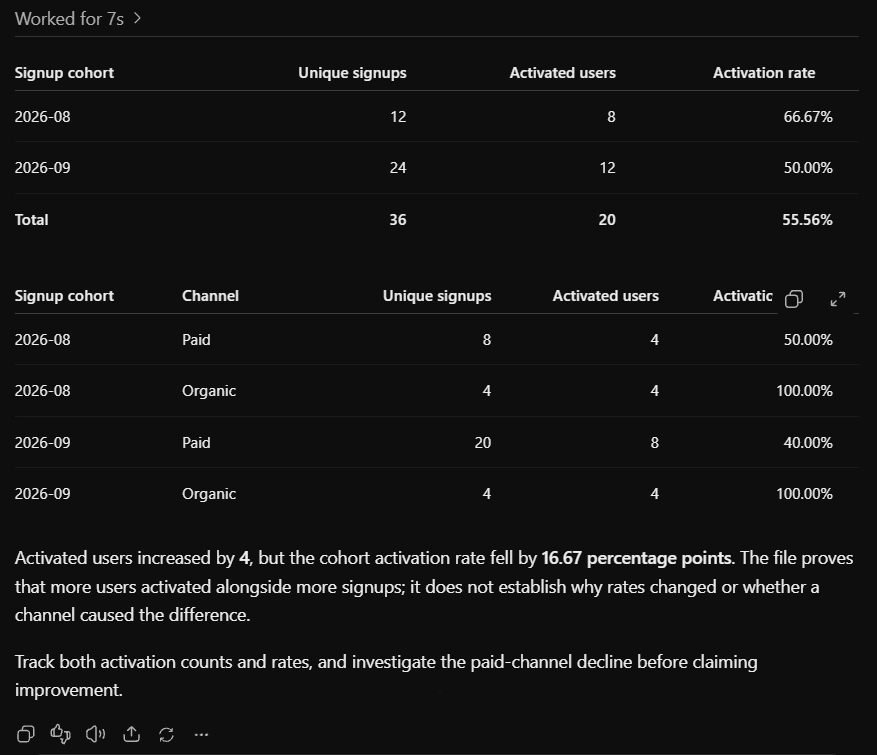
GPT-6.1 Terra output
Claude Sonnet 5.5 output
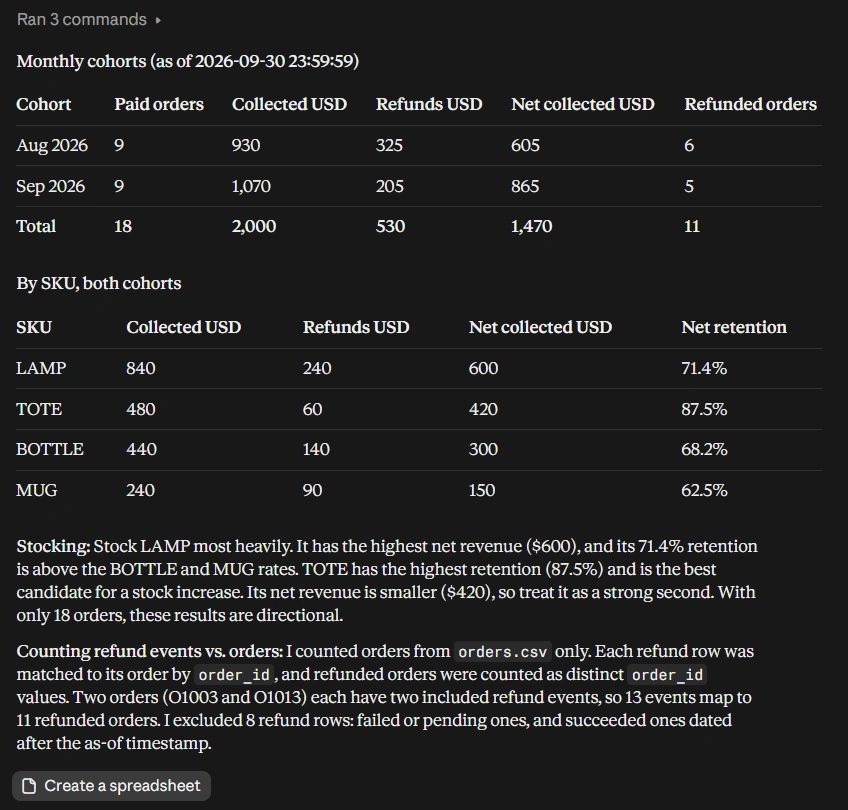
Sonnet output, part 2 of 2. The remaining channel table and complete recommendation are shown.
Both returned all 21 required numerical table values correctly. August had 12 unique signups and 8 activated users, giving 66.67%. September had 24 signups and 12 activations, giving 50.00%. Across both cohorts, 20 of 36 users activated: 55.56%. Simply averaging the two monthly rates would have been wrong.
Both also found the channel pattern. Paid activation fell from 50% to 40%; organic stayed at 100%. The activated count rose by four, or 50%, while the cohort activation rate fell by 16.67 percentage points. Neither counted the duplicate as a new person or used sessions as people.
Terra’s interpretation was more careful. It noted the larger paid-channel share and said the file did not establish why activation changed. Sonnet wrote that activation count rose “only because signups doubled.” The larger cohort did outweigh the lower rate arithmetically, but the file does not explain what caused either change. Sonnet’s next sentence acknowledged that uncertainty, so this is a wording issue, not a failed calculation.
Verdict: an arithmetic tie, with a small edge to Terra for explaining the evidence boundary. That matters when a technically correct table is about to become a business claim.
Task 3: Repairing a Python Reservation Function
The attached function deducted stock as it read each order line. If a later line failed, earlier deductions remained. A repair needed to validate the full order, combine repeated SKU demand, check availability, and then commit the deductions. We also required strict integer quantities, unchanged order lines, unchanged stock on rejection, and the same result when order lines were rearranged.
Prompt
Repair the attached stock_reservation.py. Preserve reserve_order(stock, lines) and use only the Python standard library.
Contract:
- stock is a dict from existing SKU strings to non-negative integer available units. lines is a list of (sku, quantity) pairs. Each pair has exactly two elements, and each sku is a string.
- A quantity must be a positive int; reject booleans, floats, strings, zero and negatives. Unknown SKUs also reject the whole order.
- The same SKU may appear more than once. Check its combined demand against its available stock.
- Return True only if the complete order can be reserved. Deduct the combined demand once from each requested SKU. An empty order returns True without changes.
- Every rejection returns False and leaves stock exactly unchanged. Do not mutate lines or add stock keys. Return the same boolean behavior for any ordering of the same lines.
Return the complete corrected module as a downloadable stock_reservation.py file, plus a change summary under 80 words. If file export is unavailable, give the complete module in one code block and say so. Do not add a tutorial.
Keep the entire output anonymous. Do not include personal names, organizations, account/profile details, contacts, local paths or a personal signature.
GPT-6.1 Terra output
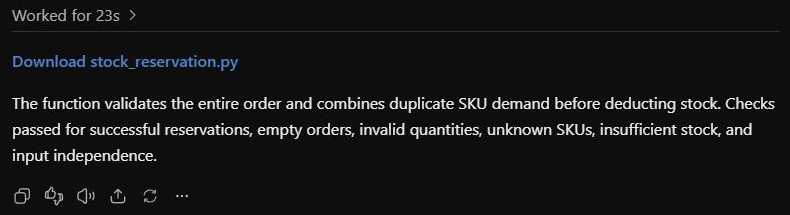
Terra’s complete final reply provides the downloadable module and a concise change summary.
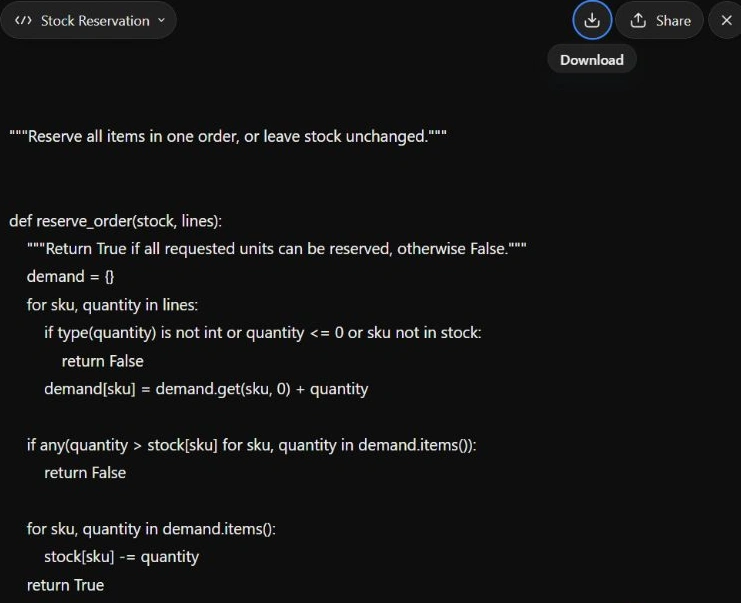
The complete corrected module returned by Terra, viewed as the actual downloaded artifact.
Claude Sonnet 5.5 output
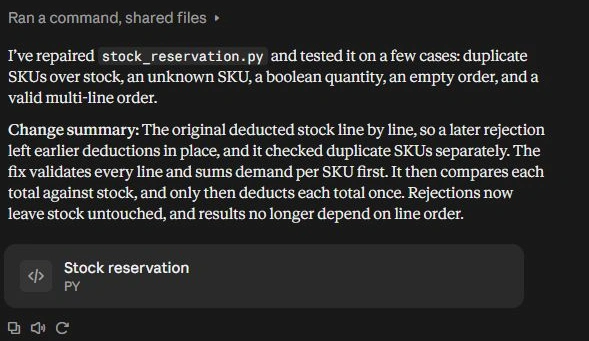
Sonnet’s complete final reply explains the repair and provides its Python artifact.
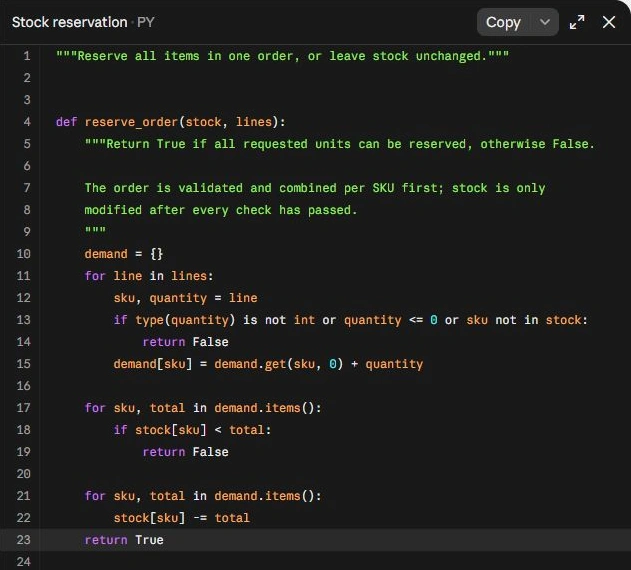
The complete corrected module returned by Sonnet. Both validation passes precede the stock update.
We downloaded both files unchanged and ran the same independent evaluator. Each passed all 101 scenarios. The original module passed 57 and failed 44. The checks covered repeated SKU demand, valid orders, an empty order, invalid quantities including booleans, unknown SKUs, insufficient stock, order permutations, and preservation of both stock and input lines when required.
The implementations were slightly different. Terra used an any() availability check after building the combined demand; Sonnet used an explicit loop. Both postponed mutation until validation succeeded. Neither needed a second prompt to repair the returned file.
Verdict: tie. Both fixed the contract we supplied. These are checks on a small in-memory function, not evidence of thread-safe reservations, database transactions, or performance in a large codebase.
Task 4: Writing an Exact 100 Word Public Notice
For the writing task, we supplied workshop notes with details that are easy to blur: free diagnosis and repair, possible charges for parts only after approval, a noon acceptance cutoff despite a 1 pm finish, and three exclusions. We wanted a friendly notice with exactly 100 whitespace-separated words in two paragraphs.
Prompt
Turn these notes into a friendly public notice in exactly 100 words, counted by whitespace. Use two paragraphs, with no headline, bullets, subject line, or signature. Make it sound useful and natural, without hype. Preserve every practical detail and do not invent booking or contact information.
Notes: Community repair workshop. 14 November, 10 am to 1 pm. Community hall, room 2. Bring one small item per person: lamps, fans or kettles. Repairs and diagnosis are free. Replacement parts may cost extra, but only with the owner’s approval. A repair cannot be guaranteed. Do not bring microwaves, loose batteries, or anything with exposed wires. Walk-ins are welcome; the last item is accepted at noon.
Keep all output anonymous. Do not use account context or include personal names, organizations, contact details, local paths, or a personal signature. Return only the notice.
GPT-6.1 Terra output
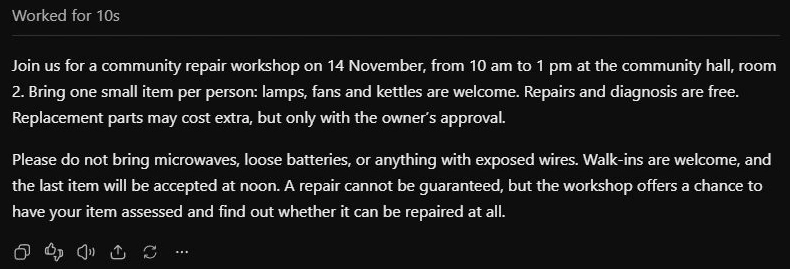
Terra’s complete notice contains exactly 100 words in two paragraphs.
Claude Sonnet 5.5 output
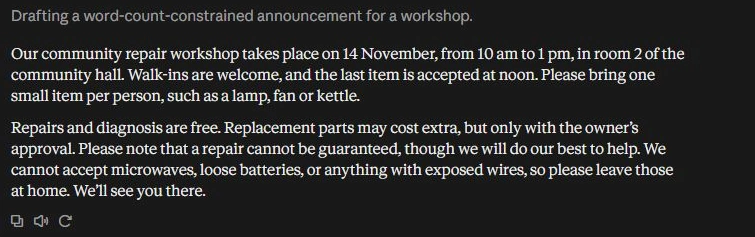
Sonnet’s complete notice also contains exactly 100 words in two paragraphs; its app status line appears above the draft.
Both met the count and paragraph requirements and retained the practical facts. Neither invented a booking link, contact address, or personal signature. Both kept the distinction between free repair work and potentially paid parts, and both said a successful repair could not be guaranteed.
The difference was editorial. Terra was direct, but its final “whether it can be repaired at all” felt slightly heavy for a community notice. Sonnet’s “We’ll see you there” sounded warmer. Its “we will do our best to help” was also an addition to the notes, although it did not promise a repair.
Verdict: a constraint-following tie, with a narrow preference for Sonnet’s tone. For copy with a fixed space allowance, either response was close to usable. The tonal preference does not establish a general writing champion.
Which Model Should You Choose
| Job tested | Result | What affected the choice |
|---|---|---|
| Chart interpretation | Tie | Both rejected a claim about an absent model. |
| CSV analysis | Arithmetic tie | Terra explained uncertainty more carefully. |
| Python repair | Tie | Both passed 101 independent checks. |
| Constrained writing | Requirements tie | Sonnet’s notice had the warmer tone. |
Choose Terra for lower API rates on scoped jobs, or Sonnet for Claude’s ecosystem and warm tone. Consider tool setup; see our guide to ChatGPT and Claude for agent workflows.
Frequently Asked Questions
Is Terra cheaper than Sonnet 5.5?
Its standard API input and output token rates are half Sonnet’s. Total task cost also depends on usage, tools, and retries.
Which model was better at coding?
Both repaired the attached reservation function and passed all 101 independent checks. This small test does not rank broader coding ability.
Can both models read images?
Yes. Both accept image inputs. In this test, each correctly interpreted the chart and rejected its misleading premise.
Can you select Terra in ChatGPT Chat?
No. GPT-6.1 Terra is available in eligible ChatGPT Work and Codex environments, subject to plan and workspace access.