

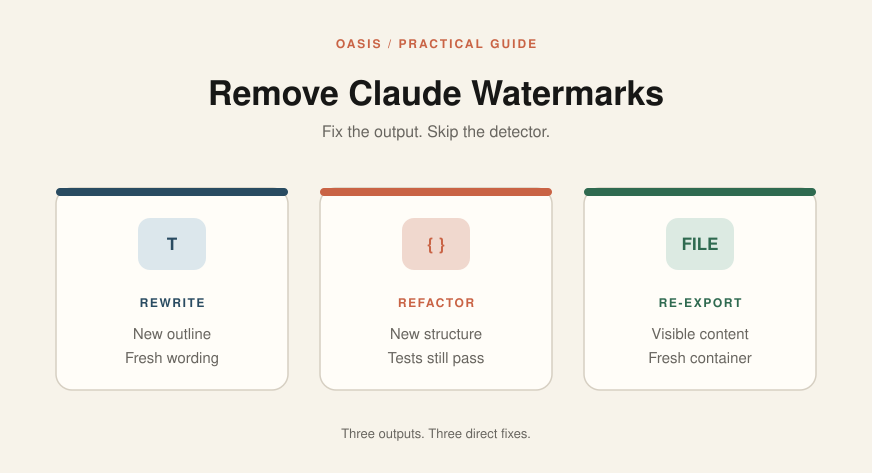
QUICK ANSWER: Paraphrase the text from 1/4th of each section. Refactor the code until the implementation is different. Re-export files from visible content into a fresh container. That is the solution. You do not need Anthropic's detector or c2patool.
Claude uses one marking method for text and code, and C2PA metadata for supported files. Fix the part that carries the mark: the generated sequence or the original file container.
Remove the Watermark from Claude Text
Do not clean punctuation, change fonts, or swap a few synonyms. Paraphrase the draft itself. On an average changing a little bit over 25% of the entire text’s length would either get rid of the watermark or would reduce its confidence sufficiently.
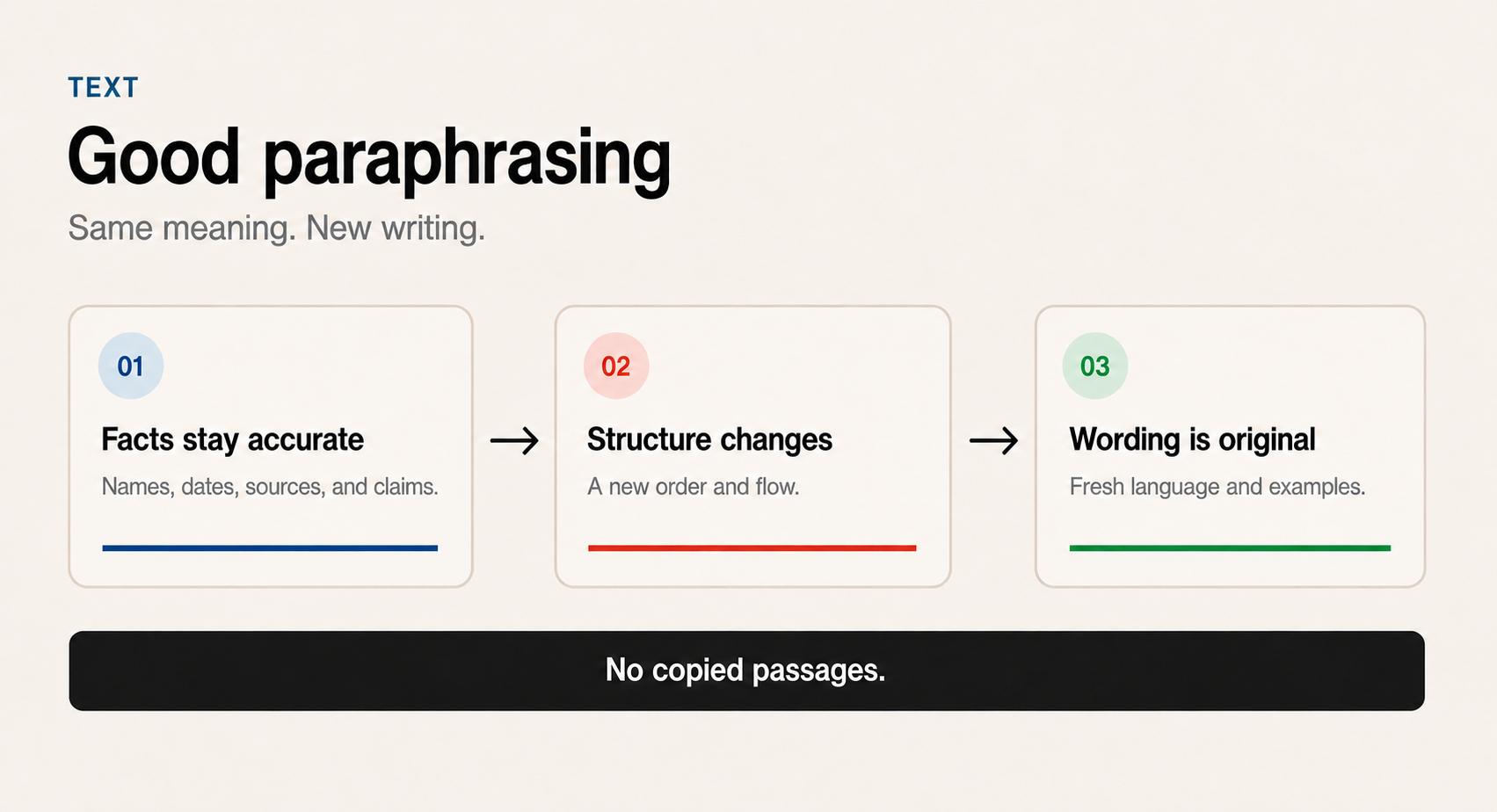
What Good Paraphrasing Changes
- The essential facts, sources, names, dates, and claims remain accurate.
- The sentence structure and order are rebuilt from scratch.
- The information follows a fresh outline based on the reader’s questions.
- The wording, examples, transitions, and conclusion are original.
- No lengthy passages or distinctive phrases remain from the source.
WORKING RULE: Do not stop after changing 25%. Rewrite at least half of the wording to be safe.
Remove the Watermark from Claude Code
Code is structurally different from text because its syntax controls how it runs. A good way of going about it is by renaming variables, extracting functions, simplifying conditions, and replacing for loops with while loops where appropriate. The result should behave the same without copying the original implementation line for line.
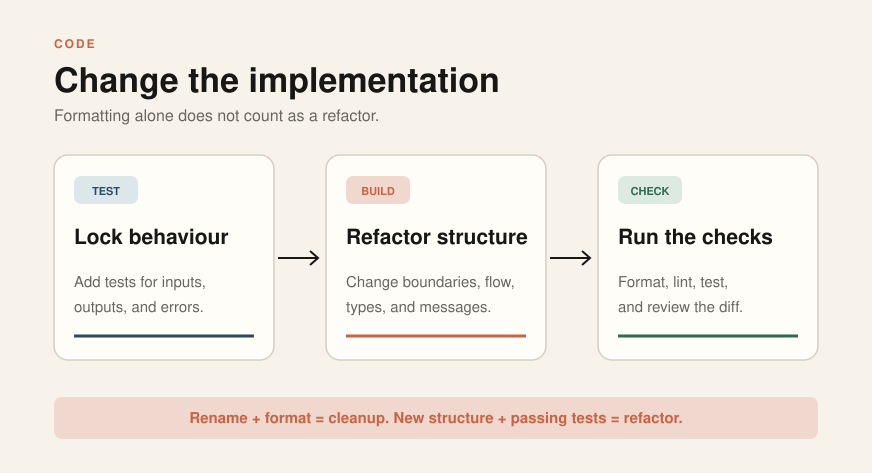
What a Proper Code Rewrite Changes
- Tests preserve inputs, outputs, errors, and side effects.
- Function boundaries, control flow, data structures, and error handling are rebuilt.
- Variable names, comments, docstrings, and messages match the project.
- Formatting, linting, typing, security checks, and tests all pass.
DO NOT COUNT THIS: Formatting, whitespace changes, and variable renaming are cleanup. They are not a structural refactor.
Remove the Watermark from Claude-Generated Files
C2PA is a file-level Content Credential. It stores signed provenance information (such as which tool created or edited an asset) inside supported files. It applies to exported files such as images and documents, not plain text or source code copied into an editor. Anthropic describes it as a cryptographically signed note attached to the file’s metadata (specificially in the headers).
Renaming or duplicating the original file changes nothing because the headers are unaffected by it. The reliable approach is to rebuild the asset from its visible content and export a completely new file.
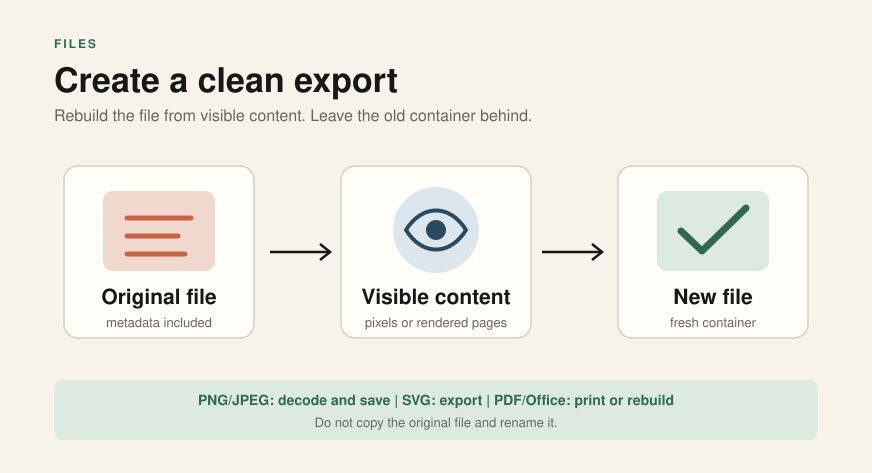
Use the Right Export Method
- PNG or JPEG: Decode the visible pixels and save them as a new image.
- SVG: Export the artwork as PNG. Rebuild the SVG only when editability matters.
- PDF: Print it to a new PDF. For complete flattening, render each page and combine the rendered pages.
- DOCX, PPTX, or XLSX: Move the visible content into a new file or export it through a fresh PDF print.
Windows shortcut: Open a PNG or JPEG in Paint and select Save As. For PDFs and Office documents, select Microsoft Print to PDF. Avoid Save a Copy, which can preserve the original file structure and metadata.
Re-export Images From Pixels
Pillow provides a repeatable way to rebuild PNG files Run:
from PIL import Image

with Image.open("input.png") as source:
   pixels = source.convert("RGBA")
   rebuilt = Image.frombytes("RGBA", pixels.size, pixels.tobytes())
   rebuilt.save("clean.png", optimize=True)
The script decodes the visible pixels, creates a new image object, and writes a fresh PNG. It does not copy the original metadata blocks or embedded C2PA manifest. This removes the embedded credential; it does not establish who created the visible content.
Check the Result
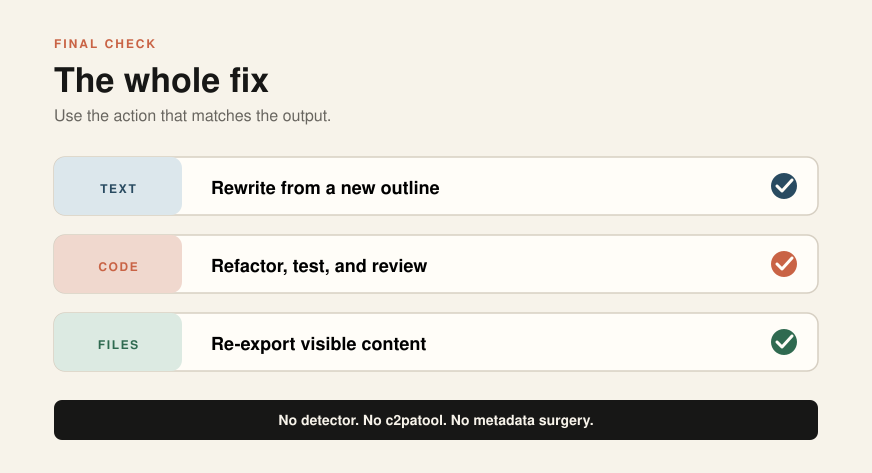
Text and code do not need a detector. Check that the prose was rebuilt, the implementation changed, and the tests pass. As for the image a re-export suffices.
SEPARATE ISSUE These steps change the output. They do not delete Claude account history, API logs, chat history, or repository history.
Final Take
Do not reverse-engineer the watermark. Replace what carries it.
The cleaner approach is to recreate the output rather than trying to identify and strip whatever marking system produced it. That also avoids depending on a watermarking method that could change over time.
- Text: write a new draft from the facts, structure, and ideas you want to preserve.
- Code: rebuild the implementation independently, then run the original tests to confirm the behavior still matches.
- Files: recreate or re-export the visible content into a genuinely new file instead of simply renaming or copying the original.
The principle is simple: preserve the useful content, not the original generated artifact.
Frequently Asked Questions
Is changing 25% of the text enough?
Do not use 25% as the finish line. Rewrite at least half and change the structure.
Do I need c2patool?
No. Use a clean export and check the result in Content Credentials Verify.
Will renaming the file remove C2PA?
No. Renaming changes the filename, not the file contents.
Does formatting remove a code watermark?
No. Refactor the implementation and verify it with tests.