

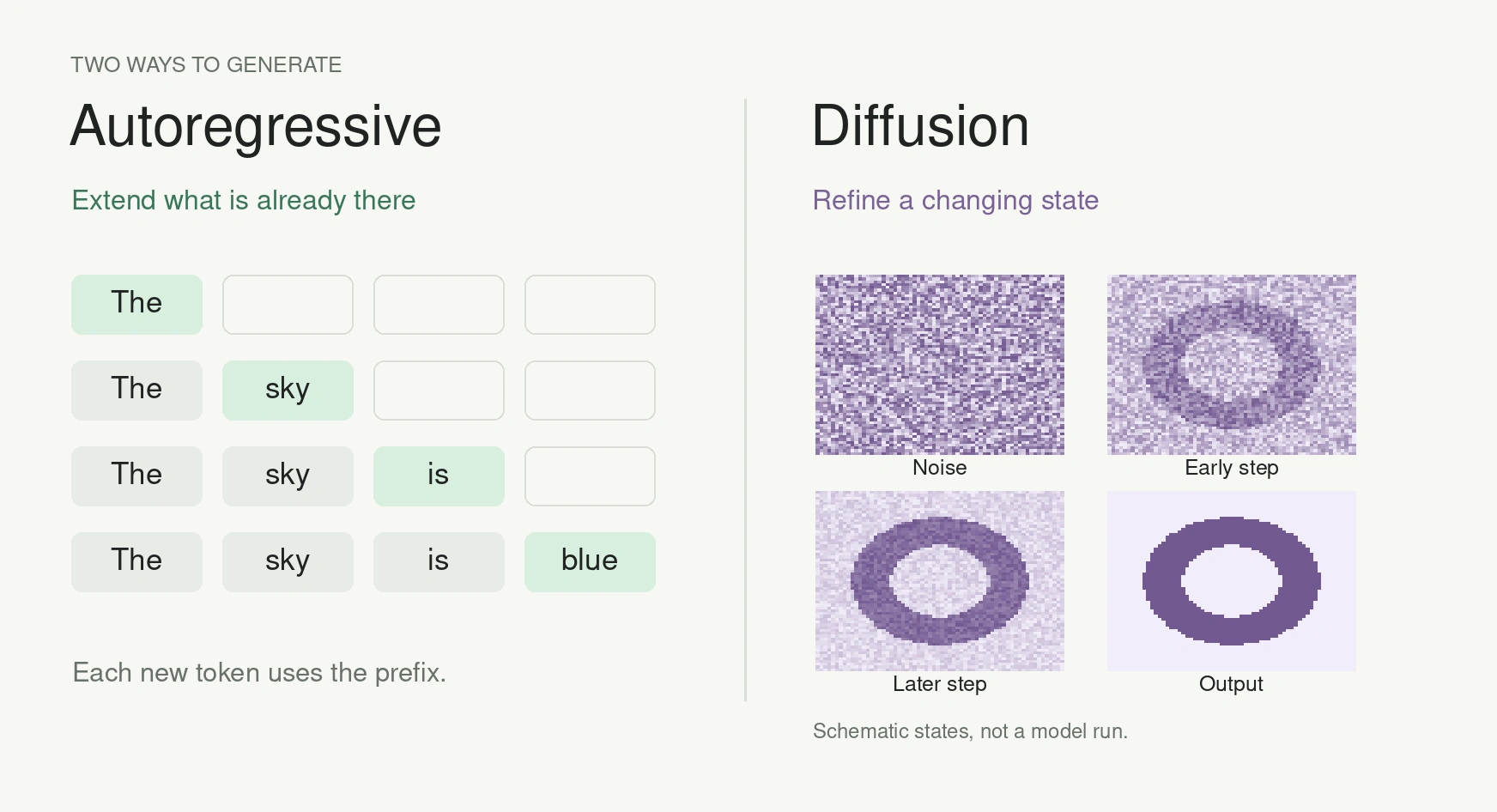
A chatbot writes an answer piece by piece. An image generator can start with noise and gradually produce a scene. These familiar experiences point to two approaches to generative AI: autoregressive modeling and diffusion. The difference affects generation order, editing, and how long you wait for usable output. This guide explains both through worked examples and visual walkthroughs, then examines where the distinction blurs. Diffusion can generate text, autoregression can generate images, and either approach can use a Transformer.
TL;DR: Autoregressive models generate the next part using earlier parts. Diffusion models learn to reverse corruption, usually producing an output through repeated refinement; neither approach wins every task.
Start with what changes at each step
Watch the output as it develops. In ordinary autoregressive text decoding, the sequence grows: each step adds a token. In image diffusion, the working representation usually keeps its shape while its values change across denoising steps.
A token is a unit the model processes, such as a word fragment or an image code. Inference means using the trained model to produce an output. We will use whole words in the diagrams to keep the process readable.
How autoregressive models generate an output
An autoregressive model predicts each new part from the parts that precede it in a chosen order. For language, that usually means predicting the next token from the prompt and the response generated so far. Decoder language models such as GPT-2 and Llama use this approach. Hugging Face explains the architecture in much detail.
Follow one sentence
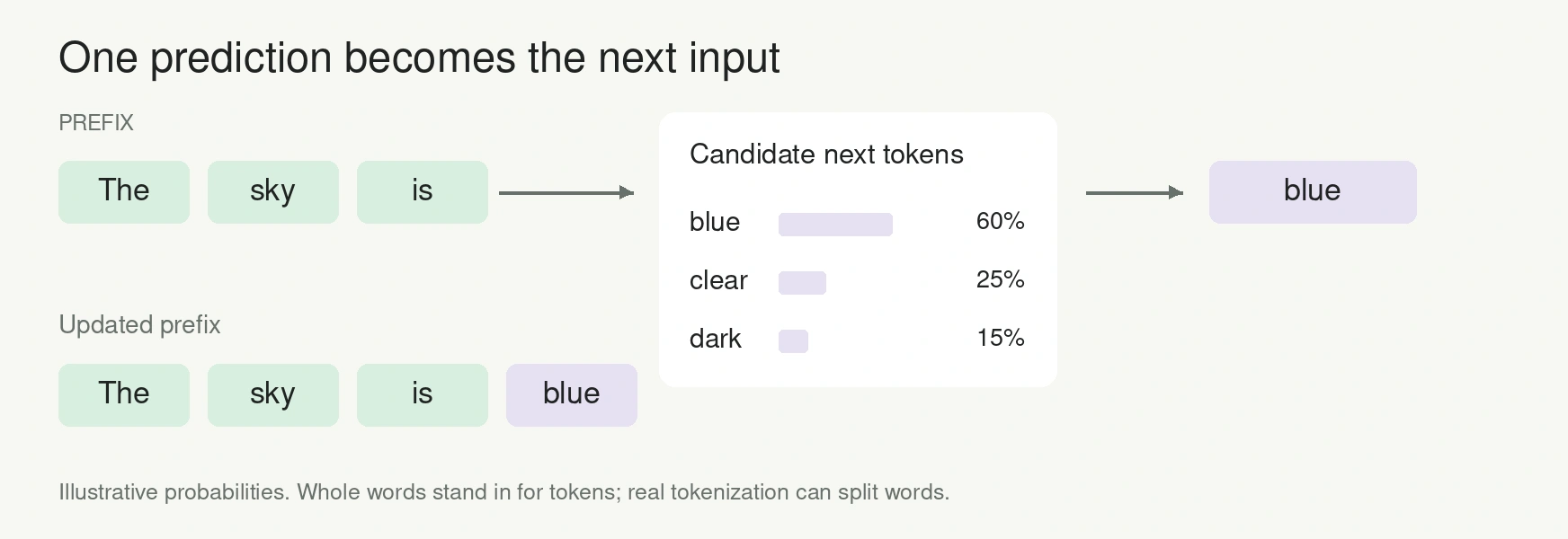
Suppose the current text is “The sky is”. The model assigns probabilities to possible next tokens. Our illustration gives “blue” 60%, “clear” 25%, and “dark” 15%. These are teaching values, not measurements from a model.
- The model processes the available prefix: “The sky is”.
- A decoding rule selects a next token. Greedy decoding chooses the highest probability; sampling allows other candidates.
- The selected token joins the prefix. The next prediction now uses “The sky is blue”.
- Generation continues until an end token, a length limit, or another stopping rule.
The model does not normally create a complete hidden answer and reveal it one word at a time. Its next choice depends on the sequence already produced. Selecting “dark” would change the context for everything that follows.
Why this matters in practice
This process naturally supports streaming: readers can see the beginning while the rest is generated. It also creates a dependency between steps. In ordinary decoding, the next token depends on the token just selected.
Previously emitted tokens stay in place within that decoding pass. A model can still revise an answer by generating a replacement, proposing edits, or using another pass. “Autoregressive” does not mean incapable of editing.
How diffusion models generate an output

Diffusion models learn to reverse a corruption process. In a common image formulation, training images receive increasing amounts of Gaussian noise. The model learns how to move from a noisy state toward a less noisy one. The DDPM paper established an influential version of this approach.
Follow an image through generation
- Start with a randomly sampled noise array.
- Give the denoising network the current array and its noise level, plus any conditioning such as a text prompt.
- Use the network prediction and a sampling rule to compute the next state.
- Repeat across the selected timesteps until an image, or an image representation, is ready.
The network can update information across the image at each step. It does not have to finish the top-left corner before generating the bottom-right corner.
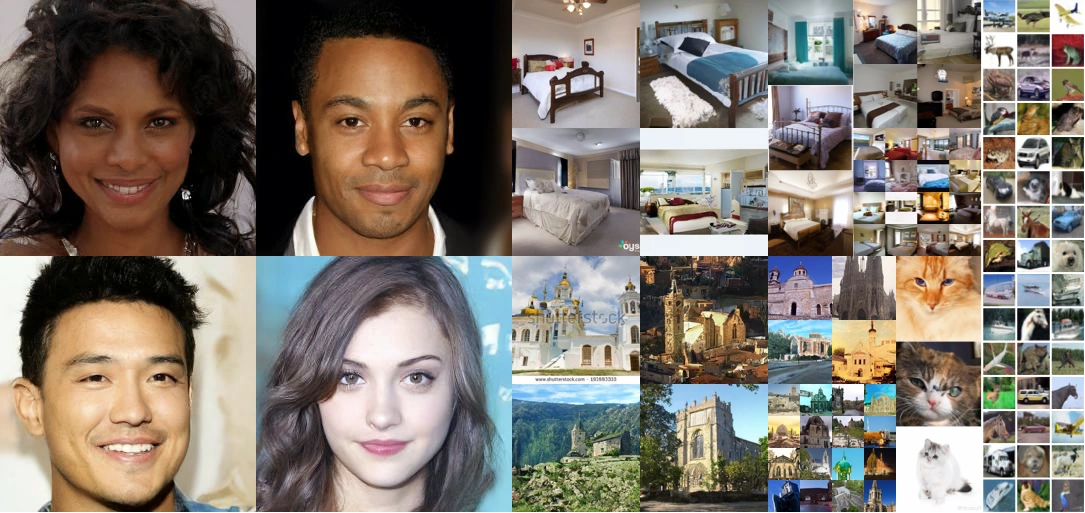
The samples above illustrate what this learned reverse process can produce. During fresh generation, there is no original photograph hiding inside the starting noise. The model constructs a sample using patterns learned during training.
Denoising also does not guarantee factual or geometric correctness. A coherent-looking image can still contain impossible objects or incorrect relationships.
Training and generation are different jobs
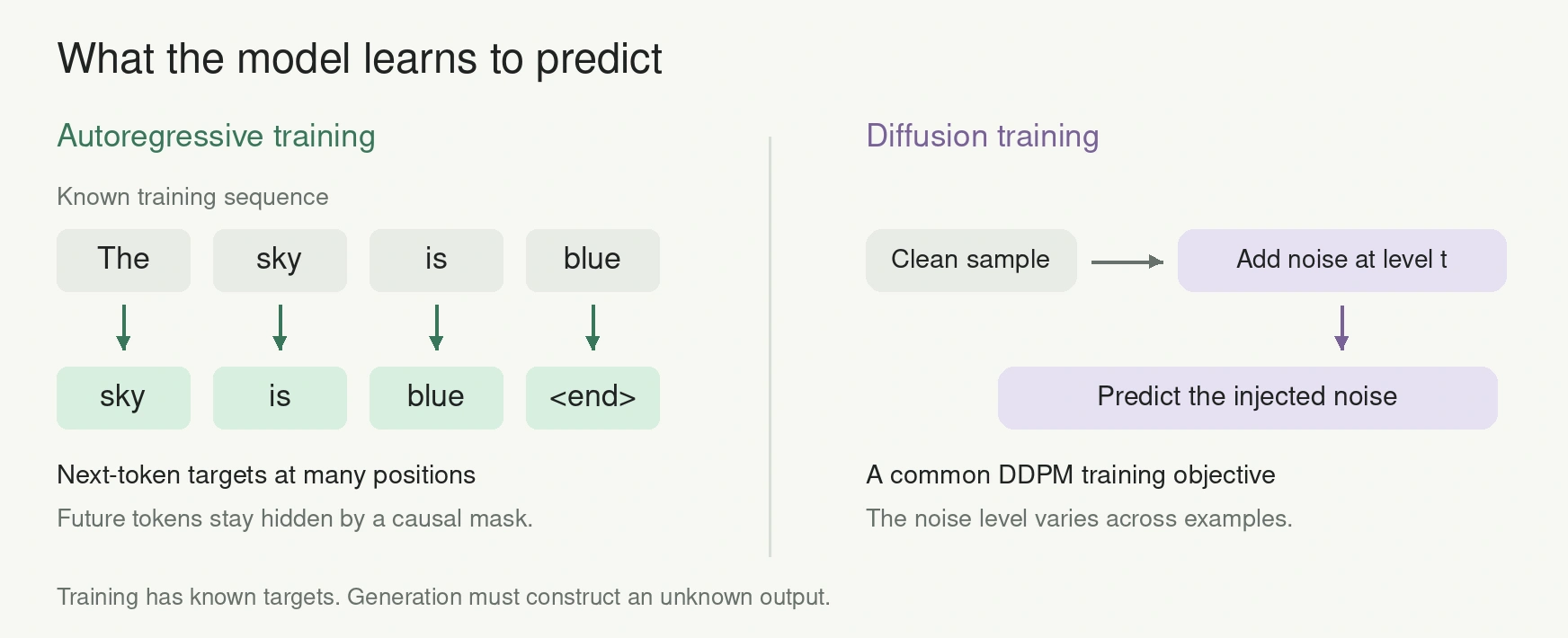
A sequential generation process does not imply that training must make one prediction at a time. During training, the desired output is already available, which changes how work can be organized.
Autoregressive training uses known prefixes
For “The sky is blue”, the training targets are the next tokens at successive positions. The model learns to assign more probability to the correct continuation. This is commonly trained with cross-entropy loss: confidently predicting the wrong token incurs a larger penalty.
A Transformer can calculate predictions for many positions in one training pass. A causal attention mask prevents each position from seeing the future tokens that would reveal its answer. This use of known prefixes is often called teacher forcing. The masking mechanism is described in Attention Is All You Need.
Diffusion training uses controlled corruption
A common training example starts with an image, a randomly selected timestep, and sampled noise. The image is corrupted to that noise level, and the network predicts the added noise. Training compares the prediction with the known noise and adjusts the network to reduce the error.
The trainer can construct a noisy example directly at the selected timestep. It does not need to run a full generation trajectory for every example. Other formulations predict the clean sample or a related target. The Diffusers training guide shows a concrete noise-prediction implementation.
Keep the two stages separate: training improves the model against known targets; generation uses the learned model to construct an output whose correct form is not supplied.
How a prompt guides diffusion
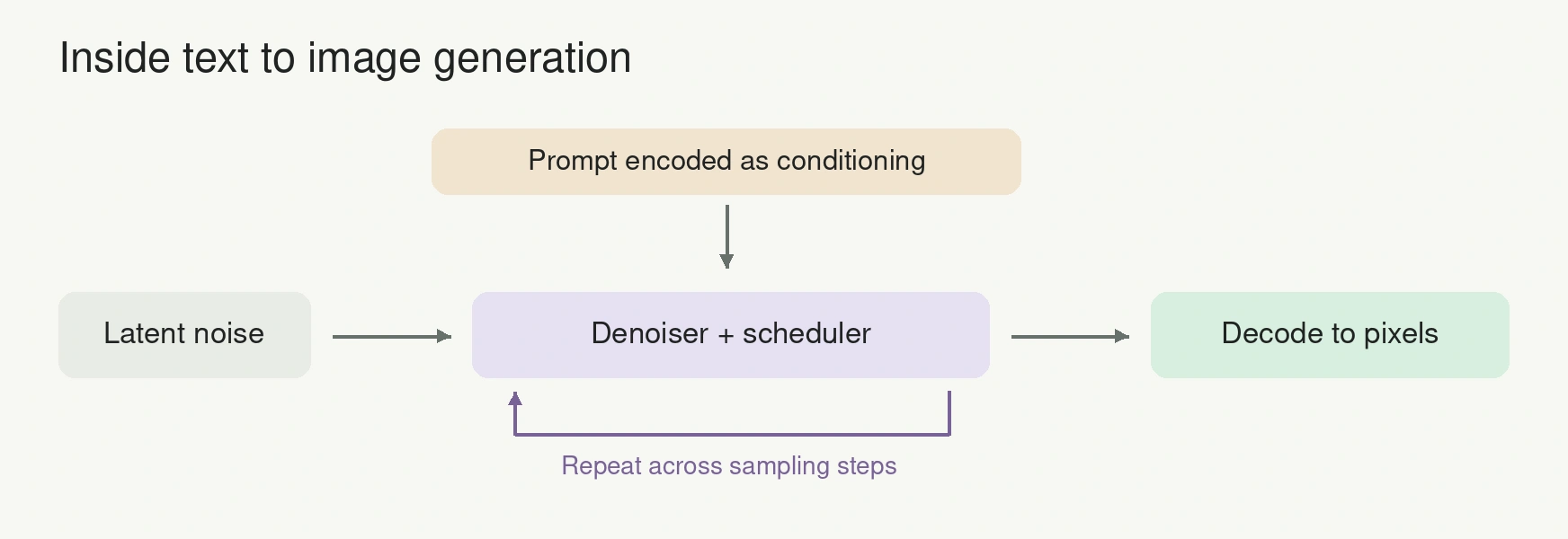
Noise alone does not specify what to generate. In text-conditioned diffusion, a text encoder converts a prompt into numerical representations. The denoising network uses those representations while updating the sample.
For “a red bicycle beside a brick wall”, the conditioning should steer generation toward the requested objects, colors, and relationship. It remains a learned constraint, so the result can omit details or place objects incorrectly.
Why many models work in latent space
Processing every pixel at every step is expensive. Latent diffusion moves the repeated denoising work into a compressed representation learned by an autoencoder. During training, an encoder maps images into that space. During text-to-image generation, the process typically starts with latent noise; a decoder converts the final latent into pixels.
The latent is a numerical feature representation, rather than simply a smaller photograph. The latent diffusion paper describes this design and how conditioning enables tasks including text-guided synthesis and inpainting.
The denoiser and scheduler have separate roles
The denoiser predicts information needed for the update. The scheduler determines the sampling timesteps and calculates how to move to the next state. Changing the scheduler can change the sampling behavior without replacing the trained network. Diffusers documents their interaction.
Editing can also change the starting point. Image-to-image generation can begin with a partly corrupted input; inpainting can use a mask to identify a region to replace. The model, mask handling, and pipeline determine how well the unedited content is preserved.
Diffusion can generate text too
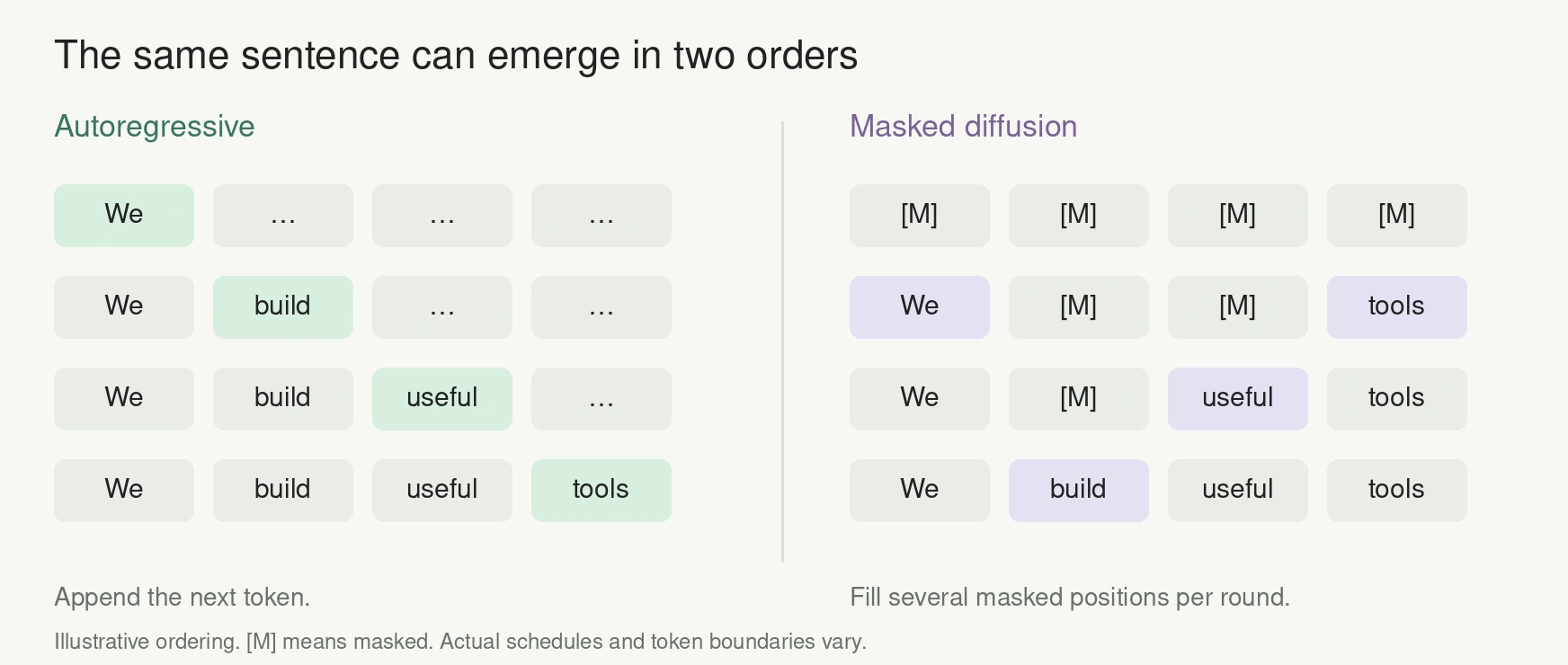
Text consists of discrete symbols, so adding Gaussian noise to visible words is not the only way to define corruption. A masked diffusion model can replace tokens with special mask tokens, then learn to recover them.
LLaDA is a concrete example. It trains on masked text and generates by predicting masked positions over repeated steps. Its decoding process can predict multiple positions together and retain or remask candidates according to the sampling procedure.
Read the two orders in the diagram
Both sides aim for “We build useful tools”. The autoregressive side extends a prefix. The masked-diffusion side starts with missing positions and fills them in an order that need not follow the sentence from left to right.
At an intermediate stage, “We” and “tools” can already be available while the middle remains unresolved. Later predictions can use visible context on either side. The diagram illustrates the mechanism; it is not a recorded LLaDA output.
This creates opportunities for filling gaps and coordinating a block of text. It also creates practical questions: how much text to allocate, which predictions to keep, and how many rounds to run.
Parallel prediction still needs coordination
Several tokens predicted together are not necessarily mutually consistent. A later refinement round uses the updated context to improve the result. Generating many positions per round therefore does not mean generating a complete answer in one pass.
Nor does an internal refinement round equal fact-checking. A model can refine wording while preserving a false statement. Evaluate factual accuracy and instruction-following separately from the generation mechanism.
Autoregression can generate images too
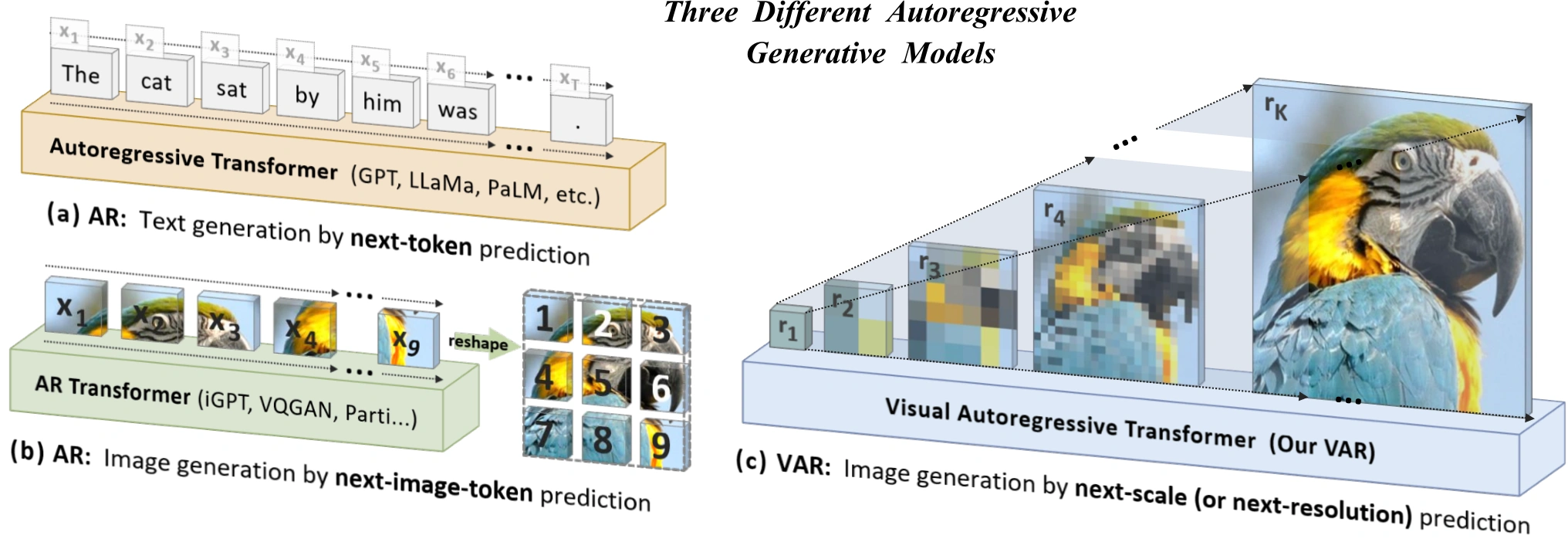
Autoregression only requires a dependency order. That order can apply to visual tokens as well as words. A visual tokenizer can represent an image as discrete codes, which a generative model predicts before a decoder reconstructs the image.
Predict the next visual token
One approach arranges image tokens into a sequence, often by scanning a grid row by row. The model predicts each next token using earlier ones. These tokens need not correspond to individual visible pixels.
Imagine a small grid describing a scene. The next predicted code could affect a patch of texture or shape, while the decoder turns the completed collection of codes into the final picture. The generation sequence belongs to the representation, not necessarily to how a person would draw the scene.
Predict the next scale
Visual Autoregressive Modeling, or VAR, uses a different order. It predicts increasingly detailed token maps, conditioning each scale on earlier scales. Tokens within a scale can be generated in parallel.
That is why “autoregressive models always generate one token per step” is too broad. It describes standard next-token decoding, but autoregressive dependencies can also connect groups of tokens or image scales.
The figure shows three distinct orders: text tokens, image tokens, and image scales. The shared principle is that later predictions depend on earlier generated information.
What appearance cannot tell you
A picture becoming more detailed over time does not identify its model family. Both denoising and next-scale generation can produce a coarse-to-fine visual progression. You need the model description to know whether it is refining noisy states, predicting new scales, or combining methods.
Both approaches can use Transformers
A Transformer describes a neural-network architecture. Autoregression describes conditional generation in an order. Diffusion describes a generative approach based on reversing corruption. These labels answer different questions about a system.
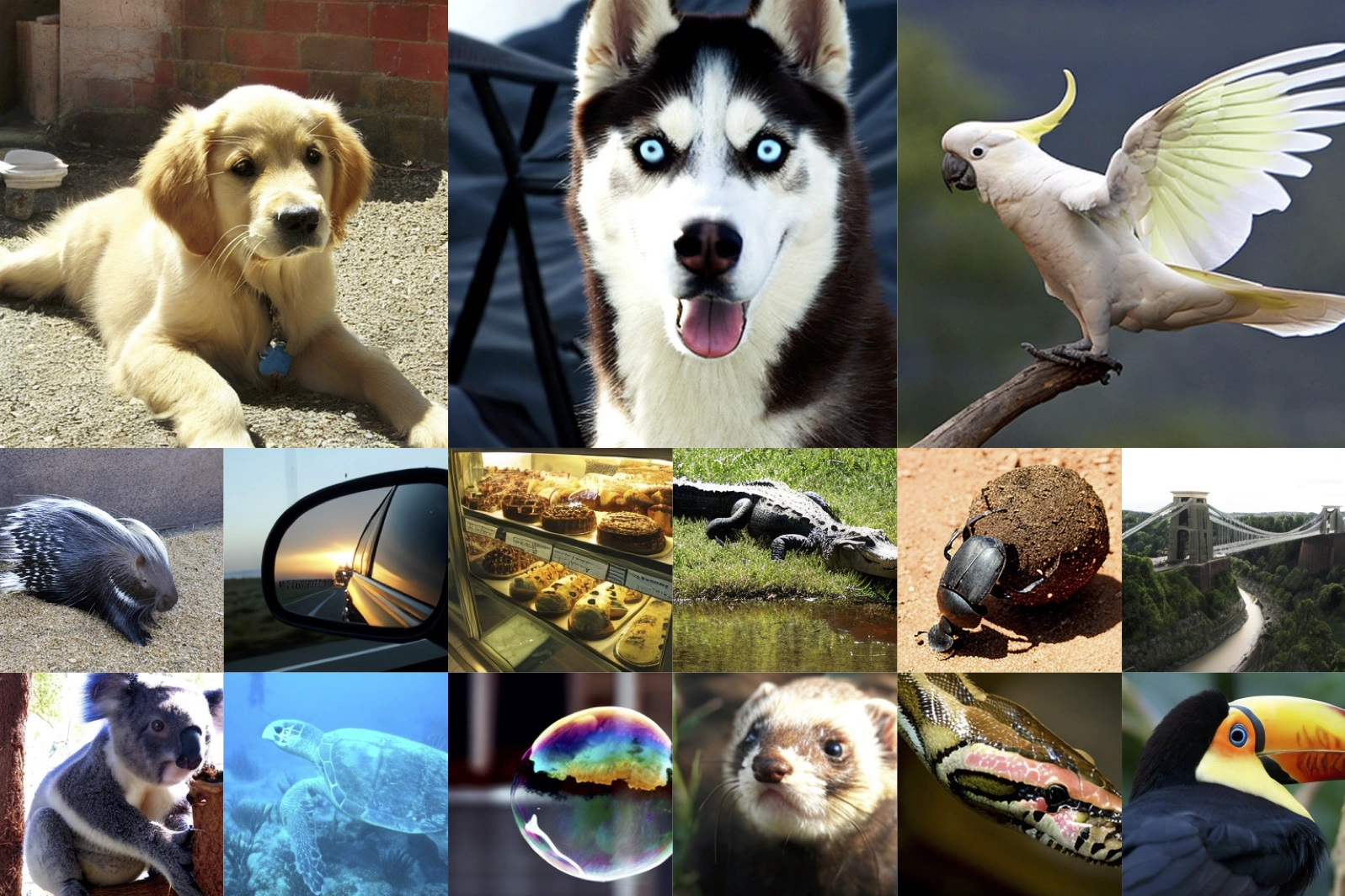
A Transformer can predict the next language token. It can also act as the denoising network in a diffusion model. Diffusion Transformers, or DiTs, process latent image patches with a Transformer backbone; the published samples above show their image-generation capability.
Calling a system “Transformer-based” therefore does not establish whether it generates autoregressively. Likewise, diffusion does not require a U-Net, even though U-Nets have been widely used as denoisers.
A product can combine several models
Consider an illustrative creative workflow: a language model writes an image prompt, an image model generates a visual, and another model evaluates the result. The application contains several generation or evaluation stages. Its chat interface tells you little about the image model underneath.
For a closed product, use its published technical documentation to identify those stages. Streaming text, a progress animation, or a slowly appearing image is insufficient evidence of the underlying architecture.
Autoregressive and diffusion models compared
| Dimension | Autoregressive generation | Diffusion generation |
|---|---|---|
| Main operation | Predict the next unit from earlier units | Reverse corruption through learned updates |
| Typical starting state | A prompt or initial prefix | Noise, masks, or a corrupted input |
| Working output | Usually grows in the chosen order | Usually changes within a working canvas or block |
| Parallel work | Training positions; some grouped or speculative decoding | Many positions per refinement step |
| Earlier decisions | Usually retained in ordinary decoding | States change; token revision depends on the sampler |
| Common examples | Llama text generation; VAR image generation | DDPM images; LLaDA masked text generation |
| Main latency question | How long to emit the required sequence? | How many updates, and how expensive is each? |
Which one is faster
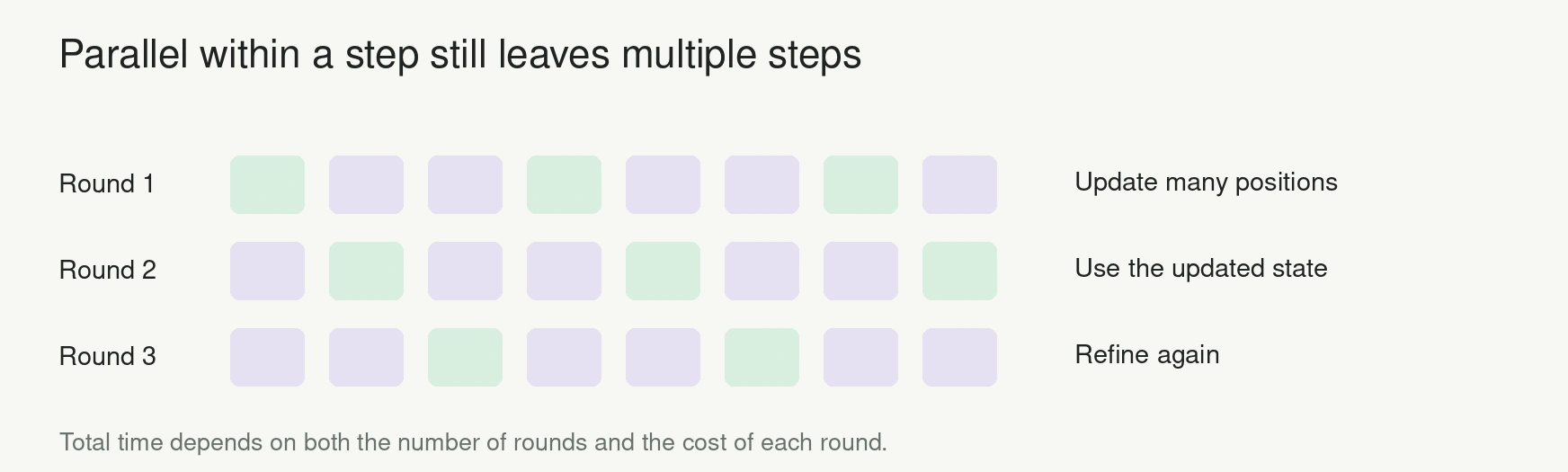
There is no universal winner. Standard autoregressive decoding follows a sequence, but a KV cache reuses earlier attention calculations. Speculative decoding can propose several tokens and verify them together.
Diffusion can update many positions at once while still requiring repeated network evaluations. Faster samplers such as DDIM reduce the number of steps. Related consistency models support one-step or multistep generation; those capabilities should not be attributed to every diffusion model.
Compare time to first usable output, total completion time, hardware, output size, and quality at the chosen settings. A 20-step sampler and a 200-token decoder do different amounts of work per step.
Which approach fits your task
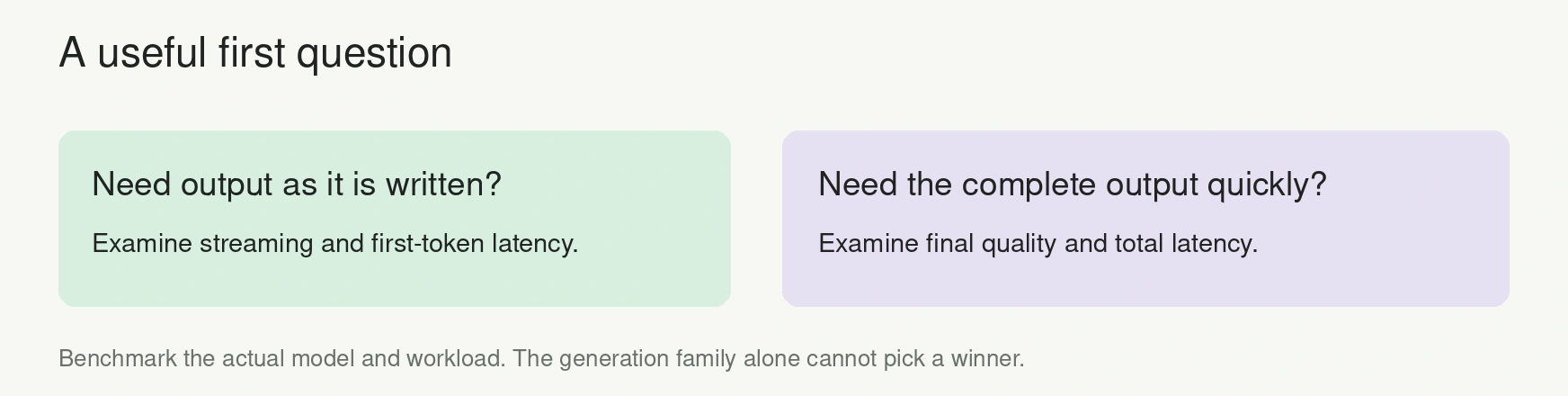
Start with the output you need and how users will consume it. Then evaluate the specific model and implementation.
| Task | What to evaluate |
|---|---|
| A conversational assistant | First-token latency, readable streaming, factual accuracy, and instruction-following. |
| Image creation or editing | Prompt adherence, visual quality, region preservation, and completion time. |
| Text completion or infilling | Correct use of surrounding context, output consistency, and latency at the required length. |
An assistant writing a long explanation benefits from readable partial output. A system returning a short finished document may care more about completion time. Neither model family guarantees better reasoning, lower cost, or higher quality.
Frequently Asked Questions
Are all large language models autoregressive?
No. LLaDA demonstrates language generation through masked diffusion. An LLM’s generation process depends on how it is trained and decoded.
Does diffusion generate everything at once?
It can update many positions within a step, but most diffusion samplers still use multiple sequential refinement steps.
Can an autoregressive model edit earlier text?
Yes, through a new generation pass or an editing workflow. Ordinary next-token decoding itself appends tokens to the existing prefix.
Is diffusion better at avoiding hallucinations?
The generation mechanism does not guarantee factual accuracy. Check the specific model’s performance on your task and verify consequential claims.