
Gemini 4 Neon and Claude Sonnet 5.5 solved the same Python bug, read the same map and found the same cheapest packing plan in our tests. The clearest difference came from a customer email. Neon put the eligibility rule inside the opening action. Sonnet made you read another paragraph to find it.
That makes this a closer choice than a spec table suggests. In this article, we compare their first answers across four practical tasks, check what each got right, and explain which differences would affect the work you do.
TLDR: Both models passed the coding, map and packing checks. Neon’s customer email was slightly easier to use. Sonnet has lower published API rates for equal token volumes.
What you get with each model
Neon is Google’s reasoning model for complex work that benefits from regular iteration, including coding and analysis. Sonnet 5.5 covers everyday coding, visual understanding and knowledge work. Both can work from an image and return usable code, but their supported inputs and pricing differ.
| Documented feature | Gemini 4 Neon | Claude Sonnet 5.5 |
|---|---|---|
| API model ID | gemini-4-neon | claude-sonnet-5-5 |
| Inputs | Text, images, audio, video and PDFs | Text, images and PDFs |
| API context | 1,048,576 tokens shared by input and output | 1 million tokens |
| Standard input per million tokens | $3 | $2 |
| Standard output per million tokens | $15 | $10 |
| Cached input reads per million tokens | $0.15 | $0.10 |
For the tests below, we used Neon in the Gemini app and Sonnet 5.5 in Claude’s web app. Both had High selected. Those are the apps’ effort labels, and each provider decides how much computation they represent.
Each task started in a fresh chat with an identical prompt and, for the map, the same attachment. We retained the first completed response. We then checked the code in Python, read the map ourselves and verified the packing optimum independently. We did not measure response latency, token consumption or actual API spending.
1. Write a customer email from conflicting release notes
A wrong date can survive an otherwise polished email. This brief gave the models an approved rollout, an approved correction and a newer draft with conflicting claims. They had to apply the correction while preserving the rest of the approved plan.
Prompt
Write a customer email of at most 95 words, including a subject, for administrators with a saved CSV import mapping. Lead with the action they can take. Return only the subject and message. Use only this fictional source packet.

Approved rollout, 18 November: Starting 1 December, the replacement importer is optional for existing workspaces with fewer than 10 saved mappings. Eligible admins can enable it in Settings > Imports. Saved mappings carry over. Workspaces with 10 or more mappings stay on the current importer. Eligible admins can switch back through 15 December.

Approved correction, 20 November: Extend the switch-back deadline to 22 December. This changes no other rollout detail.

Unapproved draft, 21 November: Require everyone to migrate on 1 December. Delete existing saved mappings. Consider retiring the current importer in January.
Gemini 4 Neon
Claude Sonnet 5.5
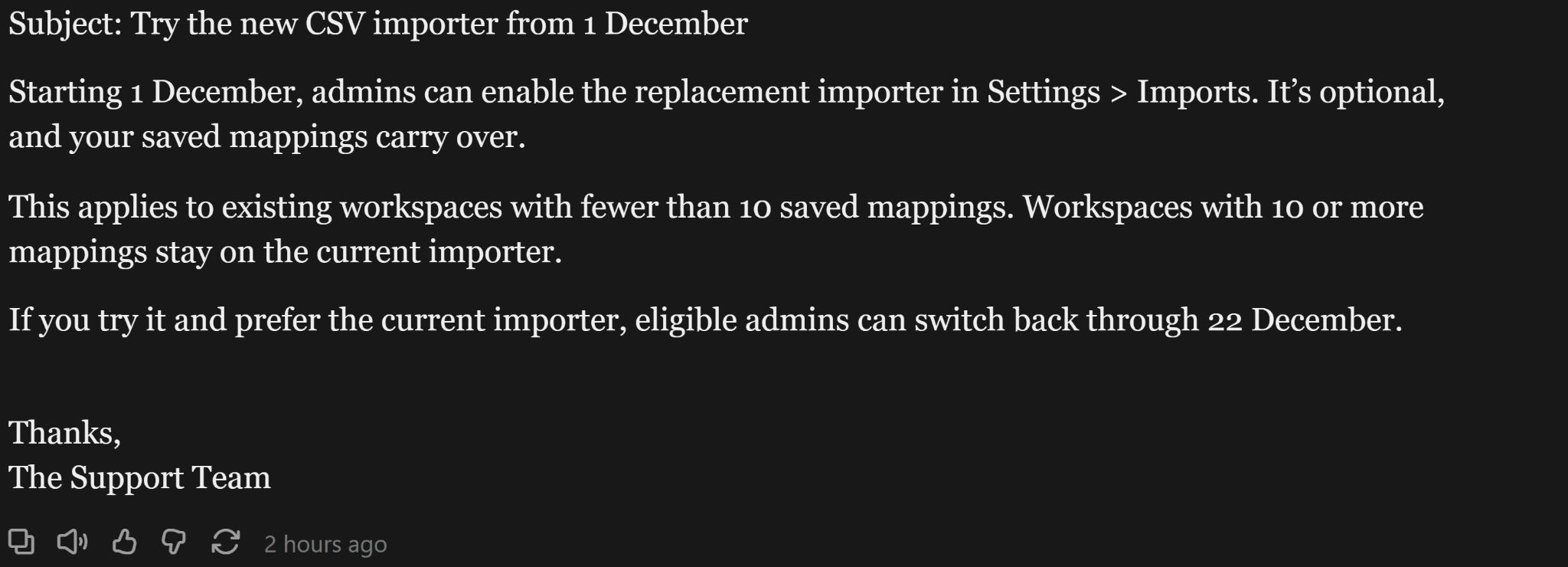
Both emails used December 22, kept the rollout optional and preserved saved mappings. They also left workspaces with 10 or more mappings on the existing importer. Neither adopted the unapproved draft’s mandatory migration or deletion claim.
Neon’s email came to 68 words, including its subject and greeting. Sonnet’s used 73, including its subject and sign-off. Both met the 95-word limit.
The editorial difference sits in the first action. Neon told readers they could enable the importer if their existing workspace had fewer than 10 mappings. Sonnet first said admins could enable it, then specified the eligible group in the next paragraph. Readers who skim the opening could temporarily take away a broader invitation than intended.
Neon earns a small edge here. Its opening carries the action and the qualification together. Sonnet’s draft is factually sound, but we would move its eligibility sentence up before sending it.
2. Follow a footpath through a campground map
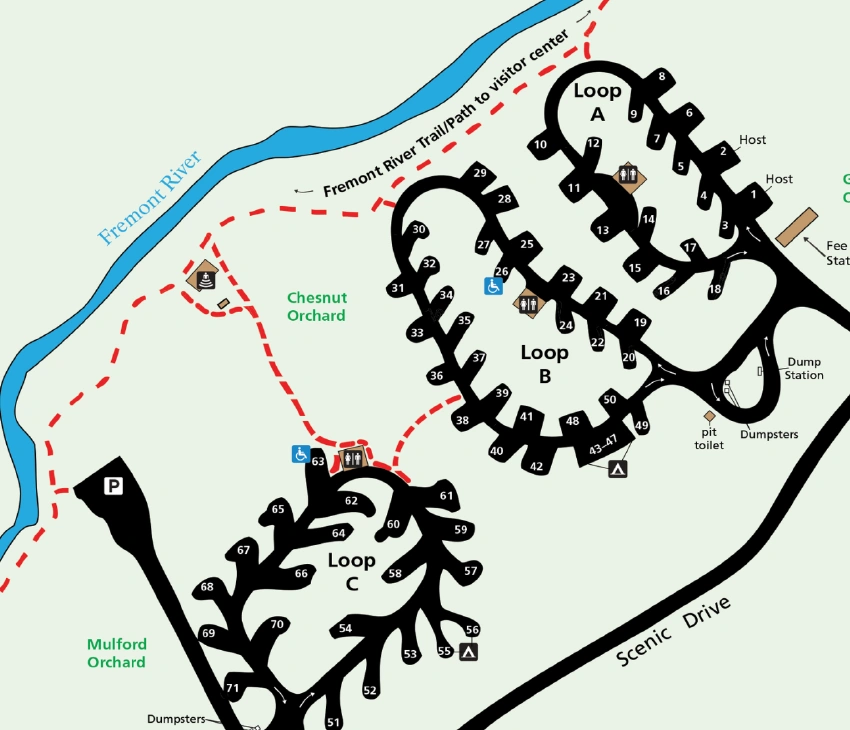
The next task changed both the input and the work. We supplied a campground map and asked the models to trace a dashed footpath, identify a facility, read a numbered accessibility marker and check a river crossing. A model had to connect the symbols to their positions.
Prompt
Use only the attached campground map. Trace the dashed footpath leaving Loop B between sites 37 and 38 toward Loop C. Which facility symbol marks its Loop C end, and which numbered wheelchair-accessible campsite sits immediately west of that facility? Identify the two campground-host sites and their loop. Does the dashed path toward the visitor center cross the Fremont River anywhere shown? Answer in four numbered lines, under 85 words. Do not browse.
Gemini 4 Neon
Claude Sonnet 5.5
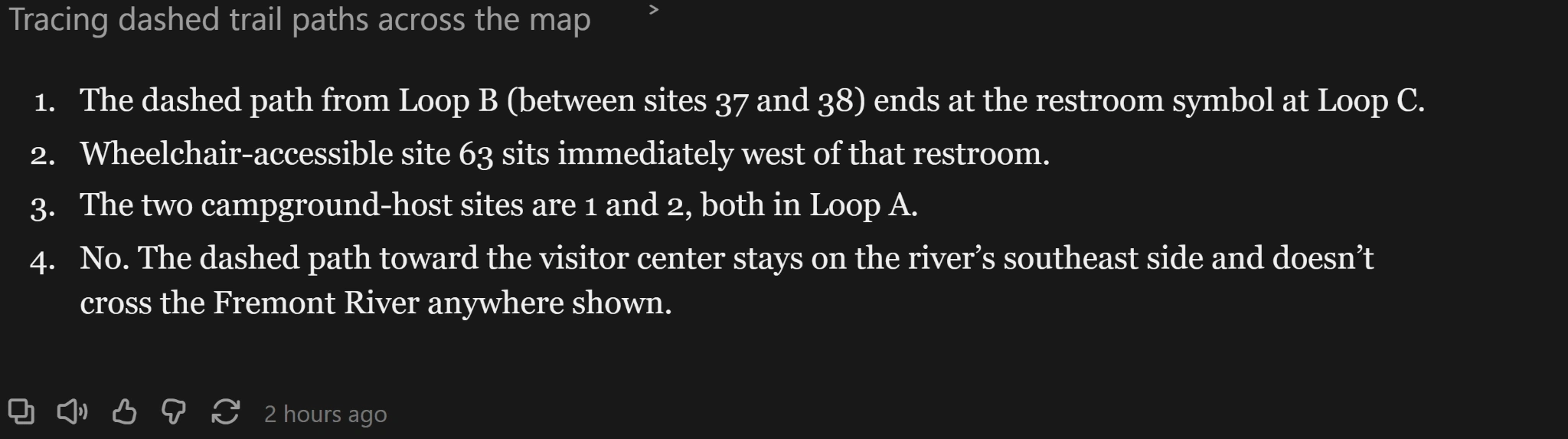
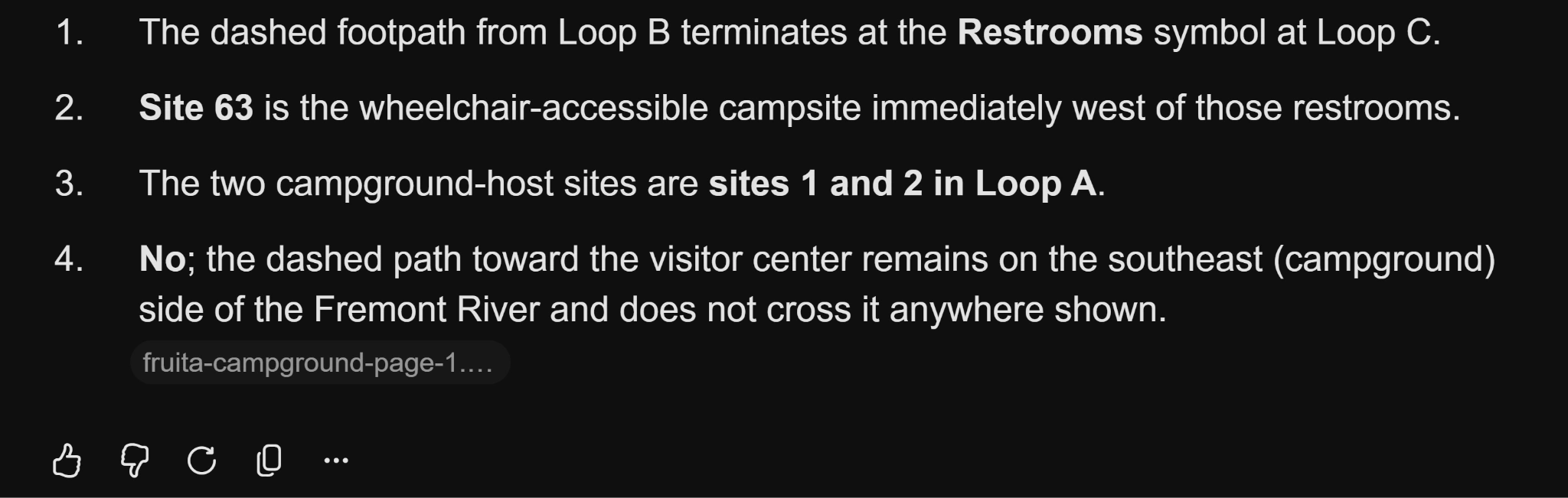
Both identified the restrooms at the Loop C end and site 63 immediately west of them. They also located the two host sites, 1 and 2, in Loop A.
The river question was the useful final check. Both said the path stays on the southeast, campground side of the Fremont River. Neither invented a crossing beyond the part of the route shown. Each returned the requested four numbered lines within the word limit.
This round is a tie. Either answer supplies the requested locations clearly, and we found no map-reading correction to make.
3. Repair Python that loses empty IDs and keeps stale records
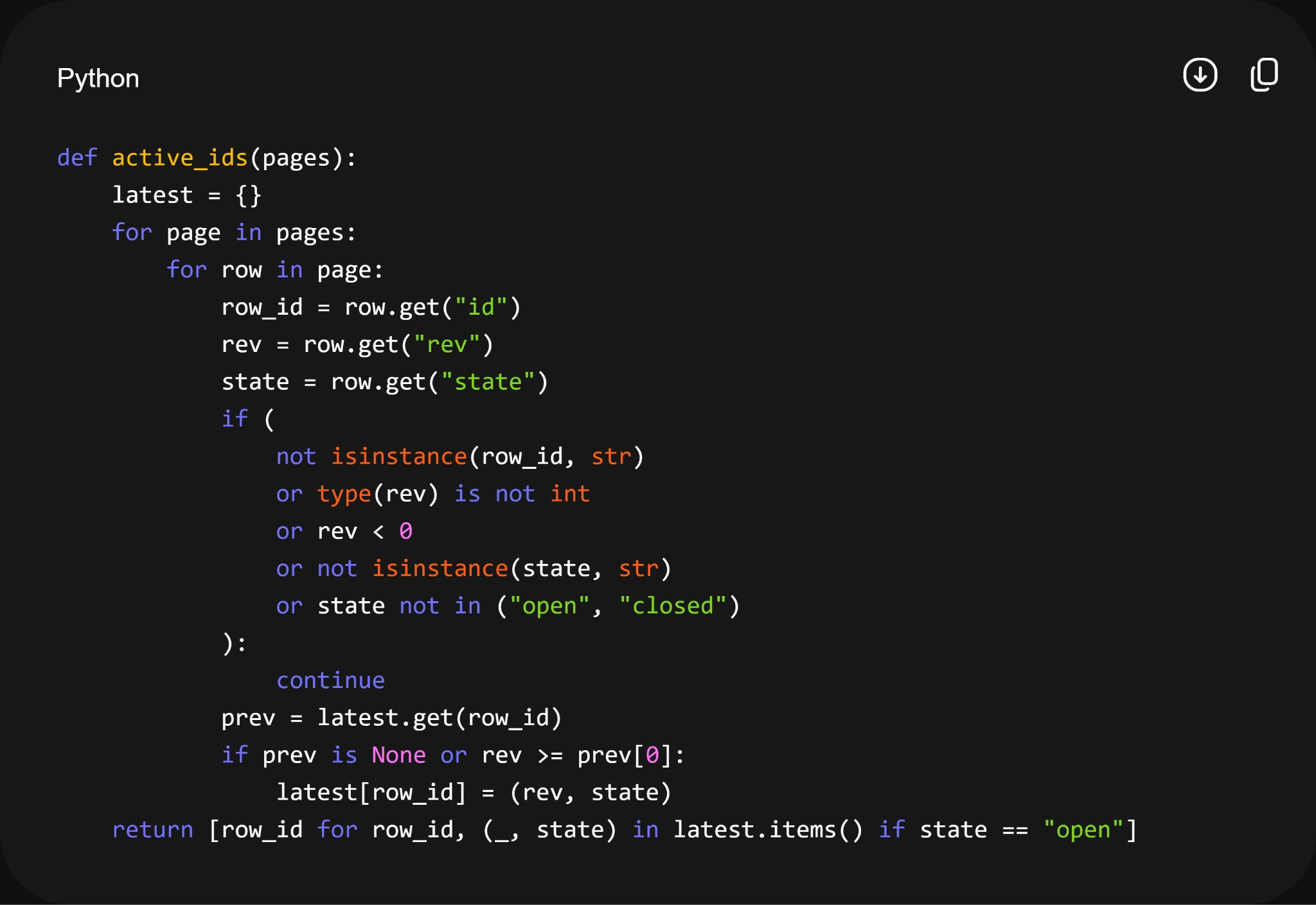
The original function collects every open row, including duplicates. It also treats an empty string as absent. The repair needed to choose the winning revision for each ID and preserve the order in which valid IDs first appeared.
Prompt
Repair this Python 3 function and return only the function in a single code block, without imports or explanation.

def active_ids(pages):
    active = []

    for page in pages:
        for row in page:
            value = row.get("id")
            if value and row.get("state") == "open":
                active.append(value)

    return active

pages is an iterable of pages, each of which is itself an iterable of dictionaries. Each valid row has id (any string, including the empty string), rev (a nonnegative value whose type is exactly int) and state ("open" or "closed"). Ignore any row with a missing or invalid required field. (Each row is a dictionary.) For each ID the highest valid revision wins. If valid rows tie at that revision, the later row in stream order wins. Return the IDs whose winning state is open in order of their first valid occurrence, even if they close and later reopen. Do not mutate inputs or iterate over pages twice.
Gemini 4 Neon
Claude Sonnet 5.5
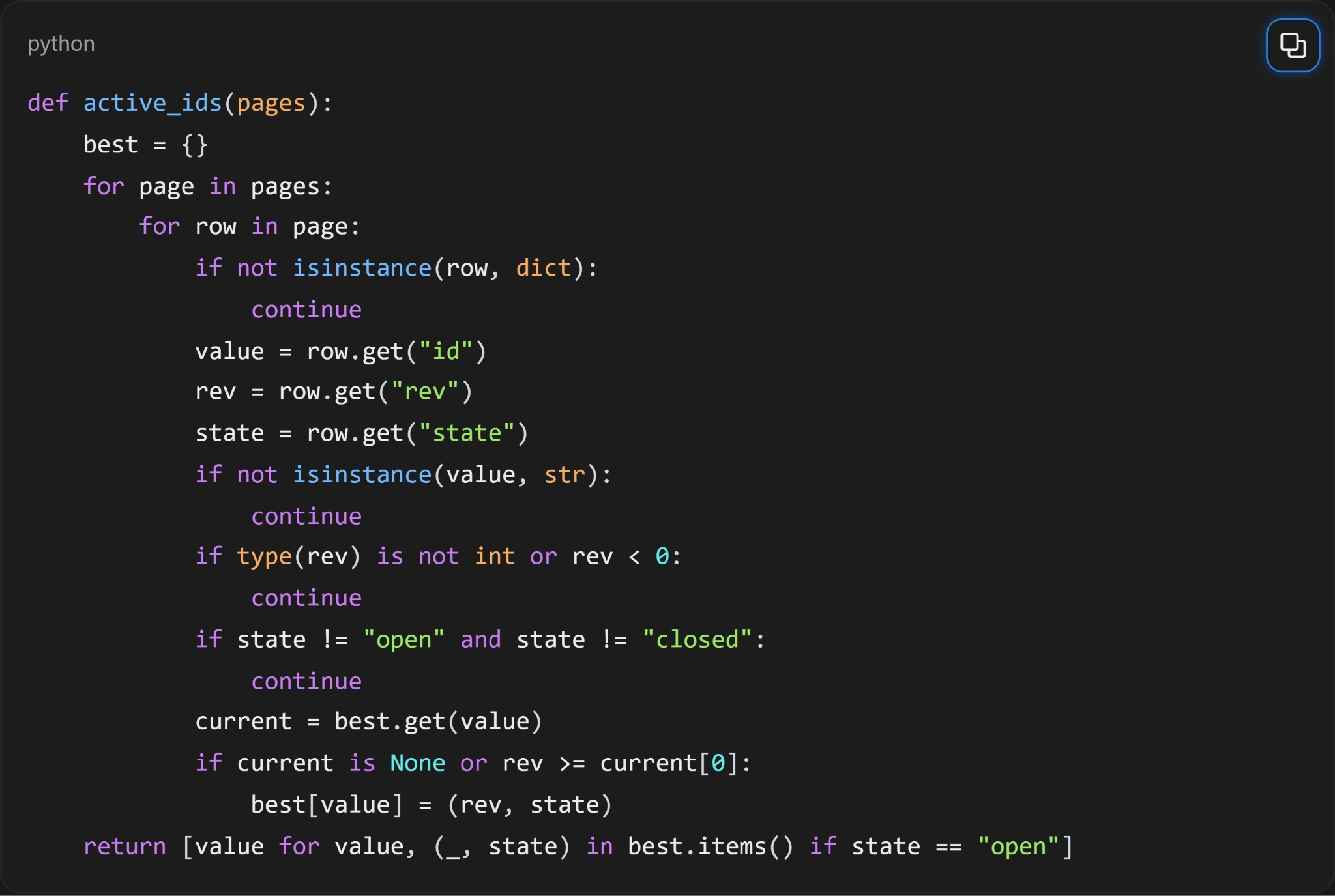
Both returned a single function in a code block and passed all 15 independent checks. These included empty IDs, tied revisions, closed records that later reopen, missing fields, invalid states and one-shot iterables. We also confirmed that the inputs remained unchanged.
One case matters particularly in Python. A Boolean is an integer subclass, so a loose integer check can accidentally accept True as revision 1. Both repairs used an exact type check and rejected it. They also handled invalid list-valued fields without trying to use those lists as dictionary keys.
Their solutions use the same broad approach. A dictionary records each ID’s winning revision and state. Updating an existing value keeps its original insertion position, which preserves first valid appearance even after a close and reopen. Using >= lets the later row win a revision tie.
This is another tie. The checks support both implementations for the specified contract. The test gives us no coding reason to choose one over the other.
4. Find the cheapest way to pack five crates
A cheaper individual run can produce a more expensive complete booking. This small logistics problem asks the model to choose both the carrier and the grouping, then explain why the result is minimal.
Prompt
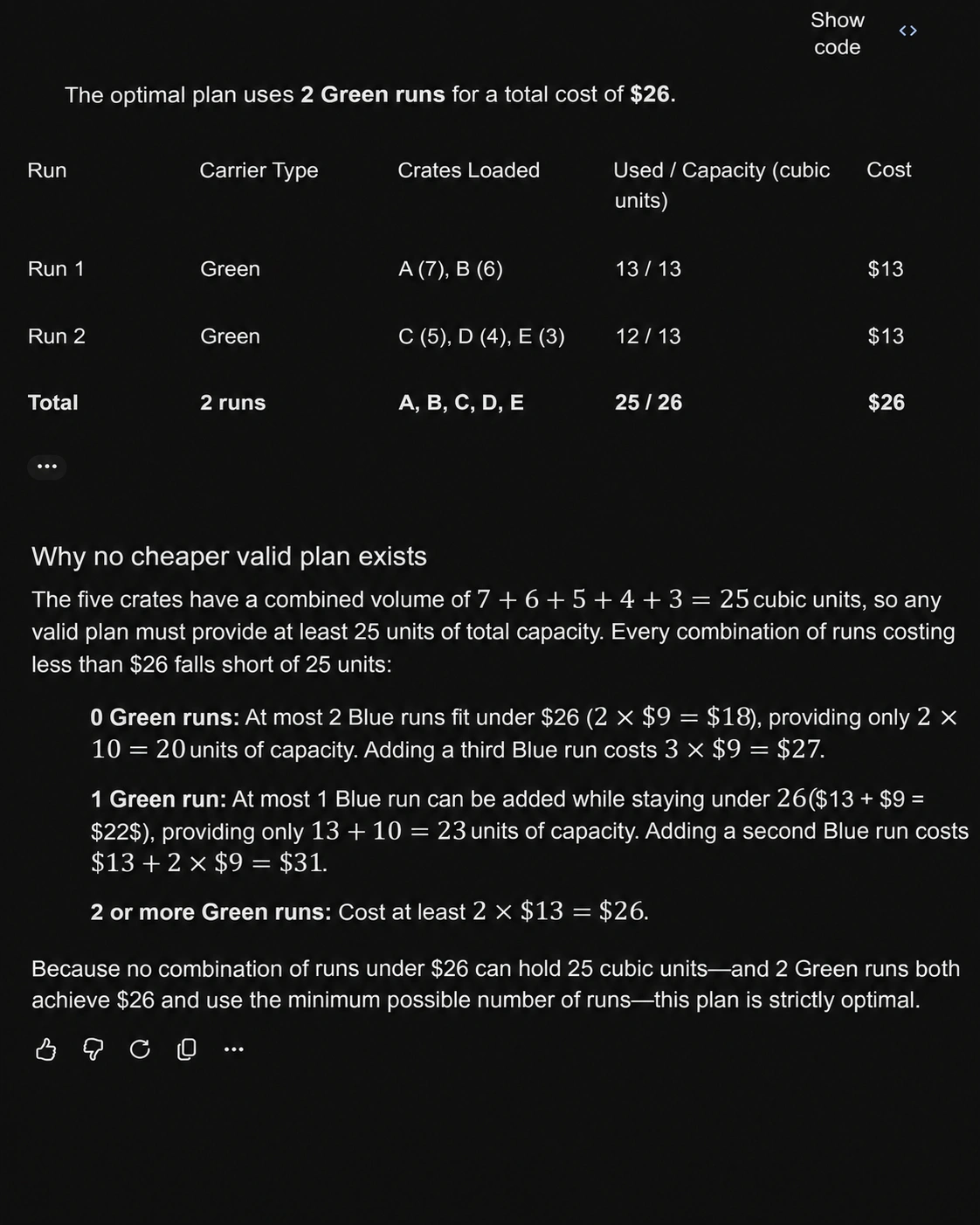
You have one indivisible crate of each size: A=7, B=6, C=5, D=4 and E=3 cubic units. Individual carrier runs may be booked more than once. A Blue run carries up to 10 units and costs $9. A Green run carries up to 13 units and costs $13. Use every crate exactly once, respecting each run's capacity. Minimize the total cost. If multiple plans tie on cost, prefer fewer runs. Return a table listing one optimal plan, its total cost, and a short explanation of why no cheaper valid plan exists. Use only the figures here.
Gemini 4 Neon
Claude Sonnet 5.5
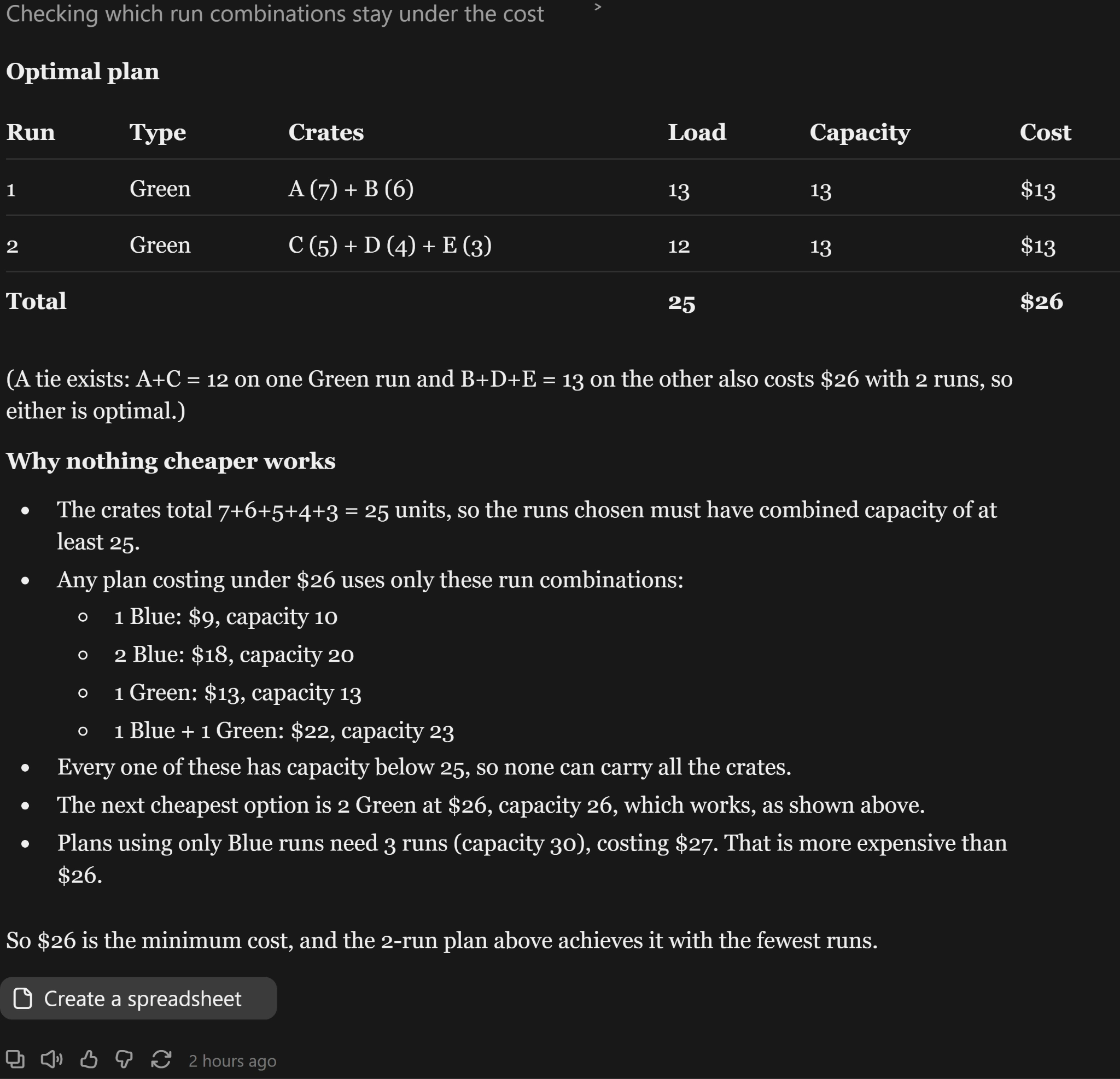
Both selected two Green runs for $26. The first carries A and B, totaling 13 units. The second carries C, D and E, totaling 12. Every crate appears once, and both loads fit.
Their lower-bound explanations also work. All five crates occupy 25 units. Two Blue runs provide only 20, while one Blue plus one Green provides 23. Three Blue runs can carry everything but cost $27. Two Green runs are therefore the cheapest feasible choice.
We independently enumerated the possible groupings and carrier assignments and confirmed the $26 optimum. Sonnet added the alternative partition A+C and B+D+E, which also fits two Green runs. That extra detail is accurate, though the prompt asked for only one plan.
Both pass. Sonnet makes the existence of a tied plan explicit, while Neon’s table gets you directly to a valid booking.
Which model would we choose?
For the coding, map and packing work tested here, keep the model that already fits your workflow. Both cleared the checks. If you are choosing an API for similar bounded jobs, Sonnet’s lower token rates give it a practical starting advantage.
Neon earns a look for source-heavy writing where the first sentence must carry an important condition, or work that starts with audio or video. Its email needed less rearranging. That is the clearest improvement we observed in these four runs.
Frequently Asked Questions
Did Neon outperform Sonnet 5.5 in these tests?
Neon had a small editorial edge on the email. The coding, map and packing checks tied.
Which model has lower API token rates?
Sonnet 5.5 costs $2 input and $10 output per million tokens, versus Neon’s $3 and $15.
Were both models tested at High?
Yes. We selected High in each app and used fresh chats, identical prompts and the same map attachment.
Did either Python repair fail the checks?
No. Both passed all 15 checks, including empty IDs, invalid fields, tied revisions and one-shot iterables.