

Gemini 4 Argon returned the more complete Python repair in this comparison. It converted every timestamp pair to a tuple; Gemini 4 Carbon left one valid input with mixed output types. That small difference matters when another part of your program expects tuples.
The other results need more qualification. Both models read the physics graph correctly, the CSV pair exposed a tool-control problem, and both writing drafts added details absent from the notes. We used Low thinking across four practical jobs and kept the latest Carbon benchmarks separate from those hands-on results.
What you get with each model
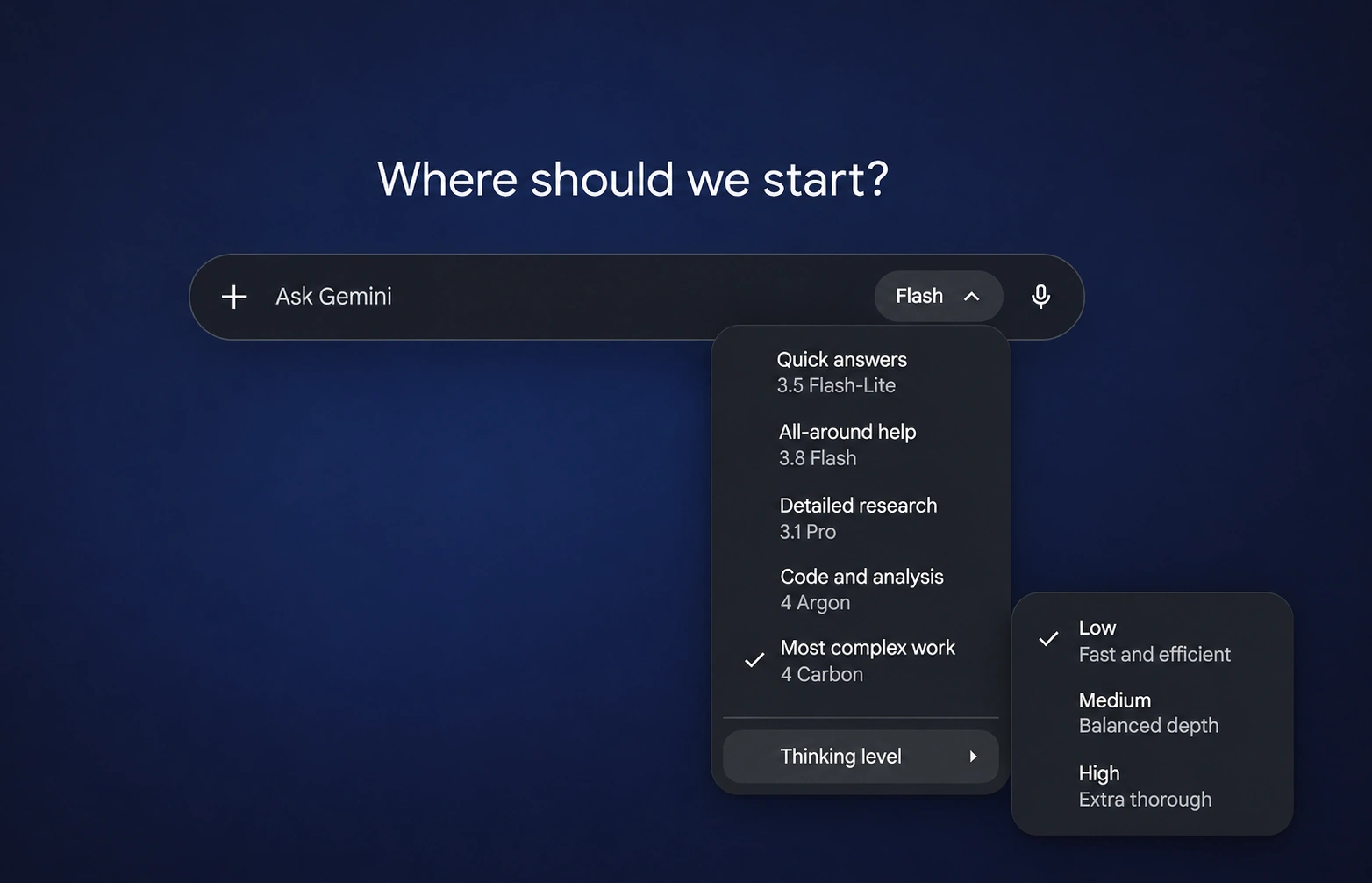
Gemini 4 Argon is Google's multimodal reasoning model designed for coding, research, data analysis, and everyday professional tasks. It balances reasoning capabilities with efficiency, making it suitable for workflows involving technical documents, programming, and problem-solving.
Gemini 4 Carbon
Gemini 4 Carbon is Google's more advanced reasoning model, built on Argon for demanding, multi-step problems. It focuses on complex coding, scientific reasoning, and extended investigations where exploring alternatives and verifying intermediate results are particularly important.
| Feature | Gemini 4 Argon | Gemini 4 Carbon |
|---|---|---|
| Primary focus | Coding, research, and everyday professional tasks | Complex reasoning and multi-step problem-solving |
| Multimodal inputs | Text, images, audio, video, PDFs | Text, images, audio, video, PDFs |
| Native output | Text | Text |
| Thinking levels | Low, Medium, High | Low, Medium, High |
| Context window | 1,048,576 tokens (shared) | 1,048,576 tokens (shared) |
| Key strengths | Coding, document analysis, tool-assisted workflows | Advanced debugging, scientific reasoning, iterative verification |
For more context on the newer model, our Gemini 4 Argon review examines a different set of practical tasks.
1. Reading a position time graph
A higher point on a position-time graph means a greater position. Speed comes from the slope. This makes a graph-reading task useful: a plausible explanation can name the right point for the wrong reason.
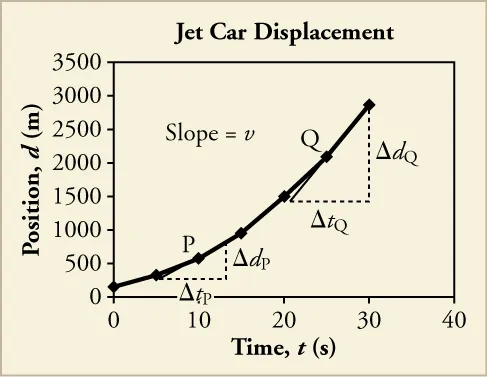
The same graph image was uploaded to both models. Compare the tangent slopes at P and Q.
Prompt:
Read the attached position-time graph as a physics tutor. In four numbered points, explain: (1) whether the car is faster at P or Q and what feature proves it; (2) whether it ever reverses direction; (3) its approximate starting position, using the axis rather than assuming zero; (4) whether this image alone establishes an exact constant acceleration. Keep the whole answer under 120 words. Do not browse. Keep the response anonymous: no personal names, organisations, account details, contact information or signature.
Gemini 4 Carbon:
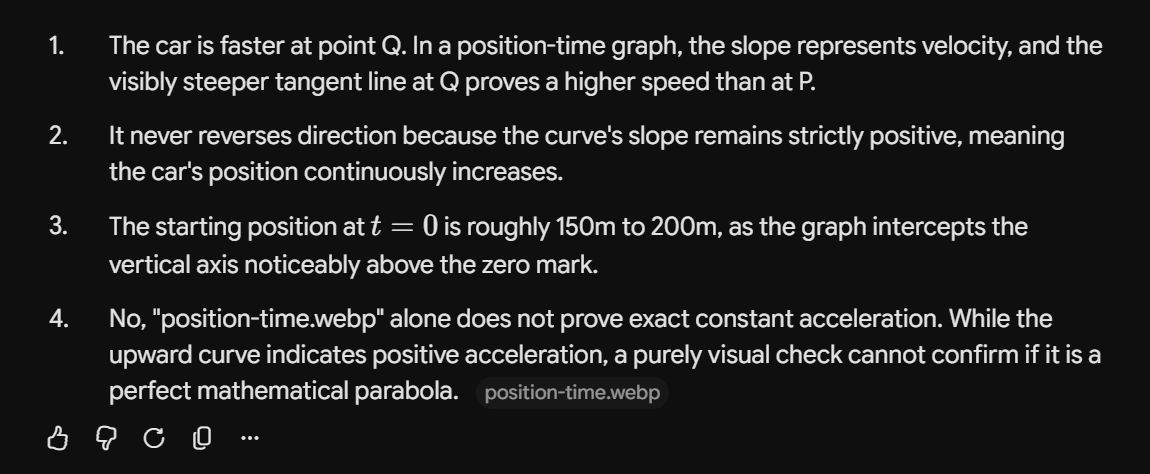
Carbon correctly identified Q as faster because its tangent is steeper. It also kept the direction of motion separate from acceleration: the rising position curve doesn’t show the car reversing. Its approximate starting-position reading acknowledged the limited precision of the drawing.
The useful restraint came at the end. Carbon didn’t treat a generally upward-curving line as proof of perfectly constant acceleration. That would require stronger information about the curve than this drawing provides.
Gemini 4 Argon:
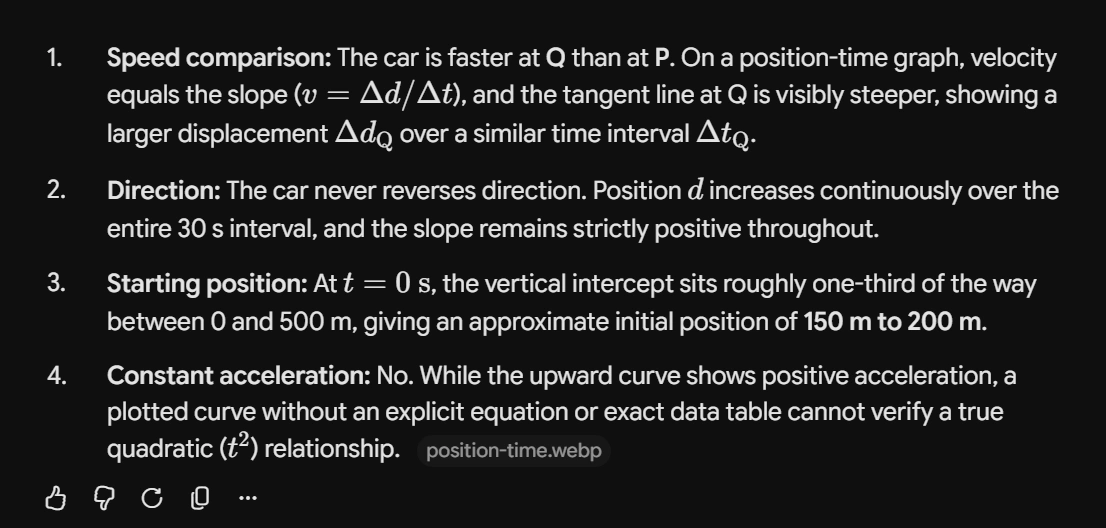
Argon reached the same four substantive conclusions, including a starting position of roughly 150–200 m. It used more notation to explain the slopes. Carbon was more direct, but this image-reading round offers little reason to switch models.
2. Auditing an inspection CSV
The operations task used an actual CSV attachment containing an exact duplicate, unfinished batches, a missing duration and a zero-unit batch with recorded time. We requested quality totals and hourly throughput, then added a restriction against Python and other tools for the final paired run.
The calculation has two different denominators. A batch with missing minutes still belongs in the failure rate, but its units must leave the throughput numerator. A zero-unit batch with recorded minutes consumes time and stays in throughput.
Prompt:
Audit the attached inspection log. Remove exact duplicate rows and use only complete batches. Give one compact table with each station's checked units, failed units, weighted failure rate, and throughput in checked units per hour. Work directly from the CSV contents. Do not use Python, code execution or other tools. Keep everything anonymous: no names, organisations, account details, contact information, personal references, or signature.
Input file
| Batch | Station | Status | Units checked | Units failed | Minutes |
|---|---|---|---|---|---|
| B001 | North | complete | 100 | 4 | 20 |
| B002 | North | complete | 50 | 1 | 10 |
| B003 | North | cancelled | 100 | 0 | 20 |
| B004 | South | complete | 80 | 8 | 16 |
| B004 | South | complete | 80 | 8 | 16 |
| B005 | South | complete | 120 | 0 | 24 |
| B006 | East | complete | 50 | 5 | 10 |
| B007 | East | complete | 150 | 3 | 30 |
| B008 | North | complete | 0 | 0 | 5 |
| B009 | South | in_progress | 40 | 2 | 8 |
| B010 | East | complete | 40 | 4 | |
| B011 | North | complete | 100 | 10 | 20 |
| B012 | South | complete | 50 | 5 | 10 |
Gemini 4 Carbon:
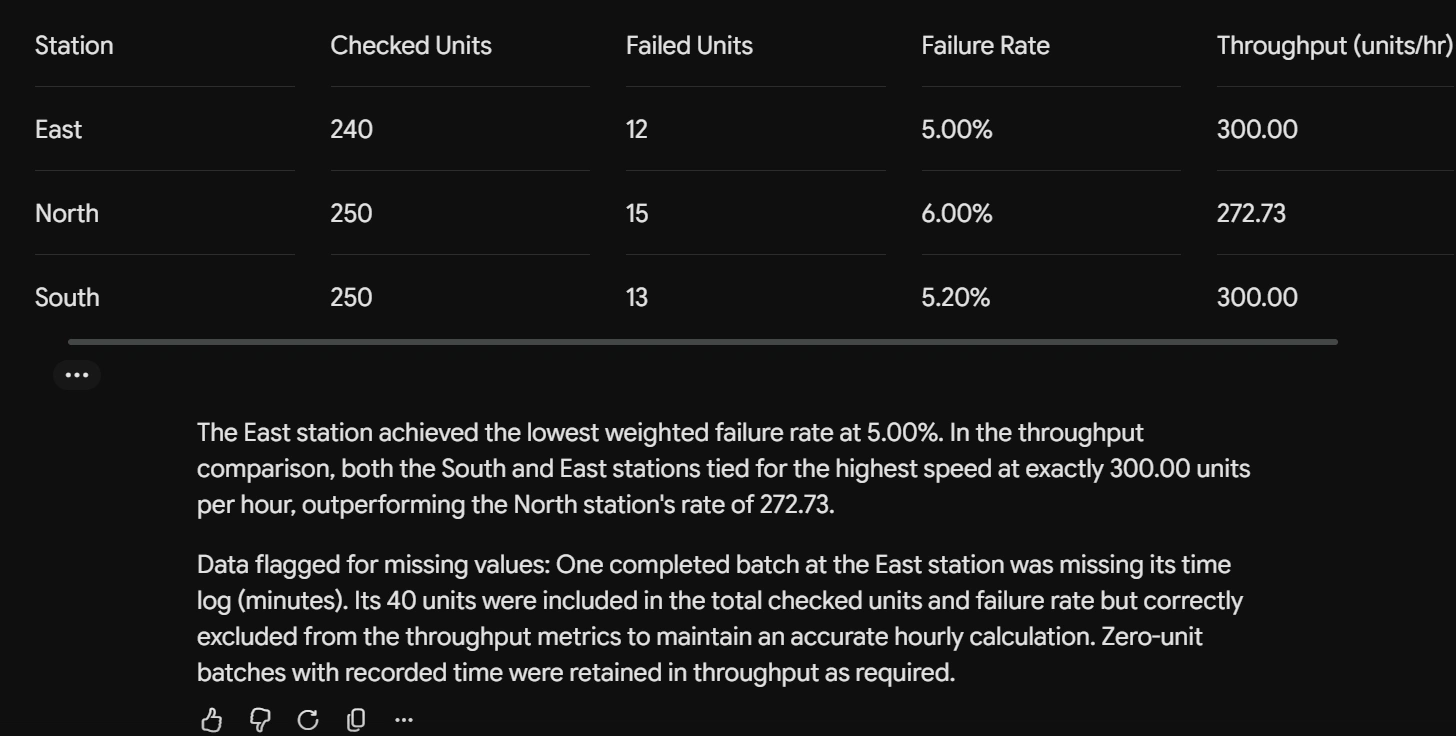
Gemini 4 Argon:
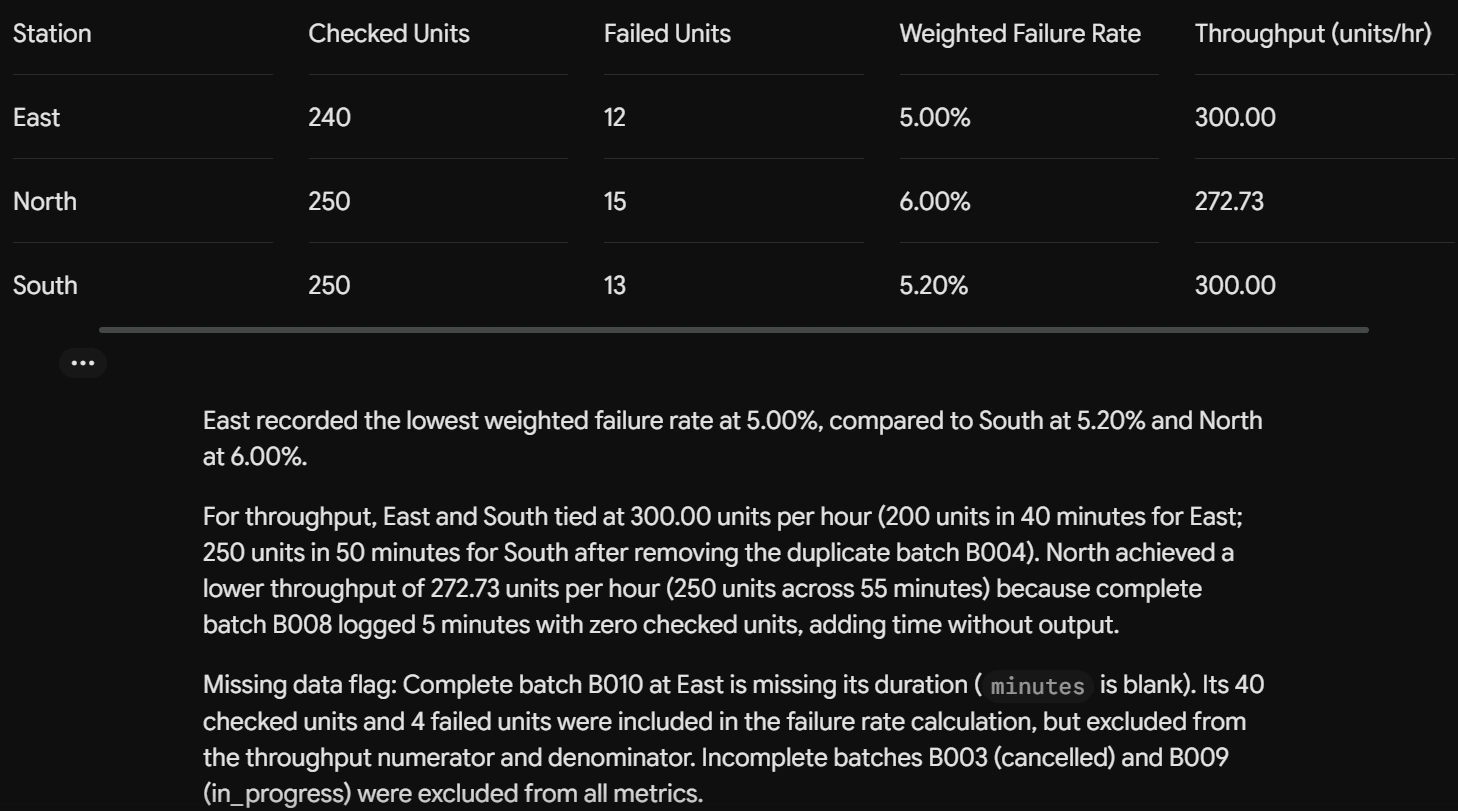
The table is barely contained within the chat window
Argon returned all 12 numeric cells correctly and stayed within 180 words. East had the lowest observed failure rate, while East and South tied on throughput for the timed records. Its explanation correctly retained North’s zero-unit time and excluded East’s untimed batch from throughput.
The code trace also showed Python reading and aggregating the file despite the explicit restriction. This is an app-assisted result, not evidence of unaided arithmetic. Carbon didn’t deliver the audit; Argon delivered the numbers through a route the prompt forbade. Neither fulfilled the entire brief.
One phrase still needs care: Argon says all active batches run at five units per minute. That is established only for the nonzero batches with recorded durations; East’s untimed batch prevents a complete throughput comparison. Check the tool trace as well as the table when the processing route matters.
3. Repairing caption timing code
Our Python file contained a broken interval-merging function for caption timestamps. The replacement had to sort spans, merge overlaps and touching endpoints, handle nested spans, reject reversed intervals, return tuples and leave the input unchanged. We limited it to 18 nonblank lines.
Prompt:
Fix
merge_spansin the attached Python file for a caption-timing utility. Input is a list of (start, end) pairs containing finite int or float timestamps. Return sorted non-overlapping spans as a list of tuples. Merge touching spans as well as overlaps, including nested spans. Return [] for empty input, raise ValueError if any start exceeds its end, and never mutate the input or its inner pairs. Use only the standard library. Return only the replacement function in one code block, at most 18 nonblank lines. Do not browse or build an app. Keep everything anonymous: no names, organisations, account details, contact information, personal references, or signature.
Input function
def merge_spans(spans):
    if not spans:
        return []

    spans = sorted(spans)
    merged = [list(spans[0])]

    for start, end in spans[1:]:
        previous = merged[-1]

        if start <= previous[1]:
            previous[1] = max(previous[1], end)
        else:
            merged.append([start, end])

    return merged
Gemini 4 Carbon:
Gemini 4 Argon:
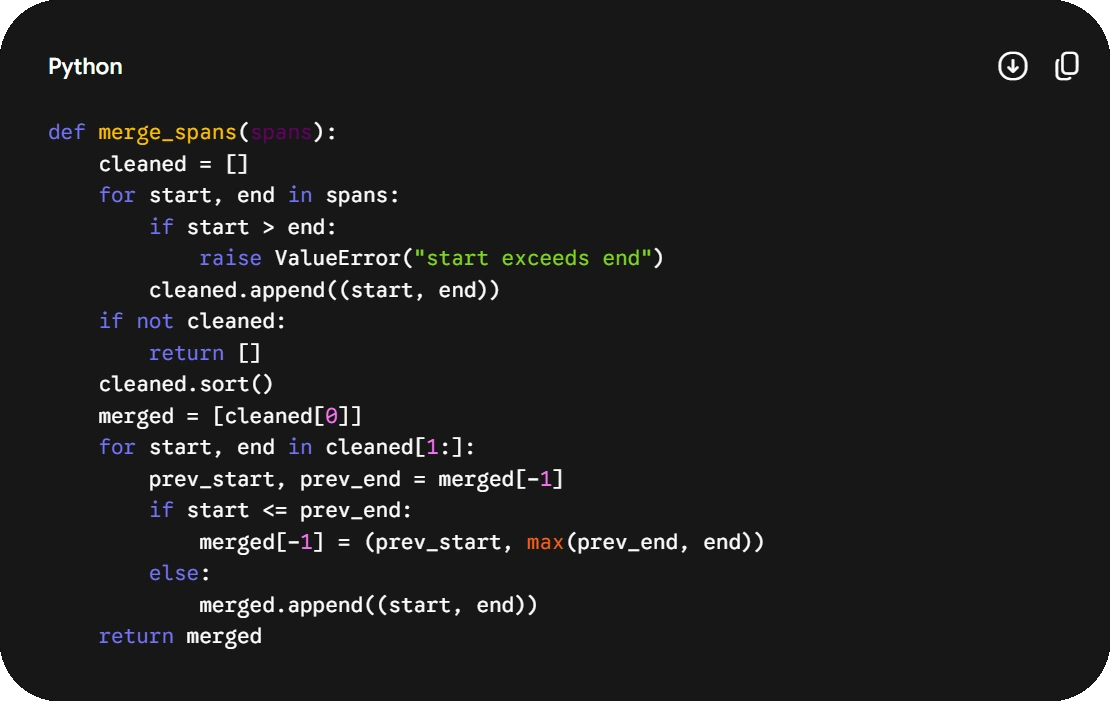
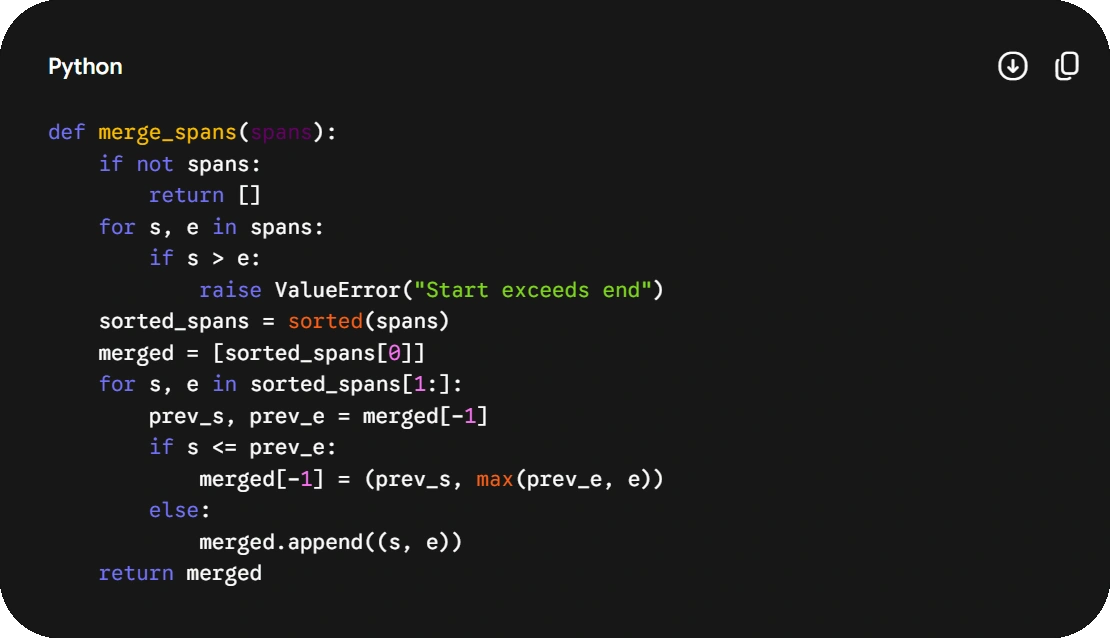
Argon passed all 10 independent behavioral cases. Carbon passed nine. Both met the line limit, and Carbon’s failing case wasn’t an arithmetic error: it found the correct time ranges and preserved the input.
The failure appeared with two separate mutable pairs: [[5, 8], [1, 3]]. The required return was [(1, 3), (5, 8)]. Carbon returned [[1, 3], (5, 8)], leaving the first result as a list. Its initial merged entry reused the first sorted pair; later entries were converted to tuples. Overlap could hide that difference because the merge branch replaced an entry with a tuple.
Argon avoided the inconsistency by copying every pair into a tuple before sorting and merging. That made it the stronger repair on the tested contract. A downstream consumer can rely on one result type without adding its own cleanup.
This is a useful win, with a clear boundary. Ten cases demonstrate the checked behaviors; they don’t prove every possible program using the function is correct.
4. Writing a museum audio guide
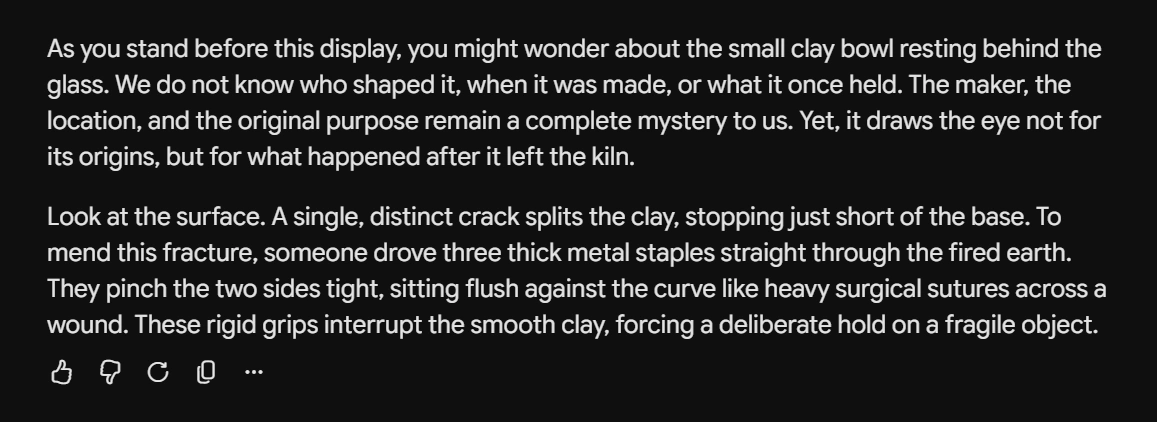
The final task moved from calculation to cultural writing. The notes described a small clay bowl, one visible crack and three metal staples holding two sides together. The maker, date, place and original use were unknown.
We requested 110–140 words in two paragraphs, direct address to the visitor and a sentence of no more than five words. The repair had to become interesting through a concrete image, without invented provenance, an owner, a price or a motivational lesson.
Prompt:
Write the opening of a museum audio guide from these curator notes: a small clay bowl; one visible crack; three metal staples hold the two sides together; the maker, date, place and original use are unknown. Write 110-140 words in two paragraphs. Address the visitor as "you". Make the repair feel worth noticing through a concrete image rather than a motivational lesson. Include one sentence of at most five words. Do not invent provenance, monetary value or an owner; do not use "timeless", "testament", "journey" or "resilience". Return only the audio-guide text. Do not browse. Keep everything anonymous: no names, organisations, account details, contact information, personal references, or signature.
Gemini 4 Carbon:
Gemini 4 Argon:
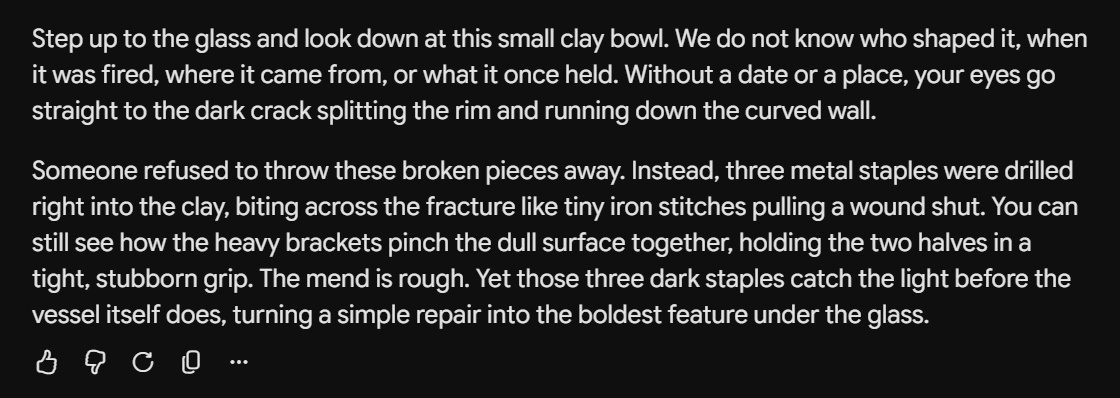
Both met the mechanical constraints. Carbon wrote 131 words; Argon wrote 136. Each kept two paragraphs, addressed “you,” included a short sentence and avoided the prohibited words. Both retained the unknown provenance and made the metal repair visually memorable.
The editing problem was factual restraint. Carbon placed the crack just short of the base and described thick staples sitting flush against the bowl. Argon supplied a dark crack running down the wall, heavy brackets and a motive for the repair: someone refused to discard it. Neither had evidence for those details.
Carbon’s surgical-suture comparison and Argon’s iron-stitch image both direct attention to the repair. I’d keep that focus while checking every physical claim against the object. Neither response was ready for a museum recording on the notes alone.
Benchmarks
The following table compared Gemini 4 Argon alongside Carbon and other frontier models.
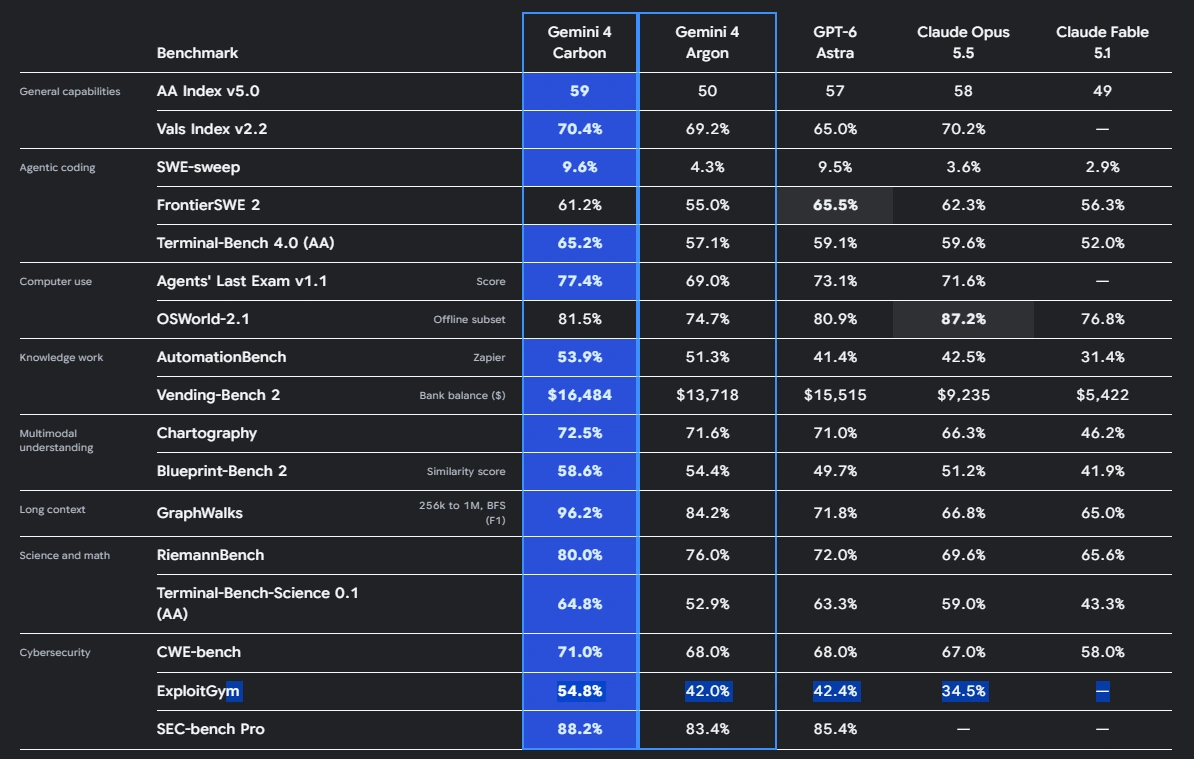
Carbon scores 59 on AA Index v5.0 against Argon’s 50. The Terminal-Bench 4.0 results are 65.2% and 57.1%; Chartography is much closer at 72.5% and 71.6%. GraphWalks, on the 256K–1M subset, reports 96.2% for Carbon and 84.2% for Argon.
Access pricing and keeping the tests bounded
Google AI Ultra includes Argon and Carbon access in the Gemini app. Ultra starts at $99.99 and has Carbon access, with higher usage tiers available.

And carbon even more so
| Pricing Tier / Token Type | Gemini 4 Carbon (**gemini-4-carbon**) | Gemini 4 Argon (**gemini-4-argon**) |
|---|---|---|
| Standard Input (Through Nov 30, 2026) | $2.00 | $2.00 |
| Standard Input (Starting Dec 1, 2026) | $4.00 | $4.00 |
| Standard Output (Through Nov 30, 2026) | $10.00 | $10.00 |
| Standard Output (Starting Dec 1, 2026) | $20.00 | $20.00 |
We used High thinking to get the fullest extent of their comparison. Gemini’s usage is compute-based, with five-hour refreshes alongside weekly limits; prompt complexity, model choice and conversation length affect consumption.
Which model would I choose
I’d start with Argon for this caption-timing repair. Its output satisfied the complete checked contract, including the easy-to-miss tuple requirement. Carbon’s result needed one further correction before it matched that contract.

For the graph, either model gave a useful explanation. Decide whether tool use is allowed before treating the table as a model win.
Read Fable 5.2 and Argon comparison for another set of outputs to inspect before choosing.
Frequently Asked Questions
Were both models tested at Low thinking?
Yes. Each task used a fresh regular Gemini web chat with Low explicitly selected.
Do Carbon benchmark scores measure Argon?
No. Carbon and Argon have separate columns. The latest table doesn’t include Gemini 4 Carbon.
Does forbidding Python disable the app’s tools?
Argon still used Python in our CSV run. Carbon asked for pasted text. Check the tool trace.
Does a lower token price guarantee cheaper work?
No. Thinking, answer length, tools and retries affect total c