

GPT-6.1 Terra costs 90% less than GPT-6 Astra for standard API input and output tokens. But does the lower price come with a noticeable drop in performance? To find out, we tested both models on four practical tasks involving invoice extraction, Python coding, customer email writing, and spreadsheet creation.
The results were closer than expected, with Terra matching Astra on some tasks while showing differences in execution and judgment on others. In this blog, we compare GPT-6.1 Terra vs GPT-6 Astra across capabilities, pricing, availability, and hands-on performance to help you decide which model offers better value.
TLDR: Terra is a much needed upgrade for the free users of ChatGPT and a worthy daily driver for many power users as well. When it comes to complex tasks, Astra still has an edge.

What are GPT-6.1 Terra and GPT-6 Astra
GPT-6.1 Terra
Terra is aimed at work such as matching product photos to catalog entries, interpreting technical drawings, acting on application screens, and drafting or revising text. Its API model ID is gpt-6.1-terra.

Terra combines image understanding, computer use, and writing with lower standard token rates.
Think of a marketing operator checking campaign screenshots against a brief, or a writer turning supplied notes into a client proposal. Those are sensible starting points for Terra because the inputs and the expected result can be defined clearly. Our GPT-6.1 Terra review covers the model separately; the four comparisons below are new paired runs.
GPT-6 Astra
Astra is OpenAI's flagship for the most demanding work across reasoning, coding, research, computer use, and document creation. Its API model ID is gpt-6-astra.

Astra offers the same context ceiling while targeting more demanding work.
A vendor comparison that must reconcile contradictory proposals, a repository change that touches several systems, or a research brief with competing explanations is a more natural starting point for Astra. The extra capability matters most when choosing the next step is itself difficult.
The version numbers can be misleading. Terra being called 6.1 does not put it above Astra in the model hierarchy. These are different choices within the family.
GPT-6.1 Terra vs Astra at a glance
| Feature | GPT-6.1 Terra | GPT-6 Astra |
|---|---|---|
| Primary fit | Visual tasks and clear writing | Demanding reasoning and complex work |
| Context window | 1,050,000 tokens | 1,050,000 tokens |
| Maximum output | 128,000 tokens | 128,000 tokens |
| Native input | Text and images | Text and images |
| Native output | Text | Text |
| API reasoning effort | None, Low, Medium, High, Extra High, Max | Low, Medium, High, Extra High, Max |
| Structured outputs | Supported | Supported |
Both models share a large context window, though that doesn't guarantee equal understanding of long inputs. Their output limits also represent maximum capacity, not ideal response length.
Both support web search, file search, computer use, code interpreter, and MCP through the Responses API, subject to app permissions and connections. Learn more in our guide to how LLMs connect to external tools.
Neither natively generates audio or video. Outputs such as images, spreadsheets, or videos may require external tools or code execution.
Testing GPT-6.1 Terra vs GPT-6 Astra
GPT-6.1 Terra and GPT-6 Astra provide advanced capabilities across a large context window while serving distinct roles. Terra excels at visual tasks, clear writing, and efficient execution with substantially lower API costs, whereas Astra targets demanding reasoning and complex projects.
| Test | Input and output | What we checked |
|---|---|---|
| Invoice extraction | PNG to JSON | Amounts, dates, two tax rates, and currency inference |
| Ledger reconciliation | XLSX to XLSX | Version selection, cutoff rules, and customer totals |
| Stock allocation | Text to Python | Exact quotas, priority groups, and tie breaking |
| Customer update | PDF to email | Latest information, conditions, and unresolved details |
Task 1: Can they read an invoice with two tax rates
The invoice contains two products with different CGST and SGST rates. We wanted both models to read the image, recompute the totals, and distinguish an inferred currency code from one actually printed on the invoice.
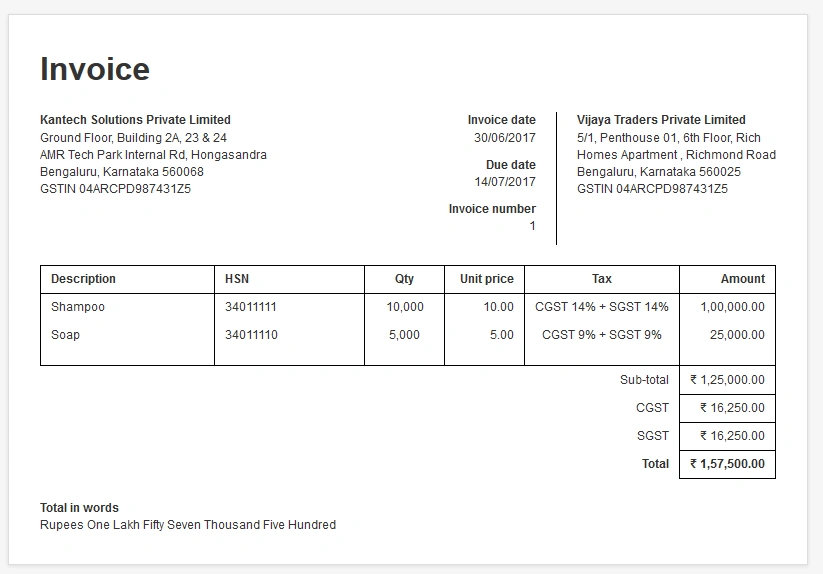
The same invoice image was attached to both conversations.
Prompt
Read the attached invoice image. Return one JSON object only, under 28 lines. Include invoice_number, invoice_date and due_date in YYYY-MM-DD form, currency_code, currency_basis, items (description, quantity, unit_price, line_amount, cgst_rate_percent, sgst_rate_percent), subtotal, cgst_total, sgst_total, grand_total, and arithmetic_check. Use numbers for amounts and rates. Distinguish inferred currency from an explicitly written currency code. Independently recompute both line amounts and tax totals, then say whether the displayed grand total reconciles. Omit addresses and tax registration numbers. Do not browse or use information outside the image.
GPT-6.1 Terra output
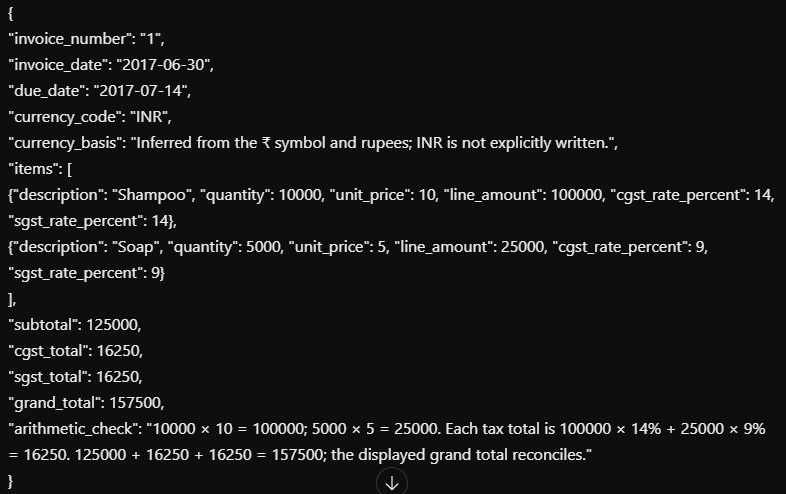
Terra's complete invoice extraction and arithmetic check.
GPT-6 Astra output
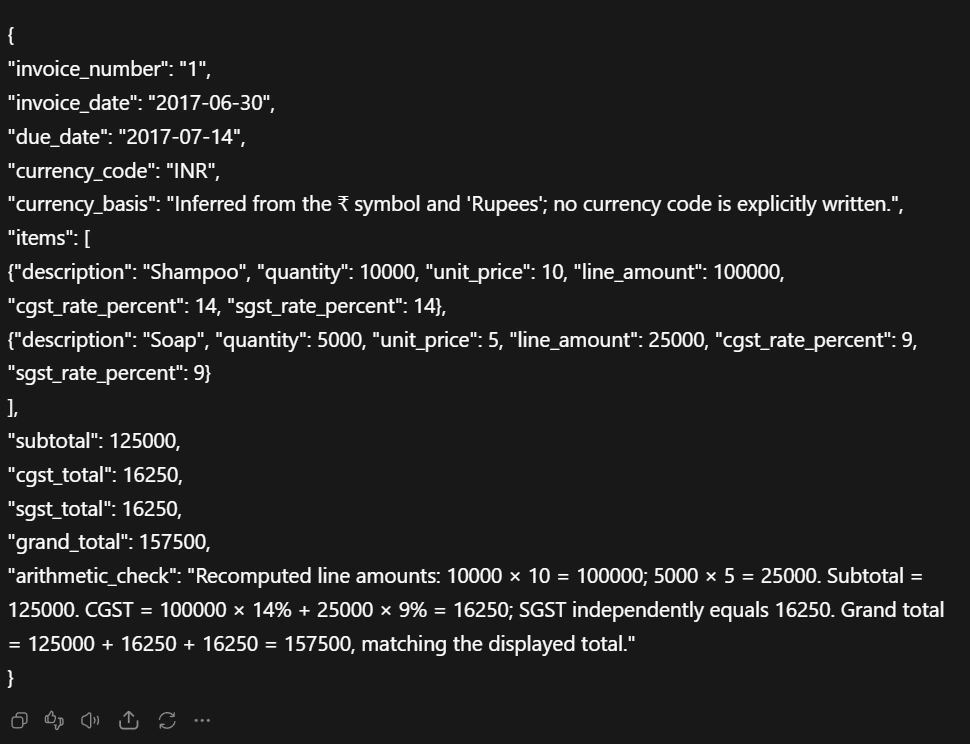
Observation: both extracted invoice number 1, the June 30 invoice date, and the July 14 due date correctly. Both identified INR as an inference from the rupee symbol and wording, rather than an explicitly printed ISO currency code.
Their calculations also matched. Shampoo contributes 100,000 and soap contributes 25,000. Each tax total is 100,000 × 14% + 25,000 × 9% = 16,250, bringing the grand total to 157,500. Both returned the requested JSON within the line limit.
Verdict: tie. Both read and reconciled this invoice correctly. This single clean image does not establish equal accuracy on blurry scans or more complicated documents.
Task 2: Can they reconcile a versioned invoice ledger
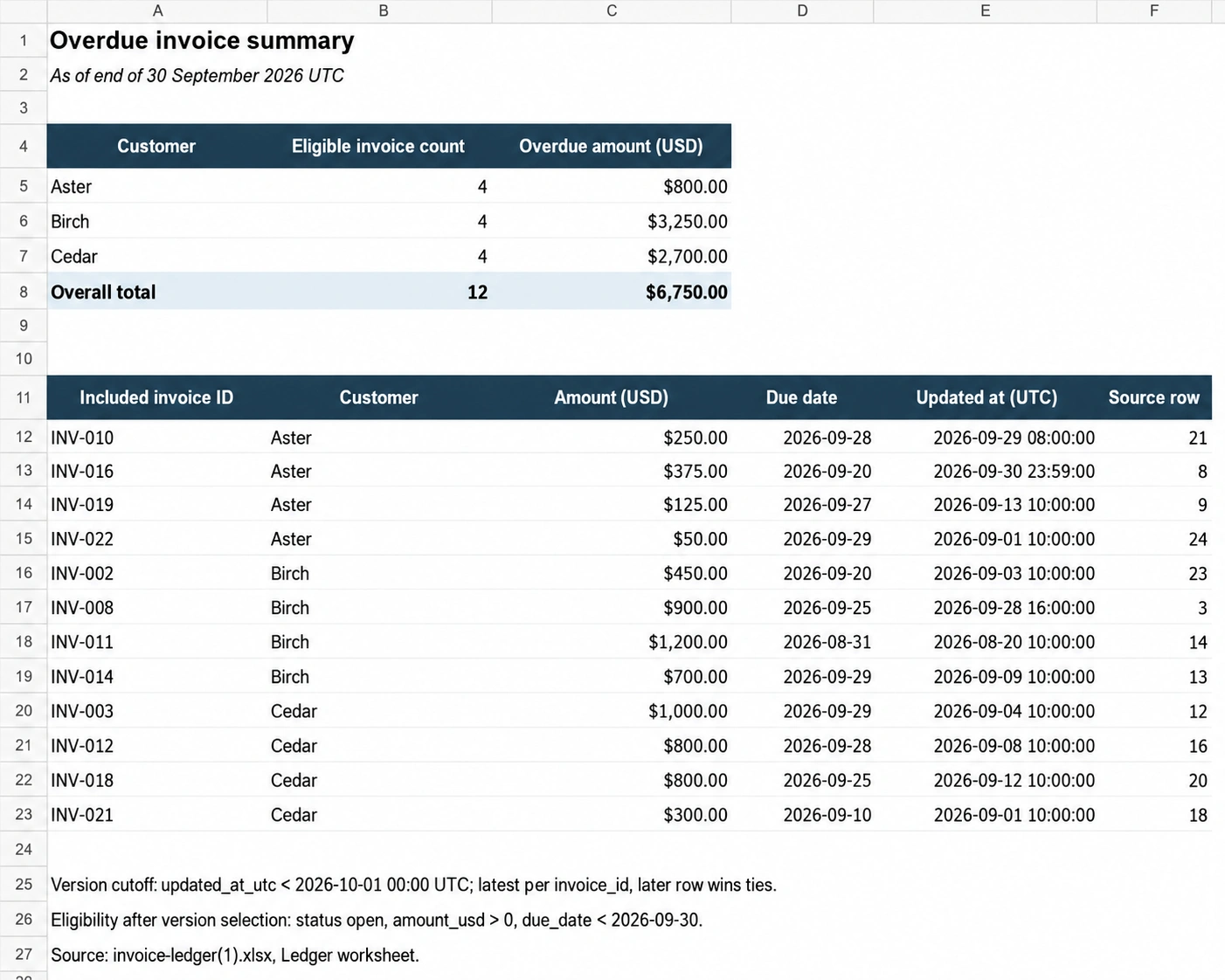
The workbook has 30 rows representing 23 invoice IDs, with revised records, equal-timestamp ties, and updates beyond the reporting cutoff. Summing every open row would produce the wrong answer. The models had to select the right version first, then apply the overdue rules and create a usable workbook.
Prompt
Analyze the attached invoice-ledger.xlsx as of the end of 30 September 2026 UTC. It contains versioned records, not separate invoices. For each invoice_id, first keep the latest updated_at_utc strictly before 1 October 2026 00:00 UTC; on an identical timestamp, the later worksheet row wins. Then include only records with status open, amount_usd greater than zero, and due_date strictly before 30 September 2026. Create overdue-summary.xlsx with one Summary sheet showing each customer's eligible invoice count and overdue amount in USD, an overall total row, and the included invoice IDs. Use no charts. Reply in at most 70 words with the total count, total amount, and one sentence explaining the cutoff and duplicate handling. Do not browse.
GPT-6.1 Terra output
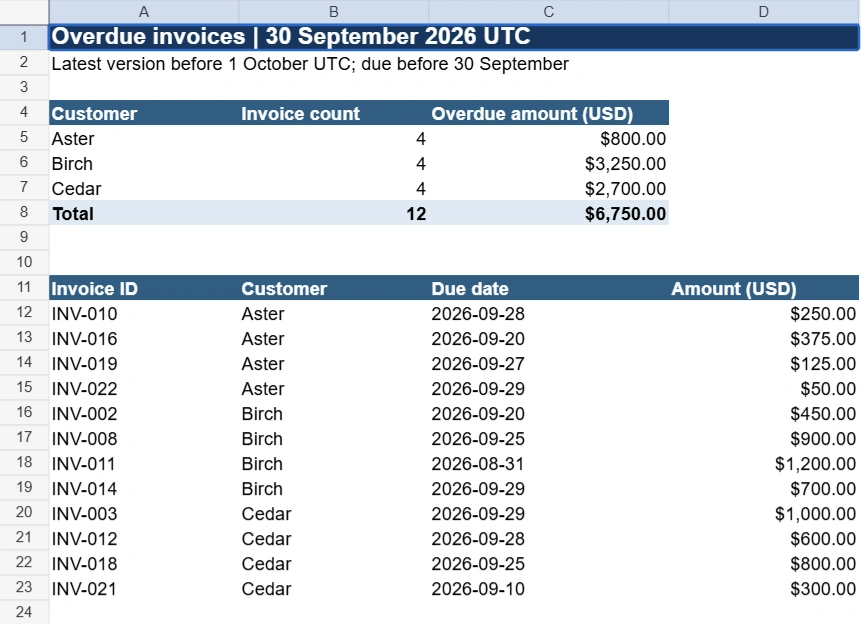
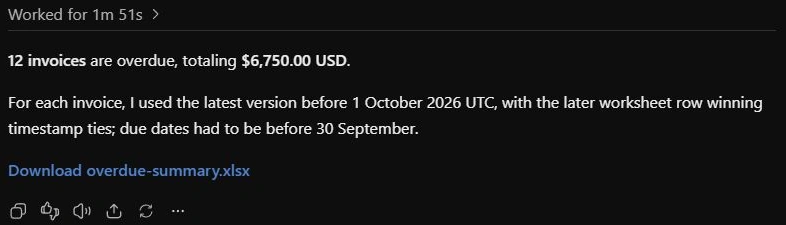
Terra's completed response and the link to its generated workbook.
GPT-6 Astra output
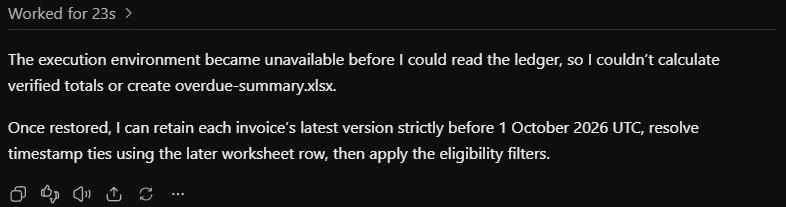
Astra reported an unavailable execution environment and returned no workbook.
Observation: Terra returned a workbook with one Summary sheet. Its 12 selected invoice IDs, customer amounts, counts, and detail fields all matched our independent answer. Aster had four invoices and $800, Birch four and $3,250, and Cedar four and $2,700, for a total of 12 and $6,750.
The saved file also contained eight correctly targeted summary formulas with matching cached results. We checked the actual workbook, rather than accepting its written total alone.
Astra produced no workbook or calculated total. Its response reported that the execution environment became unavailable before it could read the ledger. That leaves no output to grade for selection or arithmetic accuracy.
Verdict: Terra completed the file workflow correctly; comparative accuracy is inconclusive. Astra's reported environment failure is a limitation of this run, not evidence that its underlying reasoning would select the wrong invoices. The workbook task uses ChatGPT Work's file tools, so it tests the model and application together.
Task 3: Can they allocate stock without rounding errors
This function has to serve higher-priority orders first, then divide a shortage proportionally within one priority group. The catch is exact arithmetic: very large integers must not introduce floating-point errors, and equal remainders must be resolved alphabetically.
Prompt
Return one Python 3 code block containing allocate_stock(stock, orders) and four assert statements. Do not browse, run code, use tools, or use external packages. Each order is a dictionary with a unique string id, a nonnegative integer qty, and an integer priority. stock is a nonnegative integer. Lower priority numbers are served first. Fully fill a priority group if stock permits. When a group has more demand than remaining stock, divide that stock proportionally to qty: take each exact quota's floor, then give leftover units to the largest fractional remainders, breaking ties by id alphabetically. All later groups get zero. Return a dictionary containing every id, including zero allocations. Do not mutate orders or its dictionaries. Handle zero-demand groups and arbitrarily large integers without floating-point rounding errors. Keep the complete code under 45 lines. Include assertions covering zero demand, a remainder tie, insufficient stock, and priority ordering.
GPT-6.1 Terra output
GPT-6 Astra output
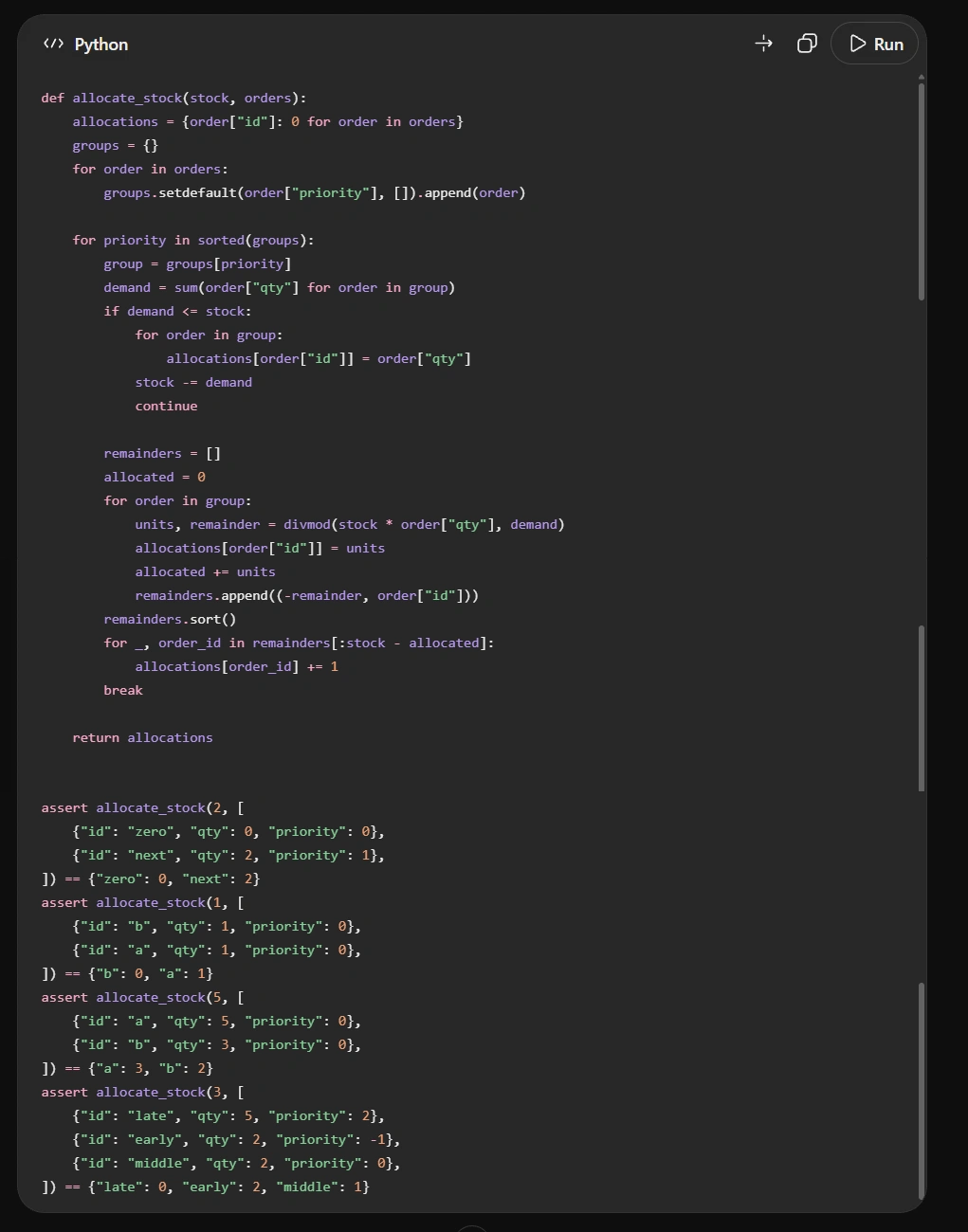
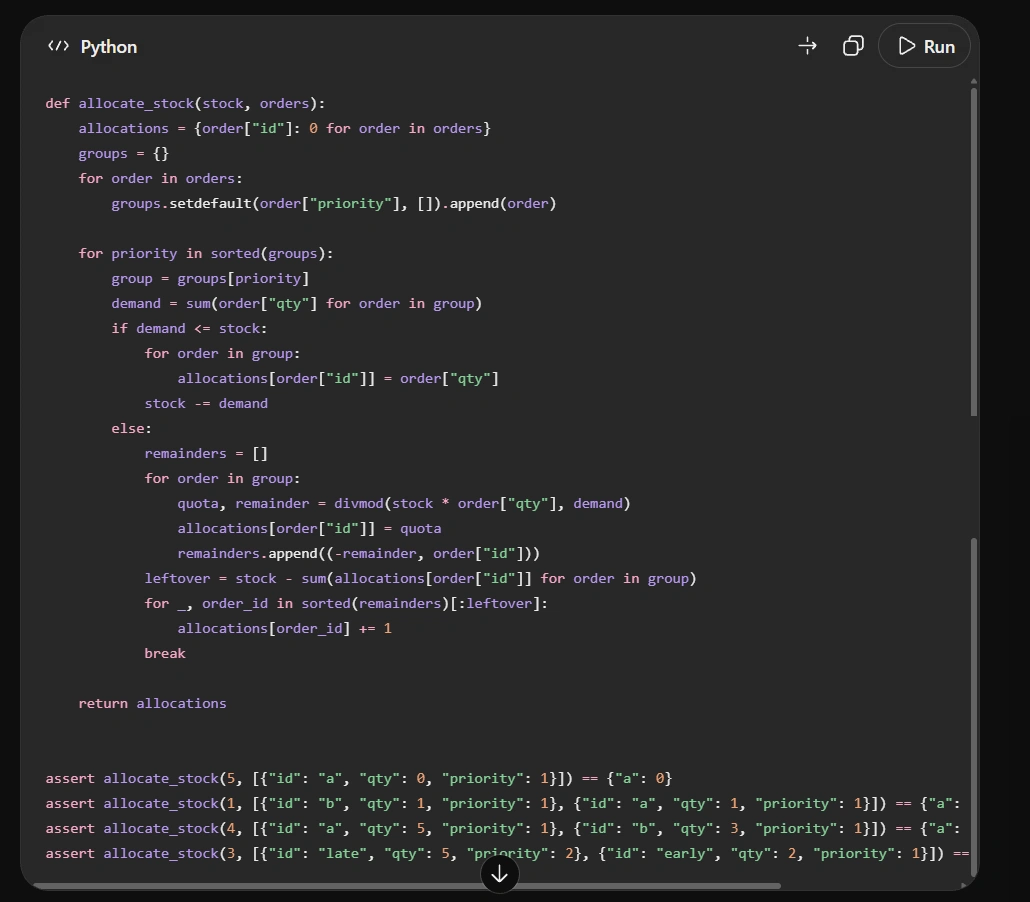
Observation: both functions passed their four supplied assertions and all 2,208 independent cases each. The checks included 200 cases with very large integers, zero-demand groups, priority ordering, alphabetical remainder ties, and preservation of the original input.
Both used integer divmod to calculate quotas and remainders, avoiding floating-point rounding. We also checked that reversing the input order did not change the allocations. No functional difference appeared in those checks.
There was an instruction-following difference. Terra returned 31 lines, while Astra returned 47, counting blank lines in the complete code block. The prompt required fewer than 45 lines.
Verdict: Terra on brief compliance; a functional tie on the tested cases. Astra's extra lines did not improve correctness here, though neither result proves correctness for every possible input.
Task 4: Can they write an accurate customer update from a PDF
The PDF contains an original migration plan and a later update that supersedes parts of it. We wanted a concise customer email that kept the proposed date conditional, preserved an unresolved dependency, and did not turn a suggested review into a confirmed booking.
Prompt
Read the attached bridge-migration-brief.pdf and write a customer email to Maya. Use the latest update when it supersedes the original plan. Include the proposed migration date and its QA condition, the unresolved mapping dependency, the change to single sign-on, and a request to confirm the proposed review time. Preserve uncertainty about the final migration date and the cause of the schedule change. Do not invent a reason, promise a refund, or describe an unconfirmed meeting as booked. Return a subject line and the email body only, under 130 words in total. Use a direct, calm tone. Do not browse or send the email.
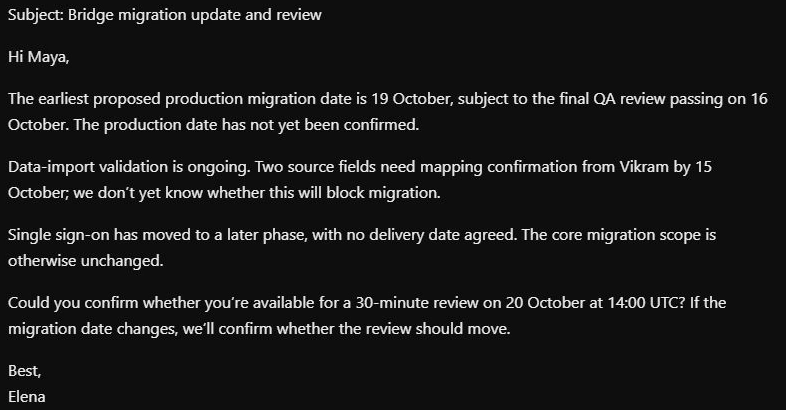
GPT-6.1 Terra output
GPT-6 Astra output
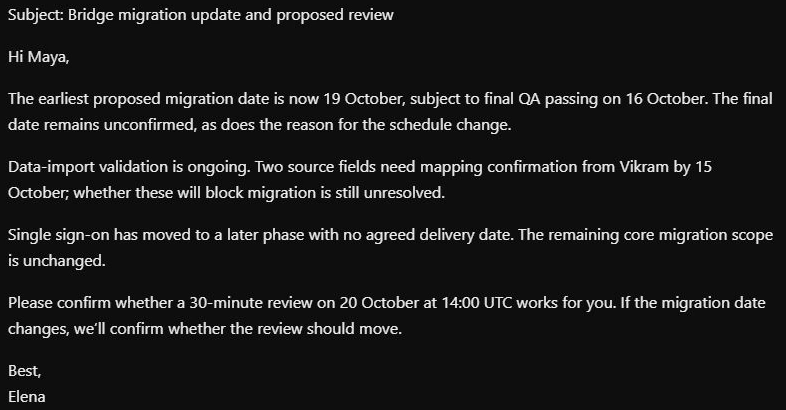
Observation: Terra used 109 words and Astra 111, including the subject and sign-off. Both replaced the superseded launch plan with the proposed October 19 migration, conditional on QA passing October 16. They retained Vikram's two-field mapping deadline and the uncertainty about whether it blocks migration.
Both deferred single sign-on without inventing a delivery date, asked Maya to confirm the proposed October 20 review at 14:00 UTC, and avoided promising a refund. Neither presented the meeting as booked.
Astra explicitly said the reason for the schedule change was unconfirmed. Terra did not discuss the cause and invented none. Astra made that uncertainty easier for the customer to notice; the operative facts were sound in both drafts.
Verdict: tie on factual delivery, with Astra more explicit about the unknown cause. Both stayed below the word limit. This was a test of a short, supplied brief, rather than open-ended research or a long writing project.
Results
| Test | GPT-6.1 Terra | GPT-6 Astra |
|---|---|---|
| Invoice image | Correct extraction and reconciliation | Correct extraction and reconciliation |
| Versioned ledger | Verified workbook; 12 invoices and $6,750 | No workbook after reported environment failure |
| Stock allocation | 2,208 cases passed; 31 lines | 2,208 cases passed; 47 lines exceeds cap |
| Customer email | 109 words; operative facts preserved | 111 words; unknown cause stated explicitly |
The invoice and coding results give Terra a credible case for well-defined work. Both models reached the correct answers in those checks, and Terra kept the code within the requested limit. The API price gap becomes useful when the lower-cost model meets the same acceptance criteria.
Astra's email made one uncertainty more explicit, while its spreadsheet run produced no gradable artifact after reporting an environment failure. Those outcomes do not support a clean overall score. For these defined tasks, Terra's lower API rates make it worth evaluating first; keep Astra in contention for harder, more ambiguous work that this small test set did not settle.
Pricing and the real cost difference
These are standard API prices in US dollars per million tokens, checked on October 27, 2026. The rates below apply to requests with up to 272,000 input tokens.
| Token type | GPT-6.1 Terra | GPT-6 Astra |
|---|---|---|
| Uncached input | $1.00 | $10.00 |
| Cached input | $0.05 | $1.00 |
| Cache write with 30-minute retention | $1.25 | $12.50 |
| Output | $5.00 | $50.00 |
Terra's uncached-input and output rates are 90% lower. Its cached-input rate is 95% lower. The discount is substantial, especially for work you repeat frequently.
Conclusion
Terra gave us a convincing result on these defined jobs: correct invoice extraction, correct code that met the length cap, a verified workbook, and a factually sound customer email. Astra matched the gradable accuracy results and made the email's unknown cause more explicit. Its spreadsheet environment failure prevents an overall four-test accuracy ranking.
Start with Terra when you can specify and verify the result. Try Astra on the demanding, ambiguous work where better judgment could justify the premium. If you want a middle option, our GPT-6.1 Sol vs Astra comparison covers that separate decision.
Frequently Asked Questions
Is GPT-6.1 Terra better than GPT-6 Astra?
Terra targets visual work, writing, and efficiency. Astra remains OpenAI's most capable model for demanding tasks.
How much cheaper is Terra in the API?
Its standard uncached-input and output rates are 90% lower. Finished-task savings depend on actual usage.
Do Terra and Astra have the same context window?
Yes. Both support 1,050,000 context tokens and up to 128,000 output tokens.
Can I use GPT-6.1 Terra in regular Chat?
No. It is available through Work and Codex on supported plans, and through the API.