
Can GPT-6.2 Sol handle the everyday jobs you would trust an AI assistant with? Reading an image, checking a spreadsheet and finding a calendar slot sound simple, until a duplicate row or overlooked rule changes the answer.
We tested Sol on four tasks covering visual reasoning, CSV analysis, a support reply and scheduling. In this article, we examine its accuracy and instruction-following to see how well OpenAI’s everyday model handles the details.
TLDR: GPT-6.2 Sol offers lower API pricing than Astra; our four practical tests examine whether its answers are accurate, usable and faithful to instructions.
What Is GPT-6.2 Sol?
GPT-6.2 Sol is OpenAI’s model for everyday writing, coding and multistep work. It accepts text and images and produces text, with a 1,050,000-token context window and up to 128,000 output tokens. Browsing, file access and creating deliverables depend on the tools available around the model.
| Standard API pricing | Cost per million tokens |
|---|---|
| Uncached input | $2 |
| Cached input | $0.10 |
| Output | $10 |
These are short-context Standard rates. Requests above 272,000 input tokens incur higher rates across the full request. Speed tiers and tools can also affect the final cost. Work and Codex subscription usage is separate from API billing.
To match our setup, open a fresh Work chat, select GPT-6.2 Sol and choose Ultra effort before submitting your prompt. Sol is also available in Codex, subject to your plan, rollout and workspace permissions.
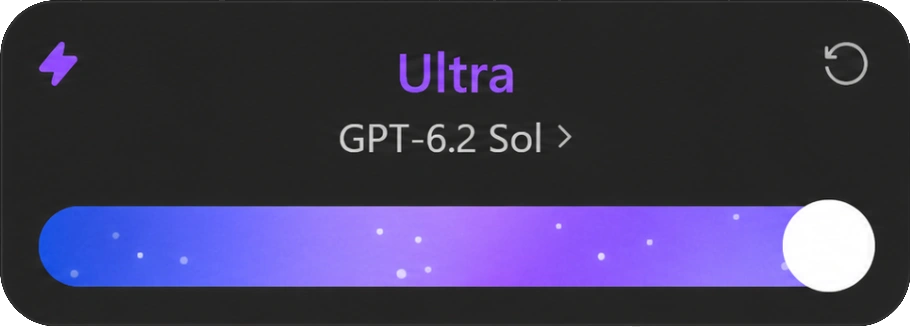
We kept the first completed response for each task and checked the results independently. The tests used an image, an attached CSV, a self-contained policy request and an attached ICS calendar file.
Our GPT-6.1 Sol review covers the previous release. For context on browsing, attachments and app integrations, see how LLMs connect to external tools.
Reading the diagram without mistaking distance for a cause
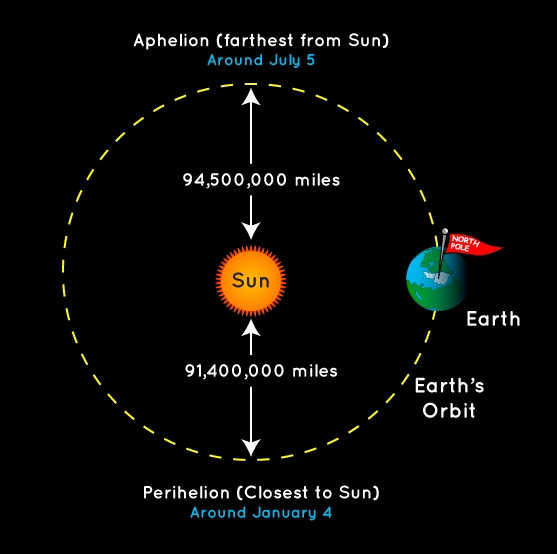
The first task combined reading visible labels with a small calculation and a science explanation. The trap was the proposed conclusion: a diagram showing the nearest and farthest points doesn't establish that the whole planet has summer at its nearest point.
Prompt
Read the attached orbital-distance diagram. Identify the closest and farthest labelled positions and their distances. Calculate the distance difference and the percentage increase from closest to farthest. A student says this proves the whole Earth has summer when it is closest to the Sun. Explain why that conclusion doesn't follow; distinguish what is visible from outside scientific knowledge. Don't infer scale. Keep the answer under 130 words and don't browse or use tools. Keep it anonymous: no personal names, account details, organisations or signatures.
GPT-6.2 Sol
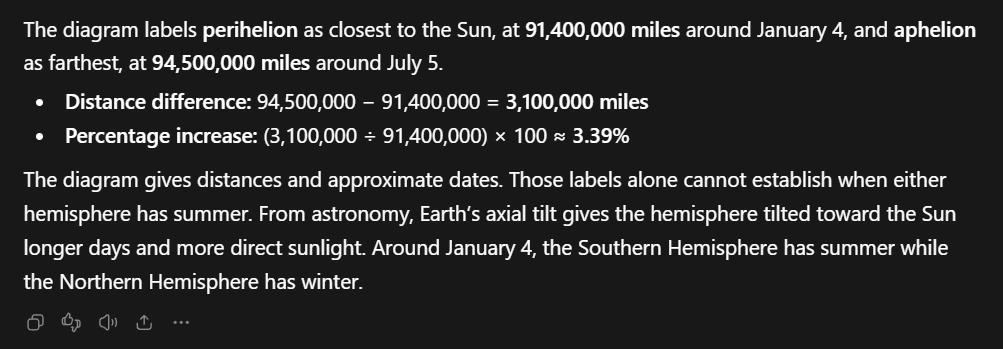
Sol read both distances, calculated the difference and percentage increase correctly, and kept the response to 91 words. More usefully, it marked the boundary between the evidence and its explanation: the labels give distances and approximate dates, while axial tilt explains the seasons. It also identified the opposite seasons in the two hemispheres. That makes this a usable short teaching explanation, rather than a calculation followed by an unsupported causal claim.
Checking a rollout that looks better only in the total
The CSV contains a repeated export row and a deliberately uneven device mix. A model that sums every row or stops at the overall rate can recommend the wrong next step. Here is the complete input table, including the duplicate.
| row_id | arm | device | visitors | conversions |
|---|---|---|---|---|
| R1 | control | desktop | 1000 | 90 |
| R2 | control | mobile | 1000 | 20 |
| R3 | variant | desktop | 10000 | 800 |
| R4 | variant | mobile | 100 | 1 |
| R4 | variant | mobile | 100 | 1 |
Prompt
Read the attached CSV as a file. Duplicate row_id values are repeated exports of the same record; count each ID once. Compare control and variant conversion rates overall and separately for desktop and mobile. Report visitors, conversions and rates, plus the variant's overall percentage-point change. Would you roll out the variant based on this result? Explain the traffic-mix issue and one useful next check. Don't invent statistical significance. Use a calculation tool if useful. Keep the answer under 180 words. Keep it anonymous: no personal names, account details, organisations or signatures.
GPT-6.2 Sol
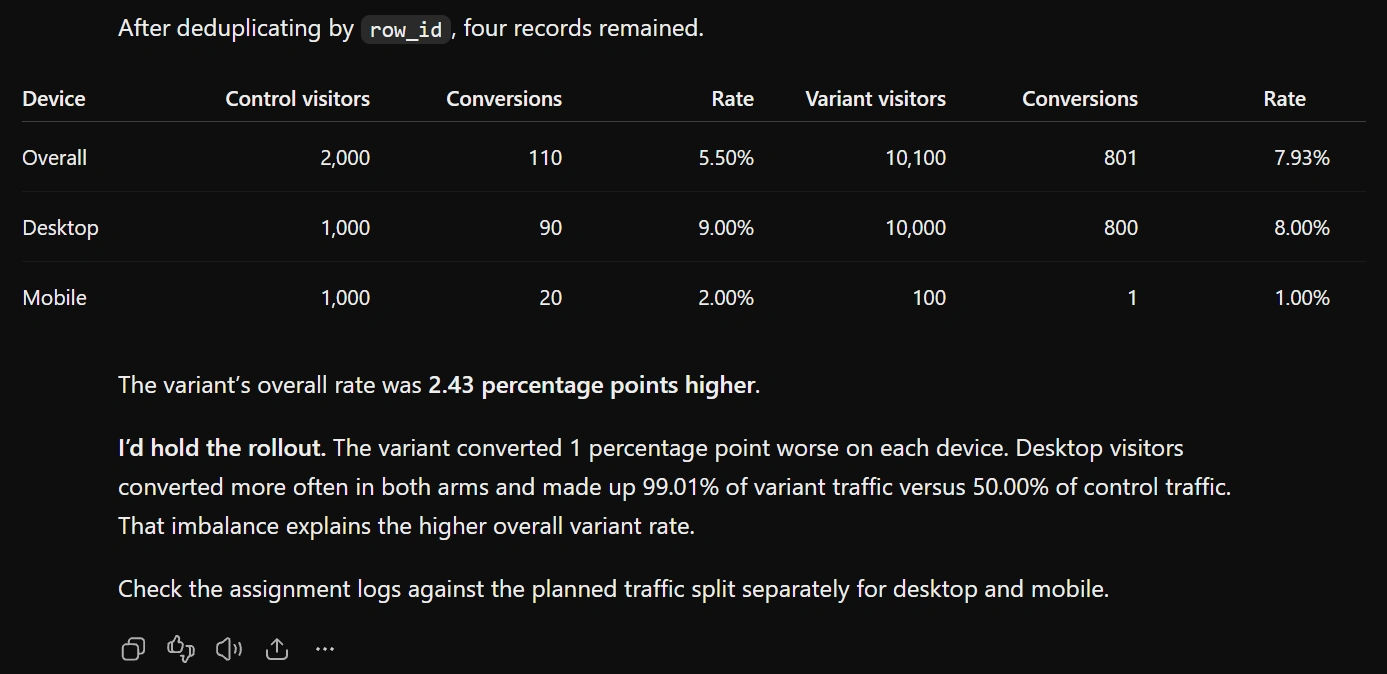
Sol counted the repeated ID once and got every total and rate right. The decisive move was holding the rollout despite the positive overall change. The variant had more of the higher-converting desktop traffic, while performing worse within each device group. Sol asked for assignment logs checked against the planned split, which follows directly from that imbalance.
This doesn't establish that the experiment's assignment was broken, or that either difference is statistically significant. It identifies why the aggregate result cannot carry the decision on its own. For a first pass over a small experiment export, that's exactly the distinction worth preserving.
Writing a support reply without promising a refund
Next came a customer who wanted both a refund and file recovery that day. The policy allowed a refund review under specific conditions and gave support no ability to restore files. The answer had to remain helpful without pretending those limits had disappeared.
Prompt
Write a warm, direct reply of 70–100 words to this customer. Policy: a refund may be requested within 14 days of purchase if usage is under two hours. A missing receipt doesn't automatically block review; support can search using the purchase email address and approximate payment date. Refunds aren't guaranteed. Support cannot delete or restore the customer's files. No action has been taken yet. Customer: 'The app crashed and my project disappeared. I bought it about two weeks ago and used it for maybe 90 minutes. I lost the receipt. Please refund me and recover my files today.' Ask for the minimum information needed to check eligibility. Don't invent a fix, promise a refund, or claim anything has been processed. After the reply, add one sentence identifying the unresolved eligibility detail. Keep everything anonymous: no names, account details, organisations or signature.
GPT-6.2 Sol
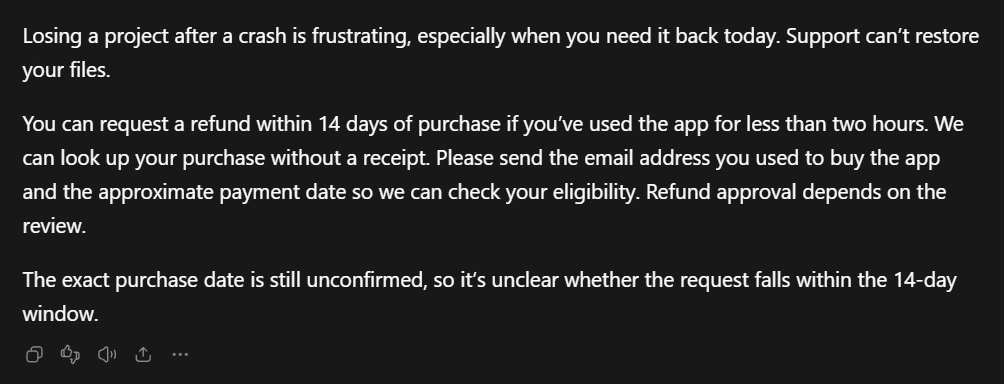
The reply was 77 words, inside the requested 70–100-word range. It asked for the purchase email and approximate payment date, allowed a lookup without a receipt and made no recovery or refund promise. Its separate audit sentence identified the missing exact purchase date. 'About two weeks' is too imprecise to settle a 14-day condition.
Finding no available slot in the calendar file
The ICS attachment tested file interpretation and an availability check. All entries were on 20 November 2026 in UTC. These were the event details in the file; cancelled and transparent entries should not consume availability.
| Event | Time UTC | Status | Transparency |
|---|---|---|---|
| Review A | 08:00–09:00 | Confirmed | Opaque |
| Review B | 09:30–10:15 | Cancelled | Opaque |
| Review C | 10:00–10:30 | Confirmed | Opaque |
| Focus placeholder | 09:15–09:45 | Confirmed | Transparent |
| Review D | 11:00–12:00 | Confirmed | Opaque |
Prompt
Read the attached ICS calendar file. Find the earliest 45-minute slot on 20 November 2026 between 08:00 and 12:00 UTC. Treat confirmed opaque events as busy, cancelled events and transparent events as free. Keep a 15-minute buffer before and after each busy event; the new meeting itself needs no extra buffer beyond those existing buffers. Use UTC throughout. Give the slot and briefly explain which entries block earlier times and which entries you ignored. Don't create a real calendar event. Keep the answer under 130 words. Keep it anonymous: no names, account details, organisations or signature.
GPT-6.2 Sol
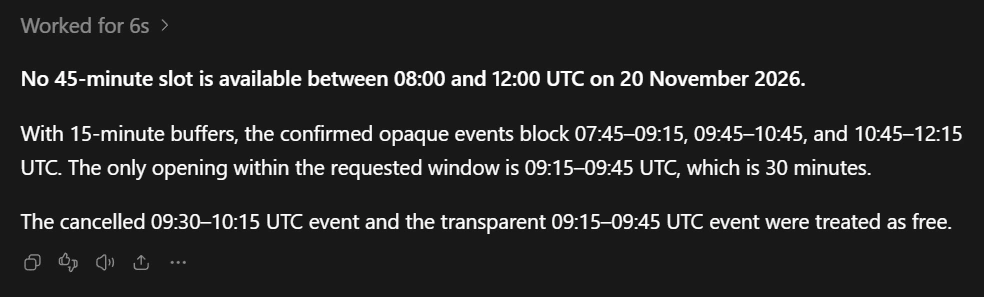
Sol ignored the cancelled event and transparent placeholder, applied the buffers to the three busy events and found the only opening: 09:15–09:45 UTC. That is 30 minutes, so it correctly found no 45-minute meeting slot. The 56-word answer retained enough detail to check the conclusion. This tests one explicit calendar file, without recurrence rules or a live calendar integration; it doesn't prove that Sol can manage an entire scheduling workflow.
What the benchmarks and pricing add
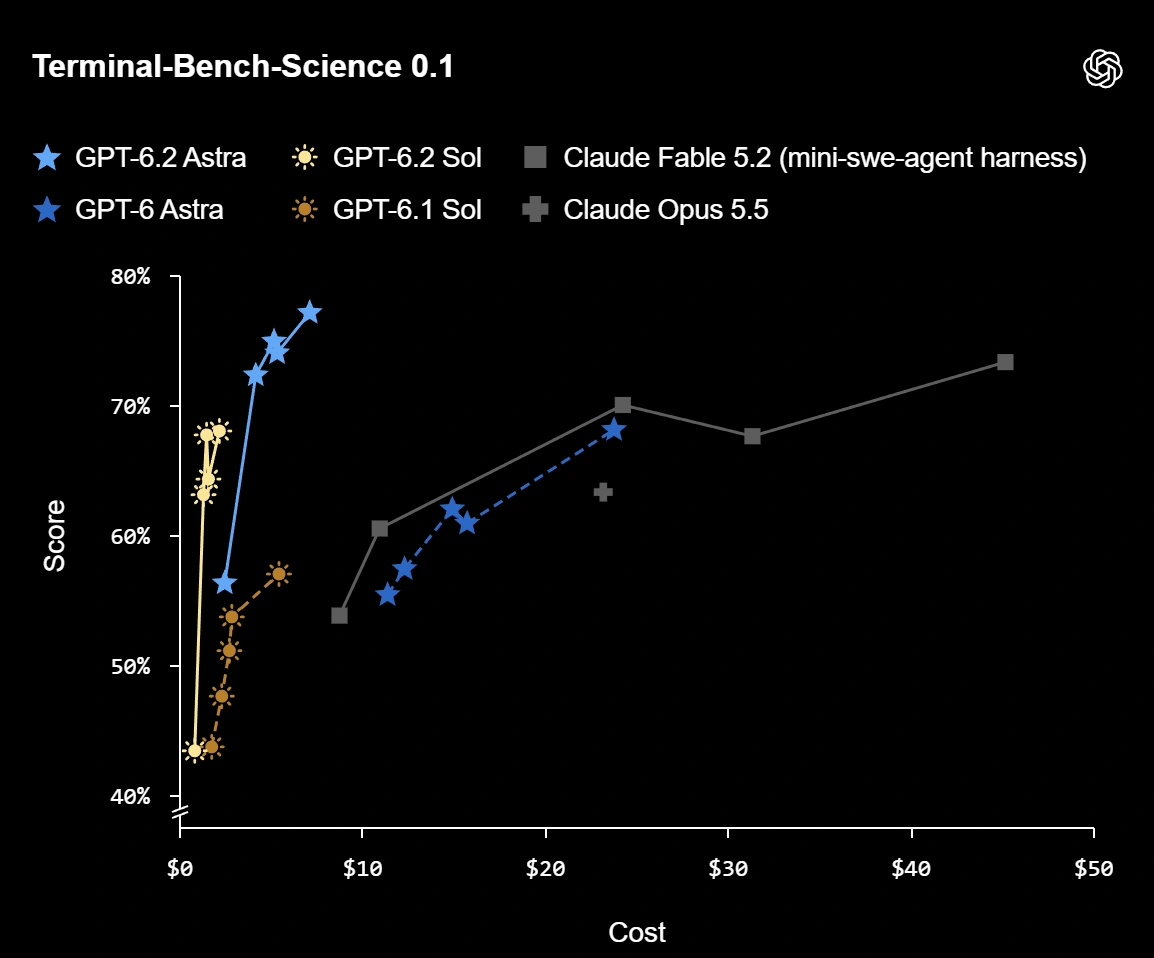
The published results help explain the release, but they aren't a clean sweep over 6.1. At Ultra effort, OpenAI reports the following results. These are vendor evaluations, not scores produced by our four tasks.
| Evaluation at High | GPT-6.1 Sol | GPT-6.2 Sol |
|---|---|---|
| Agents' Last Exam | 72.3% | 72.0% |
| Terminal-Bench-Science 0.1 | 51.1% | 67.7% |
That spread matters: a strong science gain doesn't justify promising an improvement on every professional workflow. OpenAI also reports Sol close to Astra on FrontierCode 2.0 at Max, but Max isn't the setting used here. Keep the effort level attached to the claim.
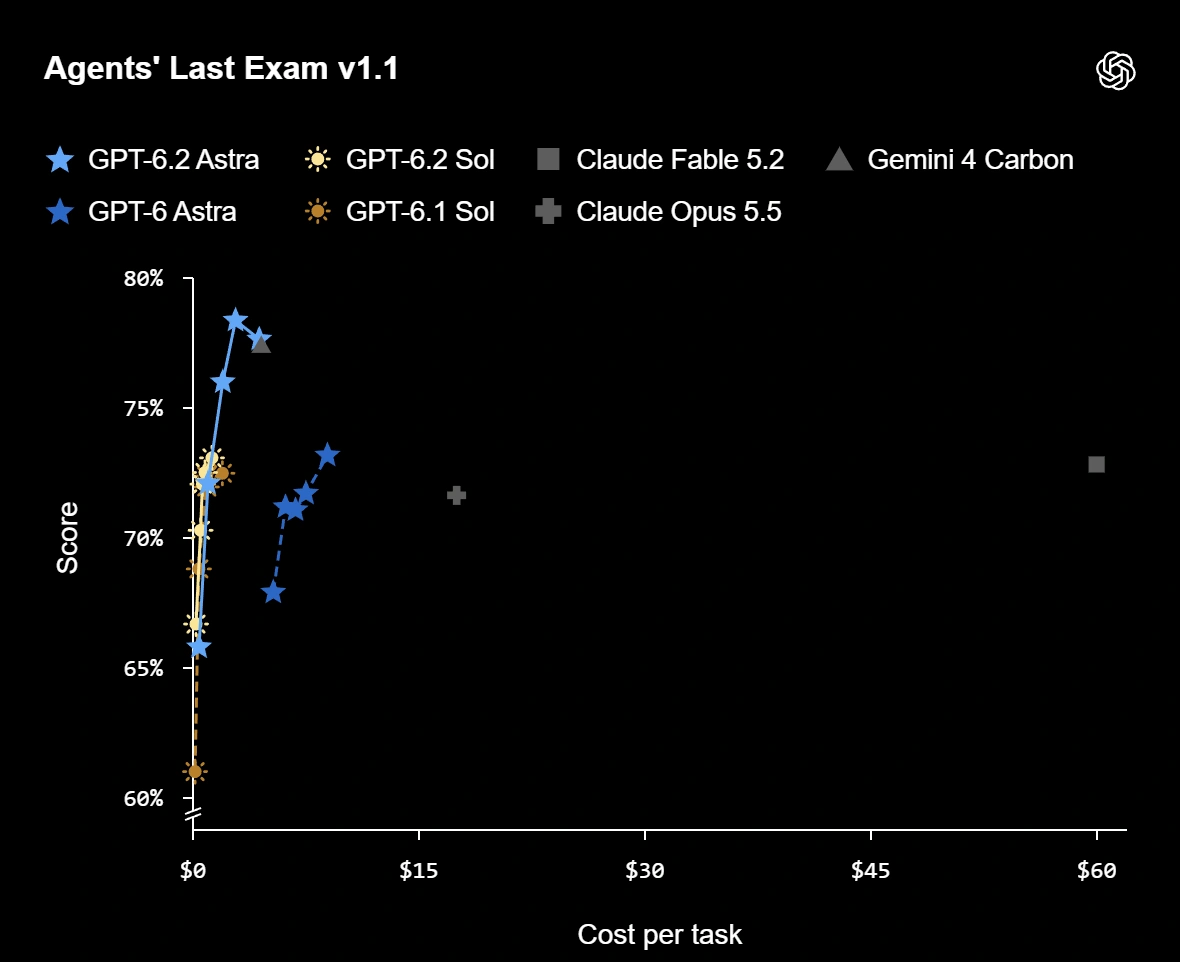
Sol retains 6.1's standard short-context API rates: $2 per million uncached input tokens, $0.10 per million cached input tokens and $10 per million output tokens. Requests above 272,000 input tokens have higher rates for the entire request. Work subscription usage and API billing are separate, and token prices don't tell us the actual cost of completing these tasks. We didn't measure that bill or make speed comparisons.
Should you switch to GPT-6.2 Sol
Sol handled all four core tasks in these first responses. I'd try it for mixed everyday work where you need an explanation, a small-file analysis or a constrained draft you can check. The result isn't a reason to skip review: the value was that Sol exposed the conditions the reviewer needed to inspect. If 6.1 already works for you, bring your own difficult inputs to 6.2 before switching a larger workflow.
Frequently Asked Questions
How do I access GPT-6.2 Sol?
Select it in Work or Codex where your plan and workspace allow it. These tests used Work at Ultra effort.
Does GPT-6.2 Sol accept images?
Yes. Its model card supports text and image inputs. Other file handling depends on the tools in your environment.
How much does GPT-6.2 Sol cost?
Standard short-context API rates are $2 per million uncached input tokens and $10 per million output tokens. Long-context requests cost more.
Should I replace GPT-6.1 Sol?
Try your workload first. These four High-effort runs weren't a paired comparison with GPT-6.1 Sol.